
Electric Car Tax Ireland: A Used-EV Buyer's Honest Guide
Contents
- Why Most EV Tax Savings Quietly Disappear at a Used-Car Purchase
- Annual Motor Tax for a BEV in Ireland
- VRT Relief for BEVs and Why It Does Not Help a Used Buyer
- Where a Used EV Stands Versus a New EV on Tax
- Tolls, NOx Levy and the SEAI Home-Charger Grant
- The 2026 Cliff and What to Verify Before You Buy
- A Used-EV Buying Checklist With Tax in the Right Place
- Frequently Asked Questions on Electric Car Tax in Ireland
A used battery electric vehicle in Ireland pays €120 a year in motor tax, and that rate is the one saving that follows the car into second ownership. The headline €5,000 VRT relief and the €3,500 SEAI new-car grant do not apply to a second-hand purchase.
That is the bit most ads leave buried. Buyers see EV tax headlines, assume they all carry over to the used market, then discover the story is much narrower. This guide keeps it simple for the Republic of Ireland, uses only current verified figures, and flags where the rules are changeable so a buyer can check the live version before paying a deposit.
Why Most EV Tax Savings Quietly Disappear at a Used-Car Purchase
Shoppers seeking electric car tax Ireland advice often read misleading headlines. They see new-car support, assume the savings follow the car forever, and only later discover that several eye-catching benefits stop at the first registration, or never applied to a second-hand sale in the first place.
A used EV buyer is not buying a grant package. They are buying a car, a battery, and the ongoing tax treatment that survives after the first owner has taken the original incentives. For a plain-speaking breakdown of the wider Irish EV picture, the most useful starting point is ShamAuto's guide to electric cars in Ireland, because the battery, range and charging details matter more than the brochure slogans.
Practical rule: if a saving is tied to registration, it is usually a new-car or import benefit, not a second-hand discount.
That is why honesty matters here. A used buyer can still benefit from the low annual motor tax, and there are smaller reliefs that may still matter depending on how the car is used, but the big purchase-time incentives are largely front-loaded into the first sale. The tax story for a used EV is real, just thinner than the advertising implies.
There is also a blunt reason to keep the focus on the car itself. State of Health (SoH), realistic range, charging speed and connector type affect ownership cost every single day. Tax helps, but it does not rescue a tired battery or a bad fit for a long commute.
Annual Motor Tax for a BEV in Ireland
The one tax saving that remains consistent
A battery electric vehicle (BEV) registered in Ireland sits in the lowest motor tax band at €120 per year. Citizens Information confirms the rate for electric vehicles, and the official tax rules place BEVs in the same lowest band. That matters for a used buyer, because the annual motor tax stays with the vehicle after the sale. The previous owner does not take it with them.
This is a flat annual bill, not a usage charge. Mileage does not change it, battery size does not change it, and power output does not change it. The saving is predictable, which is useful if you want one ownership cost that does not swing around with every trip or every fuel price move.
For the live rate and the official band structure, use Citizens Information's electric vehicle motoring guide. For a used-buyer lens on tax and inspections, ShamAuto's EV motor tax and NCT guide is the cleaner starting point than a glossy ad.
That €120 figure is the part that still helps a second-hand buyer. It is one of the few tax costs tied to the car itself rather than the first registration or the sales pitch around it.
The tax treatment is also simple in practice. Once the car is registered as a BEV, the annual motor tax stays at the lowest band, so you are budgeting for a fixed yearly outlay rather than a variable bill based on emissions or engine size.
VRT Relief for BEVs and Why It Does Not Help a Used Buyer
What Revenue gives at registration
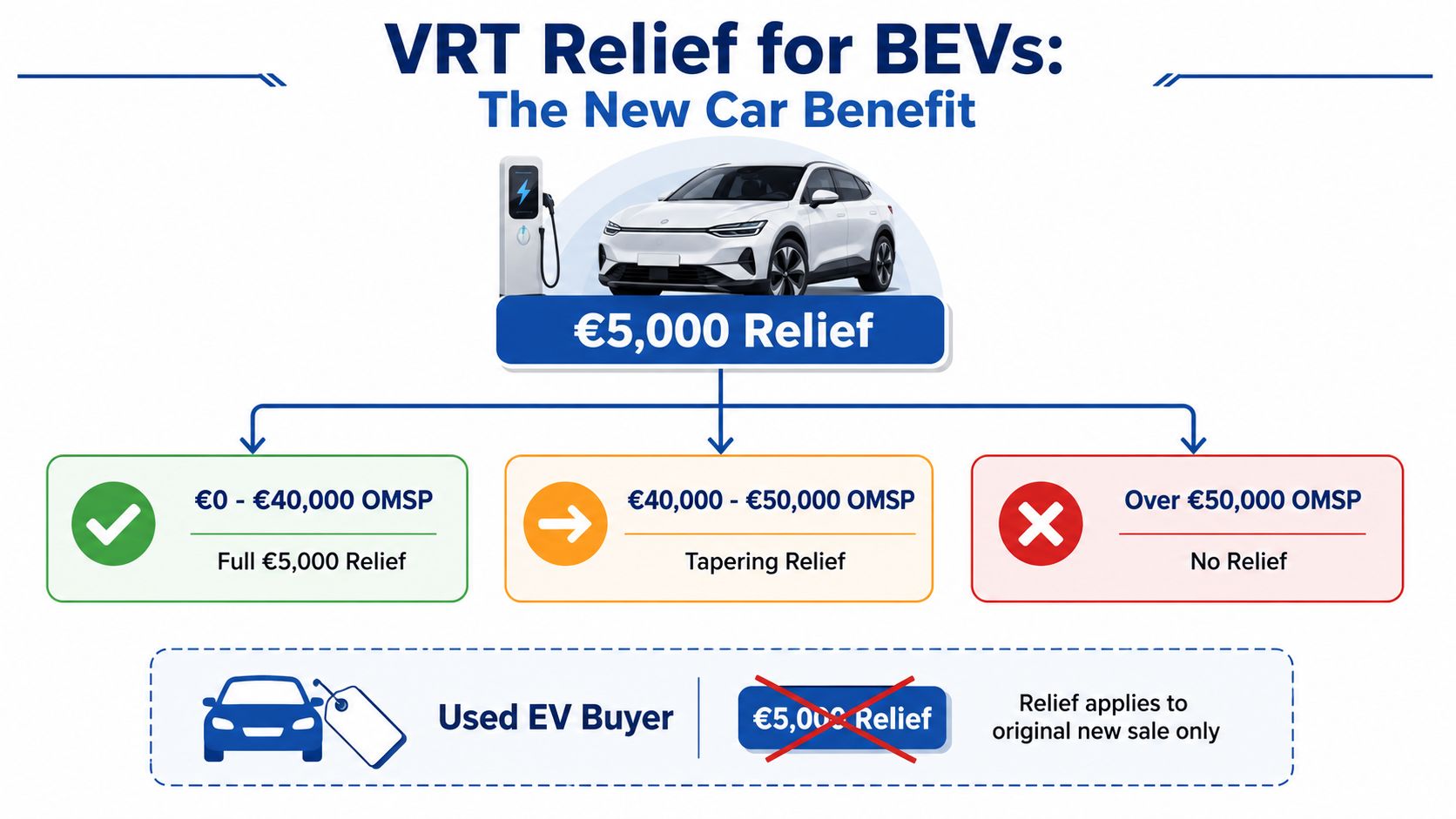
Revenue's current rule is straightforward. Eligible BEVs can get VRT relief of up to €5,000, with full relief where the OMSP is up to €40,000, tapering relief between €40,000 and €50,000, and no relief above €50,000. Revenue applies that relief automatically at registration, which is why it works as a first-registration or import incentive rather than a second-hand discount. The tax calculation still starts with OMSP, so the closer a car sits to the threshold bands, the more the net outcome matters.
That is the practical cliff buyers need to understand. A BEV under the threshold can be cushioned by the full relief, while a similar car just above it does not get the same help. The vehicle can be electric in both cases, but the registration bill can still land very differently.
For the official live rule, use Revenue's electric vehicle VRT relief page. A useful plain-English summary for buyers is also available in Irish Tax Hub's electric vehicle tax guide, which is consistent with Revenue on the key thresholds.
Why it stops helping on a private used sale
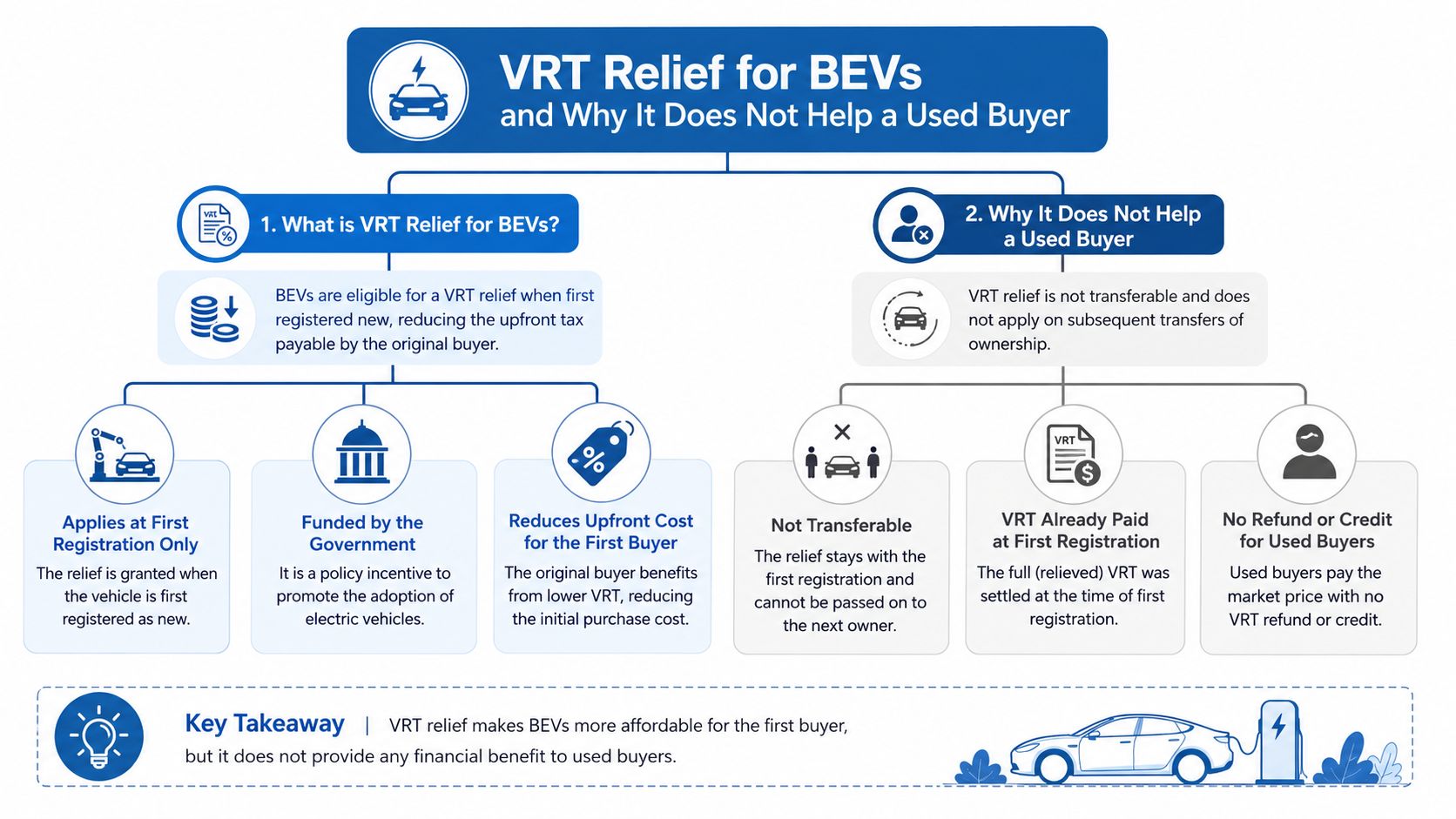
A private buyer of a second-hand EV is not getting a fresh registration benefit. The original VRT relief was used, or not used, when the car was first registered. Once the car is already on Irish plates, the used buyer is no longer the person triggering that incentive.
That is the point that ads often blur. They talk about EV tax relief as if it is baked into every sale, when in reality the relief belongs to the original registration event. If a used EV is bought privately, the buyer should price it on the basis that the VRT relief has already done its job, if it ever applied at all.
Revenue also says the current relief is scheduled to end on 31/12/2026. That deadline matters for anyone importing a new EV or comparing new and used stock near the threshold bands, because the benefit is not guaranteed beyond that date. Anyone making a purchase decision close to that line should verify the live rule on Revenue before committing.
Where a Used EV Stands Versus a New EV on Tax
A new BEV can still look better at the point of purchase because it may qualify for support that a used car does not get again. A used BEV keeps the day-to-day tax benefit, but the headline purchase help belongs to the original sale, not the resale. That split matters. Buyers should separate purchase-time help from ownership-time help and price the car accordingly.
| Tax item | New BEV | Used BEV |
|---|---|---|
| VRT relief | Available on eligible new registrations, up to the current cap and threshold bands | Not available on a private second-hand purchase |
| SEAI new-car purchase grant | Available only for eligible new cars | Not available |
| Annual motor tax | €120 BEV band | €120 BEV band |
| NOx levy | BEVs are exempt | BEVs are exempt |
| Toll reductions | May apply under current scheme rules, subject to status and caps | May apply under current scheme rules, subject to status and caps |
The true value for a used EV buyer sits in the running costs after purchase. Annual motor tax stays in the same low band, and the broader cost profile of electric driving is where the saving usually shows up. For a practical check against diesel ownership costs, ShamAuto's used EV versus diesel running costs guide is the better reference point.
The SEAI purchase grant is where used-car ads drift into nonsense. It is tied to a new-car purchase, so it does not put cash back into a private second-hand sale. Treat any ad that suggests a used EV still gets fresh VRT relief at resale with caution, because that incentive belongs to the original registration event.
The clean way to judge a used EV is simple. Look at the ownership savings that still apply, and ignore the new-car incentives that were already used up or never applied to this car in the first place.
Tolls, NOx Levy and the SEAI Home-Charger Grant
Smaller items that still touch the wallet
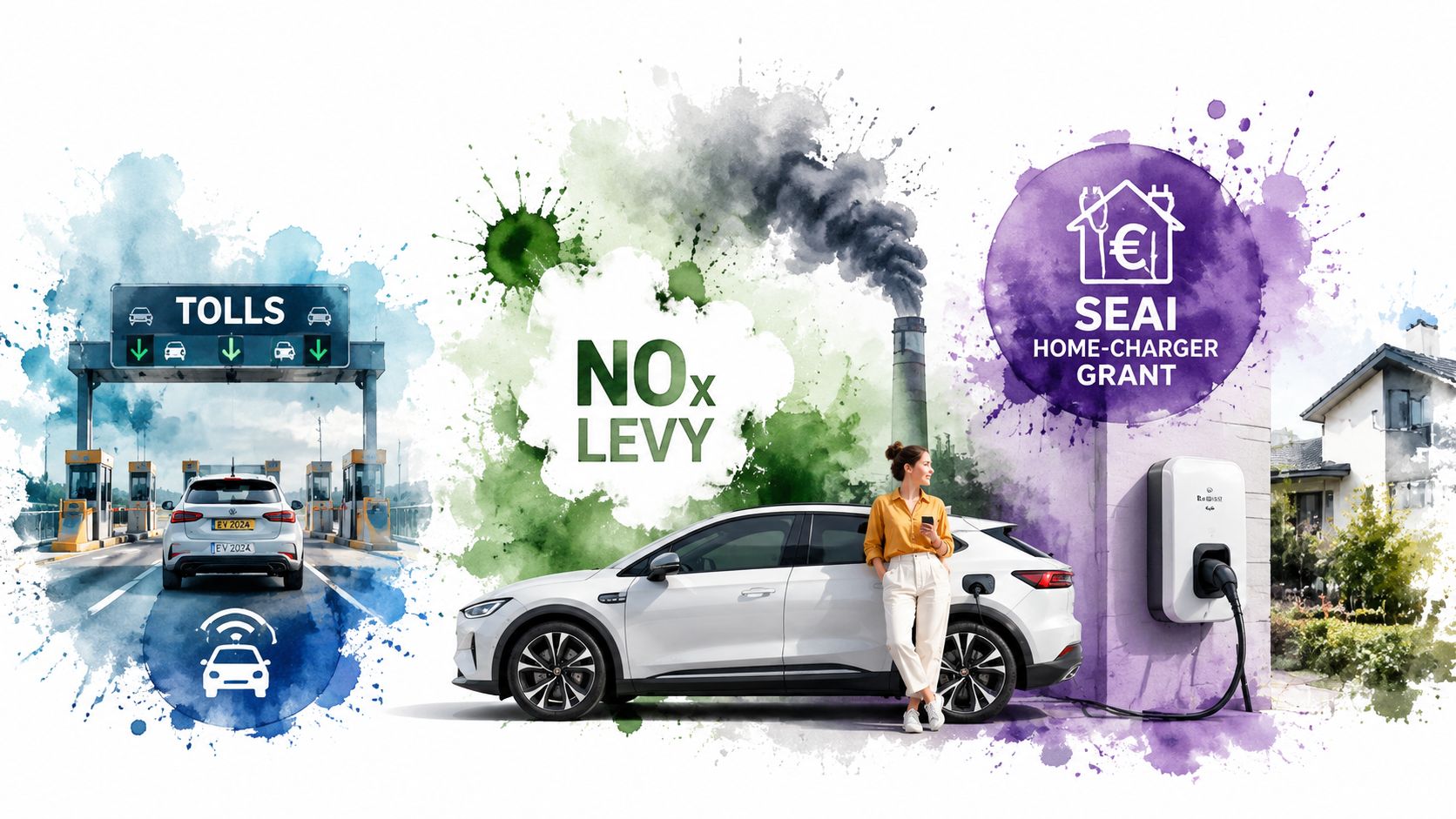
BEVs are exempt from the NOx levy, and that does matter, even if it is not the headline saving people advertise. It is one more reason the tax position of an electric car is different from a petrol or diesel car, especially once the buyer starts stacking all the ownership costs together.
Toll reductions also exist under LEVTIS, but that scheme has been winding down and the current status and caps should be checked on the official source before anyone relies on it. Treat that one as a live-policy item, not a permanent perk. Anyone planning regular motorway use should verify the current toll treatment directly on government guidance rather than on a sales listing.
The other item people mix up is the SEAI home-charger grant. That is separate from the car purchase itself. A used-EV buyer installing a charger at home may still qualify, subject to the current SEAI rules and the property setup, because the support is tied to the charger installation rather than whether the car was sold new or used.
For charger planning and installation basics, ShamAuto's home EV charger installation guide is a useful read before calling an installer. The official grant position should still be checked with SEAI and government guidance on the day of application, because grant rules and caps can shift.
What to verify before assuming a saving
NOx levy status: Confirm that the vehicle is exempt before relying on the saving.
LEVTIS treatment: Check whether the current toll discount still applies and what caps are live.
Home charger support: Verify the SEAI application rules, especially if the property is older or the installation is unusual.
That is the clean way to handle the smaller supports. Don't build a used-EV budget around a grant or discount until the official rule is checked, because these items are the easiest ones for ads to overstate and the easiest ones for a Budget update to change.
The 2026 Cliff and What to Verify Before You Buy
The biggest trap for Irish buyers is assuming EV tax rules are settled. They are not. The €5,000 VRT relief for eligible new BEVs is scheduled to expire on 31/12/2026, and the wider policy backdrop is already moving, with BIK treatment shifting into a new Category A1 structure from 01/01/2026 and a €30,000 OMV reduction in 2026.
The SEAI new-BEV price cap is also set to tighten for applications after 31/07/2026, according to current SEAI guidance, so anyone shopping near the upper end of the market should be checking that date carefully rather than assuming today's support will still be there later in the year. The exact grant amount can change, so the only safe habit is to check the live SEAI page before putting money down.
For company-car users, the tax picture is even more sensitive. The rules around benefit-in-kind are not static, and the 2026 structure matters if a buyer is choosing a car through work rather than privately. Revenue and government guidance are the places to confirm the current treatment before a purchase or salary-sacrifice decision is locked in.
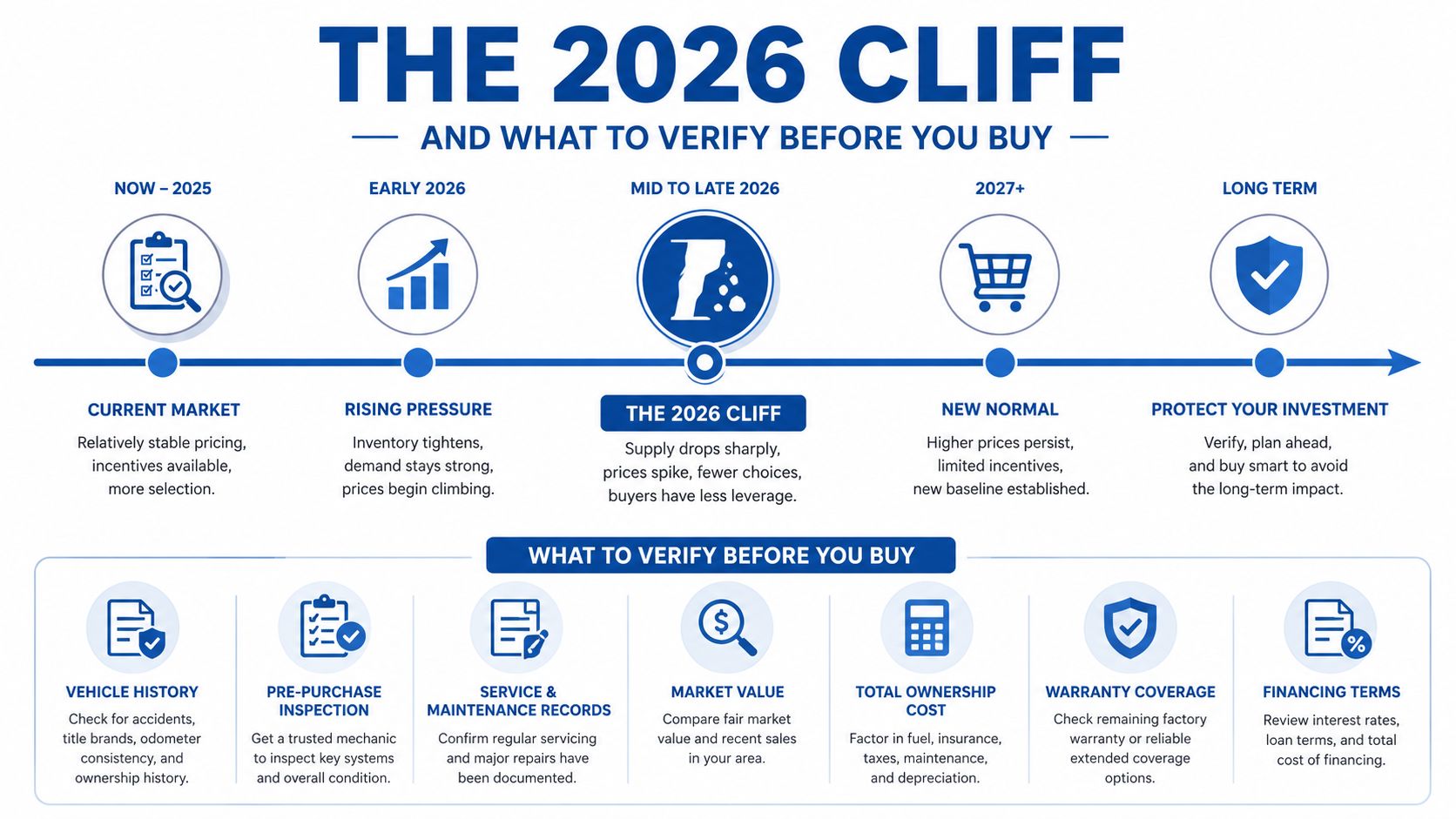
The short verification habit that saves trouble
Check Revenue first: Confirm the live VRT and motor tax rules on the day of purchase.
Check SEAI second: Confirm grant eligibility, price caps and application dates before ordering anything.
Check gov.ie for policy changes: Budget updates can move the goalposts without much warning.
The correct mindset is simple. Treat every EV tax saving as changeable, not permanent, and never sign on a scheme that is due to lapse or tighten without reading the current official rule first. ShamAuto can help with EV-native research, but it is not the authority on tax. Revenue and gov.ie are.
A Used-EV Buying Checklist With Tax in the Right Place
Tax matters, but it is not the first thing that protects your wallet on a used EV. Start with the live motor tax band on Revenue, then confirm the car is a BEV and not another electric variant with a different tax treatment. After that, check the NCT status and match the logbook details against the seller's information so nothing is sitting out of line.
Then move to the checks that decide whether the car is worth buying. State of Health (SoH) should be the first battery figure you ask for, because battery condition does more to shape value than any tax headline. Then look at the conservative range, charging speed, connector type and usable battery size. Those are the numbers that tell you whether the car fits your daily driving, your charger at home, and the routes you do.
Do not let the ad turn the tax story into the whole story. Every EV is automatic, so there is no clutch or gearbox to worry about in the usual petrol-car sense. The key questions are battery condition, charging practicality and whether the car suits the commute. If you want a plain checklist built around those points, ShamAuto's used EV buyer guide is the better place to start than a brochure full of tax talk.
Best habit: price the car on battery health and real-world usability first, then treat the tax savings as a useful but limited bonus.
Use a conservative range check before you get carried away by the advert. For planning, WLTP minus 17 percent is a sensible working figure for real-world driving, because brochure range is not what the car will do on Irish roads. That keeps expectations grounded before you start comparing trim levels or private-sale listings.
Ask for proof, not promises. If a seller can show diagnostic evidence of SoH, that matters more than a loose claim about range or an upbeat sales pitch about savings. A well-documented car with honest battery data is usually the smarter buy than a shinier listing that leans hard on tax and says little about the battery. That is the kind of listing structure ShamAuto is built around, so private sellers and dealers can list with the battery information buyers need, and buyers can browse ShamAuto when they want EV-native details rather than generic ad copy.
Frequently Asked Questions on Electric Car Tax in Ireland
Does any VRT relief survive when buying a used EV from a private seller? No. The relief is applied at registration, not as a second-hand discount, so the used buyer does not get a fresh claim. Revenue's current rules are the live reference point.
Does the SEAI purchase grant apply to a used car? No, it is for new cars only. Even for new EVs, buyers should check the live grant page because caps and price bands can change.
What is the easiest way to check the current motor tax band? Use Revenue's current band tables and the official calculator before purchase. That matters because the live band is what governs the bill, not a dealer's estimate.
What source should a buyer trust most for live changes? Revenue for tax, SEAI for grants, and gov.ie for policy updates. That trio is the safest way to catch changes before money changes hands.
If the buyer wants an EV-only place to compare listings with battery health, real-world range and Irish-market detail kept front and centre, ShamAuto is worth a look. It's built for people who want the tax story in the right place and the battery story even clearer. When the official rules move, the smartest move is to verify them first, then list or shop with the facts that affect the wallet.