
Car Buyer Guide Ireland: Switching to a Used EV Step by Step
Contents
- Why Switching From Petrol or Diesel Feels Different in Ireland
- Step 1 Work Out the Range You Actually Need
- Step 2 Set a Realistic Budget Without the SEAI Grant
- Step 3 Shortlist by Real-World Range Not WLTP
- Step 4 Browse and Filter on ShamAuto
- Step 5 Get Home Charging Sorted Before You Commit
- Step 6 View, Inspect and Ask for the SoH Screenshot
You're sitting in a driveway with a petrol or diesel car that still works fine, but the weekly grind is changing. Fuel feels dear, city driving is getting more annoying, and the idea of moving to a used EV in Ireland starts to make sense, provided the numbers stack up and the battery isn't tired. That's the core car buyer guide Ireland question for switchers, not whether an EV is fashionable, but whether it fits the daily routine, the parking space, and the budget without nonsense.
The good news is that the process is straightforward when it's treated properly. Start with what the car has to do, set a hard budget, shortlist by real-world range, check the battery's State of Health (SoH), and only then look at the car in person. Every EV is automatic, single-speed, with no clutch and no gearbox to worry about, so the decision is mostly about range, charging, and battery condition. Use the six steps below, and the move from petrol or diesel to used EV becomes a tidy process instead of a gamble.
Why Switching From Petrol or Diesel Feels Different in Ireland
A switcher usually begins in familiar territory. The current car is paid for, it starts every morning, and it has done the job well enough. Then fuel spend, commuting patterns, and the reality of charging at home start to matter more than badge loyalty. That is why a used EV begins to make sense for plenty of Irish drivers, because the decision is not just about replacing a car, it is about changing the way ownership works day to day.
The first difference is that EV buying is battery-led, not engine-led. A petrol or diesel buyer can spend hours on service history, timing belts, and mechanical noise. An EV buyer should focus on SoH, real-world range, and whether the car can charge where it lives. Irish used-car advice still says to verify the Vehicle Registration Certificate, check the NCT disc expiry date, and ask for a stamped service history, then cross-check the car's background with a history report before handing over money, because the paperwork gap in the market is real.
The decision is practical, not emotional
That is why a serious car buyer guide Ireland for EV switchers has to be process-led. Does the daily driving suit an EV? Is there a place to charge at home? Does the budget still work once you accept that the SEAI grant does not apply to used cars? Official Irish guidance makes the rule clear, the SEAI purchase support is for new battery electric vehicles, not second-hand ones, and Citizens Information says the support can be up to €3,500 for qualifying new BEVs since 01/07/2023.
ShamAuto is built around that exact switcher decision, with EV-only listings and battery-centred data. It is a better place to compare used EVs than a general classifieds site full of petrol, diesel, and hybrid noise. The order changes once you switch. Needs first, battery second, then the rest.
Practical rule: if the car cannot cover the weekly routine without constant charging stress, it is the wrong EV, no matter how good the price looks.
The six steps are simple. Know the daily distance, set the budget, shortlist by real-world range, filter the candidates properly, sort home charging, and inspect the car with the battery proof in hand.
Step 1 Work Out the Range You Actually Need
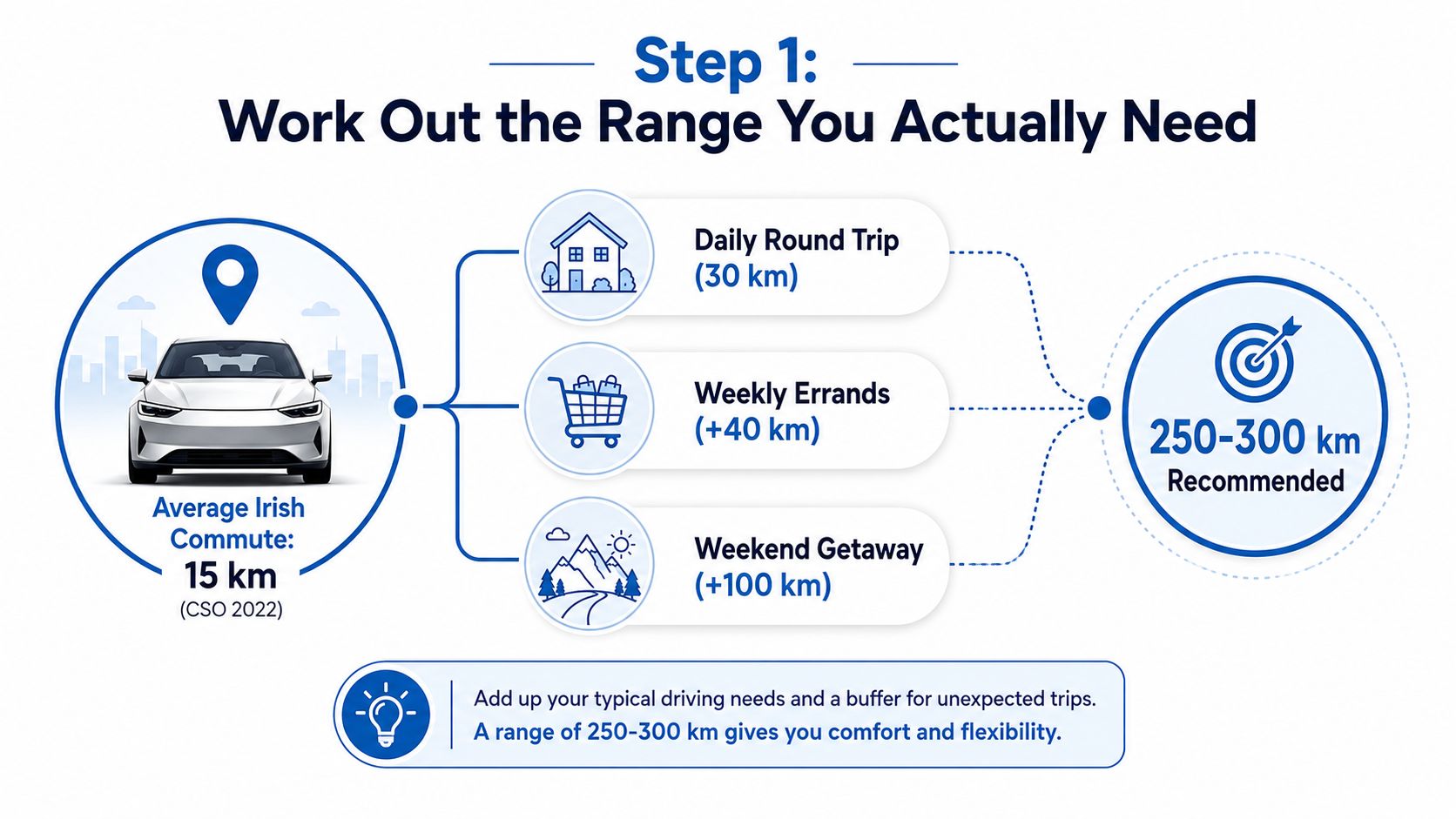
The first mistake switchers make is chasing the biggest battery on the listing page. That's backwards. Range should be matched to the life the car will live in Ireland, not to the bragging rights on a spec sheet.
A sensible starting point is the commute. The CSO's 2022 commuting data shows a national average commute of 16.8 km (CSO), but that average hides the split between urban and rural use. Dublin City comes in much lower than places like Laois in the same CSO data, and that matters because a rural driver will lean on range harder than a city driver. Short urban hops, school runs, and shopping trips can suit smaller batteries, while longer regional loops need a bigger cushion.
Turn daily life into a minimum range
The easiest way to do it is brutally simple.
Add the daily round trip. If the commute is short, the car can be smaller and cheaper.
Add the extra weekly driving. Errands, visits, and unplanned detours all eat range.
Add a weather buffer. Cold Irish mornings, motorway speeds, and battery ageing all reduce the usable figure.
The conservative planning rule here is to use the car's certified range, then allow for the real world. Irish buyer guidance already stresses mixed-road test drives, cold-start checks, and document checks because static listings miss faults and hidden wear. A listing figure on its own is not enough.
That's where ShamAuto's WLTP minus 17% real-world estimate becomes useful. WLTP is a lab figure, not a promise, so a shopper should treat the adjusted estimate as the number that matters for shortlist decisions. A 300 km WLTP car works out to about 249 km real-world under that rule, and that's before winter, motorway driving, or battery ageing bite into it further.
For a switcher, that estimate is the floor, not the target. If the routine is 200 km on a busy day, the car should still have enough margin left that charging doesn't become a daily negotiation. That's the right way to think about range in Ireland, as a buffer, not a fantasy.
Step 2 Set a Realistic Budget Without the SEAI Grant
A used EV budget has to be built on what you will really pay, not on wishful thinking. The purchase price is only one part of it, and the rest of the spend looks different from petrol or diesel ownership because home charging is usually easier on the wallet than a forecourt fill-up. The mistake is counting on a grant to close the gap on a used car. It does not.
Second-hand EVs do not qualify for the SEAI purchase grant. That support is for new BEVs only. If your budget only works because of grant money, the budget is wrong.
Price, charging, and the boring costs
Used EV ownership still has regular costs. Tyres wear, insurance matters, and charging at home still costs money, even if it is usually cheaper than petrol or diesel. Electricity prices can move, so check the live tariff with the supplier or a current comparison source rather than relying on old figures.
ShamAuto's charging cost guide is the right internal reference for the charging side of the equation, but the tariff itself should always be checked against current official or utility information. That is the number that matters now, not what someone paid last year.
Ireland's used-car market has its own pricing reality. SIMI publishes registration data and the CSO publishes vehicle statistics, which is why used-EV shopping should be based on the current market rather than stale assumptions.
The right budget is a three-part view. What you can pay for the car, what the home charger will cost to use, and what regular wear items will remain. Leave grant money out of the calculation for a used EV. Build around a car that still works without financial gymnastics.
Step 3 Shortlist by Real-World Range Not WLTP
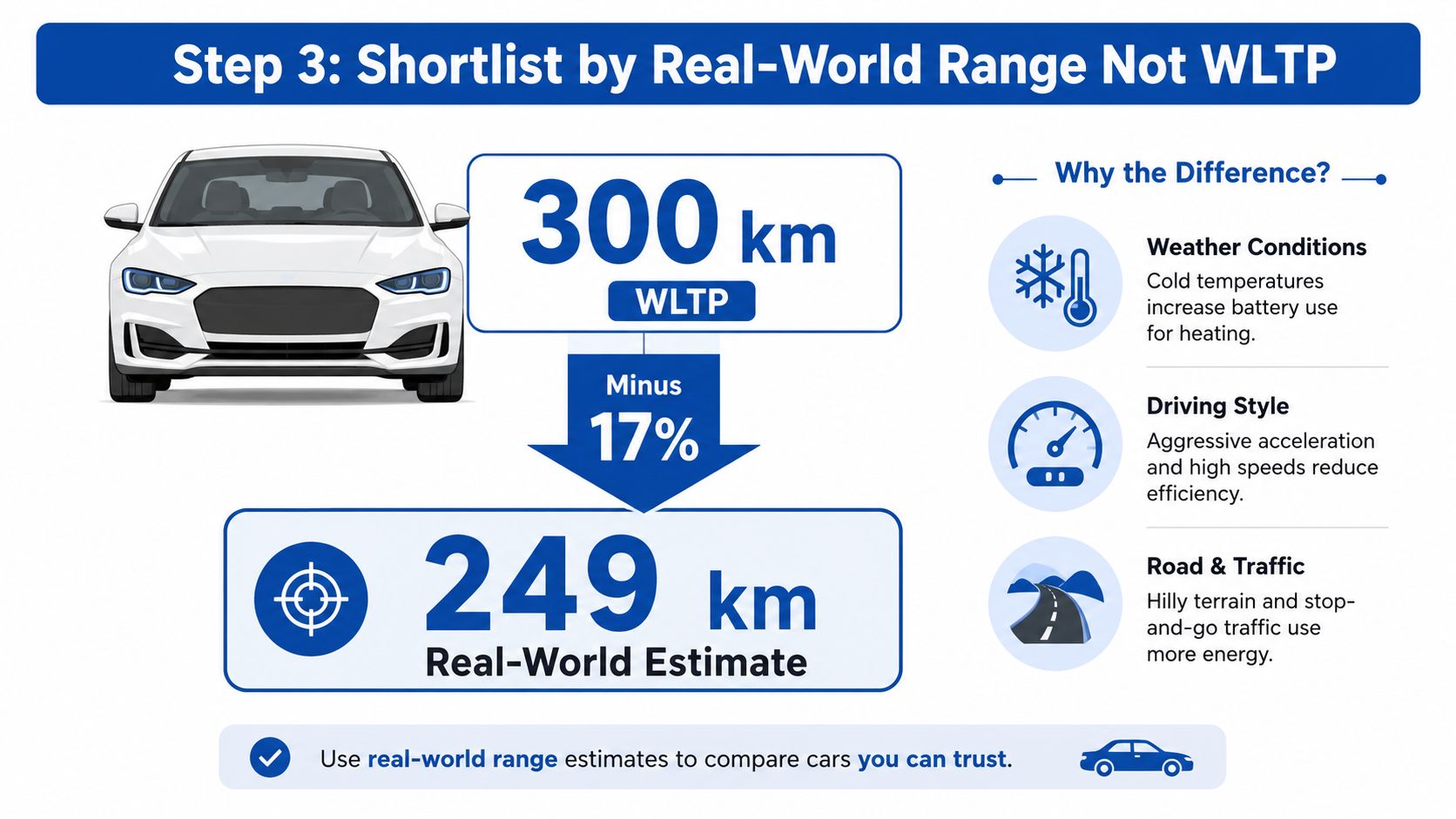
WLTP is a starting point, nothing more. It does not reflect what happens on an Irish wet Tuesday with the heater on and traffic crawling. If a switcher shortlists from the brochure figure alone, the car will look more capable than it really is between charges. The range number has to be adjusted before the shortlist is built.
Use a straight rule. Take the WLTP figure and subtract 17% to get a conservative real-world estimate. A 300 km WLTP EV works out at about 249 km real-world. That is the number to plan around. It gives a safer basis for comparing a car used for commuting with one expected to handle longer family trips.
Use the adjusted number as the hard floor
Set your floor with a buffer left in it. A car that only just matches the route on paper is too tight in winter, and battery wear tightens the margin again over time. The Irish used-car advice also points buyers toward proper test drives and cold-start checks, because that is where hidden issues show up.
Mileage alone still does not tell the story. A city car with fewer kilometres can have plenty of battery wear if it has lived on frequent charging, while a higher-mileage car can be the better buy if it has been looked after properly. The diagnostic evidence matters more than the odometer.
ShamAuto shows the adjusted range estimate on every listing, so you compare cars on the same basis instead of trusting inflated brochure claims. For the method in full, read ShamAuto's real-world range guide for the Hyundai Ioniq 5.
A real-world range figure only works if it helps the buyer rule out the wrong car.
Use the adjusted range as the filter. If the car cannot handle the daily pattern with margin, leave it off the shortlist. That keeps the decision honest and stops the common mistake of chasing the biggest battery instead of the right one.
Step 4 Browse and Filter on ShamAuto
A good EV listing page should do the hard work for the buyer. That means the filters need to reflect how Irish drivers shop, by county, price, mileage, and range band, not by a pile of irrelevant trims and engine-size noise. The best listings also show the battery and charging details in a structured way, so there's less guesswork and less room for seller spin.
The first filter should be the range band, because that's the actual use-case test. County matters too, since a buyer in a long-commute area has different needs from a city buyer, and price should only be applied after the range threshold is already sensible. Mileage helps, but it should never outrank battery evidence.
What to weigh most heavily on a listing
Verified SoH: This is the strongest battery signal. If the diagnostic screenshot is there, the listing deserves serious attention.
Usable kWh: This tells more about actual capacity than a vague range claim.
Charging speed and connector type: These decide how well the car fits public charging and home charging.
On-board charger: This matters for slower AC charging, especially for overnight use.
County, price, mileage: Useful, but secondary to battery condition and realistic range.
ShamAuto is newly launched, so the right framing is to be among the first to browse, compare, or list, rather than expecting huge stock on day one. That makes the guides library even more useful, because a new buyer can use the advice to standardise comparisons before the market fills out. The main site is the clean place to start, and the guides at buying a used EV in Ireland, the used EV buyer's checklist, and how to check battery SoH before you buy are the relevant reading.
The key point is simple. A decent EV listing should help the buyer compare apples with apples. If the page hides battery detail, the buyer is doing too much work. If it surfaces SoH, usable capacity, and charging details clearly, the shortlist gets much cleaner.
Step 5 Get Home Charging Sorted Before You Commit
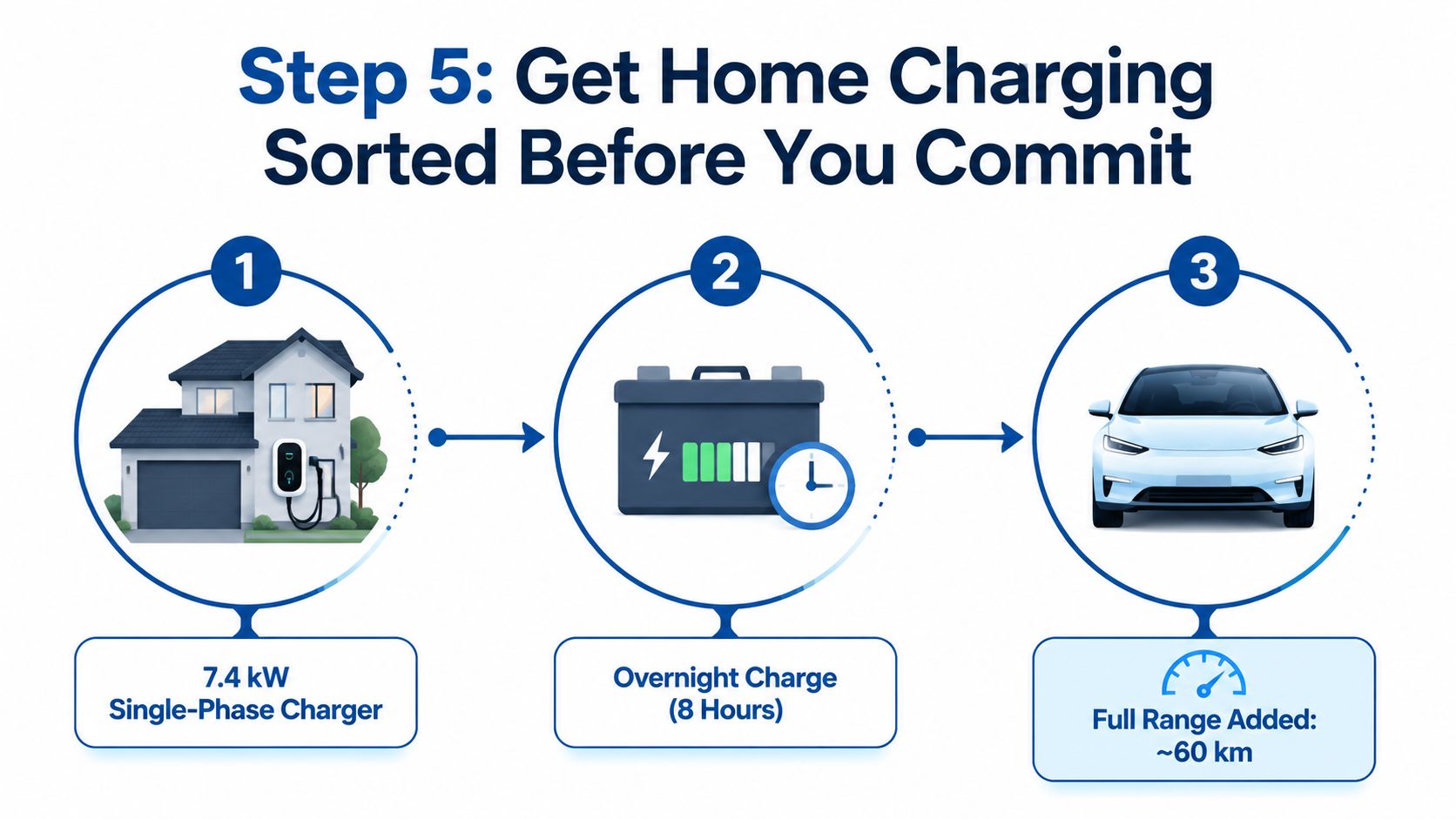
A used EV can be a brilliant fit or a constant headache depending on where it sleeps at night. If the parking setup is wrong, the ownership experience gets awkward quickly, especially for anyone who can't rely on public charging every day. This needs to be checked before the purchase, not after the deposit is paid.
In Irish homes, 7.4 kW single-phase overnight charging is the typical setup to think about. That's the common reference point for most private driveways and home installations, and it's the right baseline for deciding whether the car and the parking situation make sense together. For home charging support and scheme details, SEAI is the official source to check, while ESB and Citizens Information should be used for current electricity and consumer guidance.
Confirm the parking situation first
The practical questions are blunt. Is there a driveway, a dedicated bay, or secure off-street parking? Is a cable run realistic? Is there room for a charger to be installed without turning the front of the house into a hassle? Those answers matter more than the glossy badge on the car.
A charger choice also needs to stay aligned with official updates. The SEAI new-BEV price cap changes after 31/07/2026, so anyone checking support now should verify the live rule on the official source rather than relying on an old summary. That's the pattern with EV ownership in Ireland, check the source, then make the decision.
The simple outcome test is this. If the home setup can recharge the car overnight, the used EV fits the life better. If it can't, public charging becomes part of the routine, and that changes the whole ownership equation. ShamAuto's home charging guide is the right reference for the domestic side of that decision.
If home charging is uncertain, the car isn't ready yet, even if the listing looks perfect.
That's the thing many petrol and diesel switchers miss. A used EV isn't just bought with money, it's bought with a charging plan.
Step 6 View, Inspect and Ask for the SoH Screenshot
The final check is the most important one. A verbal reassurance about battery health is not enough, because the buyer needs evidence, not confidence. The single most useful document is a State of Health screenshot from a diagnostic tool, because it tells the buyer how the battery is holding up, not how friendly the seller sounds.
Battery condition should be judged against age, not against fantasy. The CCPC's guidance for EV buyers says SoH matters because range degradation is driven mainly by usable battery capacity loss rather than odometer reading alone (CCPC EV buying guide). A separate reference point from Geotab 2024 is that batteries lose roughly 1.8% per year, so around 90% SoH at 5 years is normal rather than alarming, provided the rest of the car makes sense.
What to check on the day
SoH screenshot: Ask for the diagnostic proof, not just a verbal claim.
Vehicle Registration Certificate: It should match the car being sold.
Stamped service history: This helps confirm the car's maintenance background.
NCT disc expiry date: The buyer should verify the current roadworthiness status.
Independent inspection: SIMI explicitly recommends getting an independent mechanic or similarly qualified person to inspect used cars, along with practical checks on tyres, lights, seat-belts, wipers, oil, and leaks (SIMI consumer advice).
A 2-4 year EV with verified SoH around 90%+ is usually in the sweet spot, while older or cheaper cars in the mid-to-upper 80s can still make sense if the price and real-world range line up. That's not a fixed rule, it's the way battery age and price should be balanced in the market.
For the paperwork-heavy bit, the earlier checks still apply. The CCPC advises buyers to confirm whether the car has been crashed, whether the mileage is correct, whether there is outstanding finance, whether it is an import, and whether the original paperwork matches the vehicle being sold (CCPC car buying advice). ShamAuto's automatic-car guide is also worth using for buyers who want the broader inspection flow around EV ownership (used automatic cars guide).
The simplest way to finish the process is to keep the six decisions in order.
Know the daily distance and parking reality.
Set the budget without assuming a used-car grant.
Shortlist by real-world range, not WLTP.
Filter listings by verified SoH and EV-specific specs.
Confirm home charging before paying a deposit.
Inspect the car, check the documents, and ask for the SoH screenshot.
A used EV in Ireland is a good move when the battery evidence is solid, the range is honest, and the home charging setup is already thought through. Browse ShamAuto when that's the standard you want, and be among the first to list or compare on an EV-only marketplace built for Irish buyers who want clear battery data, realistic range, and less guesswork.