
Buying a Used Cupra Born Ireland: Your 2026 Guide

Contents
You've found a used Cupra Born in Ireland that looks right, the price appears below the cost of a new car, and the advertised range seems more than enough for daily driving. Then the important questions arrive. How much capacity does the battery still hold? What range is realistic on Irish roads? Can the car be charged conveniently at home, or will public charging make ownership less attractive?
Those questions matter more than a polished photograph or a low odometer reading. A used EV should be assessed through its State of Health (SoH), usable battery capacity, charging capability and conservative range estimate. The following guide applies that approach to the Cupra Born, with practical checks for buyers and sellers across the Republic of Ireland.
Why Buy a Used Cupra Born in Ireland
A buyer comparing electric hatchbacks in Ireland will usually notice the Cupra Born because it looks more distinctive than many conventional family cars. It offers the quiet, immediate driving response expected from an EV, while retaining the compact footprint that suits town driving, commuter routes and Irish parking spaces. Every Born is also automatic in operation, because an EV uses a single-speed drive system rather than a conventional clutch and gearbox.
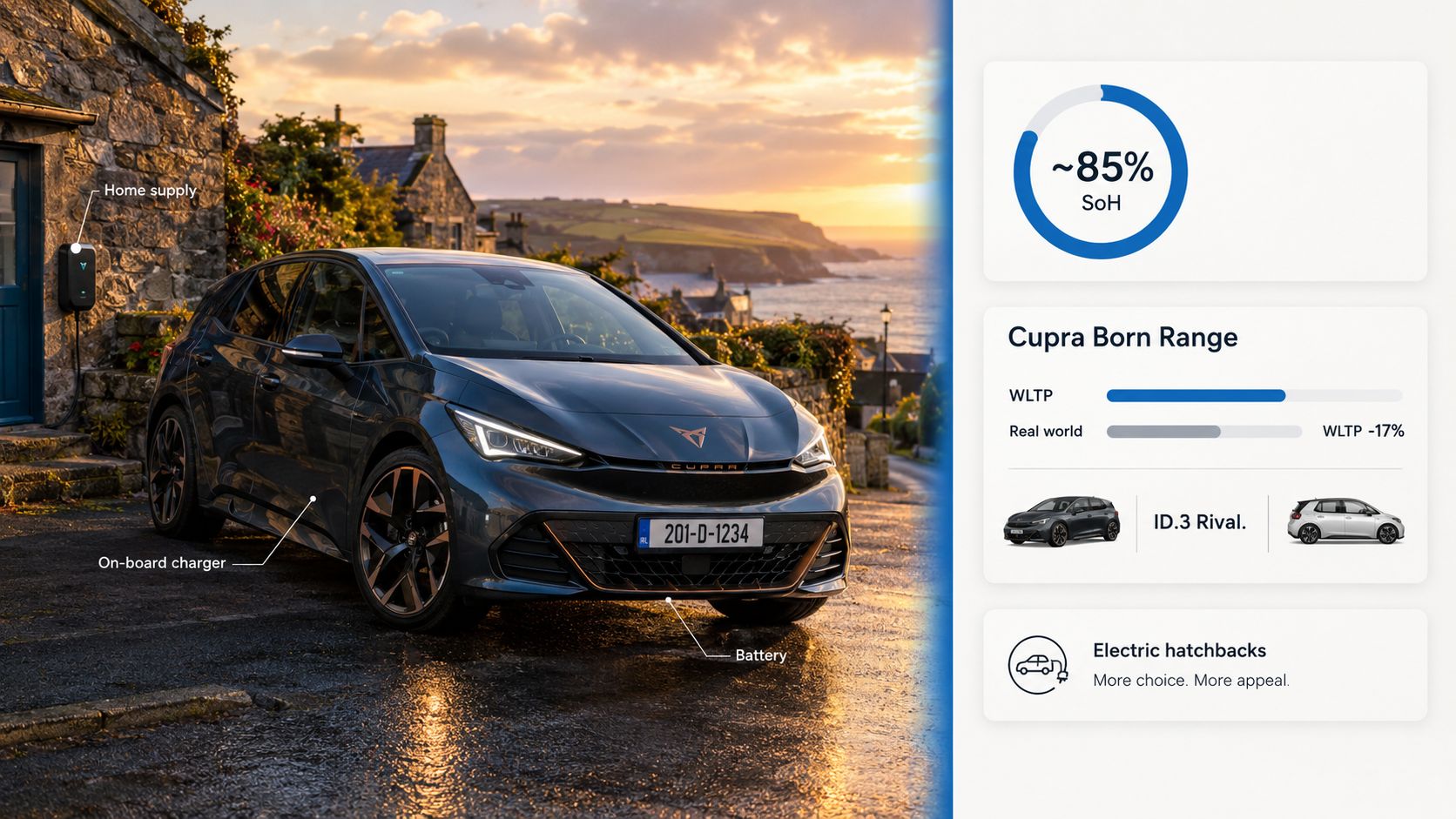
CUPRA introduced the Born in 2021 as its first 100% electric car, presenting it as a move towards sustainable mobility, advanced technology and a smaller environmental footprint for the brand. The CUPRA Ireland Born overview places the model within that wider transition, but a used-car buyer needs to look beyond the brand story and brochure design.
The central difference between a used Born and a used petrol hatchback is the component that deserves the most scrutiny. A petrol car's condition is often judged through its engine, gearbox, service history and mileage. With an EV, those checks still matter, but the battery can have the greatest effect on practical value. The key measurement is State of Health, or SoH, which indicates how the battery's available capacity compares with its original condition.
Why mileage alone isn't enough
A low-kilometre Born can still leave buyers with unanswered questions if the advert provides no battery evidence. Conversely, a car with more kilometres may be a sound purchase when its SoH is documented and its range remains suitable for the owner's routine.
The right buying order is straightforward:
- Confirm the exact version: Establish whether the car is the 58 kWh model or the 77 kWh VZ.
- Check the battery evidence: Ask for a diagnostic report or verifiable SoH reading linked to that vehicle.
- Use a cautious range figure: Compare the advertised WLTP figure with a WLTP-minus-17-percent estimate.
- Match charging to the routine: Consider home charging, workplace access and motorway use before choosing the battery size.
ShamAuto is an independent, EV-only Irish marketplace that places a verified SoH badge and conservative range information on individual listings when the required evidence is provided. That approach doesn't remove the need for a test drive or document checks, but it gives buyers a more useful starting point than a range claim without supporting battery information.
Cupra Born Models and Real-World Range
The used Irish market contains Borns from different model years and equipment updates, so the battery size should be confirmed rather than inferred from the registration date. For the catalogue comparison below, the two relevant versions are the 58 kWh Born and the larger 77 kWh Born VZ.
The range figures use one consistent rule. The practical estimate is calculated as WLTP minus 17 percent, rather than treating the laboratory figure as a promise for every Irish journey.
Cupra Born 58 kWh vs 77 kWh VZ Comparison
| Specification | Cupra Born 58 kWh | Cupra Born 77 kWh VZ |
|---|---|---|
| Usable battery | 58 kWh | 77 kWh |
| WLTP range | 424 km | 548 km |
| Real-world estimate, WLTP minus 17 percent | About 352 km | About 455 km |
| Public DC connector | CCS | CCS |
| Maximum DC charging | About 120 kW | About 135 kW |
| AC charging | 11 kW | 11 kW |
| Drive | Rear-wheel drive | Rear-wheel drive |
| Seats | 5 | 5 |
| Irish new RRP context | Circa €38,000 | Circa €42,000 |
The 58 kWh version has 58 kWh of usable energy from a 62 kWh gross battery and supports DC charging up to 120 kW, according to independent Born 58 kWh specifications. Its estimated real-world range of about 352 km makes it a sensible fit for commuting, local journeys and interurban driving where charging is mainly done at home.
The 77 kWh VZ carries a larger usable energy reserve and an estimated real-world range of about 455 km. That difference matters most on longer motorway journeys, rural routes and trips where a driver can't depend on a charger at the destination. The larger battery doesn't make public charging irrelevant, but it can reduce how often the driver needs to stop.
Practical rule: Choose the battery around the longest journeys that happen regularly, not around occasional maximum trips.
The 58 kWh model can represent better value for a driver with reliable overnight charging and predictable daily distances. The 77 kWh car makes more sense when motorway travel is frequent or when missed charging opportunities would create genuine inconvenience. Buyers comparing other EVs can use the electric car range comparison guide, but the same discipline applies, usable capacity and conservative range matter more than a headline badge.
The 2024 facelift didn't change the core 58 kWh and 77 kWh battery choices used in this guide. A buyer should still check the individual vehicle's equipment, model year, charging limits and documentation before treating any listing as directly comparable.
How to Verify Cupra Born Battery Health
State of Health (SoH) is the most useful battery condition metric for a used Cupra Born. It describes the battery's remaining capacity relative to its original capacity, so it gives a clearer indication of long-term usability than the odometer alone.
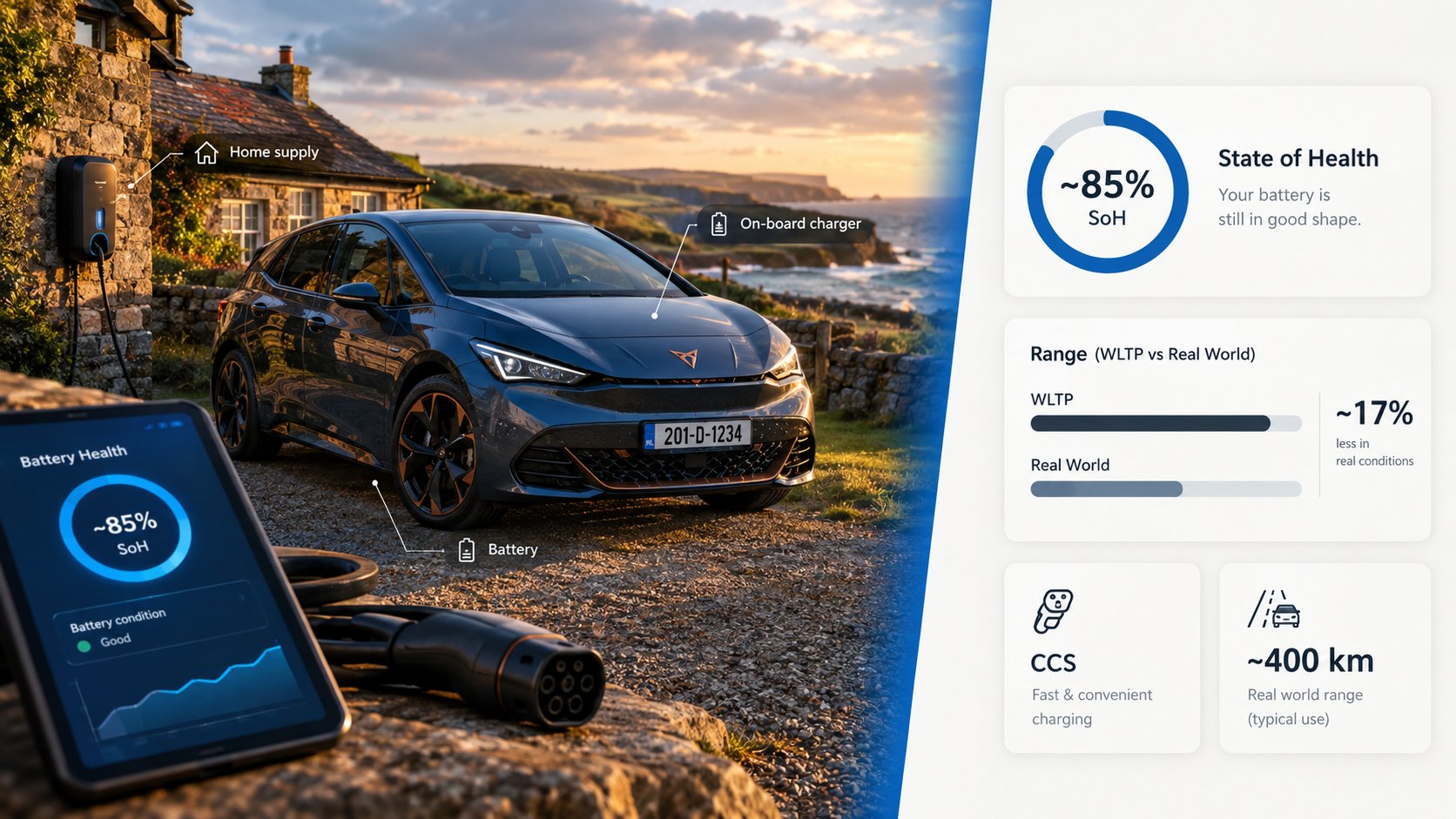
A seller may provide a diagnostic report, workshop printout or screenshot from a suitable diagnostic application. Tools such as Car Scanner can help identify battery information when used with compatible hardware, but an app screenshot should be treated as supporting evidence rather than automatic proof of accuracy. The buyer should confirm the vehicle identification details, reading date and the method used to produce the result.
A useful evidence check
A serious listing should answer four questions before a buyer travels to view the car:
- Which car was tested: The report should correspond to the advertised VIN or registration details.
- What was measured: The document should identify SoH or an equivalent battery capacity assessment, not only the dashboard range.
- When was it measured: A recent reading is more useful than an undated screenshot.
- How was it obtained: The seller should explain whether the result came from a dealer diagnostic system, an OBD-II tool or another method.
The dashboard range is useful for a road test, but it isn't a substitute for SoH. It changes with recent speed, temperature, heating use, tyre pressures, driving style and the car's previous journeys. A Born displaying a high range after gentle urban driving may show less after sustained motorway use, while a low display after demanding driving doesn't automatically prove battery degradation.
What the buyer should do
Request the SoH evidence before discussing a final price. Then compare it with the car's age, mileage, service records and estimated range. A battery report won't reveal every possible fault, so the buyer should also check warning lights, charging behaviour, underbody condition, tyres, brakes, infotainment and the operation of the charging flap and cables.
A two-year-plus Born shouldn't be judged against a blanket assumed battery percentage. Each vehicle needs its own report. ShamAuto listings can display a verified SoH badge when diagnostic screenshots are supplied, which makes the battery question visible at the point of comparison rather than leaving it to an awkward conversation after a viewing. The used car check guide for Ireland can support the wider inspection process.
A clean history and a verified battery reading are more valuable than a low asking price with no evidence behind it.
Charging Your Cupra Born in Ireland
Charging the Born is straightforward once the connector and power figures are separated. Public rapid charging uses CCS, while AC charging is used at home and at many destination chargers. The 58 kWh car supports up to about 120 kW DC, while the 77 kWh VZ supports up to about 135 kW DC. Both catalogue versions have an 11 kW AC onboard charging capability.
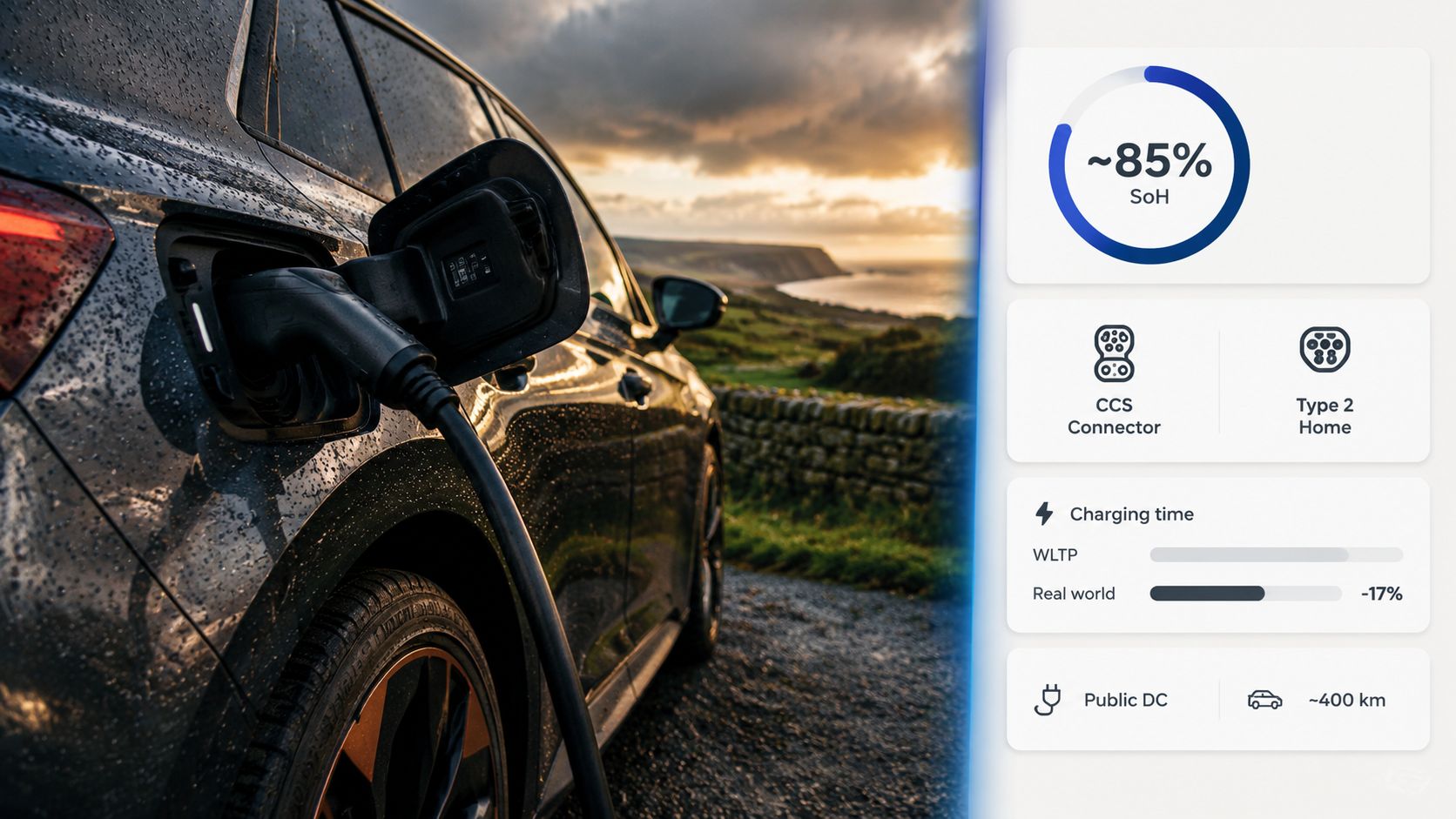
The maximum DC figure isn't a guaranteed charging speed. The car's battery temperature, state of charge, charger output and site conditions all influence the actual rate. Charging normally slows as the battery fills, so a short rapid stop can be more time-efficient than waiting for a near-full battery when the route only requires a top-up.
At home, charging speed should be matched to the property and routine. An 11 kW AC capability can be useful where suitable three-phase supply and equipment are available, while a standard home charger can still suit overnight charging for many drivers. The important question is whether the car is connected often enough to replace the energy used during the day.
Public charging and trip planning
The Born's CCS connector is compatible with the types of public rapid-charging infrastructure used by Irish networks including ESB, IONITY and EasyGo, subject to site availability, payment arrangements and the vehicle's charging conditions. Drivers should check the route before leaving, particularly when travelling through rural areas where alternative chargers may be limited.
Every EV sold in Ireland, including the Cupra Born, operates like an automatic car because it uses a single-speed transmission without a traditional clutch or gearbox. That makes stop-start traffic simple, but it doesn't remove the need to plan charging on longer journeys.
A useful routine is to leave home with enough energy for the first planned leg, identify a backup charging location and avoid relying on the final available charger in an area. The Irish EV charging guide explains the practical difference between AC and DC charging, but buyers should also ask whether the seller has the original charging cables and whether the car has charged consistently without errors.
Real-World Ownership Costs
The purchase price is only the starting point for a used Cupra Born. Build the budget around acquisition costs, insurance, motor tax, maintenance and electricity, then test those costs against your actual charging routine. A low advertised price can lose its advantage if public charging becomes your default.
The SEAI purchase grant applies to new battery electric vehicles and does not apply to second-hand cars. Check the official SEAI grant guidance for current rules and eligibility conditions. Other supports may still be available to used-EV buyers, including the home charger grant, reduced tolls, low motor tax and VRT relief for imports, subject to the relevant conditions.
Charging location changes the budget
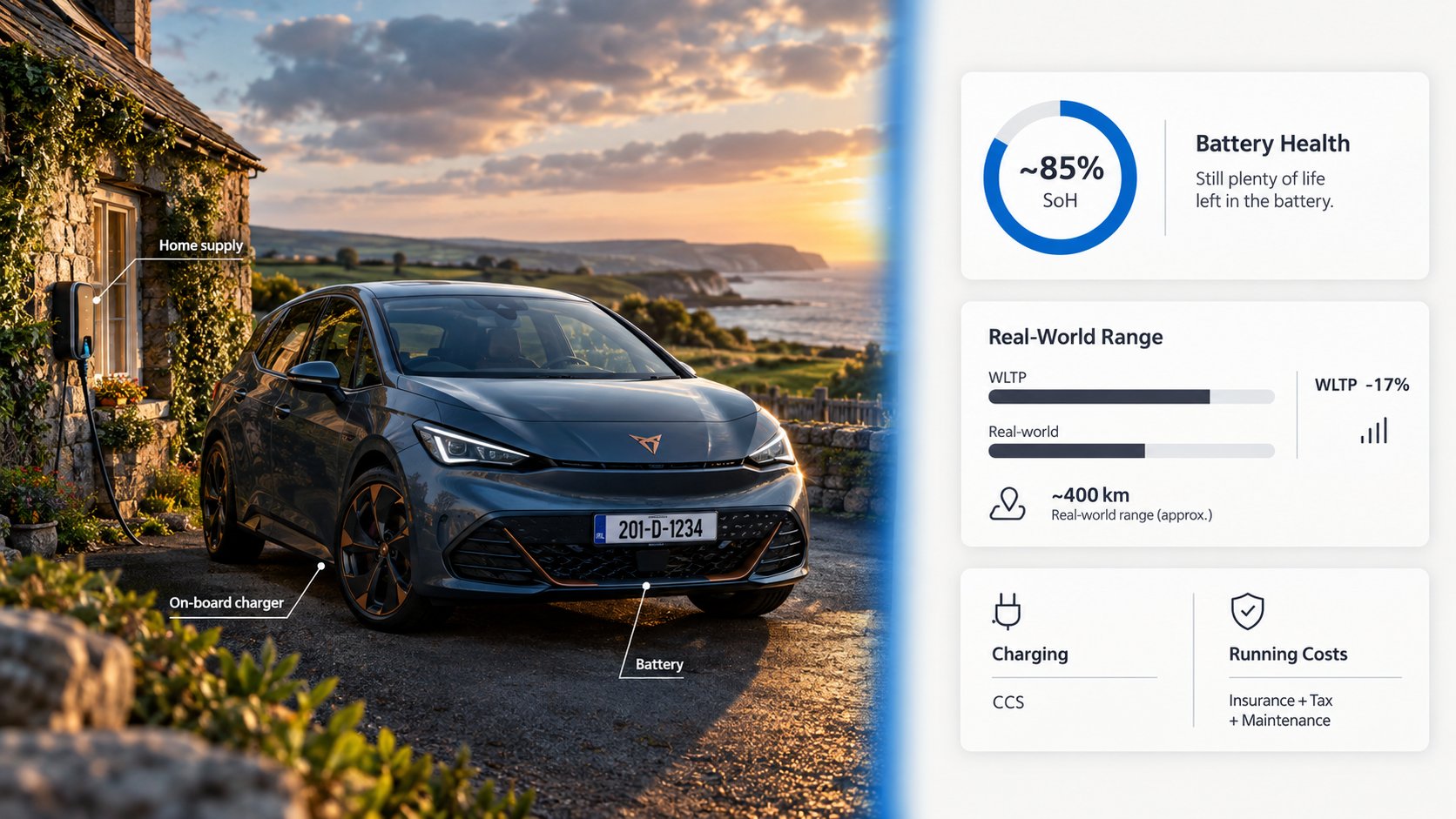
Charging location can create a larger ownership-cost difference than small variations in purchase price. Charging predominantly at home on a domestic or EV night tariff costs far less per kilometre than relying on public rapid charging, where the unit price is usually much higher. Over a typical year that difference can be several hundred euro, but the exact gap depends on your electricity tariff, charging losses and how often you use public chargers.
Treat these figures as planning estimates, not guaranteed bills. Electricity tariffs, charging losses, public-network prices and the balance between home and public charging will change the result. Apartment buyers without dependable charging should calculate a public-charging budget before assuming the Born will be inexpensive to run.
A used Born also needs a maintenance allowance. There is no engine oil or conventional gearbox, which removes some routine work found on petrol and diesel cars. Tyres, brakes, suspension, steering, cabin filters, cooling systems, software and high-voltage safety checks still require inspection and servicing. Insurance depends on the driver, battery version, specification and vehicle history, so obtain quotations for the exact car before committing.
Battery health belongs in the cost calculation too. A verifiable State of Health reading and a realistic Irish-road range estimate help distinguish a sound bargain from a car that may need earlier replacement or offer less usable range than expected.
The key ownership-cost question is where the Born's electricity will come from, and how reliably you can access it.
How to Find and Evaluate a Used Cupra Born
A used Cupra Born advert can look convincing while leaving out the information that matters most to an EV buyer. General classified platforms may show the battery version and mileage, but charging capability, State of Health and realistic range are often missing. Treat the advert as a starting point, not proof of the car's condition.
Compare each car by year, kilometres, specification, physical condition and battery health. The odometer alone cannot establish value.
The listing checklist
- Battery version: Confirm whether the Born has the 58 kWh battery or the 77 kWh VZ version, and check that the paperwork matches the advert.
- SoH evidence: Request a diagnostic reading linked to the specific vehicle. A vague claim about battery condition is not enough.
- Range framing: Estimate likely use from the WLTP figure, allowing for the lower range commonly achieved on Irish roads rather than relying on the headline number.
- Charging hardware: Confirm the CCS connector, AC charging capability and maximum DC rate for that exact version.
- Ownership records: Review registration history, invoices, service records and any outstanding-finance checks.
- Physical condition: Inspect tyres, wheels, glass, bodywork, charging cables, interior wear and the underside of the car.
- Charging test: If possible, connect the car to a suitable charger. Confirm that charging starts, continues without warnings and reaches a reasonable rate.
A direct comparison can expose the difference between advertised value and usable value. A newer Born without a battery report may warrant more caution than an older example with clear SoH evidence, complete records and a range that suits the buyer's regular routes.
Price needs context
The catalogue new-car context is circa €38,000 for the 58 kWh Born and circa €42,000 for the 77 kWh VZ. A used Born will generally sit below its Irish new RRP, but its value depends on age, kilometres, specification, condition and battery health, not just the county or seller location.
Second-hand vehicles do not qualify for the new-car purchase grant, so do not deduct a new-car grant from a used Born's price. The SEAI guidance on used EV purchases explains which supports may still apply.
A structured EV marketplace can simplify like-for-like comparisons if it displays usable battery information, charging details, range estimates, seller type and SoH status together. Independent inspection and a proper test drive remain necessary. Before paying a deposit, make sure the documented battery condition and achievable Irish-road range justify the asking price.
Selling Your Cupra Born in Ireland
A seller preparing a Cupra Born should expect informed buyers to ask about the battery before they ask about cosmetic details. A clean car, strong photographs and a complete service history help, but a recent SoH reading addresses the question that most directly affects used-EV confidence.
The evidence should be clear and tied to the vehicle. A screenshot or diagnostic document should show the measurement method and enough identifying information for the buyer to understand what was tested. The listing should also state the exact battery version, WLTP range and conservative real-world estimate, rather than presenting one unexplained distance figure.
A stronger advert
- Start with the facts: Include registration year, kilometres, battery size, drive configuration and charging details.
- Show the condition: Photograph the interior, wheels, tyres, charging equipment and any marks clearly.
- Explain the routine: State whether the car was mainly charged at home, at work or publicly, without making unsupported battery claims.
- Make SoH visible: Add the recent report or diagnostic evidence so serious buyers can assess the car before arranging a viewing.
A verified battery report removes the biggest uncertainty in a used EV advert. It doesn't guarantee a faster sale or a particular price, but it gives buyers a rational basis for comparing the Born with other cars. Sellers should be among the first to list their Cupra Born on an EV-focused platform with complete battery information.
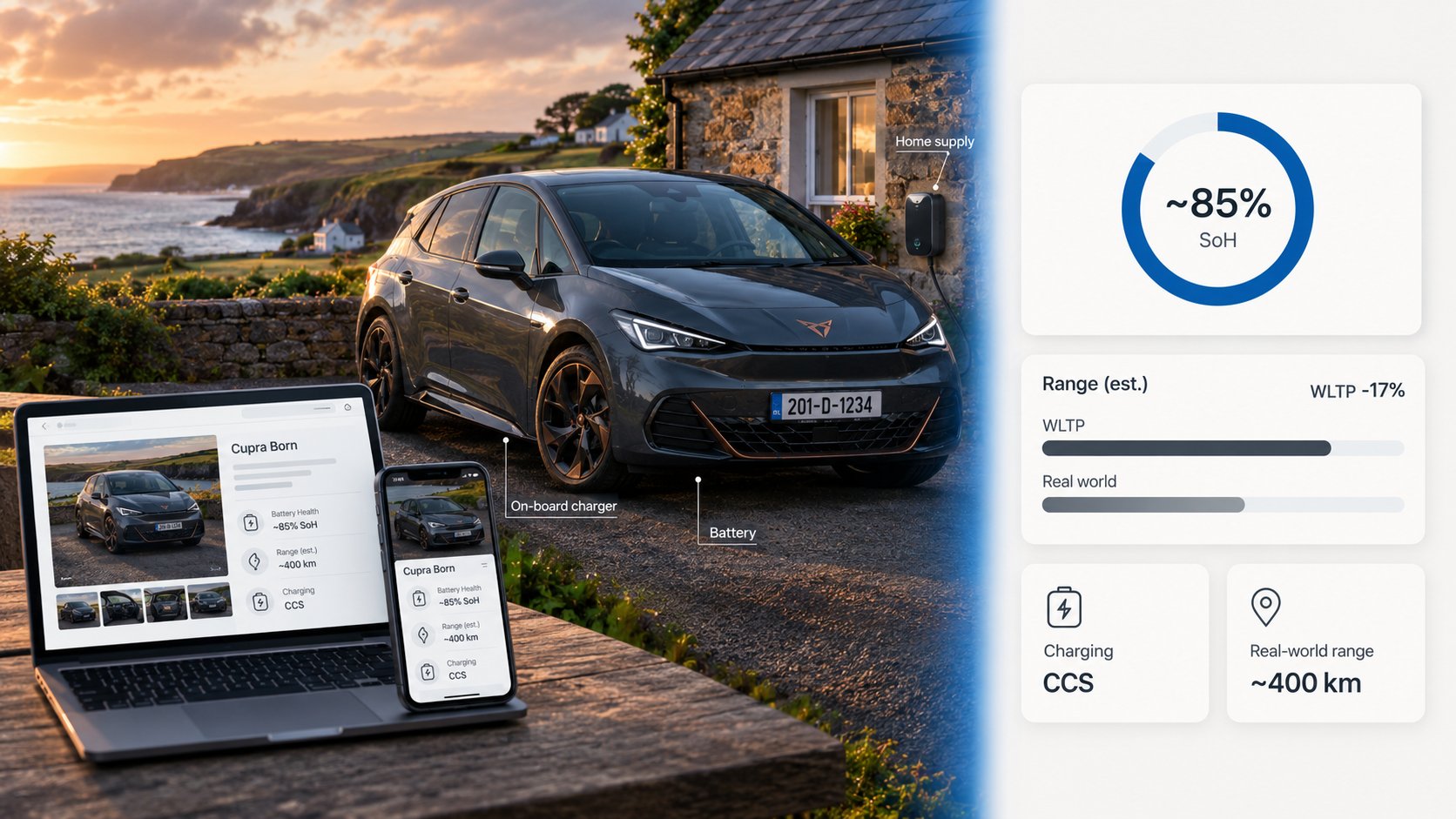
ShamAuto gives Irish EV sellers a free way to present a Cupra Born with structured specifications, a verified SoH badge when diagnostic evidence is supplied, and a conservative WLTP-minus-17-percent range estimate. Buyers can visit ShamAuto to compare evidence-led used EV listings and guides without relying on brochure range alone.