
Best Small Electric Car Ireland: Your 2026 Top Picks
Contents
Ireland's electric-car market has crossed the line from niche to mainstream. The Central Statistics Office recorded 23,398 private battery-electric car registrations in 2025, up from 17,191 in 2024, while EVs represented 19% of newly registered private cars. That expanding new-car base matters to used buyers because compact hatchbacks and city EVs should gradually become easier to find second-hand.
For an Irish city or commuter driver, the best small electric car isn't just the cheapest model or the one with the longest brochure range. It's the car with a credible State of Health (SoH) report, enough practical range for the routine, and charging hardware that fits the home and public network available to the driver.
Introduction to Small Used EVs in Ireland
Small used EVs can make strong urban and commuter cars. They're easy to park, every EV is automatic with a single-speed drivetrain, and home charging can suit a predictable daily routine. Their limits become more visible on long motorway journeys, in poor weather, or when a driver relies heavily on public rapid chargers.
The first distinction is financial. The SEAI purchase-grant rules confirm that the EV purchase grant applies to new vehicles only, so a second-hand EV doesn't qualify for that purchase support. Used buyers therefore need to judge the car itself, rather than assume a grant will close a pricing gap.
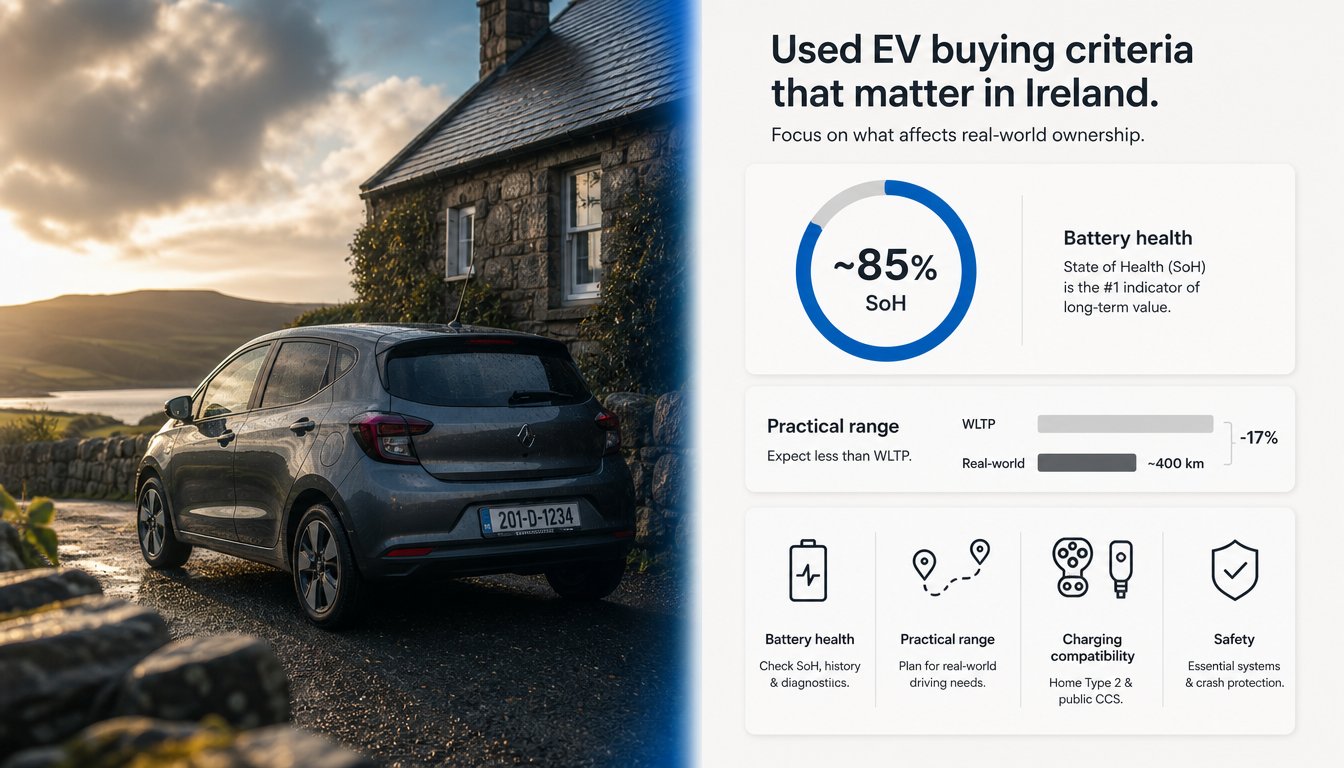
Battery condition deserves more attention than the badge. State of Health, or SoH, measures the battery's remaining usable capacity and gives a better basis for range confidence than age or mileage alone. SEAI's guidance on buying a used EV recommends checking battery condition and ownership history before purchase.
A conservative range method also improves comparisons. ShamAuto's editorial estimate treats practical range as WLTP minus 17%. A car listed at 300 km WLTP would therefore be planned at about 249 km, an internal planning estimate rather than an official government figure. The Irish guide to electric cars gives buyers a broader grounding in how battery size, weather and motorway driving affect ownership.
Core Criteria for Choosing a Small EV
A buyer comparing a Dacia Spring with a Peugeot e-208 or Renault Zoe needs four separate tests. Range alone can't answer the question because a strong battery, suitable charging equipment and manageable running costs work together.
Battery health comes first
SoH is the starting point. A diagnostic report can show whether the car still has the capacity needed for the buyer's daily kilometres. A low-mileage car without battery evidence shouldn't automatically outrank a higher-mileage car with clear documentation.
The listing should also identify whether the stated battery is owned or subject to a lease. That distinction is particularly important for some Renault Zoe examples, where the financial and contractual position can differ between cars.
Range must reflect Irish use
WLTP helps compare models, but it isn't a guarantee of motorway distance in Irish conditions. The WLTP-minus-17% method creates a consistent planning figure, then the buyer should allow further margin for cold weather, high speeds, passengers and heating.
The ShamAuto electric-car range comparison guide is useful for keeping that calculation consistent across models rather than comparing one car's brochure figure with another car's estimated range.
Charging hardware changes the verdict
Connector type, onboard AC rate and DC peak rate all matter. CCS is the more useful fast-charging choice for many newer models, while older Nissan Leaf versions use CHAdeMO. The buyer should check the exact car, not rely on the model name alone.
Ireland's public charging network is still expanding to keep pace with a fast-growing EV fleet, so dependable charging capability - a suitable home setup plus compatible public options along the usual routes - matters especially for a small EV with a modest battery.
Detailed Comparison of Leading Small EV Models
The table uses representative trims and applies the ShamAuto planning method, subtracting 17% from WLTP range. Actual equipment can vary by battery, model year and specification, so the individual listing and manufacturer documentation remain the final checks.
Small EV model specs at a glance
| Model and representative trim | Battery kWh | WLTP km | Real km, WLTP minus 17% | AC kW | DC kW | Safety rating |
|---|---|---|---|---|---|---|
| Dacia Spring Essential | 27.4 | 225 | ~187 | 6.6 | 30 | 1 star Euro NCAP |
| Renault Zoe ZE50 R135 | 52 | 395 | ~328 | Up to 22 | ~50 | 0 stars Euro NCAP |
| Peugeot e-208 51 kWh | 51 | 410 | ~340 | 11 | 100 | 4 stars Euro NCAP |
| Fiat 500e 42 kWh | 42 | 331 | ~275 | 11 | 85 | 4 stars Euro NCAP |
| Opel Corsa Electric 50 kWh | 50 | 337 | ~279 | 11 | 100 | 4 stars Euro NCAP |
| MG4 SE Standard Range | 51 | 350 | ~291 | 6.6 | 117 | 5 stars Euro NCAP |
| Mini Cooper SE | 32.6 | 234 | ~194 | 11 | 50 | 4 stars Euro NCAP |
| Honda e Advance | 35.5 | 220 | ~183 | 6.6 | 56 | 4 stars Euro NCAP |
The Dacia Spring is the clearest budget-city option, but its small battery and slower charging narrow its useful range. Its 1-star Euro NCAP rating should be weighed directly against the buyer's safety requirements, rather than overlooked because of its compact size. The Dacia Spring Ireland guide adds model-specific context, while the individual listing should confirm its equipment and condition.
The Renault Zoe ZE50 combines compact dimensions with a useful planning range of about 328 km. Its up-to-22 kW AC capability can work well where compatible public AC charging is available. Its roughly 50 kW DC limit is less suitable for repeated motorway rapid-charge stops. The Zoe's 0-star Euro NCAP rating is a material buying factor, and the listing must confirm whether the battery is owned or leased.
The Peugeot e-208 51 kWh reaches about 340 km under the same method. It offers a stronger range and charging balance than the smaller city-focused models, but the exact battery and onboard equipment still require verification. A used e-208 should be assessed by its battery State of Health, not by the model name alone.
The Fiat 500e is compact and well suited to urban driving, with approximately 275 km from its 42 kWh battery. The Opel Corsa Electric provides a larger supermini format and about 279 km from its 50 kWh battery. Their broadly similar planning ranges produce different ownership propositions, with the 500e prioritising footprint and the Corsa offering more practical space.
The MG4 SE Standard Range sits outside the narrowest city-car definition, yet its 51 kWh battery, approximately 291 km planning range and 117 kW DC capability make it more credible for mixed Irish driving. The Mini Cooper SE and Honda e are primarily urban choices. Their planning figures of about 194 km and 183 km leave less tolerance for cold weather, high speeds, passengers and heating.
For a pre-stock ShamAuto assessment, compare the listing's battery State of Health with its expected planning range, then check AC and DC hardware, safety result, battery ownership and model year. A strong catalogue specification cannot compensate for a weak SoH report or charging setup that does not match the intended routine.
Matching Models to Your Driving Scenario
A small EV becomes a good choice when its limitations occur outside the driver's normal routine. A 187 km planning figure can be ample for local work and commuting, yet restrictive for a rural driver who regularly crosses the country. The same model can therefore be sensible for one household and unsuitable for another.
Budget city commuting
The Dacia Spring is aimed at buyers who value a small footprint and simple urban use. Its approximately 187 km practical estimate, derived from the 225 km WLTP figure, is best treated as a local and commuter envelope rather than a long-distance promise.
A home-charging routine makes the Spring easier to live with because its slow charging is less disruptive when the car can remain plugged in overnight. A buyer without dependable home or workplace charging should place more weight on public-charge compatibility before choosing it.
Daily supermini driving
The Peugeot e-208 offers a more flexible supermini proposition when the relevant 51 kWh version is fitted. Its approximately 340 km planning range and around 100 kW DC charging can provide useful buffer for longer daily mileage, although the 50 kWh version's estimated range is closer to 300 km.
The Renault Zoe ZE50 reaches approximately 328 km on the same range method. It can suit a driver who values compact dimensions and faster AC charging, but the buyer must establish battery ownership and confirm whether the available public charging routine matches the car's hardware.
Premium urban motoring
The Mini Cooper SE prioritises character and driving enjoyment over maximum distance. That can make sense for a city driver with a short predictable routine, but it becomes a poor fit where motorway trips are frequent or public rapid charging is part of everyday life.
The Honda e follows a similar logic, with premium urban appeal and a short-range focus. Buyers should compare parking convenience, cabin equipment, SoH and charging access, then accept the range trade-off deliberately rather than discovering it after purchase.
Practical rule: the right small EV is the one whose range limits stay outside the buyer's normal week.
Charging Performance and Running Cost Insights
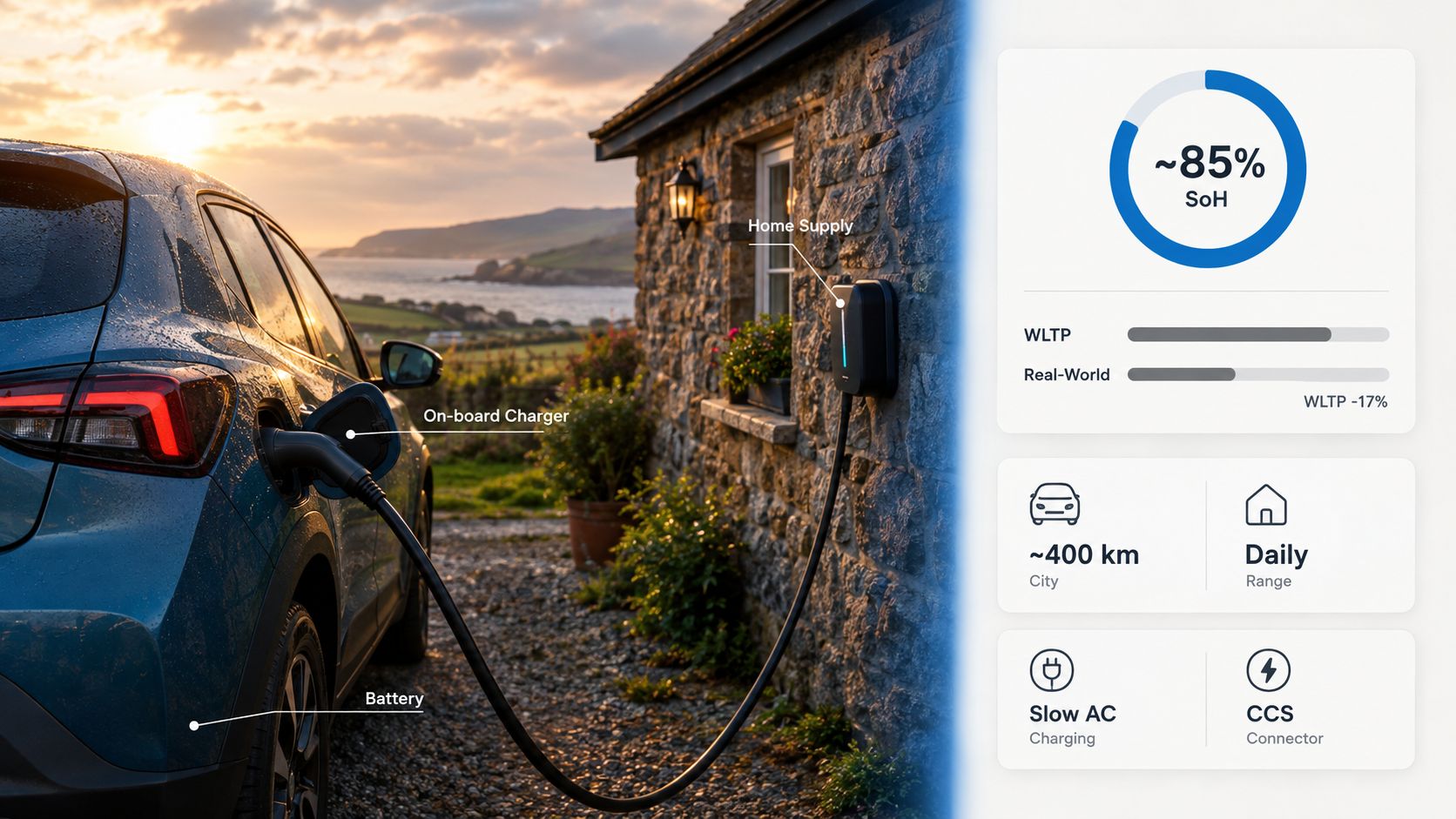
Charging performance has two separate components. AC charging covers home use and destination points, while DC charging supports rapid public top-ups. A small EV with limited DC capability may suit an Irish buyer who charges overnight at home. Conversely, strong rapid charging offers little benefit if public chargers are the only practical option and the car has a low peak rate.
Many small EVs use a 7.4 kW to 11 kW onboard AC charger. The Renault Zoe can accept up to 22 kW AC, but that advantage depends on the charging point and installation supporting the same rate. The onboard figure does not determine every home charging session, particularly where the property supply or charger is slower.
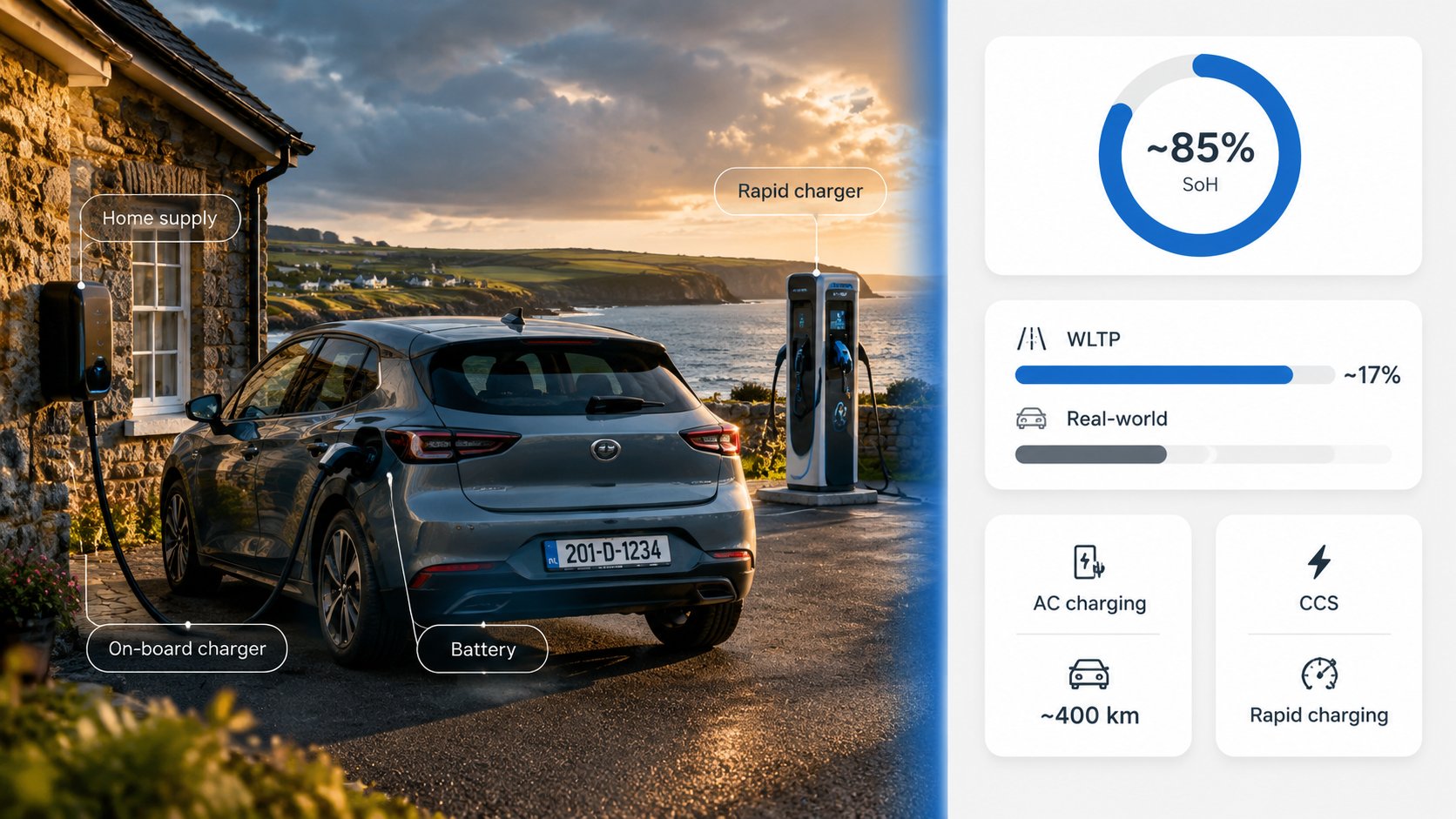
For newer used EVs, CCS is generally the more future-facing DC connector to investigate. Older Nissan Leaf examples use CHAdeMO, so compatibility should be confirmed before choosing a car for regular rapid charging. A 50 kW or faster charger can typically deliver a useful 10-80% top-up in roughly 30 to 40 minutes, though the actual time varies with battery temperature, starting charge and the vehicle's peak rate.
Running-cost analysis should separate the purchase price from ongoing expenses. The SEAI purchase grant does not apply to second-hand cars, although the home-charger grant may remain available to eligible applicants. Motor-tax and scheme rules can change, so buyers should check current SEAI and Revenue guidance before calculating the final cost. Electricity costs also vary by supplier, tariff and charging location. For a used small EV, that calculation should sit alongside State of Health evidence and a WLTP-minus-17% range estimate, not replace them.
Essential Buyer Checklist for ShamAuto Users
A used-EV inspection should produce evidence, not impressions. The listing price is only one part of the decision, and a familiar badge can't replace a battery report.
The exact checklist is:
- Verify SoH: Request a diagnostic screenshot or report showing State of Health, then compare it with the advertised range.
- Test the range logic: Apply WLTP minus 17% and decide whether the result covers the normal commute with sensible reserve.
- Confirm the connector: Check whether the car uses CCS or CHAdeMO and whether that suits the public chargers used locally.
- Check AC and DC rates: Confirm the onboard AC charger and DC peak for the exact trim, not just the model family.
- Inspect tyres: EVs can place different demands on tyres, so tread, condition and replacement history deserve attention.
- Review records: Ask for the complete service and ownership history, including EV-specific inspections.
The ShamAuto SoH inspection guide explains the evidence buyers should seek, while the used-EV buying guide for Ireland provides broader checks for documentation, charging and ownership suitability.
Final Recommendations by Use Case
For a tightly defined urban role, the Dacia Spring offers the most straightforward budget logic, provided its limited range, slow charging and low Euro NCAP safety rating are acceptable. The Peugeot e-208 is the more balanced supermini when the 51 kWh version's range and around 100 kW DC hardware suit the routine.
The Renault Zoe ZE50 makes sense for longer daily mileage and useful AC charging, but battery ownership must be checked. The MG4 is the stronger choice when a buyer needs a compact hatchback with broader ability than a pure city car. The Mini Cooper SE and Honda e suit premium urban style, not drivers seeking maximum intercity flexibility.
The best small electric car in Ireland is therefore an evidence-led decision. SoH, WLTP-minus-17% range, connector compatibility and the actual charging routine matter more than the badge.
ShamAuto is an EV-only used-car marketplace for Ireland, built around structured battery, range and charging information, with listings from private sellers and dealers. Buyers can visit ShamAuto to follow the guides, compare evidence-led EV details and be among the first to browse or list a suitable small electric car.