
Electric Car Ireland: An Honest Reality Check
Contents
Ireland's electric-car market is no longer an experiment. Central Statistics Office reporting says new private electric cars rose by 36%, and EVs reached 19% of new private cars, which is close to 1 in 5. That is the kind of share that changes the market's structure, because it means electric cars are moving from niche interest to mainstream consideration, not just appearing in headline-grabbing bursts. The practical question for buyers is no longer whether EVs exist in Ireland, but which fears still hold up against evidence.
Most of the common objections do not. Battery decline is measurable, range can be compared against real Irish driving, and charging is more ordinary than the public debate often suggests. The issue is not optimism, it is whether the data supports the purchase decision for a specific household, commute, and charging setup.
A sober way to read the Irish EV market is to start with the things that can be verified, not the things sellers like to say. Battery condition is a State of Health (SoH) figure, range should be read as a conservative real-world estimate, and charging access has to be judged against the places where a car will live and travel. That is why the most useful EV discussions in Ireland are not about hype, they're about evidence.
The Honest Picture of Electric Cars in Ireland
The Irish EV conversation still carries a lot of inherited baggage, but the market data points in a different direction. New private electric cars rose by 36% in the latest year cited, and EVs reached 19% of new private cars, which is a meaningful share for any drivetrain category. In plain terms, electric cars are no longer a fringe choice confined to early adopters, they're part of the mainstream buying conversation in the Republic of Ireland.
That shift matters because it changes what a used-EV buyer should expect. A larger new-car base eventually feeds the second-hand market, which usually means more model variety, more buyer familiarity, and more visibility around battery and charging questions.
What that means for used buyers
The useful conclusion is not that every EV suits every driver. It's that the old assumption, that electric ownership is experimental or unusually risky, doesn't match the market any more. Buyers still need to be careful, but the decision is now about evidence on a specific car, not about whether electric cars are "ready" in the abstract.
Practical rule: judge an EV by its battery evidence, range evidence, and charging reality, not by the age of the technology or the loudest opinion in the room.
The other reason this conversation has changed is infrastructure. Ireland has thousands of public charge points nationwide, with ongoing expansion of rapid charging on motorways and major routes. The implication is straightforward, more public charging makes EV use less dependent on a perfect home setup, and more rapid charging on major routes makes long-distance driving less awkward. EAFO Ireland charging infrastructure update
That does not erase trade-offs. It does, however, mean the Irish EV debate should now be about fit, not fear.
Why the Battery Does Not Die Fast
The strongest anti-EV myth is also the easiest one to test. Modern EV batteries degrade about 1.8% per year on average in the Geotab 2024 study, which leaves roughly 82% of original capacity after 10 years, and the decline slows after the first couple of years. That does not describe a battery on the verge of collapse. It describes a component that wears gradually, in a way buyers can plan around. Geotab 2024 battery degradation study summary
SoH is the number that matters
Battery age alone is a blunt tool. Two cars of the same age can have very different battery condition if one has been charged and used gently while another has had a harder life. That's why State of Health (SoH) matters more than seller language like "great battery" or "all good".
A verified SoH percentage turns battery condition into a readable figure instead of a guess. A buyer looking at a 7-year-old EV with documented SoH can compare it with another car on the same basis, rather than trusting vague reassurance. That is the core analytical shift, the battery is not a mystery box if the evidence is there.
A documented SoH reading is more useful than a reassuring sentence in a listing, because it tells the buyer what the battery is actually doing now.
Why evidence beats age and mileage
A car's odometer still matters, but it does not tell the whole story. Battery health, charging habits, and climate exposure all shape usable capacity. A same-age EV without SoH evidence is harder to price and harder to trust, even if the rest of the car looks tidy.
That is the reason battery-first listings are more useful than generic classifieds. On a normal listing, the battery often gets reduced to a few flattering words. On a battery-led listing, the buyer can see the number and decide whether the car still fits the intended use. For anyone comparing used EVs in Ireland, that is the difference between optimism and due diligence.
Why Range Is Not the Problem Irish Buyers Think It Is
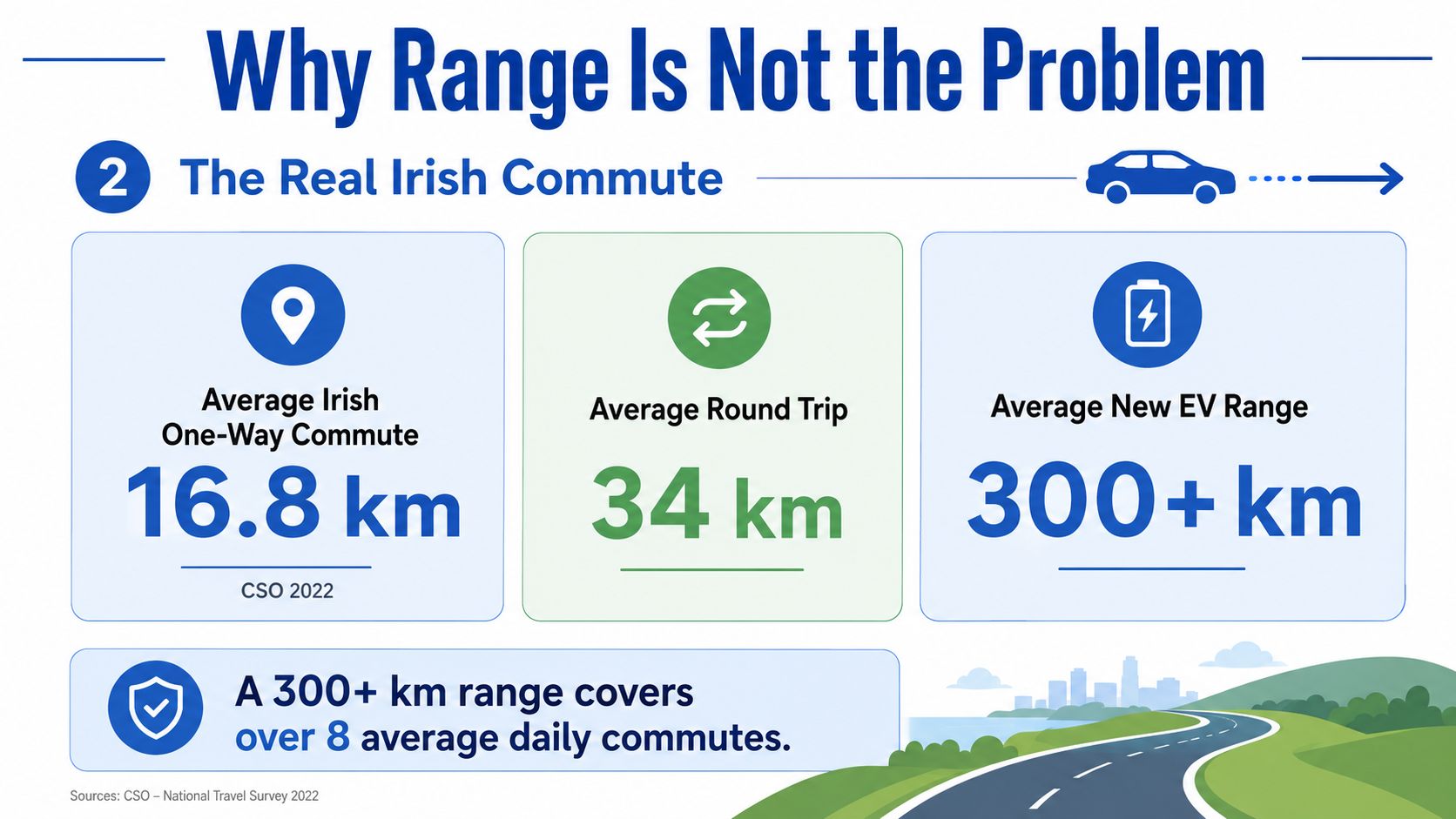
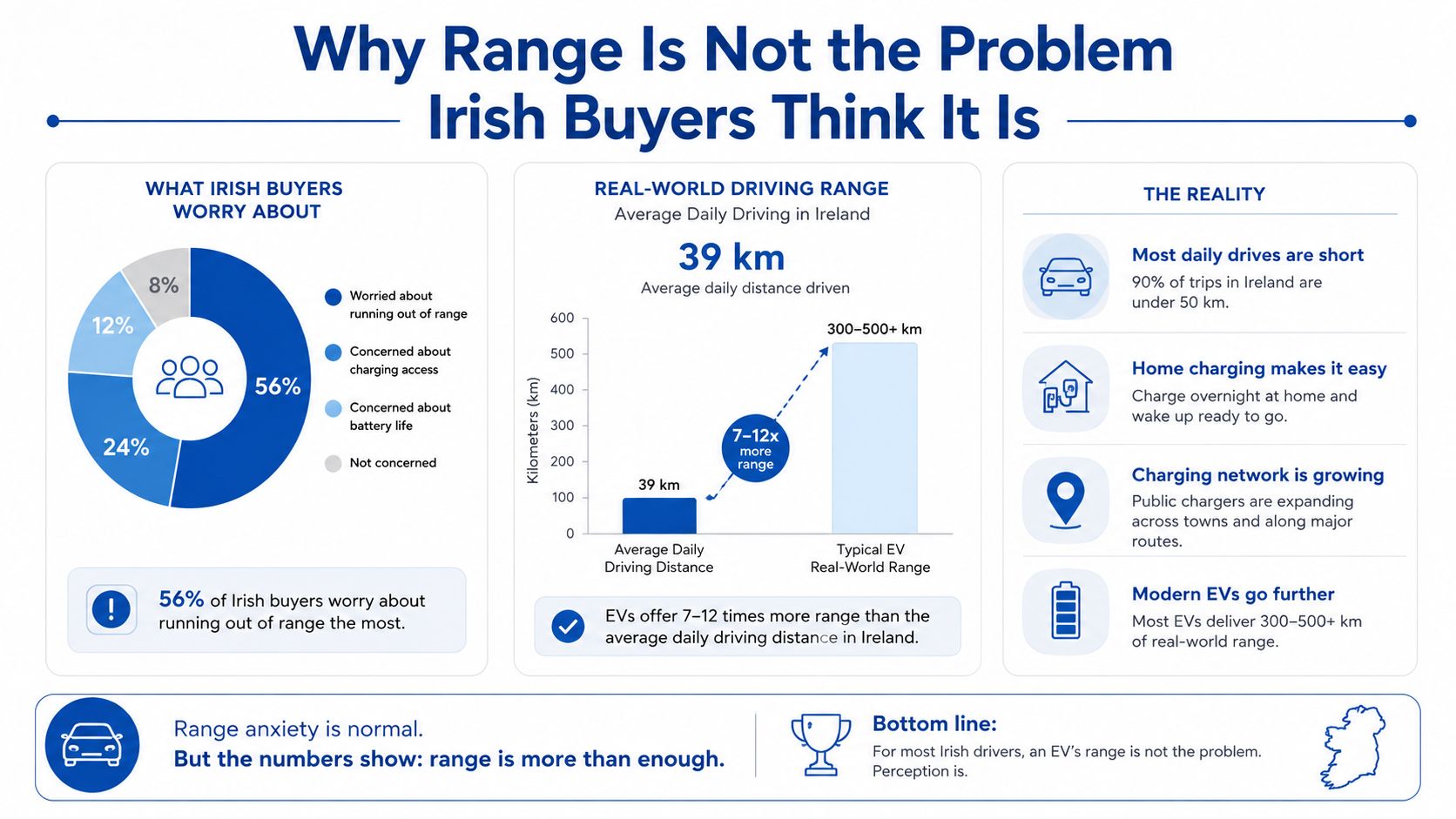
Range anxiety sounds serious until it meets the actual commute data. The CSO Census 2022 puts the average Irish commute at 16.8 km one way, which works out to about 34 km round trip. Even the longer-commuting counties named in the data, Laois at 25.3 km and Roscommon at 24.9 km, are still modest in EV terms, according to CSO Census 2022 commuting figures.
The more useful question is whether a car can cover normal Irish driving without strain. For that, a conservative real-world range estimate is better than the brochure figure. The working rule used here is WLTP minus 17%, so a car advertised at 300 km WLTP should be treated as about 249 km in real-world terms. That is a cautious planning figure, not a promise of perfect conditions. Even on that basis, a car with that kind of usable range still covers a normal Irish commute many times over between charges. Real-world range versus WLTP explained
Daily use is not the same as road-trip use
A lot of range anxiety comes from judging an EV by the annual motorway run instead of the school run or commute. That puts the rare use case ahead of the routine one.
Daily driving in Ireland is usually a short, repeatable pattern. Long-distance travel is occasional. The first is handled by ordinary usable range, the second by the public rapid DC network that is growing across the country. Range should therefore be measured against everyday driving first, then against trip planning.
Long trips are the edge case, not the default
An Irish buyer does not need the largest brochure range on the market to handle a normal week. What matters is whether the car's real-world range comfortably covers the driver's life, then whether a rapid top-up is available when a longer journey comes up. Once range is treated as a use-case question rather than a status question, the concern usually shrinks.
Home Charging as the Everyday Norm
Charging at home is still the most ordinary way to live with an EV in Ireland. For many households, that means a 7.4 kW single-phase charger used overnight, so the car is ready by morning without any daily detour to a public bay. Public charging has a different job. It fills the gaps for long trips, mixed access situations, and drivers without off-street parking.
The practical split matters. Home charging handles routine use, while public and rapid DC chargers handle flexibility. That is why it's a mistake to judge EV ownership only by the public network map. The ordinary use case is a car that sleeps at home and wakes up charged.
Citizens Information confirms that since 1 January 2024, the Home Charger Grant Scheme can provide up to €300 toward installation, and that annual motor tax for a BEV is €120. For current amounts and eligibility, buyers should always check the official SEAI guidance before buying, because schemes can change. Citizens Information EV ownership guidance gov.ie electric vehicle grant scheme
Grants and Running Costs Without the Spin
The first budgeting error in a used-EV purchase is assuming the purchase grant still applies. It does not. The SEAI Electric Vehicle Purchase Grant is for new battery-electric vehicles only, and SEAI says it cannot be claimed on second-hand vehicles. For private M1 cars, the maximum grant is €3,500, and the official eligibility rules are the only source worth checking before a buyer commits. SEAI grant amounts
What used buyers should assume instead
Used-EV pricing should be judged on the car itself, not on a grant that is not available. The upside is that running costs can still make sense, especially where home charging is practical and motor tax is modest. Exact euro figures for charging, tariffs, and tax treatment are better checked on the current official pages, because those values can move.
That means the analysis should stay qualitative unless the buyer is reading the live source directly. Electricity used at home is usually cheaper than burning fuel in a petrol or diesel car, but the actual saving depends on how often the car charges at home versus in public, the driver's mileage, and the specific tariff in use. For live figures, Citizens Information, SEAI, Revenue, and ESB should be checked directly rather than treated as second-hand reference points.
For a used-EV cost lens, the practical question is not whether there is a headline grant. It is whether the buyer has a charging setup that makes the car economical in everyday Irish life. See our breakdown of used EV versus diesel running costs in Ireland, charging a used EV at home in Ireland, and cost to charge a used EV in Ireland for a starting point.
Buying With Evidence Instead of Hope
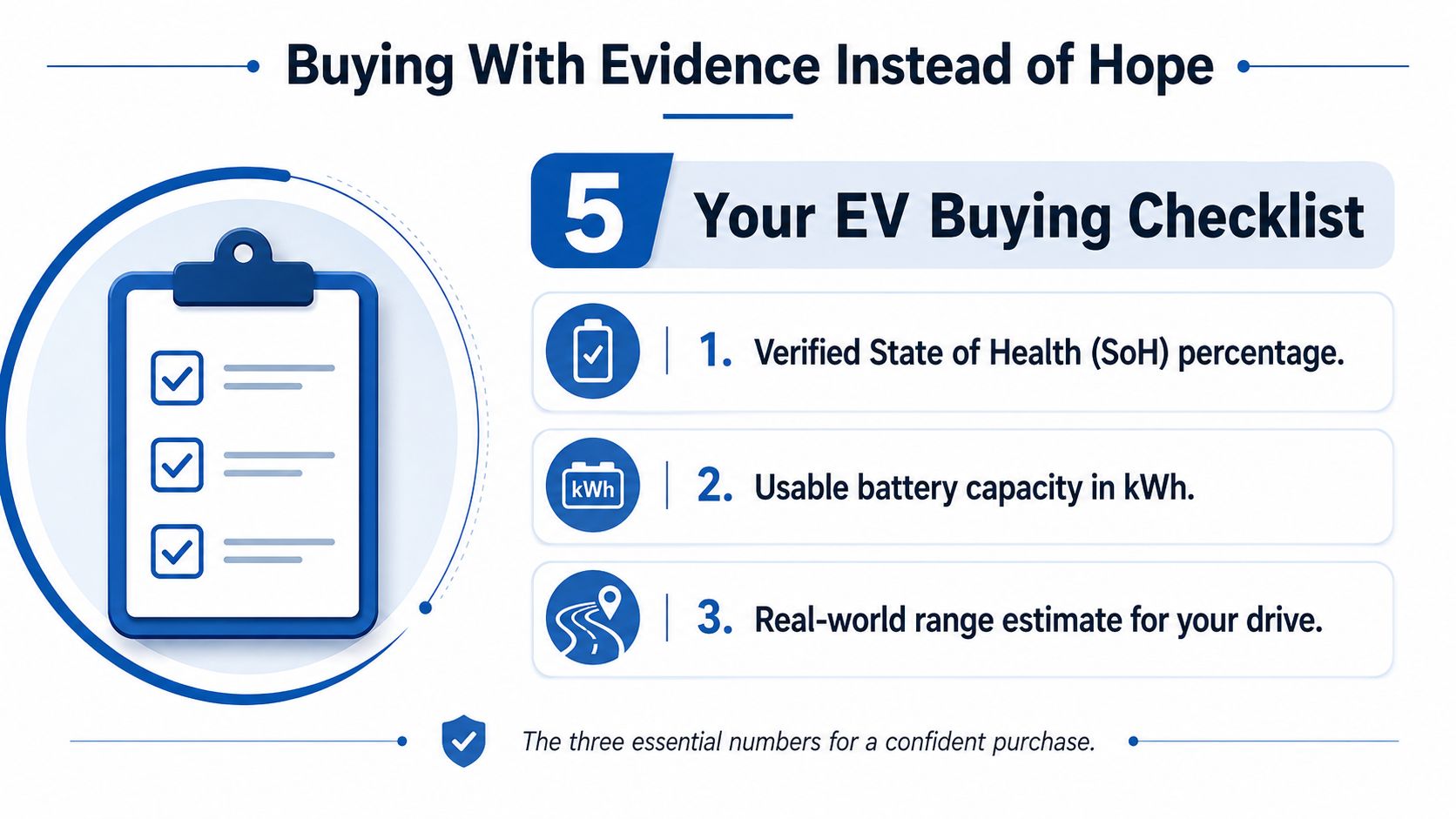
The point of a used-EV listing is not to promise confidence. It is to show enough evidence that the buyer can test the car against the commute, the charger, and the range they need. In practice, that means verified SoH, usable battery capacity in kWh, and real-world range. Those three fields address the main objections Irish buyers raise, battery condition, how far the car will go, and the gap between brochure figures and daily use.
EV-only listings are easier to read for a simple reason. Every EV is automatic, so there is no clutch, gearbox, or manual-transmission issue to factor in. The remaining questions are battery condition, charging compatibility, and whether the car fits the driver's routine.
The evidence that matters most
A cleaner comparison starts with the same three checks in the same order.
Verified State of Health, because battery condition should be shown, not inferred.
Usable battery capacity, because advertised size and usable size are not always the same.
Real-world range, because WLTP is a benchmark, not a guarantee.
That range reminder is the one buyers should keep in mind after reading the earlier explanation. The published WLTP figure is useful only if it is treated conservatively, because everyday use rarely matches the test cycle exactly. The earlier range guide covers the adjustment in more detail, so it does not need to be restated here.
For buyers who want a cleaner comparison set, an EV-only marketplace is more useful than a mixed-fuel classified pile. When the listing standardises SoH, battery size, range, and charging detail, the car is easier to price and easier to judge on its own merits. The same logic applies to other searches too, including used automatic cars for sale in Ireland.
Browse ShamAuto and Check the Evidence First
The right next move is simple. Browse ShamAuto, read the battery evidence on each listing, and use the guides library for deeper checks on battery health, SoH, winter range, home charging, and running costs. If a listing doesn't show the evidence clearly, it's not worth travelling to view yet.
Be among the first to list if you're selling, and be selective if you're buying. The safest used-EV decision in Ireland starts with the same rule every time, verify the battery first, then decide whether the car fits the commute, the charger, and the way it'll be used.
Ready to compare used EVs without the guesswork? Browse ShamAuto and start with listings that show the battery evidence clearly.