
Bmw I3 Ireland
Contents
- Why a Used BMW i3 in Ireland Is a Different Kind of Buy
- The Three Battery Generations and What They Mean for Range
- How to Read a State of Health Report Before You Pay
- Inspection Checklist for the Body, Interior and Drivetrain
- Home Charging and Motorway Stops in Ireland
- Price Bands, Negotiation and the Paperwork Side
- Your Pre-Viewing Checklist and Next Steps
The most important thing to confirm on any used BMW i3 in Ireland is the exact battery generation and its verified State of Health. Real-world range can fall from about 257 km on a healthy 120Ah car to roughly 130 km on an older 60Ah, so guessing is how buyers get burned.
That is the whole used BMW i3 Ireland decision in one line. A clean interior, low mileage, big wheels, nice trim, or a tempting price won't rescue the wrong battery pack. The i3 is still one of the smartest urban EVs on sale second-hand in Ireland, but only when the buyer proves the pack first and pays for the car that suits the daily drive.
Why a Used BMW i3 in Ireland Is a Different Kind of Buy
You drive out in what looks like a tidy, premium city EV. A week later, the range you counted on is gone the first time weather, speed and battery age all matter. That is how used i3 buyers in Ireland get caught.
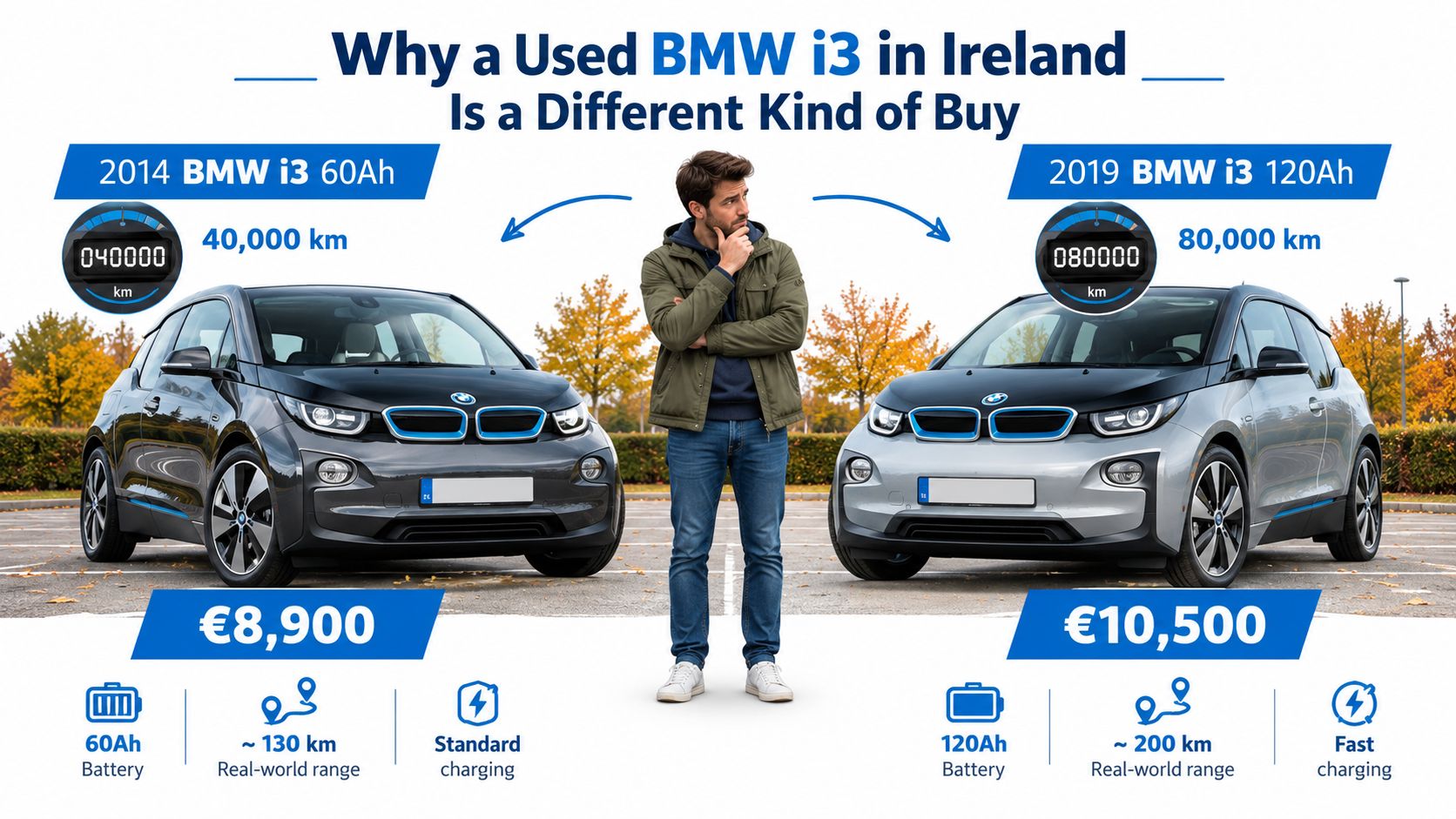
Mileage matters less than battery generation
The i3 is not a normal used hatchback purchase. The smart buy starts with the battery generation, then a verified State of Health report, then the rest of the car.
That order matters because older i3s can look almost identical in photos while offering very different everyday usefulness. The 120Ah car is the benchmark most Irish buyers should judge the market against. Its official WLTP figure was 310 km, which works out to about 257 km using the realistic buffer this guide applies. Older 60Ah and 94Ah cars do not behave like that. Treating them as interchangeable is the mistake.
Practical rule: If the seller cannot prove the battery version and battery condition, stop there.
The Irish used market makes this more awkward, not less. Stock is limited, the styling has aged well, and plenty of listings lean on trim, wheels or low mileage because those are easy to advertise. Battery evidence is what matters.
Similar-looking cars can sit in very different price bands
Price alone will not tell you whether an i3 is the right one. A 120Ah car can command a very different figure from an older battery car even when both look clean and well-kept.
Across the Irish used market, i3s appear at very different prices rather than one neat market rate, because a 120Ah car and an older battery car can look almost identical in photos. That is why buyers should compare battery generation first, not just ask whether one seller is cheaper than another.
A cheap 60Ah car is only cheap if your driving pattern suits it. If you need 120Ah range and buy on appearance instead, you will pay twice. Once at purchase, and again when you try to sell the wrong car.
Why Ireland changes the calculation
The i3 still makes good sense here. It is compact, easy to place on narrow streets, and well suited to town and suburban use. The cabin feels more expensive than many rivals of the same age, and the single-speed setup makes it simple to live with.
Irish home charging setup matters before you buy, though. The i3 can accept 11 kW AC, but many Irish homes will not supply that because the domestic connection is often single-phase, so the real home charging speed is usually lower. That does not make the car a bad choice. It means you should match the car to your actual charging setup, not the best-case brochure figure.
If you want the broader process nailed down before viewing cars, this Irish used car buyer guide is a solid starting point.
The Three Battery Generations and What They Mean for Range
A seller shows you two BMW i3s at the same money. One has lower mileage and nicer trim. The other has the bigger battery. In Ireland, the bigger battery matters more.
The used i3 market only makes sense once you separate the three battery generations. Get that wrong and the rest of the advert barely matters.
Start with the battery, not the badge
Range on a used i3 is decided first by battery generation, then by verified battery condition. Mileage, wheels, and interior spec come after that. A tidy 60Ah car will still behave like a 60Ah car. A healthy 120Ah will still be in a different league.
| BMW i3 Battery Generations: Usable Capacity, WLTP and Real-World Range | ||||
|---|---|---|---|---|
| Generation | Years | Usable kWh | WLTP Range | Real-World (WLTP minus 17%) |
| 60Ah | circa 2014-2016 | about 22 kWh | 180 km | roughly 149 km |
| 94Ah | circa 2016-2018 | about 33 kWh | 270 km | roughly 224 km |
| 120Ah | 2019-2022 | 37.9 kWh usable, 42.2 kWh gross | 310 km | about 257 km |
Those figures are the right starting point, not the seller's story about what it did once on a warm day.
What each version is actually like to live with
The 60Ah is a short-range urban car. It still suits buyers doing local trips, school runs, and town driving with easy home charging. It does not suit anyone buying with hope instead of maths.
The 94Ah is the middle car. It gives you more freedom and can work well if your daily use is modest and predictable, but it still needs honest expectations. A weak 94Ah can feel a lot closer to a healthy 60Ah than buyers expect.
The 120Ah is the one to benchmark for buyers with longer regular use, especially if the routine includes higher-speed roads or a round trip that starts pushing past 120 km. That is why it makes the best worked example here. On paper it has 310 km WLTP. Using a simple haircut of 17 percent, you get a more believable real-world figure of about 257 km.
That gap matters.
Use the 120Ah figure properly
For the 120Ah hatchback, the useful headline is simple: 37.9 kWh usable, 310 km WLTP, and about 257 km in normal use with the WLTP-minus-17-percent rule. It also brings CCS, about 50 kW DC, 11 kW AC, rear-wheel drive, and 4 seats.
That does not mean every 120Ah you see will deliver that in the real world. It means a healthy 120Ah gives you a sensible benchmark before you even start checking battery State of Health.
A seller who says "they all do around the same range" is telling you they have not understood the car, or they hope you have not.
Ask the seller to confirm the battery generation before you travel. Get registration details, trim data, or a charging or diagnostic screen that matches the car. Do not trust badges alone. Parts get swapped, adverts get copied, and battery generation is too important to guess.
Older i3 range claims are often messy because listings mix test standards, vague wording, and optimistic memory. Ignore all of that. Match the car to your real route using battery generation first, then check the actual battery condition. If you want a broader benchmark for how official figures translate into daily use, this EV range comparison guide for Irish buyers is a useful cross-check.
How to Read a State of Health Report Before You Pay
Most used i3 mistakes happen before the viewing. The buyer asks about mileage, service stamps, tyres, and price. The seller talks happily. Nobody asks for the battery report. That is backwards.
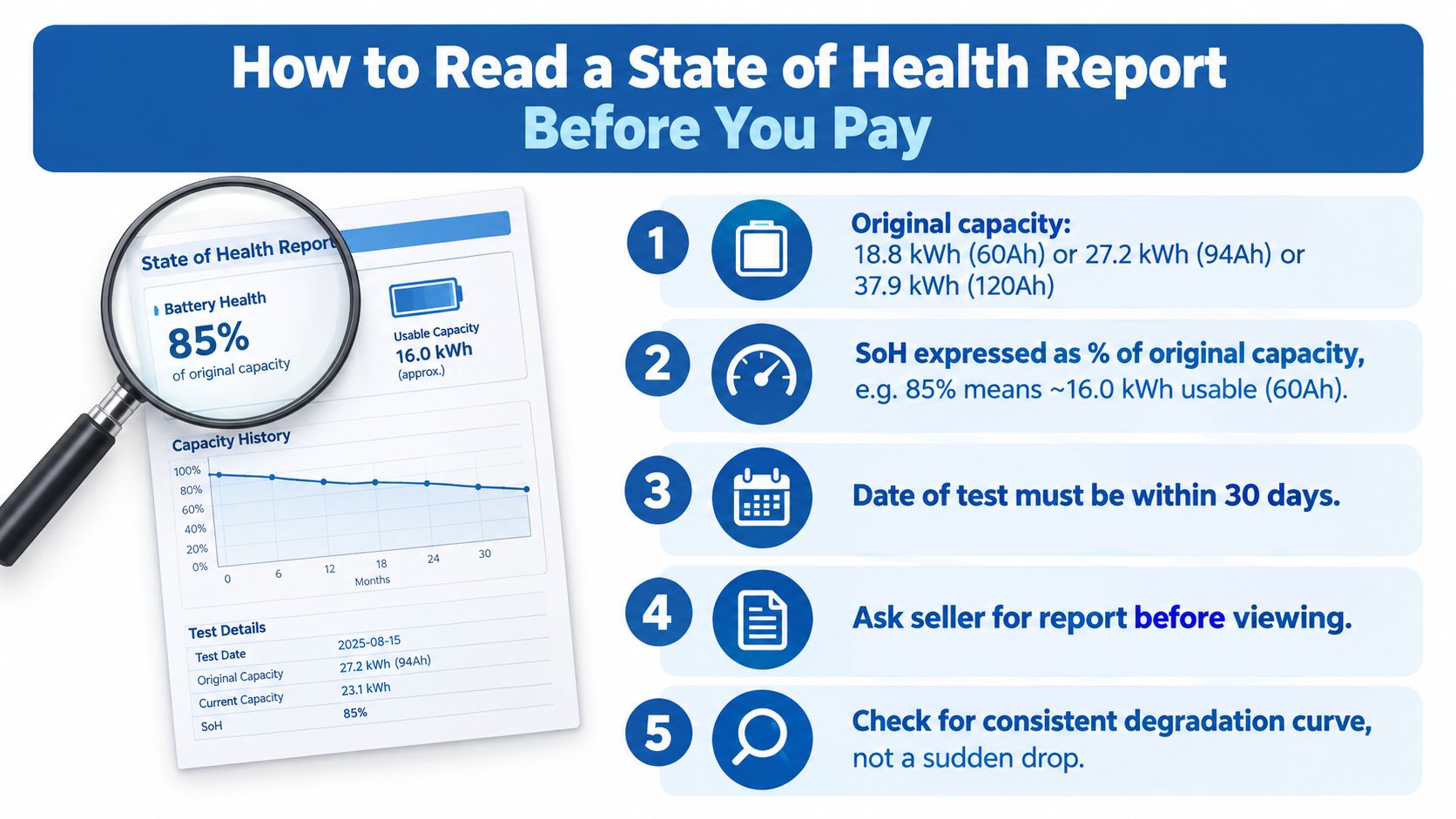
What a credible SoH report should show
A proper State of Health (SoH) report should identify the car, show the test date, and state the battery condition against original usable capacity. On an i3, the exact battery pack matters because the same SoH number means very different usable range on a 60Ah and a 120Ah.
A credible report should include:
- Vehicle identity: Registration or VIN details must match the car being advertised.
- Battery baseline: The report should make clear whether the car is a 60Ah, 94Ah, or 120Ah pack.
- SoH reading: This is the core number. It expresses remaining battery condition against original usable capacity.
- Test date: If the report is stale, it has little value. Recent evidence matters.
- Supporting battery lines: Voltage behaviour, cell balance or similar battery diagnostics matter because they can reveal whether the top-line SoH is hiding a problem.
The strongest listings are the ones that supply the report before the buyer leaves home. On an EV-only marketplace such as ShamAuto, a verified SoH badge means the seller has provided battery evidence per car rather than hiding behind a model-wide assumption.
How to read the report without fooling yourself
The top-line SoH matters, but not in isolation. A decent reading with strange supporting data deserves scrutiny.
Look for these patterns:
SoH and battery generation together
A 120Ah with strong SoH is a very different proposition from an older 60Ah with merely acceptable degradation. The newer pack starts from a far better place.Cell consistency
Big imbalance between cells is a warning sign. The exact acceptable delta depends on the test method, so if the seller can't explain the report source, caution is sensible.Cycle count in context
A higher cycle count paired with healthy SoH can be less worrying than a lower cycle count with weaker battery condition. An EV that has been used properly and charged consistently can age better than one that's been neglected.Date and temperature conditions
Reports should be recent. If the screenshot is old, blurry or obviously cropped, treat it as incomplete evidence.
If the seller won't send a battery report before the viewing, the buyer should move on to the next car.
That sounds blunt because it should. Battery uncertainty is the biggest used EV pricing gap in Ireland.
How to ask for the report
A short message works better than a long one:
"Can the seller send the battery State of Health report, confirm whether it's the 60Ah, 94Ah or 120Ah version, and share a photo of the CCS port and service history screen before a viewing is arranged?"
That single message filters serious sellers from time-wasters quickly.
How to spot a BEV i3 and avoid the REx by mistake
This guide covers the pure-electric i3 BEV only. The i3 REx is different. It carries a small onboard petrol generator and is not a pure battery-electric car.
Use a simple side-by-side check:
| Feature | BMW i3 BEV | BMW i3 REx |
|---|---|---|
| Powertrain | Pure battery electric | Battery plus petrol range extender |
| Rear quarter area | No fuel filler hardware | Fuel filler flap on the nearside rear quarter |
| Under rear bumper | No exhaust outlet | Dual exhaust outlet tucked under the bumper |
| Ownership implication | EV-only fit | Heavier, petrol servicing required |
A buyer who wants a BEV should also check the paperwork. The logbook fuel type and registration details should match an electric-only car. If the seller is vague on that point, stop.
The practical consequences matter. A REx isn't automatically a bad car, but it should be inspected and priced as a more complex vehicle. It isn't the same thing as a clean BEV i3, and it shouldn't be marketed as one.
Inspection Checklist for the Body, Interior and Drivetrain
The i3 has unusual construction and a few familiar weak spots. A calm walkaround catches more than a rushed test drive.
Start with the coach doors
Open and close both rear-hinged doors several times. Misalignment, rubbing, or odd gaps can point to previous crash repair or poor bodywork. On an i3, that matters more than on a plain steel hatch because the design and materials are different.
Then look low. Scrapes on the lower plastic trim are common. The thermoplastic exterior panels don't rust like steel, but cosmetic repair can still be awkward and expensive compared with what many buyers expect.
Move inside before the test drive
The cabin check is where hidden ownership hassle usually appears.
- 12V battery: Ask for the age of the auxiliary battery and inspect the date sticker if accessible. A weak 12V battery can trigger a mess of false faults on an EV.
- Screens and controller: Test the iDrive controller, menus, reversing camera if fitted, and all display functions.
- HVAC and heated seats: Run the heating and air conditioning properly. Weak cooling or odd smells deserve follow-up.
- Boot floor: Lift the floor and look for water staining or dampness.
A tidy cabin doesn't prove a tidy electrical system. Test every function.
Finish underneath the glamour
The i3 often lives an urban life, so the wear pattern tells a story.
Check tyre condition carefully. Uneven wear can hint at alignment or suspension issues. Inspect brake discs too, especially at the front, because light regenerative use can leave them looking rough on cars that rarely do longer drives. During a short drive, listen for knocks from suspension links and bushes over broken surfaces.
This section is where buyers must stay qualitative on costs unless they have a written quote. The right approach is simple: if a seller can't evidence a recent fix for a known wear item, price the uncertainty in or walk away.
Home Charging and Motorway Stops in Ireland
You get home with 20 percent left, plug in overnight, and leave the next morning with a full battery. That is the ownership pattern that suits a used i3 in Ireland.
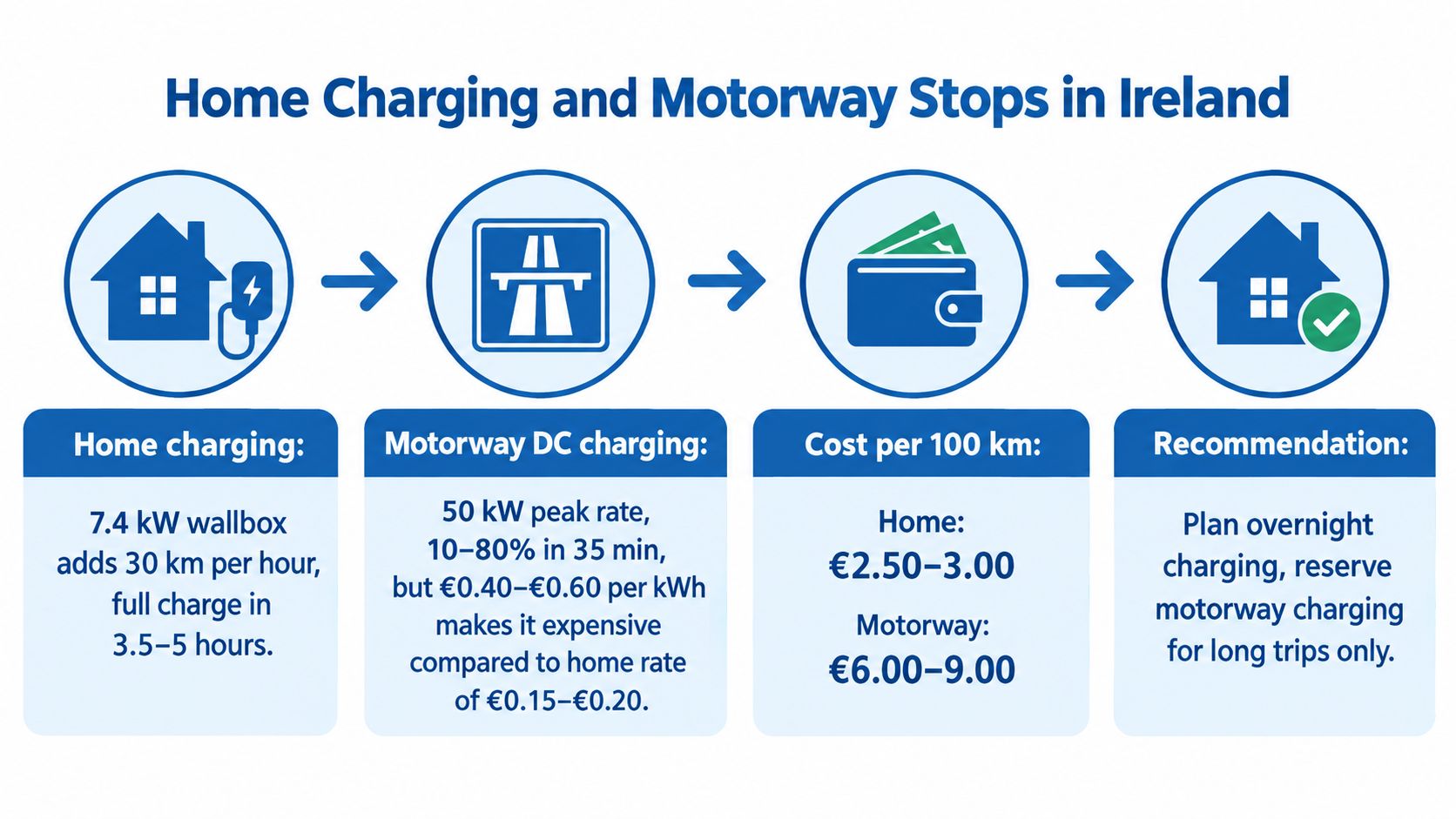
Why home charging suits the i3
Buy the i3 for home charging first. Public rapid charging should be your backup plan for longer days, not the routine.
That matters even more once you separate the battery versions properly. A healthy 120Ah car is the one that gives this section real flexibility. Start from the official WLTP figure, cut 17 percent for a more grounded real-world expectation, and you get a practical range in the low- to mid-200 kilometre bracket depending on version and conditions. That is enough for a lot of Irish commuting with easy overnight recovery at home. Older 60Ah and 94Ah cars behave very differently. They demand more frequent charging stops and punish lazy trip planning.
Your house setup decides whether the i3 feels easy or annoying:
- Single-phase homes: Common in Ireland, and perfectly workable for overnight charging.
- Three-phase access: Useful if available at home or work, but not a reason on its own to choose the car.
- Charging kit: Confirm exactly what comes with the car. Do not assume the cable, granny charger, or any adapter is included.
Check your charging plan before you view the car. If you need a clear rundown of sockets, wallboxes, and Irish tariffs, read this guide to EV charging at home and on the road in Ireland.
Motorway charging needs planning
The i3 uses CCS for DC rapid charging, but used examples here are modest by current standards for motorway top-ups. Fine for occasional stops. Less convincing if your weekly routine involves repeated Dublin to Cork or Galway runs with little margin.
The battery generation changes the experience more than trim does. A 120Ah i3 with verified battery health can handle strategic rapid stops without turning the day into a charging exercise. An older 60Ah car on the same route is a different proposition entirely. Buyers who ignore that distinction usually focus too much on mileage and too little on usable battery.
Use the ESB ecars and Ionity apps before any long trip. Check live status, location, and backups. Then ask yourself one blunt question: if that charger is busy or down, does this battery version still suit your actual route? If the answer is no, walk away from the car, not into an ownership problem.
Price Bands, Negotiation and the Paperwork Side
A buyer pays €17,000 for a tidy i3 with nice wheels and low mileage, then learns it is an older battery car with weak battery evidence and range that does not suit their week. That is how people overpay for i3s in Ireland.
Price the car by battery generation first, then by verified State of Health, then by mileage and condition. Trim comes after that.
Use asking prices carefully
Irish asking prices move around a lot because weak cars and strong cars are often advertised too close together. A 120Ah BEV with battery proof deserves a different conversation from a 60Ah car, even if the odometer gap is smaller than buyers expect.
Used i3 asking prices in Ireland vary widely, and the battery generation is the biggest driver of value. A 120Ah BEV with battery proof sits well above an older 94Ah car, which in turn sits above a 60Ah car, with mileage, condition and equipment adjusting the figure from there. A REx usually carries a small discount against an equivalent BEV because of its extra mechanical complexity. Judge any advertised price against the confirmed pack and the SoH report rather than a headline figure.
Treat those as market bands, not permission to stop checking the car. An overpriced 60Ah can sit beside a fair-value 94Ah. A cheap 120Ah can hide poor paperwork or weak battery evidence. The right question is simple: does this price match the battery version, the SoH report, and the condition in front of you?
A 120Ah car changes the value equation because its usable range is in a different league. Start from the official figure, then knock off 17 percent for a more believable real-world baseline. That puts a 120Ah i3 with its 310 km WLTP rating at about 257 km in mixed use before weather, speed, and heating take their cut. Older 60Ah and 94Ah cars do not behave like that, so do not let a seller price them as if they do.
What moves a seller
Three points shift the deal fastest:
- A current SoH report: This is the big one. If the seller cannot show battery evidence, price the car as a risk.
- Recent spend on wear items: Tyres, brakes, and a fresh 12V battery save you immediate cost and hassle.
- A clean ownership file: Service records, NCT history, import documents, and charging cables all add up.
Be blunt in negotiation. If a seller is asking 120Ah money for a 94Ah car, say so. If the car has no battery report, reduce your offer or leave. Guessing is how buyers get burned.
Grant confusion and paperwork traps
Used EV ads still recycle bad grant information. The SEAI electric vehicle grant page is clear. The purchase grant applies to new battery electric vehicles, not used cars. A used BMW i3 is not grant-eligible under that scheme.
Imported cars need extra scrutiny. Check the registration details, verify the fuel type is recorded correctly, and make sure the VRT history lines up with the car you are viewing. On a REx, confirm the paperwork reflects the correct version of the car rather than a vague EV description.
Do not hand over money until the logbook, seller ID, service records, and battery evidence all match. On an i3, the paperwork is part of the valuation.
Your Pre-Viewing Checklist and Next Steps
A used i3 viewing goes better when the buyer arrives with a fixed checklist and refuses to improvise. That removes emotion from the deal.
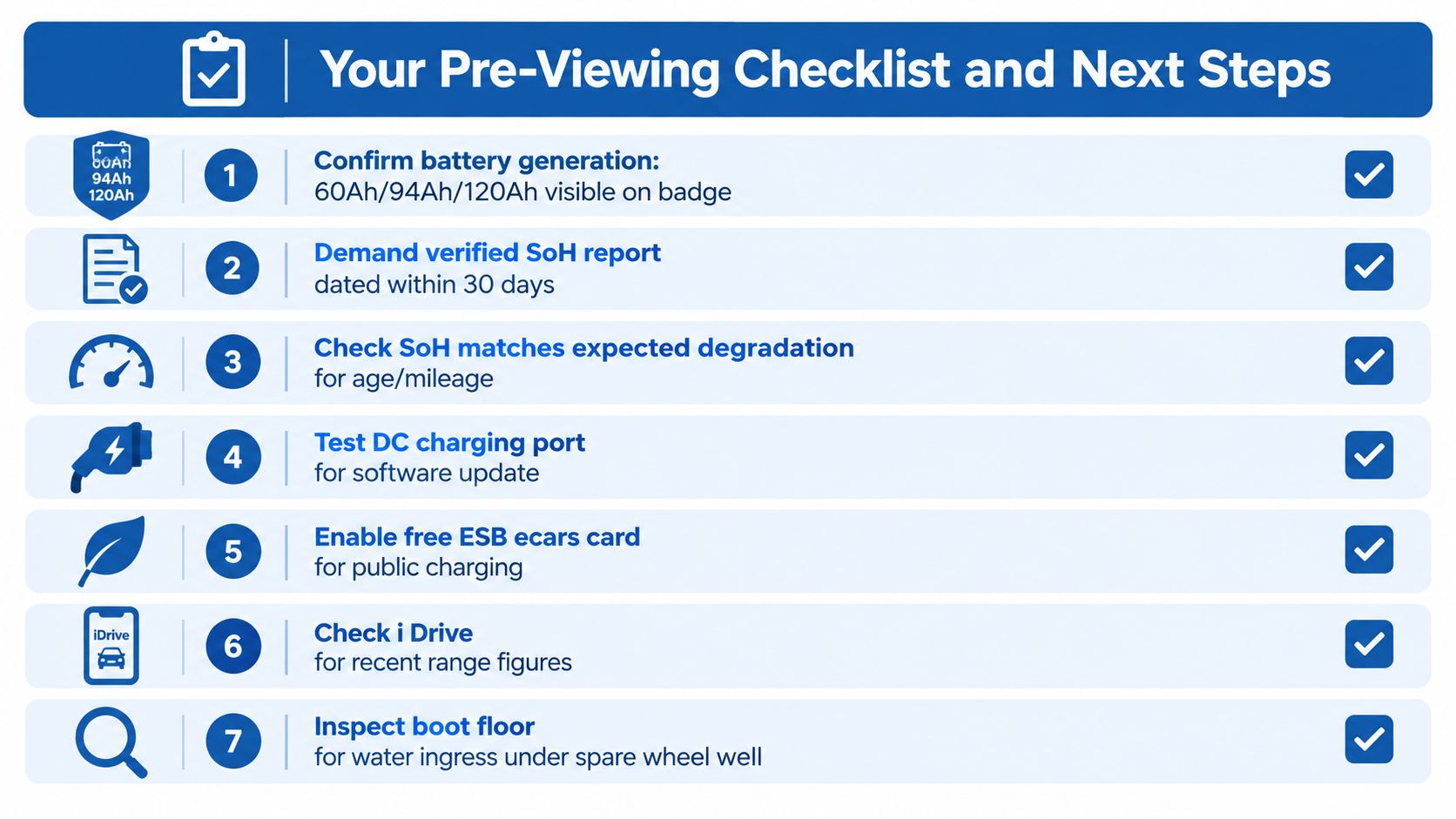
Screenshot this before leaving home
- Confirm the battery version: The seller should state clearly whether the car is 60Ah, 94Ah, or 120Ah.
- Demand the SoH report first: No battery evidence, no journey.
- Check BEV versus REx: Look for petrol filler hardware and exhaust clues.
- Verify charging hardware: Open the charging flap and confirm Type 2 and CCS condition where fitted.
- Run the cabin checks: iDrive, HVAC, heated seats, warning lights, service history screens.
- Inspect the coach doors: Alignment tells a story quickly.
- Look under the boot floor: Water ingress and hidden hardware matter.
The right used i3 is still a clever Irish buy. The wrong one is an avoidable battery gamble.
What to do after paying
As soon as ownership transfers, the new owner should organise charging access, confirm servicing with a BMW-aware workshop, and keep the battery report with the car's documents. That SoH PDF becomes part of the resale file later.
The strongest next move is to keep shopping with evidence-first filters and ignore listings that treat battery condition as an afterthought.
ShamAuto is an EV-only used-car marketplace for Ireland that puts verified battery State of Health and conservative real-world range at the centre of each listing, which is exactly what a used BMW i3 buyer needs. If the next car must be judged on the pack, not the sales pitch, visit ShamAuto and be among the first to list or browse evidence-led EV ads.