
Electric Car Range Comparison: Honest Guide for Ireland
Contents
Brochure numbers make EV range look cleaner than it is. In Ireland, that matters because a car can look generous on paper and still feel short on a wet motorway run, on a cold morning, or after a few years of battery use. A serious electric car range comparison has to start with measured reality, not the optimistic number printed beside the badge.
That is why ShamAuto uses one transparent yardstick across every listing, WLTP minus 17%, so buyers compare cars on the same conservative basis instead of chasing whichever model has the slickest lab figure. That method sits comfortably within the wider evidence that real-world EV range often trails official figures, including BEVDB's June 2026 snapshot showing combined real-world range estimates averaged 19.5% below official WLTP/EPA figures, and 24.6% below WLTP in Europe (BEVDB real-world range report). For Irish buyers, the point is simple, the brochure is a starting point, not the answer.
| Model | WLTP Range | Real-World Range, WLTP -17% |
|---|---|---|
| Hyundai Kona Electric | 484 km WLTP | about 401 km |
| MG4 64 kWh | 450 km WLTP | about 374 km |
| Nissan Leaf e+ 62 kWh | 385 km WLTP | about 320 km |
Why Brochure Range Figures Mislead Irish Buyers
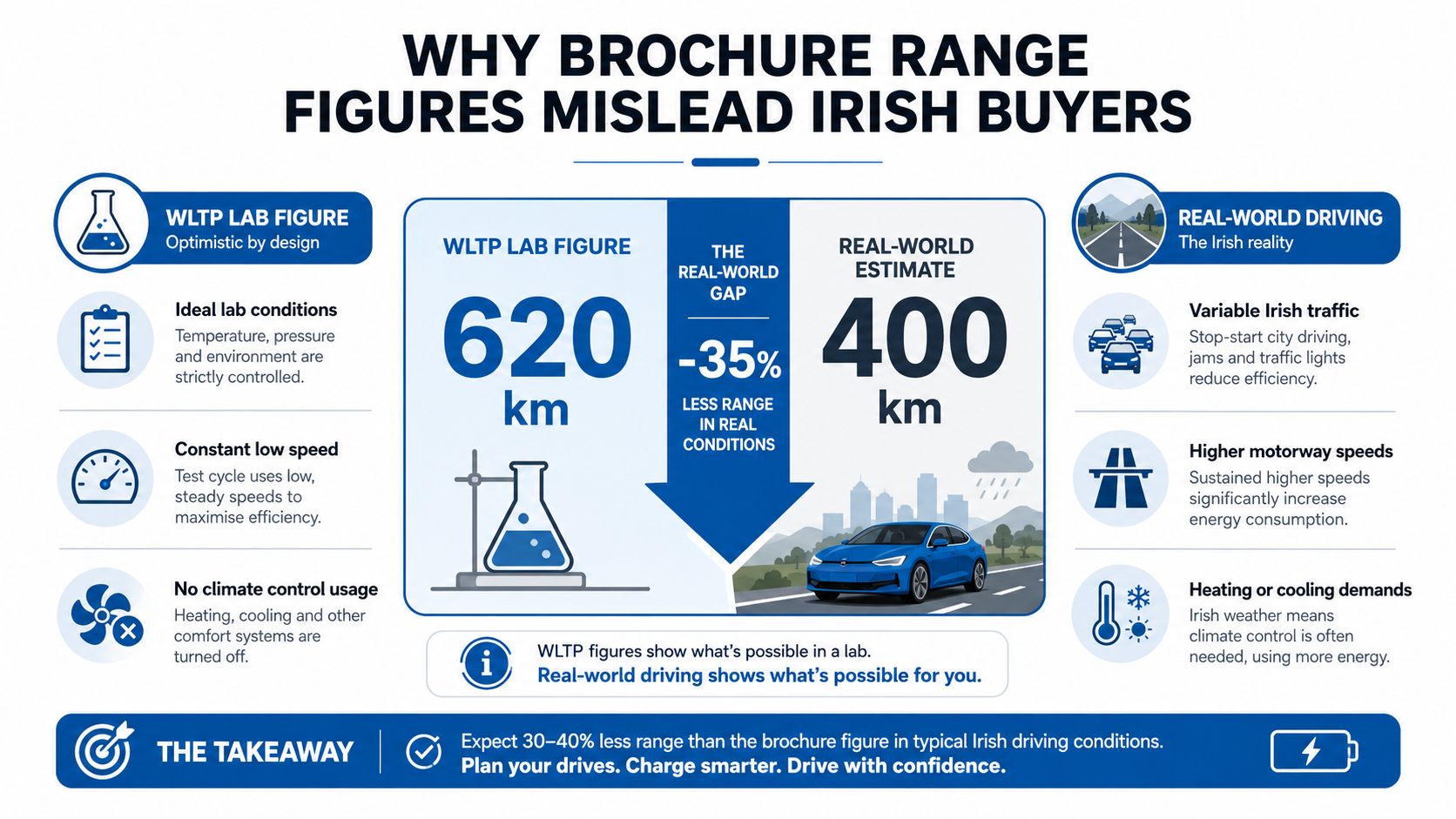
WLTP is useful only when it is treated as a comparison standard, not as a promise. The test happens under controlled conditions, while Irish driving adds traffic, colder weather, speed changes, hills, and heater use that all reduce the distance an EV can cover. In practice, brochure figures usually sit on the optimistic side of the ledger.
A flat adjustment gives buyers a cleaner basis for comparison. ShamAuto uses WLTP minus 17% for every model, so every listing is judged on the same conservative scale rather than on whichever official figure looks most flattering. A car advertised at 400 km WLTP becomes roughly 332 km under that rule, which is a more defensible planning number for Irish use than the lab figure on its own.
Practical rule: compare cars on the same conservative basis first, then refine the shortlist with battery health, charging speed, and your own driving pattern.
That approach matters most when two EVs look similar on paper but behave differently once they meet Irish roads. A buyer comparing a hatchback, a saloon, and a taller SUV should not have to reverse-engineer three different levels of brochure optimism. The value of a standardised range figure is not that it flatters every car equally, it is that it makes the differences easier to see.
What the comparison needs to show
The cleanest comparison uses one adjustment across the board, then lets the buyer judge the result against daily needs. That matters for used cars, where two models with similar WLTP figures can behave differently once age, road speed, and weather are part of the picture. For a broader Ireland-specific overview of EV shopping, see ShamAuto's electric car guide.
Irish buyers do not need a polished lab fantasy. They need a figure that holds up through an ordinary day, and a margin that does not disappear the moment the car leaves the showroom spec sheet behind.
What Actually Determines Real-World Range
Battery size matters, but it does not decide range on its own. Two cars can share the same kWh figure and still differ in how efficiently they move through air, how much mass they carry, how their motors are tuned, and how their body shape affects drag. That is why the smartest electric car range comparison starts with engineering, not badge size.
Efficiency beats battery size more often than buyers expect
The cleanest example in ShamAuto's catalogue is the Hyundai Kona Electric and the MG4 64 kWh. Both use a 64 kWh battery, yet the Kona sits at about 484 km WLTP while the MG4 is about 450 km WLTP, a gap of roughly 34 km WLTP and about 28 km on ShamAuto's real-world basis. The battery is the same size, but the cars are not built the same way.
| Model | Battery (kWh) | WLTP Range | Real-World Range (WLTP -17%) | Key Efficiency Factors |
|---|---|---|---|---|
| Hyundai Kona Electric | 64 | 484 km | about 401 km | More efficient body shape, lower drag, lighter-feeling packaging |
| MG4 64 kWh | 64 | 450 km | about 374 km | Different body form, different aero profile, different packaging priorities |
The key lesson is that range is a systems outcome. A taller body disturbs the air more, extra mass needs more energy to move, and drivetrain tuning changes how efficiently the battery is used at Irish road speeds. That is why a larger battery can sometimes be a blunt instrument, while a better-shaped car goes farther on less energy.
Why body shape and aerodynamics matter so much
The driver usually feels this most clearly on faster roads. A car shaped to cut through the air cleanly tends to hold onto range better once speeds rise, while a boxier vehicle pays a bigger penalty. That's also why WLTP figures can mislead buyers into thinking all long-range EVs belong in the same category when, in practice, their everyday use cases are quite different.
Two cars with the same battery can still live in different range classes, because the battery only stores energy. The body decides how much of that energy gets wasted on the way to the wheels.
ShamAuto's range pages for specific models help keep that comparison orderly, including the Hyundai Kona Electric range guide, the MG4 range guide, and the Nissan Leaf range guide. Use them to compare like with like, then decide whether the shape, size, and charging behaviour suit the journeys that matter.
How Winter Weather and Battery Age Affect Range
Cold weather does two things to an EV. It makes the battery less efficient, and it forces the car to spend energy warming the cabin. General guidance for Irish drivers is that winter can cut real-world range by roughly 10-25%, and short trips suffer most because the heating load is high before the battery and cabin have settled. ShamAuto's winter range guide for Ireland sets out that seasonal reality in plain language.
Seasonal range loss is not the same as battery damage
Winter range loss is temporary and weather-driven. Battery ageing is different, because usable capacity declines slowly over time as the pack goes through charge cycles and sits in service. Independent fleet data from Geotab puts battery degradation at about 1.8% per year, which is useful context for used buyers even though every car will age differently.
That is why odometer mileage on its own is a poor proxy for battery health. A low-mileage car that has spent years sitting hot, charged to poor habits, or used hard can present a worse battery than a higher-mileage car with sensible charging behaviour. The relevant number is State of Health (SoH), not just age or miles.
Why SoH should sit beside range in every listing
Citizens Information explains that EV battery range and charging performance depend on battery condition and use, which is why SoH is the practical way to assess remaining usable capacity. In other words, a used EV needs two checks: what the model should do in actual driving conditions, and what the specific battery can still do today. ShamAuto's battery SoH guide shows how to interpret that figure before money changes hands.
A used EV with decent SoH can outperform a newer-looking car with a tired pack, even if the badges are similar.
That distinction is what makes used-EV shopping tricky and worth doing properly. A range estimate based on the average model is useful for planning, but a verified SoH tells the buyer how much of that average is still available in the actual car on the forecourt. That is the difference between buying a category and buying a specific vehicle.
Matching Range to Your Irish Driving Profile
Irish driving is often shorter, more repetitive, and less varied than the brochure figures imply. For most buyers, the right range target is the one that comfortably covers the ordinary week, with enough margin left for cold mornings, side trips, and imperfect charging habits. A driver who knows the pattern of use can avoid paying for range that will rarely matter.
A Dublin commuter with home charging may get more value from a car that delivers a dependable 300 km in real use than from one advertised at 400 km but carrying a larger battery, slower charging, or a higher asking price. The extra claimed distance only matters if the car needs it.
Start with the journeys that happen every week
The first question is practical, how far does the car need to go on a normal day, not on a once-a-year trip? Daily commuting, school runs, and shopping loops often account for most use, so the focus should be on reliable coverage rather than the biggest number on a spec sheet. A home charger changes the equation again, because overnight top-ups reduce the need to squeeze every journey to the limit.
For buyers planning to install charging at home, ShamAuto's home charger guide is the most relevant companion piece, because the range target only makes sense alongside how easily the car can be recharged between trips.
Separate urban use from motorway use
Motorway driving exposes weak range assumptions quickly. A car that feels generous in town can lose buffer fast once speeds rise and climate control stays on for a longer stretch. The same EV can suit a Dublin commuter, a rural school-run car, and an intercity driver in very different ways.
A Dublin commuter with home charging might prioritise 300 km of real-world range over 400 km if the daily commute is short and the car recharges overnight. A rural driver needs more buffer, because detours, colder starts, and patchier charging access reduce flexibility. A regular intercity user should place more weight on charging speed as well as range, since fast top-ups matter on longer routes.
The useful rule is simple. If the car covers the normal day with winter margin left over, there is little reason to pay extra for a much larger battery. If it cannot, the model is the wrong fit, no matter how good the brochure figure looks.
How to Compare EVs Using Standardised Metrics
Once the range method is fixed, the rest of the comparison gets much easier. The buyer can line up usable battery capacity, standardised real-world range, charging speed, and verified SoH, then judge each car on the same scale. That is far more useful than chasing marketing language about efficiency, premium feel, or urban confidence.
Read the listing for the data that changes the answer
A ShamAuto listing is useful because it keeps the core EV facts in one place, including usable battery in kWh, real-world range, charging details, and verified State of Health where diagnostic proof is provided. That format removes a lot of the guesswork that normally surrounds used EV ads. It also keeps the focus on what the car can do, not what the seller hopes the buyer will infer.
For range comparison, the buyer should pay attention to the relation between battery size and real-world output. Two cars can have similar batteries and wildly different range, while another pair can have different batteries but nearly the same everyday reach because one is more efficient. The right question is not "Which has the biggest battery?", it is "Which car gives the most usable kilometres for the driving it will face?"
Use the standardised figures to narrow the shortlist
That process works best when the shortlist is built from the buyer's own profile. A commuter with home charging, a family doing occasional motorway trips, and a rural driver without easy charger access will not rank the same cars in the same order. The standardised figures let them compare apples to apples before they start arguing about trim levels, badges, or colour.
The difference between a good decision and an expensive one often comes down to whether the buyer compared a few sensible options, or ten optimistic ones. A transparent method avoids that trap by making every listing answer the same questions in the same units.
Making Evidence-Based Range Decisions
Range decisions get better when they stop being emotional. Buyers who trust the same method across every listing can judge whether the car suits the route, the battery condition, and the charging pattern instead of getting distracted by a lab number that looks generous but never lands in daily use. That is the whole point of evidence-based EV shopping.
Use used-EV facts before you use assumptions
Second-hand EVs do not qualify for the SEAI purchase grant, because the scheme is for new battery electric vehicles only. Any used listing that suggests grant eligibility is misleading, and buyers should check the current SEAI rules before making a decision. The same applies to transmission language, because all-electric cars are automatic in practice, with a single-speed drivetrain and no clutch or conventional manual gearbox.
For buyers who want a broader checklist before purchasing, ShamAuto's car buyer guide for Ireland is the right place to start. It sits naturally alongside SoH checks and range comparison, because the strongest purchase decisions combine battery condition, range reality, and ownership fit.
Choose the car that fits the life, not the advertisement
The best EV for an Irish driver is usually not the one with the biggest official number. It is the one with enough real-world range, a battery in healthy condition, and charging behaviour that matches the way the car will be used most days. That is a much smaller target than the brochure world suggests, and a much safer one.
ShamAuto is built around that idea, with standardised EV specs and conservative range framing so buyers can compare used electric cars on evidence rather than hope. If the next step is to shortlist a car that fits the commute, the road trips, and the battery health on the listing, visit ShamAuto and compare the numbers before the test drive.