
Polestar 2 Ireland: The Honest Used Buyer Guide

Contents
- Understanding the Polestar 2 for Irish Roads
- Comparing Trims and Real-World Range Estimates
- Evaluating Battery Health and Charging Speeds
- Navigating Used Prices and Market Availability
- Calculating Ownership Costs and Government Incentives
- Inspecting Listings and Securing Your Car on ShamAuto
- Making Your Final Decision
You're looking at a used Polestar 2 in Ireland, comparing a low-mileage example with a newer car and wondering which one represents value. The answer isn't found in the paintwork or the headline WLTP figure alone. For a second-hand EV, the decisive evidence is battery State of Health (SoH), realistic range, charging capability and the exact motor and battery version.
The Polestar 2 remains a compelling premium electric hatchback for Irish driving, but buyers need to separate catalogue claims from daily use. The practical benchmark used here is WLTP minus 17%, giving a cautious estimate for Irish roads, motorway speeds, weather and heating demands. Every Polestar 2 is also an automatic, with a single-speed drivetrain and no clutch or conventional multi-speed gearbox.
Understanding the Polestar 2 for Irish Roads
A used Polestar 2 can make sense for a driver moving from a premium petrol or diesel car who wants quieter travel without giving up a substantial cabin, strong road manners or long-distance ability. Polestar launched the 2 in Ireland in 2022 as a premium electric entry point for the brand, sold directly rather than as an obscure import. Current model details are on Polestar Ireland's Polestar 2 page.
The used-buying question is different from the new-car question. A prospective buyer isn't mainly assessing whether the Polestar 2 is attractive or whether electric driving suits Irish roads. The buyer is deciding whether a particular battery, motor and charging system still deliver the expected ownership experience.
The drivetrain is simpler, not risk-free
The automatic transmission is one of the easier parts of the ownership equation. A Polestar 2 uses a single-speed electric drivetrain, so there's no clutch to wear out and no conventional gearbox with multiple ratios to service. That doesn't mean every used example is trouble-free, but it removes several familiar mechanical concerns from a combustion-car inspection.
The high-voltage battery deserves more attention than a superficial mileage comparison. Two cars with similar odometer readings can deserve different prices if one has clear diagnostic evidence and the other only has a seller's description saying the battery is healthy.
Practical rule: Mileage helps explain a car's history, but verified SoH tells the buyer more about the battery's remaining capacity.
A proper inspection should still cover tyres, brakes, suspension, bodywork, charging cables, software operation and accident repairs. Yet those checks should sit alongside a battery report, not replace it. A clean interior and low mileage cannot prove how much usable capacity remains in the traction battery.
Why Irish conditions change the calculation
Irish ownership often combines urban traffic, regional roads, motorway journeys and exposed rural routes. Cold weather, rain, headwinds, high speeds, passengers and cabin heating can all reduce the distance achieved between charges compared with a laboratory result.
That's why a buyer searching for a Polestar 2 in Ireland should treat range as a planning tool, not a promise. A conservative estimate makes it easier to choose a suitable battery and avoids paying for a specification that isn't needed, or discovering too late that a shorter-range version leaves too little buffer on regular motorway trips.
Comparing Trims and Real-World Range Estimates
The Polestar 2 range is easier to understand when the three main versions are compared on the same basis. The figures below use the catalogue specifications supplied for the Fastback range from 2021 to 2025, with the real-world estimate calculated as WLTP minus 17%.
| Trim Level | Usable Battery | WLTP Range | Real-World Estimate |
|---|---|---|---|
| Standard Range Single Motor | 64 kWh | 478 km | About 397 km |
| Long Range Single Motor | 75 kWh | 540 km | About 448 km |
| Long Range Dual Motor | 75 kWh | 480 km | About 398 km |
The Standard Range Single Motor is the straightforward efficiency-led option. It has front-wheel drive, CCS charging, up to about 130 kW DC charging and an 11 kW AC onboard charger. Its Irish RRP was circa €49,000 new. With an estimated real-world range of about 397 km, it can suit daily commuting, family use and regular charging at home, provided the driver doesn't routinely make long motorway journeys without a charging stop.
The Long Range Single Motor adds the larger usable battery and reaches a WLTP range of 540 km, or about 448 km using the WLTP minus 17% approach. It supports up to about 150 kW DC charging and retains the 11 kW AC charger. Its Irish RRP was circa €55,000 new. For drivers covering longer distances, this version offers more buffer without the additional driven motor of the dual-motor car.
The Long Range Dual Motor also uses a 75 kWh usable battery but has all-wheel drive, up to about 150 kW DC charging and an official WLTP range of 480 km. Applying the same adjustment gives an estimate of about 398 km. The lower range compared with the single-motor long-range car reflects the additional drivetrain hardware and its energy demands. Its Irish RRP was circa €58,000 new.
The model-year detail matters
The MY24 update changed the single-motor Polestar 2 from front-wheel drive to rear-wheel drive and improved aspects of range and charging. Buyers shouldn't assume that two cars with the same badge have identical hardware. The listing and vehicle documents should confirm the model year, motor arrangement and battery pack.
For a fuller explanation of how laboratory figures translate into driving expectations, the electric car range comparison guide provides useful context. The important buying decision isn't choosing the highest WLTP number. It's matching usable battery capacity, driven wheels and estimated real-world range to the driver's regular routes.
Evaluating Battery Health and Charging Speeds
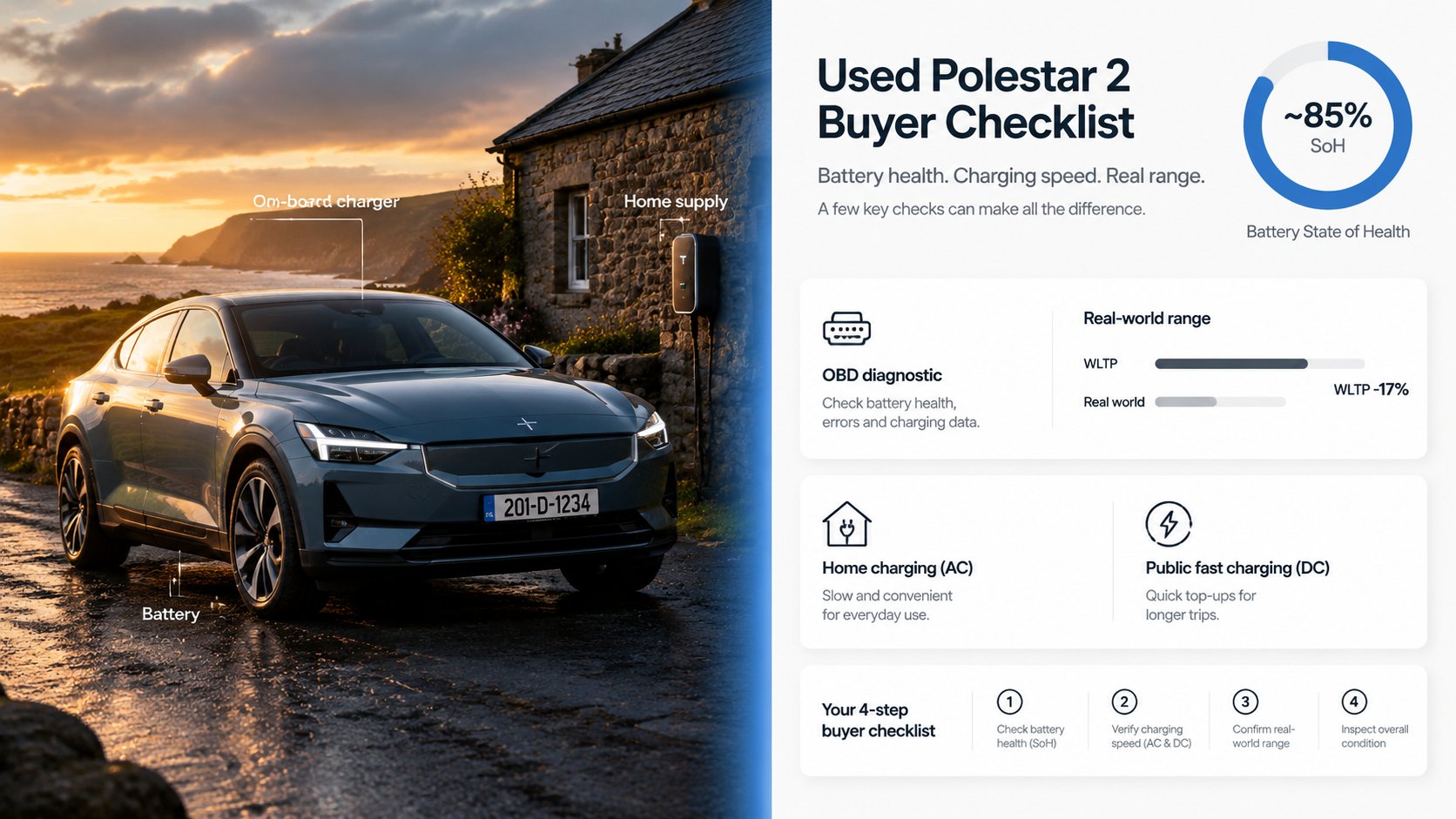
State of Health, or SoH, is the key battery condition metric for a used Polestar 2. It describes the battery's remaining capacity relative to its original usable capacity. A verified SoH reading is more informative than mileage alone because battery ageing depends on factors such as time, charging history, temperature exposure and how the vehicle was used.
A seller may provide a dashboard range estimate, but that figure changes with recent driving conditions and isn't a substitute for diagnostic evidence. An OBD-based report or other credible battery diagnostic record can show whether the individual car supports the range expected from its battery version.
Charging at home and on the motorway
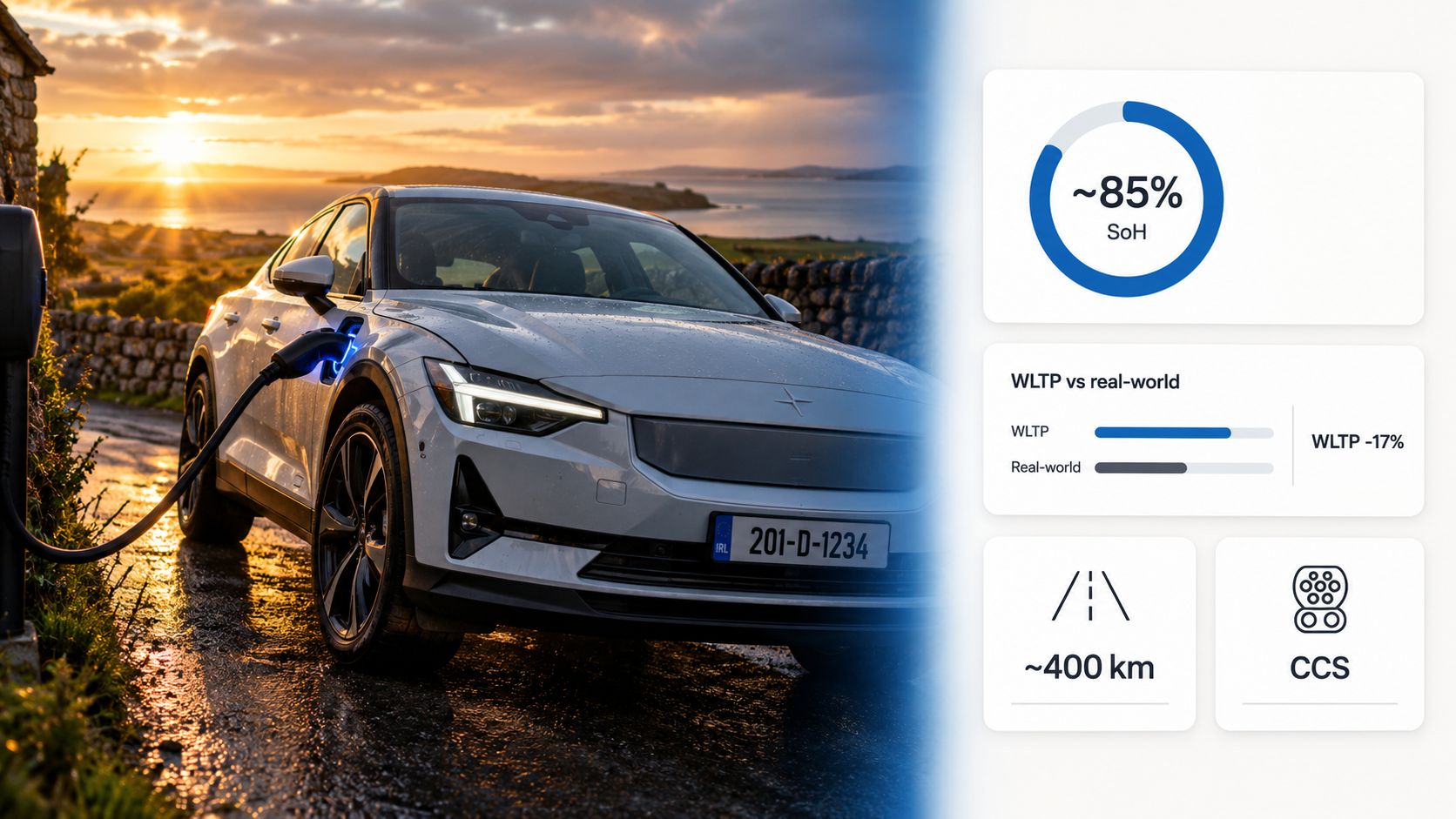
Polestar Ireland's current specifications list the newer Standard Range version at up to 180 kW DC, with 10-80% charging in 26 minutes. Long Range versions are listed at up to 205 kW DC, with 10-80% charging in 28 minutes, according to the Polestar 2 specifications for Ireland. These figures apply to the relevant newer Irish-market versions, so a used buyer should confirm the exact car rather than apply them to every model year.
The catalogue versions covered in this guide use an 11 kW AC onboard charger. That suits overnight or workplace charging more than repeated rapid turnarounds. A suitable three-phase supply can make full replenishment practical over a night, while a lower-power domestic connection will take longer.
The car uses CCS for DC rapid charging. Buyers unfamiliar with the different public charging connectors can use the EV charging connector types guide before inspecting a vehicle.
What a buyer should verify
A charging test doesn't need to be theatrical. The buyer should confirm that the car starts AC charging, accepts the expected power for the available supply and initiates DC charging correctly. A single session may not prove the entire charging curve, but it can reveal faults with the port, cable communication or onboard charging system.
A low odometer reading is reassuring only after the battery evidence has been checked.
The strongest listing combines the exact battery and motor specification with a verified SoH badge, charging details and a realistic range estimate. Without those details, the asking price is difficult to judge fairly.
Navigating Used Prices and Market Availability
Used Polestar 2 pricing in Ireland varies widely by model year, mileage, motor, battery version, equipment and whether the car is dealer or private stock. For context, the new Irish RRP ran from circa €49,000 for the Standard Range Single Motor to circa €58,000 for the Long Range Dual Motor, and a used example will generally sit below the equivalent new price. Treat any advertised figure as an asking price, not a guaranteed transaction value, and judge it against the specification and battery evidence behind it.
A cheaper car isn't automatically a bargain. It may be an earlier Standard Range model, a higher-mileage example, a car without verified SoH evidence or a version whose range doesn't suit the buyer's routine. Conversely, a higher-priced car may justify part of its premium through a newer battery system, improved charging capability, rear-wheel drive on a MY24 single-motor version or stronger documentation.
Read the specification before the price
The Polestar 2 had entered the Irish market in 2022, but the used market now includes different technical phases. A buyer comparing an early car with a newer update shouldn't treat the model name as the complete specification. Model year, battery size and drivetrain need to appear clearly in the advert and be checked against the vehicle identification details.
Used availability also depends more on those attributes than on location. A buyer in one county may find a suitable car elsewhere, while a nearby example may be the wrong battery or lack battery evidence. The sensible approach is to judge each Polestar 2 on its own documentation, condition and charging suitability.
What creates genuine value
A sound comparison should include:
- Battery evidence: A verified SoH report is more useful than an unsupported statement that the battery is "perfect".
- Range fit: The WLTP minus 17% estimate should cover normal routes with a sensible reserve.
- Hardware differences: MY24 rear-wheel-drive single-motor cars and newer charging specifications should be identified rather than assumed.
- Ownership history: Service records, charging equipment, accident information and tyre condition can affect cost after purchase.
The forecourt price is only the starting point. A car that needs immediate tyres, lacks a usable charging cable or has uncertain battery condition may be more expensive in practice than a better-documented example with a higher asking price.
Calculating Ownership Costs and Government Incentives
The most common budgeting error is carrying a new-car incentive into a used-car purchase. Second-hand EVs do not qualify for the SEAI electric vehicle purchase grant. The SEAI grant rules state that the purchase grant applies to new vehicles only, so a used Polestar 2 buyer should calculate the purchase on the advertised price without assuming that a grant will be deducted.
Government schemes can change, so buyers should check the live SEAI guidance and the relevant Revenue information before committing to a purchase. The eligibility position may differ between buying a new vehicle, importing a vehicle and purchasing an already registered used car, and a seller's old advert may not reflect current rules.
Separate the purchase price from running costs
A practical ownership budget should include:
- Purchase cost: The car price, finance interest where applicable, transfer expenses and any inspection fee.
- Charging setup: Home charging equipment, installation and the driver's chosen electricity arrangement.
- Routine upkeep: Tyres, brakes, suspension, wipers, cabin filters and scheduled servicing.
- Public charging: Motorway and destination charging can carry different tariffs, so frequent public charging needs its own allowance.
- Insurance and tax: Quotes depend on the individual driver and vehicle, while tax and relief rules should be checked through current official sources.
An EV's simpler drivetrain can reduce some maintenance requirements compared with a combustion vehicle, because there's no engine oil, clutch or multi-speed gearbox. It doesn't remove wear items, software issues or the need to inspect the high-voltage system.
The electric car tax guide for Ireland can help organise the questions around VRT, motor tax and incentives. It shouldn't replace a current check of official government pages, particularly where scheme conditions or thresholds are scheduled to change.
Budgeting rule: Treat every grant as unavailable until the official eligibility rules confirm otherwise for the exact transaction.
That approach prevents an attractive advert from distorting the finance calculation. The reliable savings case for a used Polestar 2 comes from the driver's actual energy and maintenance pattern, not from a grant that belongs to a new-car purchase.
Inspecting Listings and Securing Your Car on ShamAuto
A Polestar 2 listing should answer the technical questions before a buyer arranges a viewing. The first screen should identify the model year, trim, usable battery, motor layout, charging connector and stated range estimate. A vague title such as "Polestar 2 long range" isn't enough because the single-motor and dual-motor versions have different driven wheels and range characteristics.
The next check is battery evidence. ShamAuto is an EV-only used-car marketplace that can display a verified State-of-Health badge on an individual listing when diagnostic screenshots are provided. That doesn't create an average SoH figure for the model, and it shouldn't be treated as a substitute for examining the actual report. It gives the buyer a clear signal to distinguish documented battery condition from an unsupported seller claim.
A useful inspection sequence
Start with the advert, then move to the car:
- Match the advertised version to the vehicle: Confirm model year, motor, battery and driven wheels from the car's documents.
- Read the SoH evidence: Check that the diagnostic record relates to the individual vehicle and is recent enough to support the seller's description.
- Compare the range sensibly: Use the WLTP minus 17% estimate as the planning baseline, then allow extra margin for motorway speed, cold weather, passengers and heating.
- Inspect charging operation: Test the CCS port and AC charging where possible, and ask whether the car has experienced repeated charging faults.
- Review ordinary used-car condition: Check tyres, brakes, suspension, bodywork, glass, interior wear, cameras and driver-assistance systems.
A low-mileage car with no battery report should not automatically outrank a higher-mileage car with clear SoH evidence and complete ownership records. Buyers should also ask whether the seller has the original charging cable, whether the car has been imported, and whether outstanding finance or accident repairs have been resolved.
The platform's value is the standardised EV information, not a promise that every car is identical. Buyers still need to inspect the vehicle, verify documents and agree terms carefully. Sellers, meanwhile, can be among the first to list a Polestar 2 with the battery and charging information that serious EV buyers need.
Making Your Final Decision
The right Polestar 2 for an Irish buyer is the one whose evidence matches the job. The Standard Range Single Motor offers a practical entry point, the Long Range Single Motor provides the strongest range buffer in this catalogue comparison, and the Long Range Dual Motor prioritises all-wheel drive and performance while returning a lower WLTP figure than the long-range single-motor version.
The decision should follow a simple order:
- Battery first: Require a verified SoH report for the individual car.
- Range second: Use WLTP minus 17%, not the laboratory figure alone, and allow for Irish motorway and winter conditions.
- Specification third: Confirm model year, motor, battery and charging hardware, especially around the MY24 single-motor change.
- Cost last: Add insurance, charging, tyres, maintenance and any immediate repairs to the purchase price, with no used-car SEAI grant assumed.
A fresh valet, low mileage or attractive finance illustration can't answer the battery question. A transparent listing can. Buyers who insist on diagnostic proof and realistic range are more likely to choose a Polestar 2 that fits their actual driving rather than the version that looks most impressive on paper.
ShamAuto gives Irish EV buyers a focused place to compare used electric cars using battery evidence, EV-native specifications and a conservative range metric. Visit ShamAuto to explore the guides, assess Polestar 2 listings as they appear, or be among the first sellers to list a car with verified SoH information.