
EV Charging Connector Types Explained for Irish Used Buyers
Contents
- Why the Plug Matters When You Buy a Used EV
- Type 2 AC and the On-Board Charger
- CCS2 and the DC Rapid Network
- CHAdeMO, Type 1 and Other Connectors You May Still See
- What the Connector Really Says About Charging Speed
- Adapters, Granny Cables and Workarounds
- What to Check on a Used-EV Listing in Ireland
- Bringing It Together for the Irish Used-EV Buyer
You can stand at a forecourt in Ireland, see two EVs that look similar, and still end up with two very different charging lives. One might plug neatly into the chargers you already know. The other might work at home but leave you hunting for the right rapid charger on a long trip. That's why ev charging connector types matter so much on the used market, alongside State of Health (SoH) and realistic range.
The plug on the car is not a small detail. It decides what works at home, what works in public, and which motorway stops are even worth planning around. For Irish buyers, the key is simple, understand the connector before the sale is done, because it is fixed at manufacture and it shapes every charging decision after purchase. A useful starting point is ShamAuto's guide to choosing an electric car for sale in Ireland.
Why the Plug Matters When You Buy a Used EV
A used EV buyer usually starts with the badge, the price, and the mileage. The charging plug should be part of that first check as well, because it tells you what the car can realistically do after it leaves the forecourt. For an Irish buyer, the question is not just whether the car is electric, but whether its connector matches the chargers you are likely to use at home, in town, and on longer trips.
The three plug families buyers meet most often
On the Irish used market, the connector is part of the car's identity. It is fixed at manufacture, so it is not something you can change by swapping a cable at the last minute. A car built around Type 2/CCS2 is set up for the European charging pattern, while older or imported models may follow a different setup.
That matters because charging is not just about finding any socket. It is about finding the right socket, the right cable, and the right kind of charge for the job at hand. A buyer who checks connector type early can avoid the common shock of discovering a car that suits daily commuting but does not line up with the motorway chargers they expected to use.
Practical rule: If the connector does not fit the charger you plan to use, the rest of the spec sheet will not solve the problem.
A first-time buyer can save time by treating the plug as a core spec, the same way they would treat range or battery health. The Irish EV buying guide from ShamAuto is a useful reminder that the listing should answer practical charging questions before you commit. The badge on the boot tells only part of the story.
Type 2 AC and the On-Board Charger
Type 2 is the everyday AC plug for modern EVs sold in Europe, and that is why it shows up so often on Irish listings. It is the connector most buyers will use for overnight home charging, daytime top-ups, and workplace charging. In other words, it is the plug that handles most of normal ownership.
What Type 2 actually does in daily life
Type 2 is the socket shape, but the car's on-board charger decides how quickly AC power is turned into usable battery energy. That is why two cars with the same Type 2 inlet can behave differently when plugged into the same wallbox. A buyer should read the car's AC limit as part of the car's spec, not the charger's spec.
For a typical Irish homeowner, that often means an evening plug-in and a full battery by morning. That is the main reason 7.4 kW works well for many daily driving patterns, because the car is parked for hours anyway. If a driver has access to 11 kW or 22 kW AC charging at home or work, the advantage is not that the plug changes, it is that the car's own charger can accept more power when the supply allows it.
Practical rule: AC speed is set by the car's on-board charger, not by the wallbox on the wall.
One extra point matters for buyers comparing used EVs for the first time. Every EV is automatic, with a single-speed drive and no clutch or gearbox to think about in the way a manual petrol or diesel car would demand. That makes the charging specification even more important, because the drivetrain itself is usually less variable than the charging hardware.
For a plain-English view of home charging in Ireland, ShamAuto's home charging guide is the natural companion read. A Type 2 EV with the right AC limit is usually the most straightforward choice for day-to-day ownership.
CCS2 and the DC Rapid Network
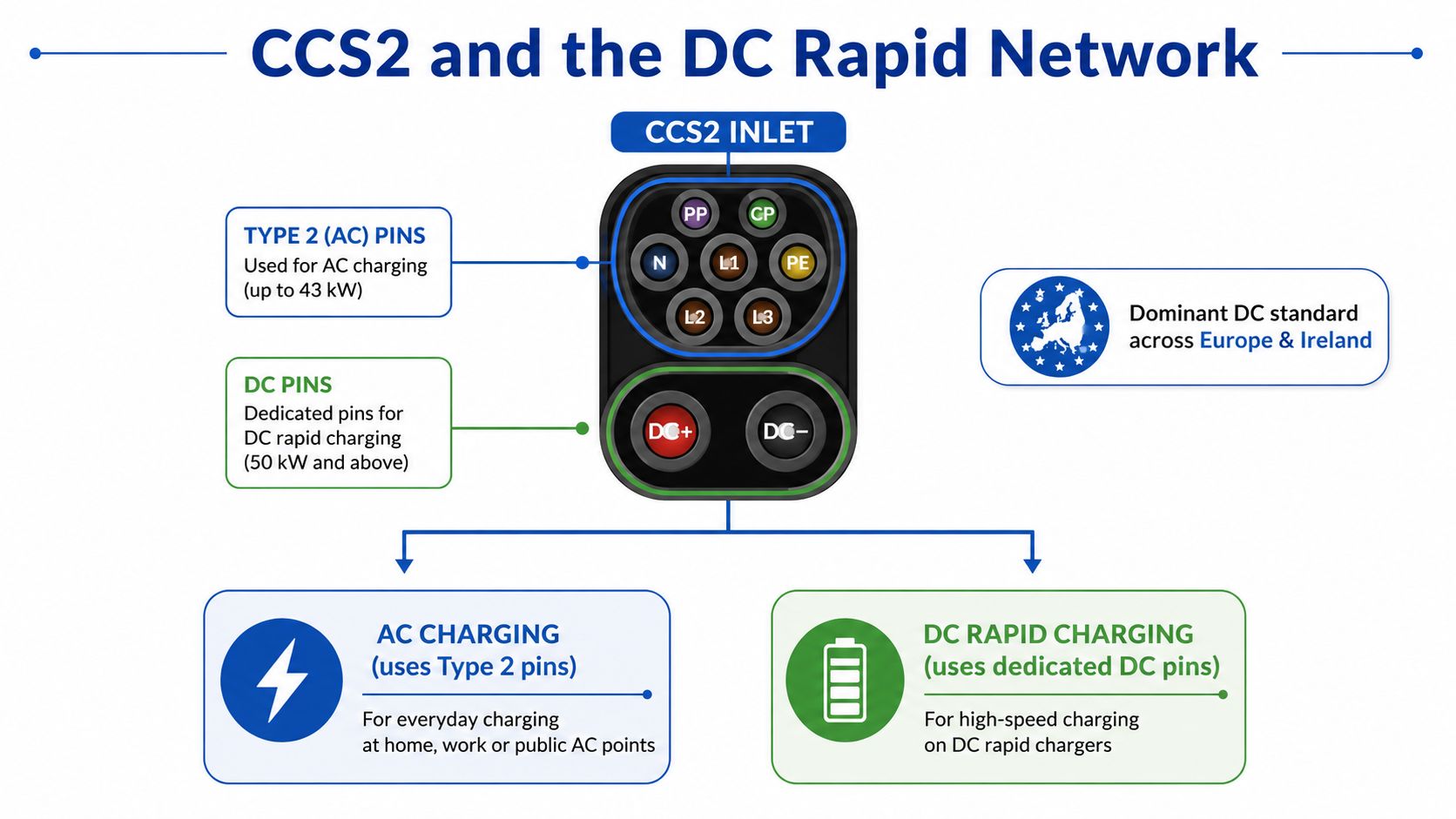
If Type 2 is the everyday plug, CCS2 is the long-trip plug. It is the dominant DC rapid-charging standard across Europe and Ireland, and it is built on the same Type 2 shape with two extra DC pins underneath. That is why one flap on the car can cover both home AC charging and motorway rapid charging.
Why CCS2 dominates public rapid charging
The CCS2 format is the backbone of modern public rapid charging in Ireland because it matches the European standard used across the wider market. It can deliver up to 500 amps, 1,000 volts, and a maximum output of 360 kW in the connector design itself, although the car still controls how much power it draws. The charging speed always depends on the vehicle's own DC limit, not the headline number on the charger cabinet. That point is central to the connector type overview from Power Sonic.
For a driver doing a Dublin to Cork run, the difference between a lower-power DC stop and a high-power DC stop is obvious in practice. A 50 kW hub can be enough for a stop and a coffee, but a faster unit can shorten the wait if the car is built to accept it. The buyer still has to check the car's maximum DC rate, because a fast charger cannot force extra power into a car that does not want it.
There is also a bigger market reason CCS2 matters. Industry overviews note that the world has consolidated around a small number of connector families, and in Europe the standard that really counts is Type 2/CCS2. That makes it the safest default for anyone choosing a modern used EV in Ireland, especially if the car will be used for public charging as well as home charging.
A useful way to think about CCS2 is that it is the connector family for modern road-tripping. If the car supports it, the driver gets access to the rapid-charging ecosystem that most Irish public sites are built around. That is why CCS2 remains the most comfortable answer for buyers who want fewer surprises on the road.
CHAdeMO, Type 1 and Other Connectors You May Still See
Older EVs and some imports can still turn up with connectors that make perfect sense historically, but feel less convenient today. The main one Irish buyers run into is CHAdeMO, the older Japanese DC rapid standard used by early Nissan Leaf models and a small number of others. A few very old imports may also use Type 1, which is the North American J1772 AC standard.
What these older plugs mean in Ireland
CHAdeMO is still usable, but it is no longer the easy default it once was. Fewer rapid chargers now support it than support CCS2, so a CHAdeMO-only car narrows the buyer's route choices on longer journeys. That does not make the car unusable, but it does make the charging map thinner and the planning more important.
Type 1 is even more niche in Ireland. It appears on some very old imports and is mainly an AC connector, not a DC rapid one. Compared with Type 2, it is tied to older vehicle designs and is not the normal fit for modern European EVs. That is why buyers should treat it as an import-era exception, not a common local option.
The wider point is simple. The older the connector standard, the less aligned the car usually is with Irish public charging today. That is not a verdict on the car itself, only a warning that the buyer should check the plug before committing. A car can be excellent value and still be awkward to rapid-charge if the connector is dated.
A buyer looking at an older Nissan Leaf should not assume CCS2. The car may use CHAdeMO for DC charging, and that changes where it can stop on a long trip.
What the Connector Really Says About Charging Speed
Connector type and charging speed are related, but they are not the same thing. The plug tells the buyer whether the car uses AC or DC, while the car's own hardware sets the actual ceiling. That is the part that trips people up most often.
The three limits that matter
For AC charging, the on-board charger is the limiter. For DC rapid charging, the car's own DC acceptance rate is the limiter. The connector type just tells the buyer which family of charge the car can use. That is why a listing that only names the plug, without the charging rate, is incomplete.
A mid-2010s Leaf and a newer Korean-built crossover can both charge from public infrastructure, but they do not charge in the same way. One may rely on CHAdeMO for DC, the other on CCS2. One may have a modest DC ceiling, the other a much higher one. The label on the socket is only part of the picture.
| Connector | Use | Typical speed in Ireland | Common on Irish used EVs |
|---|---|---|---|
| Type 2 | AC home, workplace, and slower public charging | 7.4 kW, 11 kW, sometimes 22 kW, depending on the car's on-board charger | Very common |
| CCS2 | DC rapid charging | Around 50 kW on older or smaller EVs, up to 150 kW to 350 kW on newer long-range models, depending on the car | Very common |
| CHAdeMO | DC rapid charging on older models | Usually up to 50 kW | Older cars, especially early Nissan Leaf |
| Type 1 / J1772 | Older AC imports | Lower than Type 2 in practical Irish use, and not the usual European standard | Rare, mostly very old imports |
Real-world range also belongs in the same conversation. For Irish roads, a useful planning rule is that real-world range is generally WLTP minus 17 percent, which is why the charging speed matters most on longer journeys rather than around town. For cost planning, ShamAuto's charging cost guide is a helpful next stop, because charging speed and charging price are easiest to compare when the car's limits are clear.
Adapters, Granny Cables and Workarounds
Used EV buyers often ask whether an adapter can solve a connector mismatch. Sometimes it can, but only in a limited way. An adapter may help an older import connect to a charging point, but it does not turn a slow car into a fast one.
What a workaround can and cannot do
A Type 2 to Type 1 adapter can be useful for some older AC imports, especially when the car itself was built around J1772. It can make charging more convenient, but it does not create extra power. The car still charges at the rate its own hardware allows.
The same caution applies to the common 3-pin granny cable. Many used EVs include one, and it is useful as a backup or for occasional top-ups on a standard Irish socket. It is not a proper substitute for a wallbox or a public charger, and long-term reliance on a domestic socket is not the same thing as normal EV charging.
There is also no practical DC adapter that turns one rapid standard into another. A CHAdeMO car cannot be turned into a CCS2 car by cable magic, and a CCS2 car cannot pretend to be CHAdeMO at a rapid hub. If the public charger has the wrong plug, the best fix is to choose a car that matches the network the buyer plans to use.
The boot cable is therefore a backup, not the plan. The buyer still wants the right connector on the car and the right charging setup at home. That combination is what makes used EV ownership straightforward rather than awkward.
What to Check on a Used-EV Listing in Ireland
A decent used-EV listing should do more than show the badge and the price. It should tell the buyer which connector the car uses, what AC speed the on-board charger supports, what DC rapid rate it can accept, and whether SoH is available for the battery. It should also show a realistic range figure, not just a headline WLTP number.
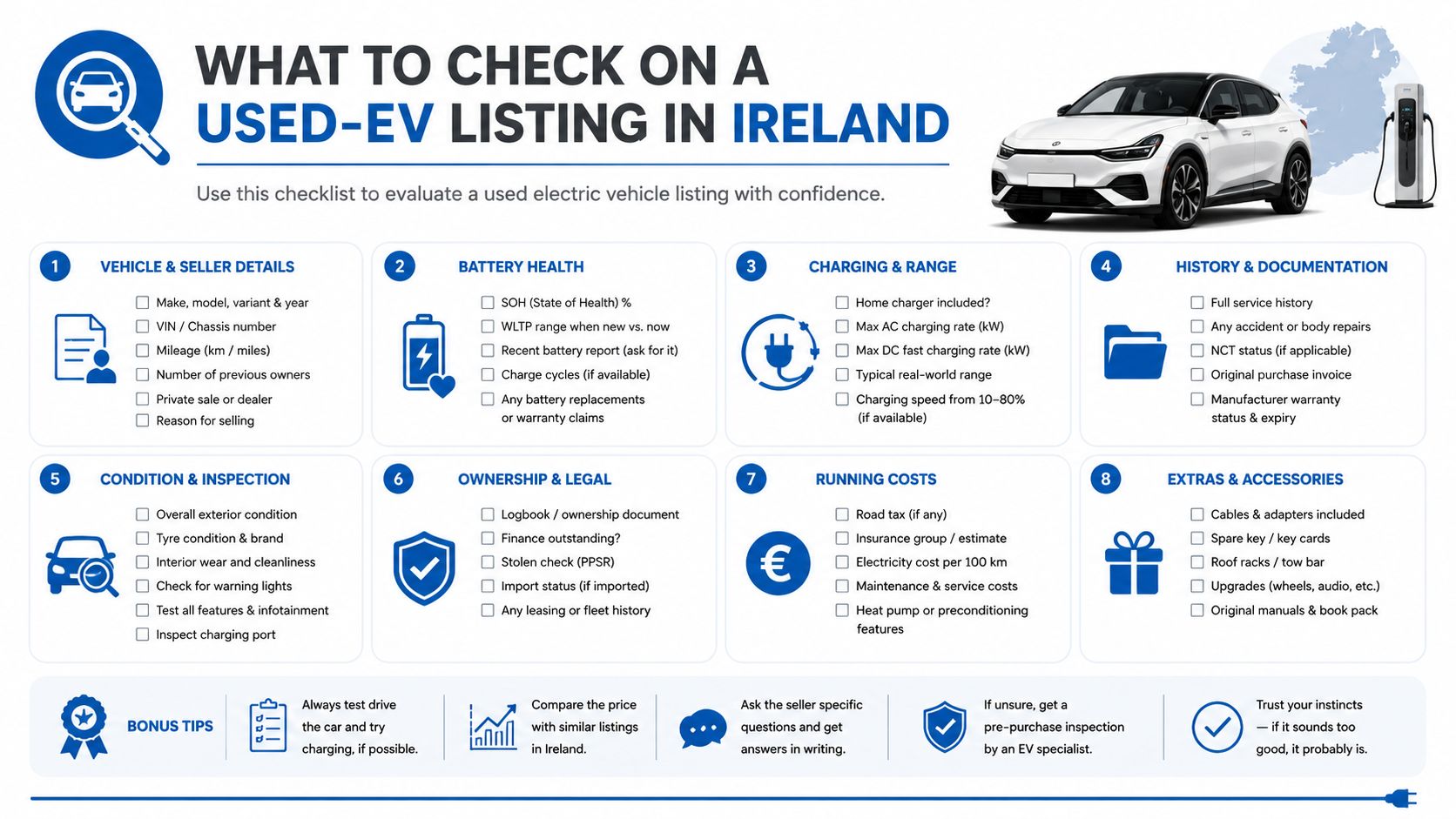
The fields that should be visible before a buyer travels
A buyer can use a simple check. If the listing does not mention connector type, charging speed, or battery condition, it is asking for too much guesswork. If the seller can provide diagnostic screenshots, the battery condition becomes much easier to judge with confidence.
Connector type: Confirm whether the car is Type 2, CCS2, CHAdeMO, or a rarer import standard before assuming compatibility.
Charging speeds: Look for the car's AC limit and DC limit, not just the charger type.
Battery condition: Ask for State of Health (SoH) where available, because battery health matters as much as the badge.
Realistic range: Use a cautious real-world figure rather than relying only on WLTP.
Grants and incentives: Remember that second-hand EVs do not qualify for the SEAI purchase grant, which applies to new cars only. For current rules and any changing caps or dates, check SEAI directly rather than relying on memory.
That last point matters because grant details can change, and buyers should go straight to the official source before making a financial decision. A figure that applies to a new-BEV application today may not apply later, especially when scheme dates or caps are revised.
For practical Irish reading on the ownership side, ShamAuto's guide to buying a used EV in Ireland sits well beside the charging guides on home charging and public charging. The useful habit is to compare cars like for like, with connector and charging data already laid out instead of guessed at.
Bringing It Together for the Irish Used-EV Buyer
The easiest rule is also the most reliable one. For a modern Irish used EV, Type 2 AC plus CCS2 DC is the safest and most flexible setup. CHAdeMO still works for some older cars, but it is a narrower path, and Type 1 is mainly an import-era edge case that buyers should recognise rather than seek out.
That rule sits alongside two others. Every EV is automatic, so there is no manual gearbox or clutch to worry about. And for value, State of Health (SoH) and realistic range deserve as much attention as the plug itself. A car with a friendly connector but weak battery health is still a poor buy.
The best way to judge a used EV is to treat charging, battery health, and range as a single package. A buyer who checks all three can quickly tell whether the car fits home charging, public rapid charging, and the kind of driving it will do in Ireland. That is the level of detail that turns a promising listing into a sensible purchase.
ShamAuto is a good next stop for anyone ready to compare Irish used EVs on connector type, charging speed, usable battery, and SoH instead of on guesswork. If the aim is to make a careful decision before money changes hands, that is the right place to start.