
BYD Atto 3 Ireland Used Buyer's Guide and Real Range
Contents
- Introduction Why the BYD Atto 3 Makes Sense as a Used Buy in Ireland
- What You Actually Get With a Used BYD Atto 3 in Ireland
- Blade LFP Battery Trade Offs You Should Understand Before You Buy
- How to Assess Battery Health and Real World Range With Confidence
- Charging and Living With an Atto 3 on Irish Roads
- What Shapes Used Atto 3 Value and Availability Across Ireland
- Your Practical Buying Checklist on ShamAuto
A buyer in Cork, Galway or rural Donegal can look at a used BYD Atto 3, see a 420 km WLTP figure and still wonder whether the car will manage a regular commute, a motorway journey or a cross-country weekend without stressful charging stops. The harder question is usually hidden from the advert: how much usable battery capacity remains in that particular car?
That is why a careful BYD Atto 3 Ireland purchase should start with battery evidence, not mileage alone. The model is always automatic, with a single-speed drivetrain and no clutch or conventional gearbox, but two cars with the same specification can still deserve different prices if their State of Health (SoH) reports differ.
Introduction Why the BYD Atto 3 Makes Sense as a Used Buy in Ireland
A family buyer comparing the Atto 3 with a used petrol SUV may first notice the familiar advantages of an electric car. There's no clutch pedal, no manual gear changes and no need to plan around a conventional engine. Every Atto 3 uses an automatic single-speed transmission, so the driving experience is straightforward for urban traffic, school runs and longer Irish roads.
The next question is range. Official figures are useful for comparing cars, but they aren't a promise of the distance available in every season or driving situation. For this guide, the cautious planning figure is calculated as WLTP minus 17 percent, which places the Atto 3 at about 349 km against its 420 km WLTP rating. That calculation is an editorial planning method, not a claim that every journey will produce the same result.
Battery condition adds another layer. State of Health describes the remaining condition of the high-voltage battery compared with its original usable capacity. Mileage matters, but it doesn't tell the full story. Charging habits, age, storage conditions and the individual battery report all deserve attention before a buyer agrees a price.
Practical rule: A used EV should be assessed as a car and as a battery system. The second part needs its own evidence.
ShamAuto's approach is to show a verified SoH badge per listing when diagnostic screenshots are supplied, rather than implying that every Atto 3 has the same battery condition. That makes the buyer's task clearer. The decision can focus on the individual car's report, realistic range expectation, charging equipment and service history.
The rest of the guide keeps the same calm approach. It explains the single Irish-market battery specification, the advantages and compromises of Blade LFP chemistry, the difference between home and public charging, and the checks that can help a used buyer judge value across the Republic of Ireland.
What You Actually Get With a Used BYD Atto 3 in Ireland
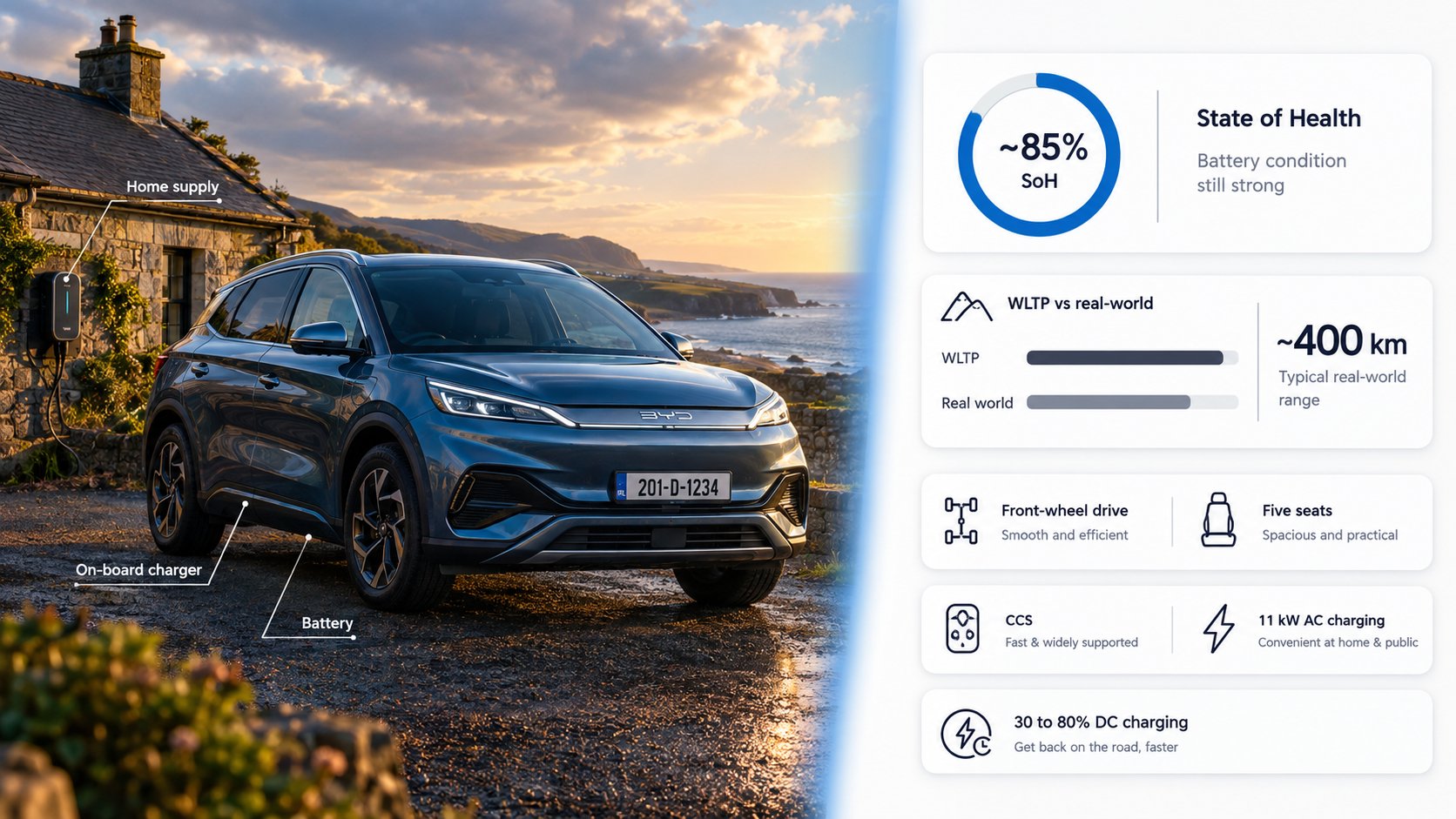
The Irish-market Atto 3 is a compact electric SUV with one main battery specification. It uses a 60.5 kWh usable Blade Battery, front-wheel drive, five seats and a CCS charging connector. BYD Ireland lists 420 km WLTP combined range, while its Irish product information also gives the charging details buyers need for daily ownership, including 11 kW AC charging on higher trims and a 30 to 80 percent DC charging time of 29 minutes. These specifications are available on the BYD Ireland Atto 3 product page.
One battery version simplifies comparison
The catalogue basis for this guide is the 60.5 kWh usable Blade LFP battery. Buyers shouldn't assume that Irish Atto 3 adverts represent a choice of different battery sizes. Instead, the individual listing should confirm the car's trim, registration details and equipment.
The drive system sends power to the front wheels. That suits buyers who want a practical family SUV for ordinary Irish driving, including towns, commuter routes and regional roads. It also means the car should be compared with similar front-wheel-drive electric SUVs on the basis of usable battery, charging speed and battery health, not just the badge or advertised monthly payment.
New-car Irish launch coverage placed the Atto 3's RRP at roughly €40,000, with the exact launch pricing varying by trim and the available new-car support at that time, as reported by the AA's Irish launch coverage. Used buyers should treat that as market context rather than a current valuation. A second-hand car's price depends on its own year, mileage, condition, equipment and SoH evidence.
Turning WLTP into a planning figure
The Atto 3's official figure is 420 km WLTP. The practical range figure used here applies the requested 17 percent deduction, producing about 349 km:
- Official comparison figure: 420 km WLTP.
- Cautious planning figure: about 349 km, calculated as WLTP minus 17 percent.
- What changes the result: speed, temperature, wind, payload, tyre pressure, road surface and cabin heating.
The WLTP number remains useful because it gives buyers a consistent comparison point. The about-349 km figure is more useful for early trip planning because it avoids treating a laboratory result as a guaranteed Irish-road distance.
BYD Ireland also states that a full overnight AC charge can take about 6.5 hours under the relevant charging conditions. The AA's Irish review described the usable battery as 60.48 kWh and gave a more cautious real-world range of about 330 to 350 km, which broadly supports using a planning figure near 349 km rather than relying on 420 km for every journey. That review is available in the AA new-car review of the BYD Atto 3.
Blade LFP Battery Trade Offs You Should Understand Before You Buy
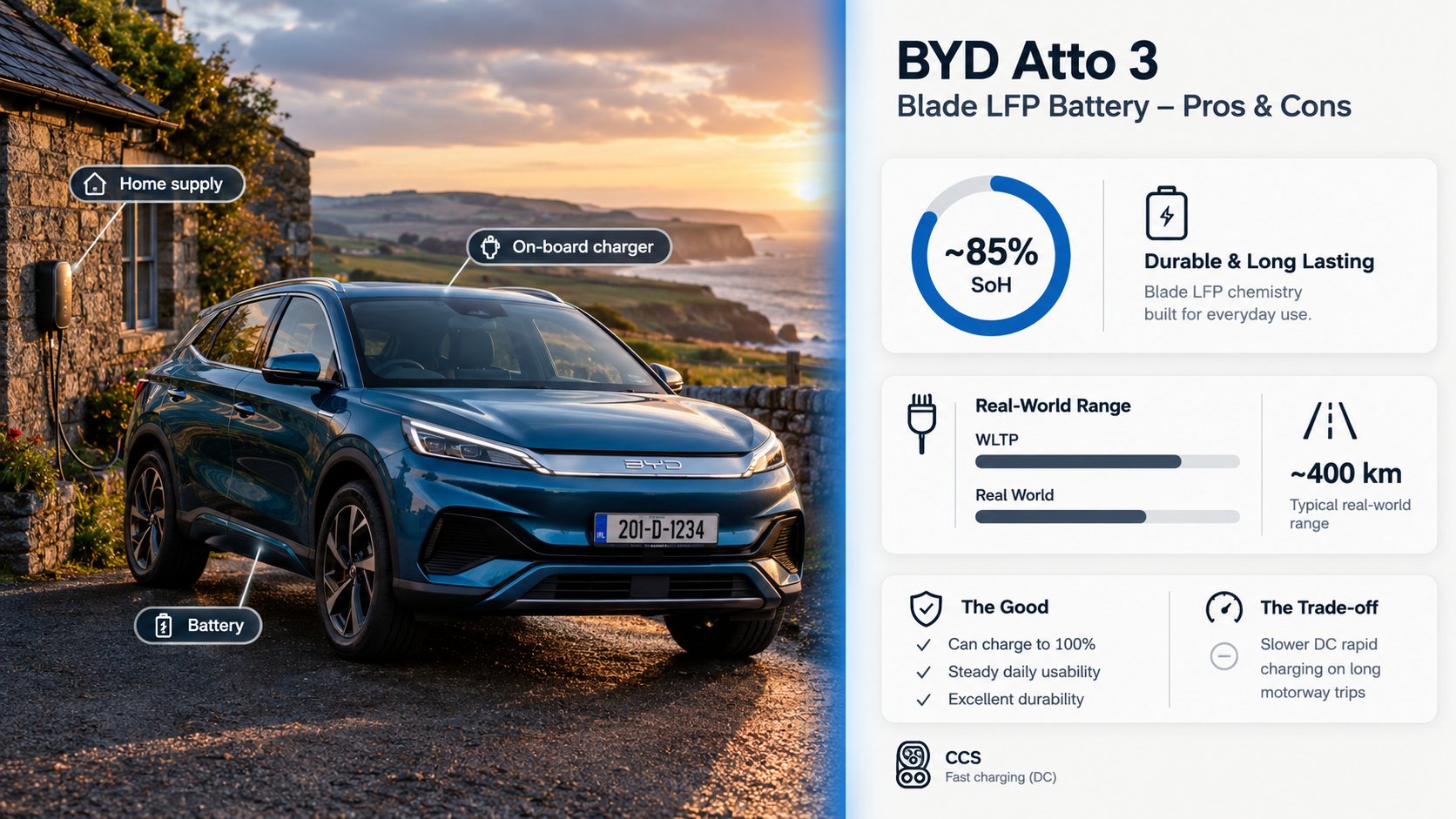
The Atto 3's Blade battery uses lithium-iron-phosphate, or LFP, chemistry. In practical terms, that chemistry is known for being durable and for tolerating regular charging to 100 percent. That can make daily ownership simpler for a driver who wants to charge fully at home rather than manage a strict 80 percent limit.
The trade-off appears during rapid charging. The Atto 3's DC system is rated at up to about 88 kW, so a motorway stop can take longer than it would in a rival designed around a higher DC peak. That isn't a defect. It's a choice that favours a durable, steady battery character over the shortest possible rapid-charge visit.
Where LFP suits everyday driving
For local and mixed driving, the ability to charge fully can be convenient. A household with a dependable home charger can begin a longer day with the car's available energy maximised, rather than treating 100 percent as an occasional exception.
LFP chemistry is also durable, but no battery is immune to ageing. That's why the buyer still needs an individual SoH report. Chemistry can explain how the battery is designed to behave, but it cannot prove the condition of a specific used car.
Where the charging compromise matters
A driver who regularly travels long motorway distances may care more about the time spent at public chargers. The Atto 3 can recover energy through its CCS connector, but its lower peak means the fastest part of the charging session won't match every higher-power rival.
The difference matters less for a driver who charges overnight at home and only uses rapid charging on occasional trips. It matters more for someone covering frequent inter-county journeys with tight arrival times, especially if a route has limited charger choice.
| Driving pattern | What the LFP trade-off means |
|---|---|
| Local commuting | Regular full charging can be convenient. |
| Mixed family use | Home AC charging may cover most needs. |
| Frequent motorway travel | Longer rapid stops deserve route planning. |
| Used-car comparison | SoH evidence remains more important than chemistry alone. |
A broader comparison with another BYD model can help buyers understand how battery size and charging expectations change across the range. The BYD Seal Ireland guide provides that separate model context without changing the Atto 3's single-battery specification.
How to Assess Battery Health and Real World Range With Confidence
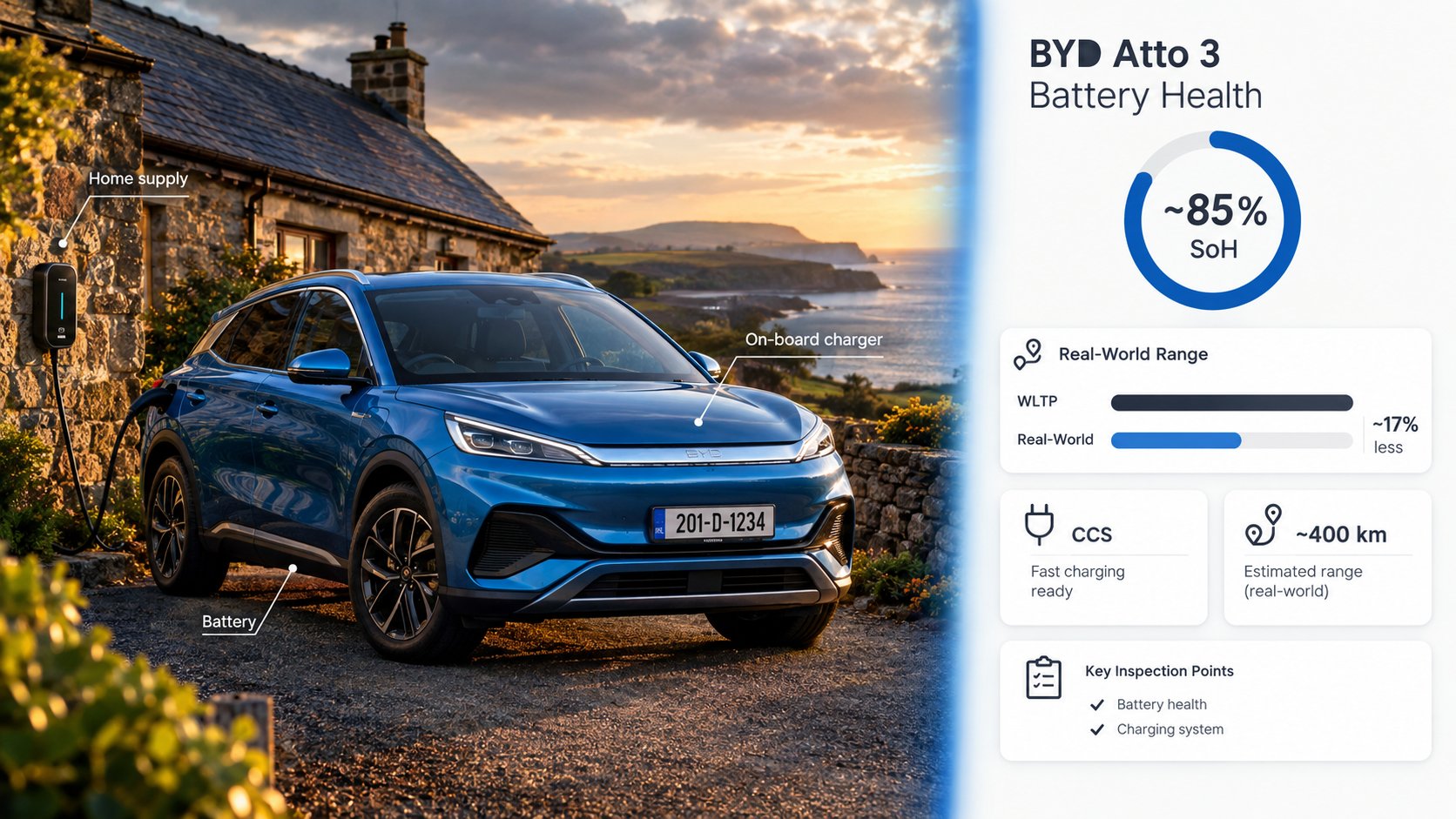
State of Health, or SoH, is the central battery figure in a used Atto 3 advert. It describes the battery's remaining usable condition compared with its original usable capacity. A higher SoH generally gives the buyer more confidence that the car can deliver a range close to the model's expected planning figure, although driving conditions still affect the result.
Two Atto 3s can have similar mileage and still deserve different scrutiny. Age, charging history, storage and usage patterns can differ, so mileage should be treated as one part of the evidence rather than a substitute for a battery report.
What a buyer should request
A sensible check starts with the specific vehicle, not a general reputation for the model.
- Find the SoH evidence. Look for a diagnostic report, battery health certificate or clear supporting screenshot. A seller who can show the evidence gives the buyer something concrete to assess.
- Match the report to the car. The registration or vehicle identification details should correspond with the Atto 3 being viewed.
- Compare range using one method. The guide's planning figure is about 349 km, calculated from 420 km WLTP minus 17 percent. It shouldn't be confused with a guaranteed dashboard estimate.
- Check the charging behaviour. The car should accept AC and CCS charging as specified, subject to the equipment and charger being used.
- Use the test drive to check the whole car. Battery evidence doesn't replace checks of tyres, brakes, steering, suspension, screens, seats and warning lights.
ShamAuto's verified SoH badge is useful only when the individual listing includes the required diagnostic evidence. It isn't an average for all Atto 3 cars, and it doesn't mean every vehicle carries the same badge status.
A clean battery report turns a vague question, "Is the battery healthy?", into a specific question, "What does this car's evidence show?"
Cold weather, high motorway speeds, strong wind and heavy loads can reduce the distance available on a charge. The most honest comparison keeps the 420 km WLTP figure beside the about-349 km planning figure, then allows the individual SoH report to influence confidence in that estimate.
Charging and Living With an Atto 3 on Irish Roads
Charging at home usually shapes EV convenience more than the car's brochure figure. The Atto 3 supports 11 kW AC charging on higher trims, while many homes use a single-phase wallbox rated at 7.4 kW. The higher AC rate can reduce charging time where the home electrical installation supports it, but buyers shouldn't assume that every property can provide three-phase charging.
A qualified installer can confirm the household's supply, wallbox suitability and cable route. Tenants, apartment residents and households without off-street parking may need to rely more heavily on public AC or DC charging, so the car's CCS connector and local charger access become more important.
Home charging and public charging serve different jobs
Home AC charging is best suited to predictable overnight replenishment. Public DC charging is more useful when a driver needs to recover usable range during a journey. BYD Ireland quotes 29 minutes for a 30 to 80 percent DC session, but the actual experience depends on battery temperature, charger output, site availability and the car's charging curve.
That 30 to 80 percent window is important because it focuses on the part of a rapid session designed to recover useful energy efficiently. A driver shouldn't plan every trip around arriving at a charger nearly empty and leaving completely full. A shorter, earlier stop may be easier, particularly on busy routes.
Irish route planning needs local judgement
Ireland's charging network is expanding, but availability isn't equally convenient on every route. The Department of Transport announced 53 new high-power hubs delivering 175 fast and ultra-fast points in June 2025, as reported in the official government announcement. New infrastructure improves the outlook, but it doesn't remove the need to check a specific route before setting off.
A rural or inter-county journey should be planned around more than distance. The driver should check:
- Charger location: Confirm that a suitable CCS point exists near the route.
- Backup options: Identify an alternative site if the first location is busy or unavailable.
- Arrival buffer: Avoid planning to reach a charger with no reserve.
- Home access: Decide whether most charging will happen at a private wallbox or in public.
- Seasonal conditions: Allow for colder weather, wind and motorway speeds.
The ShamAuto guide to EV charging in Ireland offers wider ownership context, but the individual route still needs checking before a long journey.
What Shapes Used Atto 3 Value and Availability Across Ireland
A used Atto 3's value should be judged car by car. Year, mileage and battery health all matter, while trim, condition, service history, tyres and charging equipment can influence the final decision. County location can affect convenience for a viewing, but it shouldn't replace evidence about the vehicle itself.
A low-mileage car with unclear battery information isn't automatically a better purchase than a higher-mileage example with a clear diagnostic report. The buyer needs to compare the complete record, including the SoH status and realistic range basis, rather than choosing on mileage alone.
ShamAuto is newly launched and pre-stock, so no reliable claim can be made about listing totals or which Irish counties have the most Atto 3 stock. Buyers should treat availability as fluid and focus on the evidence attached to each individual advert.
Grant rules need careful reading
A second-hand EV does not qualify for the SEAI electric vehicle purchase grant. The SEAI grant information states that the purchase support is for new EVs, so a used Atto 3 should never be priced on the assumption that the buyer will receive that grant.
SEAI's used-EV guidance explains that some other ownership supports can still apply to used EVs, including the home charger grant, reduced tolls, low motor tax and VRT relief for imports. These arrangements can change, so a buyer should check the live official guidance before completing a purchase or budgeting for ownership.
The financial question is therefore broader than "Is the used price lower than a new price?" It includes battery confidence, charging access, expected driving pattern, insurance, servicing and the support available for the buyer's circumstances.
Your Practical Buying Checklist on ShamAuto
A used Atto 3 advert should answer the important questions before a viewing is arranged. A buyer can use the following sequence to keep the comparison organised.
- Confirm the battery specification. Check that the individual car is listed with the 60.5 kWh usable Blade LFP battery, CCS connector, front-wheel drive and the stated AC and DC charging capability.
- Check the verified SoH badge. Look for the badge and the diagnostic evidence behind it. If the report isn't available, ask why and treat the missing information as part of the buying decision.
- Use the same range calculation. Keep 420 km WLTP beside the cautious about-349 km figure, calculated as WLTP minus 17 percent. Compare cars using the same basis.
- Inspect charging and service records. Confirm that the CCS port, AC charging equipment, cables and service history match the advert.
- Arrange a proper inspection. Check tyres, brakes, suspension, bodywork, warning messages and the operation of the automatic drivetrain during a test drive.
The ShamAuto car-check guide can support the wider inspection process. Official SEAI guidance should be used for current grant and used-EV support rules, while the charging route itself should be checked before longer Irish journeys.
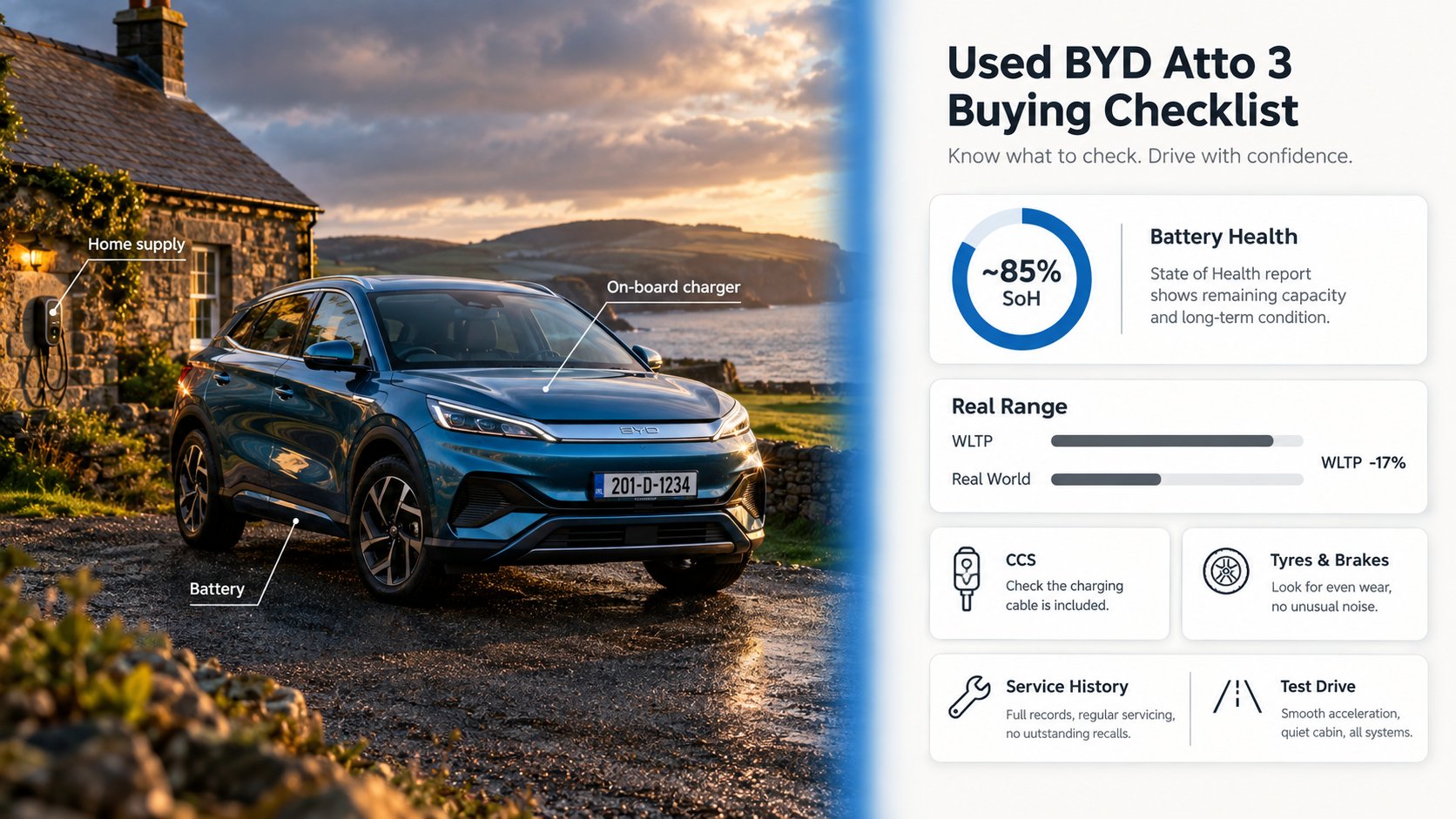
ShamAuto gives Irish EV buyers a focused way to compare used Atto 3 cars using per-listing battery evidence, a verified State of Health badge where diagnostics are supplied and a cautious WLTP minus 17 percent range measure. Buyers can visit ShamAuto to use the guides, assess available evidence and be among the first to list or discover an Atto 3 through an EV-only Irish marketplace.