
Car Check Ireland: Essential Guide Before You Buy
Contents
Most advice on a car check in Ireland starts in the wrong place. A clean listing, a fresh valet, and a seller saying "full service history" do not tell a buyer much on their own. A proper check should be split into three separate jobs: paperwork and history, the physical inspection and road test, and, if it is an EV, a battery diagnostic that many generic guides leave out.
That matters more in Ireland than many buyers realise. The national test system is large, with 50 NCT centres, and the scale of roadworthiness failure is significant, with 71,308 vehicles classified as dangerously defective in the first half of 2026, equal to 7.7% of vehicles tested, or about 1 in 13 Irish Examiner. If a buyer stops at just one layer, the chances of missing a problem rise quickly.
For EV buyers, the gap is even bigger. A car can look fine on paper, pass a quick visual check, and still have a weak battery that changes its value completely. That is why smart Irish buyers treat a car check as evidence gathering, not reassurance shopping.
Why a Car Check in Ireland Is Really Three Checks
Many buyers think the job is done once a reg search comes back clean. In Ireland, that is too shallow, especially in a market shaped by imports, older cars, and frequent ownership changes. Official fleet data show a large licensed vehicle parc, with 2,860,984 vehicles under current licence in 2020, including 2,215,127 private cars, which means private cars made up 77.4% of licensed vehicles CSO. In a market like that, a buyer needs more than a seller's description.
History tells you one thing, the car tells you another
The paperwork check answers different questions from the physical check. A history report can flag finance, mileage inconsistencies, or ownership changes, but it cannot tell a buyer whether the tyres are legal, the suspension is worn, or the battery is fading. The road test then catches faults that documents cannot show, and for an EV the battery diagnostic goes a step further.
That separation is the whole point. A clean-looking car with a valid NCT is not automatically a sound buy, because the test covers roadworthiness items, not every history issue and not every hidden wear problem. Irish guidance and buyer checklists point to the same practical truth: a buyer needs evidence from more than one source.
Practical rule: if the seller only offers paperwork, the buyer is missing the car.
EVs add one more layer
On a petrol or diesel car, a strong history file and a decent road test still leave open the question of long-term mechanical health. On an EV, the battery becomes the main value driver, and that is where a generic Irish car check often falls short. This is why an EV-specific marketplace like ShamAuto focuses on battery evidence, not just registration data.
That matters because EV buyers do not just need to know whether the car exists and is legal. They need to know whether the range suits real Irish driving, whether the battery still has useful capacity, and whether the advertised price reflects the actual condition of the pack. If those questions are left until after the sale, the buyer is already at a disadvantage.
Paperwork and History Checks for Irish Buyers
The document trail should come first because it frames everything else. Start with the seller's registration certificate, then compare the registration number, VIN, engine number, and colour against the logbook and the car itself. Irish guidance also says a buyer should check that the seller can provide the vehicle registration certificate, and for cars 4 years or older, a valid NCT certificate should be part of the documents reviewed before purchase Citizens Information.
Verify the official status before trusting the listing
The next step is the NCT record. Buyers should confirm the car's test status through the official NCT system rather than relying on a seller's screenshot, because paperwork can be out of date as soon as a listing goes live. For ownership changes, the official trail runs through the motor tax system and the National Vehicle Driver File, so change-of-ownership paperwork should line up clearly with the vehicle's current identity.
A buyer also needs a paid vehicle history report, not just a free reg lookup. Irish guidance specifically says a verified provider should have access to the National Mileage Register and Irish finance databases, because free checks often miss mileage or finance issues Citizens Information. That is the difference between a basic lookup and a check that protects your money.
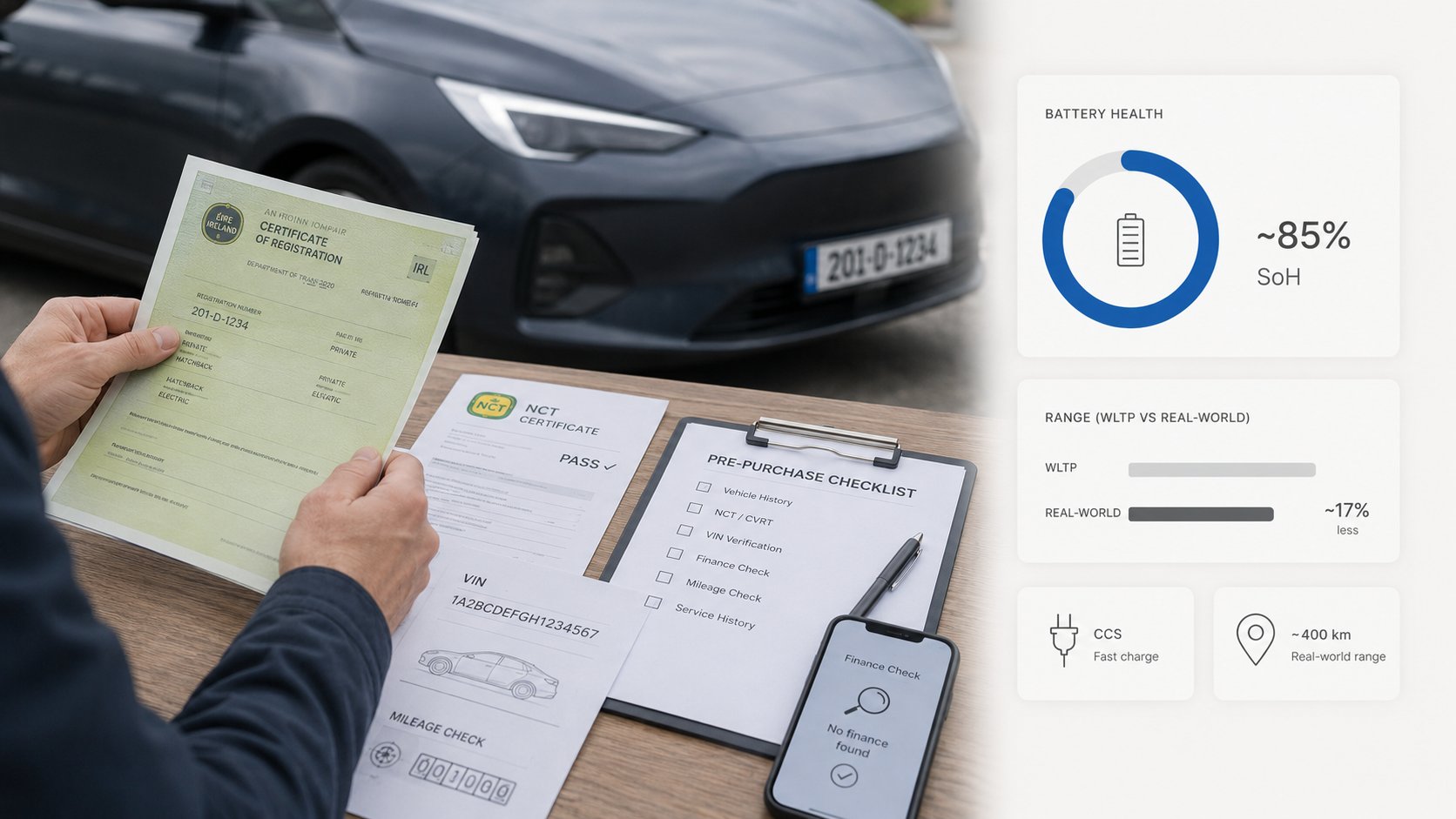
A good paid report should be used to look for four things in particular:
- Outstanding finance: if money is still owed on the car, the buyer needs to know before agreeing a price.
- Write-off or insurance category flags: these affect both value and risk, even if the car looks tidy.
- Mileage inconsistencies: a mismatch between the history file and the odometer is never a minor detail.
- Plate or ownership changes: multiple changes are not automatically a problem, but they should have an explanation that matches the paper trail.
That process is boring, and that is a good thing. Boring is better than buying a car with hidden obligations or a confused identity. A seller who cannot produce the basics cleanly is asking the buyer to do the legwork.
Use this guide on Irish reg plates and the best time to buy if the paperwork trail looks odd or the car has been recently re-plated.
The Physical Inspection and Road Test
Paperwork can be perfect and the car can still be rough. That is why the physical check matters, because it shows how the car has been treated, repaired, and maintained in daily use. The NCT covers a long list of roadworthiness items, but it is a minimum legal standard, not a buyer's inspection, so a valid certificate is never enough on its own.
Walk the car before touching the key
Start outside. Check panel gaps, tyre wear, wheel damage, stone chips, glass, lights, and mismatched paint. Then move inside and check warning lights, seat condition, screen function, heater and air conditioning operation, and whether anything rattles, sticks, or smells damp. A tidy cabin can hide a hard life, and a rough cabin can be harmless, but the buyer only finds out by checking properly.
A valid NCT is useful, but it does not replace a proper walkaround.
For an EV, the road test should be calmer than a petrol test. Every EV is automatic, with a single-speed drive, so clutch wear and gear changes are not part of the equation. That means the focus shifts to smooth take-off, clean deceleration, regenerative braking behaviour, brake feel, warning lights, and any unusual humming or knocking under load.
What the road test should expose
A good test route does not need drama. It needs enough variety to show whether the car tracks straight, brakes evenly, and settles at speed without vibration. If the steering pulls, the suspension crashes, or dashboard lights stay on, the seller should explain why before the buyer gets any closer to paying.
The point of this step is simple. Paperwork cannot reveal a bent wheel, worn suspension, brake noise, or a cooling issue, and a polished listing will not warn a buyer about a fault light that appears only sometimes. A road test turns vague promises into visible behaviour, and that is where many weak cars reveal themselves.
The EV-Specific Check Most Irish Guides Miss
The battery check is the part most generic Irish guides gloss over, and it is the part that matters most on a used EV. State of Health (SoH) is the percentage of original usable battery capacity that remains, and that figure changes what the car is worth, how far it can go, and how confidently it can be used. Two EVs with the same age and mileage can still be very different purchases if one battery is clearly healthier than the other.
A seller's promise is not battery evidence
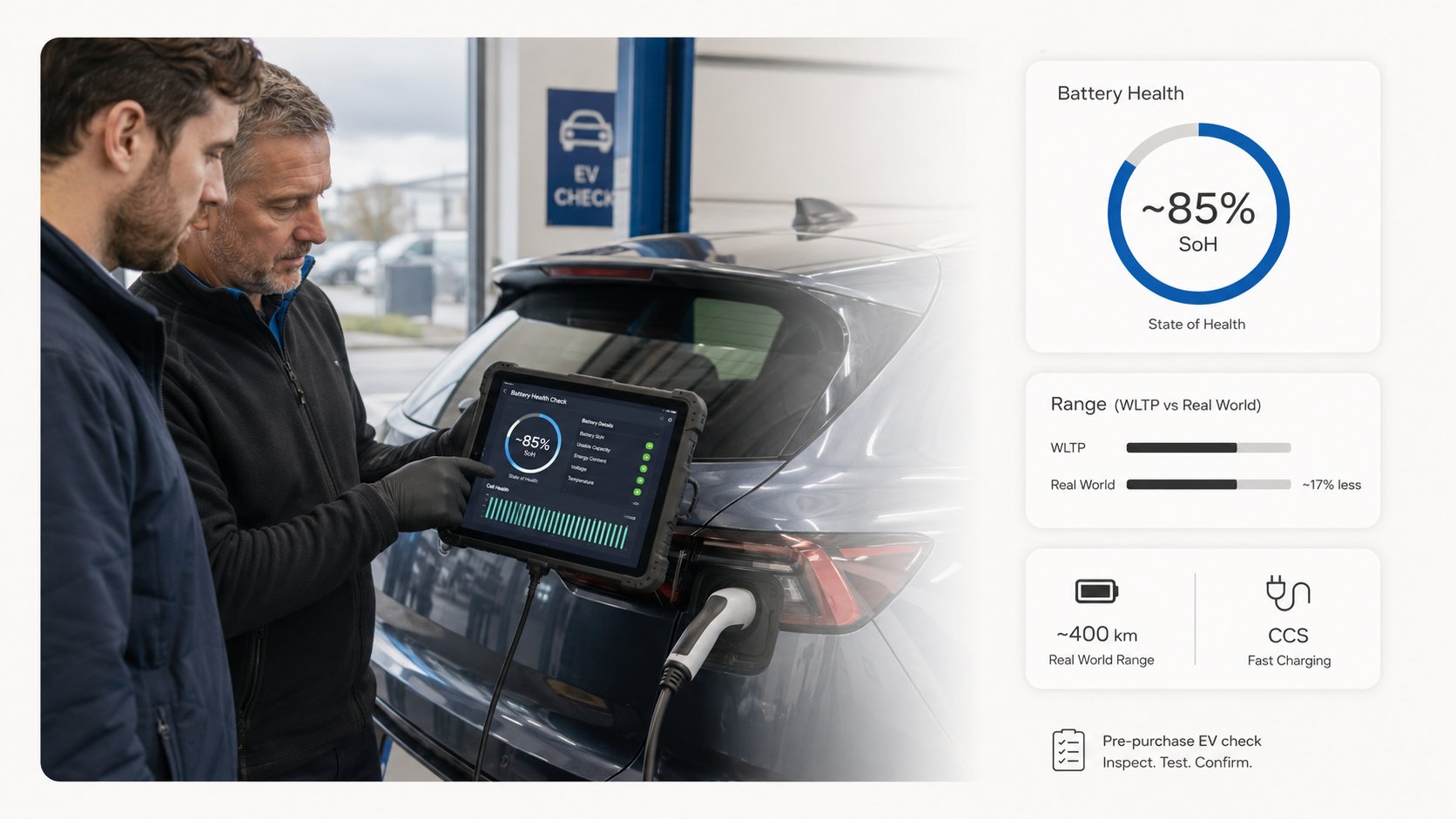
The clearest way to verify SoH is through an OBD2 diagnostic and a recorded reading from the car's battery data. That turns a vague statement like "the battery is fine" into something the buyer can assess. A verified SoH screenshot is not just a nice extra, it is the evidence that separates a solid used EV from a tired one.
For range, buyers should stop treating WLTP as the number that matters in daily use. A conservative real-world rule is WLTP minus 17%, which gives a more grounded picture for Irish roads and charging habits. ShamAuto uses that framing because buyers need a cautious comparison figure, not a lab number that flatters the car.
The used EV pricing reality is also simple. Second-hand EVs do not qualify for the SEAI purchase grant, so there is no subsidy cushion to hide behind. The price has to make sense against current listings, the SoH reading, and the realistic range the car can deliver.
What a serious EV buyer should ask for
A used EV should come with battery evidence, not just a glossy spec sheet. A buyer should ask for a recent diagnostic readout, the charging cable situation, and the realistic range figure being used for comparison. If the seller cannot provide that, the price should reflect the uncertainty.
The other mistake is comparing an EV as if it were just a petrol hatchback with an electric badge. Battery condition, usable capacity, charging speed, connector type, and driving range matter more than old engine-based thinking, because there is no engine to rebuild around poor range. For buyers who want a deeper checklist, checking battery SoH before you buy is the right place to start.
Putting the Three Checks Together Before You Pay
The best approach is to treat the car as three separate evidence files that must all make sense together. The paperwork tells the buyer whether the car's identity is clean, the physical inspection shows whether the car has been looked after, and the EV battery diagnostic shows whether the range and value are still there. If any one of those three looks weak, the price should move.
Ask for the right proof, not more reassurance
A seller should be able to produce the NCT status, service history, ownership trail, and, for an EV, a recent SoH screenshot or equivalent diagnostic proof. A polished answer is not enough. The buyer wants the documents, the numbers, and the car in front of them to agree.
A useful way to read a listing is to compare evidence against evidence. If one car has a clean history file but no battery proof, and another has a solid SoH reading but slightly higher mileage, the second car may be the safer buy because the battery is the expensive part that generic checks miss. That is exactly why an EV-native marketplace needs to put SoH first, not bury it.
ShamAuto's Verified SoH badge is built around that idea, a disclosed diagnostic reading that turns battery condition into something a buyer can inspect instead of guess at. It is a capability, not a promise of a bargain, and it belongs in the same conversation as finance checks and ownership records.
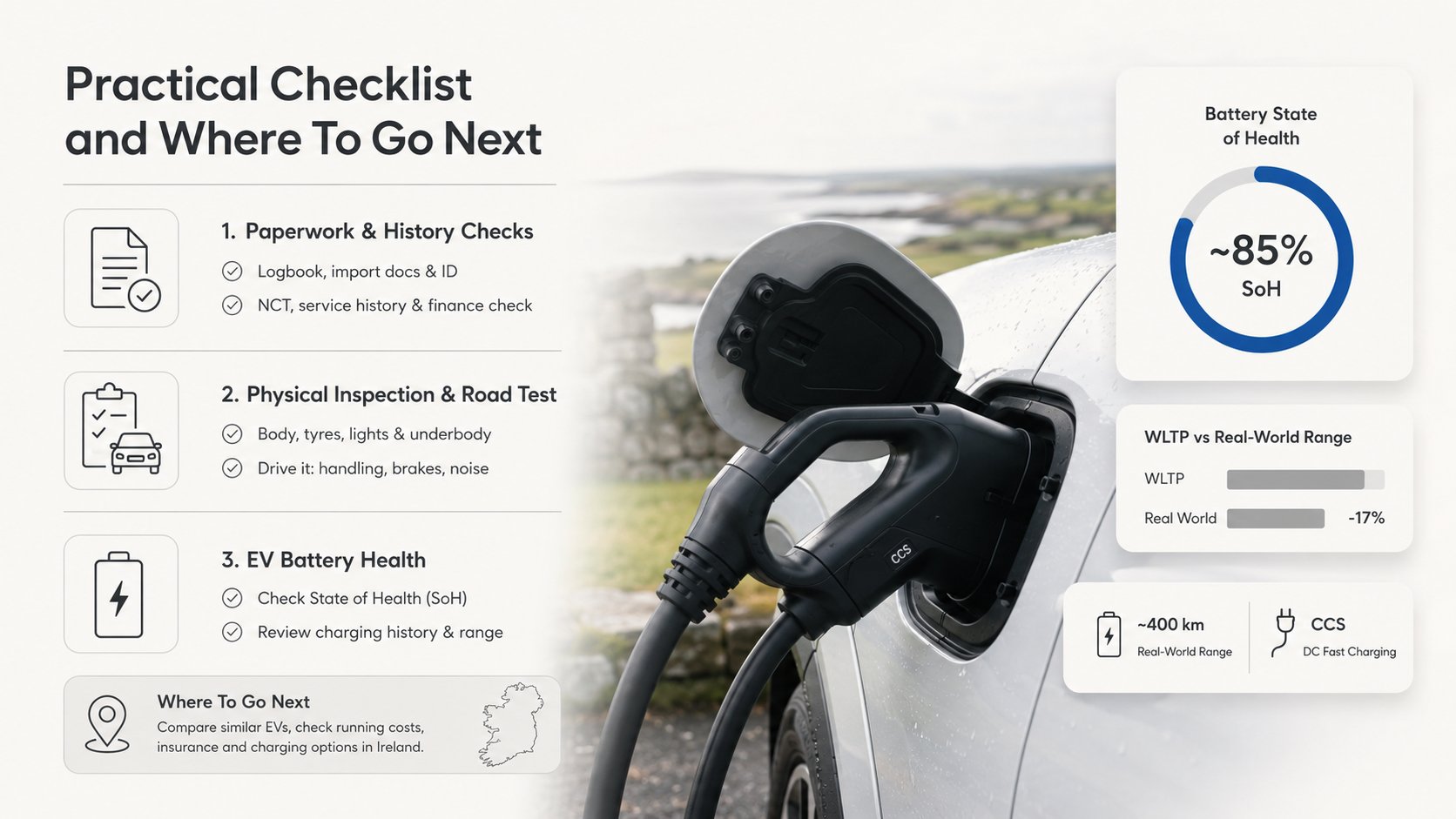
The basic decision rule is blunt. If the paperwork is messy, walk away. If the road test is noisy, dig deeper. If the SoH reading is weak for the age, mileage, and asking price, negotiate hard or move on.
For a fuller buying framework, the used EV buyer's checklist for Ireland is the right companion guide, and the real-world range versus WLTP explainer helps stop inflated range claims from distorting the decision.
ShamAuto is built for buyers who want EV evidence, not guesswork. If the car check in Ireland matters to the buyer, battery condition should be part of the listing, the conversation, and the price. Visit ShamAuto to read the EV buying guides, see how SoH and real-world range are presented, and be among the first to list when the right car is ready to go live.