
BYD Seal Ireland Guide for Used Buyers
Contents
- Why a Used BYD Seal Is a Different Kind of Buy
- The BYD Seal and Its Blade LFP Battery Explained
- Seal Variants, Real-World Range and Charging
- How ShamAuto Calculates a Real-World Range You Can Plan Around
- Battery State of Health and the Used-Seal Checklist
- Used Value, Irish Pricing Context and Where to Look
- The Honest Takeaway for an Irish Used-Seal Shopper
You're probably looking at a BYD Seal because the numbers look sensible, the shape is clean, and the monthly running cost should beat a petrol saloon. That's the right instinct, but a used EV should never be judged on badge and WLTP alone.
For a BYD Seal Ireland buyer, the decision sits on two things only, battery State of Health (SoH) and realistic range. Everything else, trim, launch hype, even whether the car is rear-wheel drive or all-wheel drive, comes second.
Why a Used BYD Seal Is a Different Kind of Buy
A used Seal doesn't ask the same questions as a used diesel saloon. There's no clutch to wear out, no gearbox to worry over in the usual sense, and no exhaust system waiting to start costing money. That strips away a lot of the old second-hand anxiety.
The big-money part is the high-voltage battery, so the buyer should stop thinking like a petrol shopper and start thinking like an EV shopper. Mileage matters, but SoH matters more, because two cars with the same odometer reading can age very differently if one battery has been treated well and the other hasn't.
Practical rule: on a used EV, the battery is the car's centre of gravity for value, not the badge on the boot.
That's why the Seal deserves a battery-first review rather than a brochure-led one. Every EV is automatic, so there's no clutch test, no manual-shift feel to judge, and no old-school drivetrain drama to rescue a weak battery case. If the pack is healthy and the range suits the commute, school run, motorway work, or county-to-county driving, the Seal can make sense. If the battery is tired, the same car can become a false economy very quickly.
The Irish angle matters too. This is a market where the Seal is still building its footprint, not a mature, saturated used model with years of resale history behind it. That means the safest way to buy is to focus on the car in front of the buyer, not the model name in the abstract.
The BYD Seal and Its Blade LFP Battery Explained
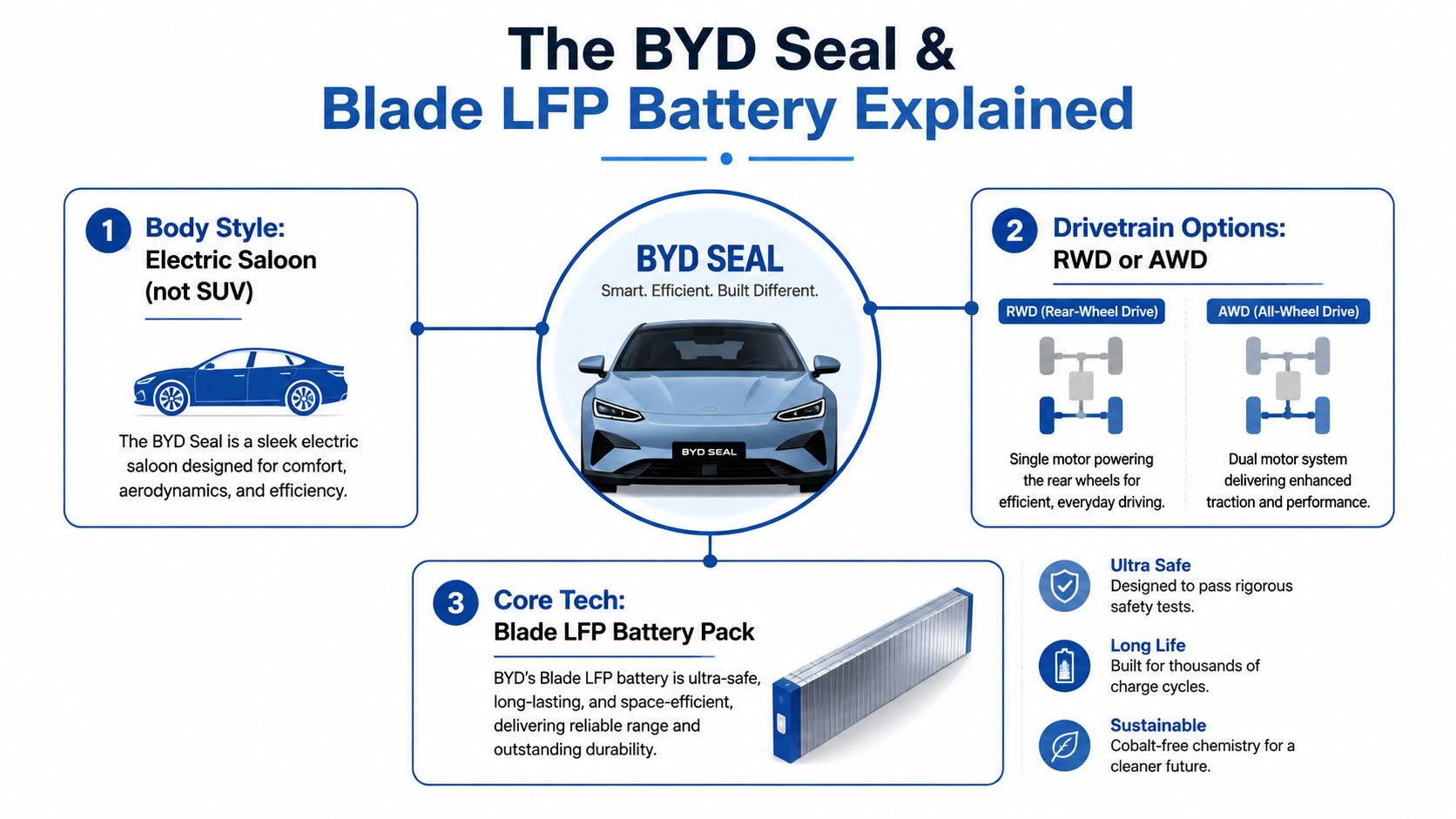
The Seal is BYD's mid-size electric saloon, not an SUV, and it should be kept separate in the mind from the Sealion 7. In Ireland it comes with rear-wheel drive or all-wheel drive, and it uses CCS charging. That already puts it in the mainstream EV conversation, not in some niche tech corner.
Why the Blade LFP pack matters
BYD's Blade Battery uses lithium iron phosphate, or LFP, which is a different chemistry from the nickel-heavy packs found in many European EVs. In plain terms, LFP is generally known for slower ageing and for coping better with regular charging to 100% than many other chemistries. That suits Irish home charging habits well, especially for buyers who want to leave the car plugged in overnight and start the day fully charged.
That said, chemistry is only a tendency, not a guarantee. A well-treated battery can still be weak, and a hard-used one can still look fine from the outside. The buyer should treat the chemistry as a positive background trait, not as proof of condition.
Bottom line: Blade LFP is a good fit for commuter and family use, but verified SoH still decides whether the individual car is worth the money.
The practical takeaway is straightforward. The Seal's battery design is a strong starting point, especially for predictable daily use, but the car still has to prove itself on diagnostics. A seller's claim that "LFP lasts longer" is not enough. The viewing has to end with evidence, not optimism.
Seal Variants, Real-World Range and Charging
The Irish Seal range is best understood variant by variant, because one blended figure hides the trade-offs. The Design RWD uses a 61 kWh battery, is rated at 460 km WLTP, and ShamAuto's planning figure puts that at about 382 km real-world using the WLTP minus 17% method. The Excellence RWD uses an 82 kWh battery, is rated at 570 km WLTP, and comes out at about 473 km real-world. The Excellence AWD also uses the 82 kWh battery, is rated at 520 km WLTP, and lands at about 432 km real-world.
Here's the key point, the AWD version gives away range for performance. BYD's Irish material gives it 530 hp / 390 kW combined and a 3.8 s 0-100 km/h claim. The 61 kWh Design RWD is about 7.5 s to 100 km/h, while the 82 kWh Excellence RWD is about 5.9 s. That's not a flaw, it's the trade-off.
| Variant | Battery | WLTP Range | ShamAuto Real-World | DC Peak |
|---|---|---|---|---|
| Design RWD | 61 kWh | 460 km | ~382 km | ~110 kW |
| Excellence RWD | 82 kWh | 570 km | ~473 km | ~150 kW |
| Excellence AWD | 82 kWh | 520 km | ~432 km | ~150 kW |
Charging is useful, but the curve matters more than the headline
BYD and Irish launch coverage point to up to 150 kW DC and 11 kW AC, with a 30% to 80% DC fast-charge time of 26 minutes in the Irish launch material. That combination tells the story, the pack can charge quickly, but the session will taper before the headline peak is held.
For a used buyer, that matters more than the brochure number on its own. A Seal with the larger pack is the better fit for longer trips, but only if the buyer wants the extra range enough to accept the added complexity of the performance trim or the higher asking price. A smaller-pack Design can still be the smarter value if most driving is local and the buyer prefers a lower entry point.
How ShamAuto Calculates a Real-World Range You Can Plan Around
WLTP is useful for comparison, but it's not how an Irish driver lives. Cold mornings, motorway speed, hills, headwinds, passengers, luggage, and a heavy right foot all pull the number down. That's why a conservative adjustment is more useful than repeating the brochure range back to the buyer.
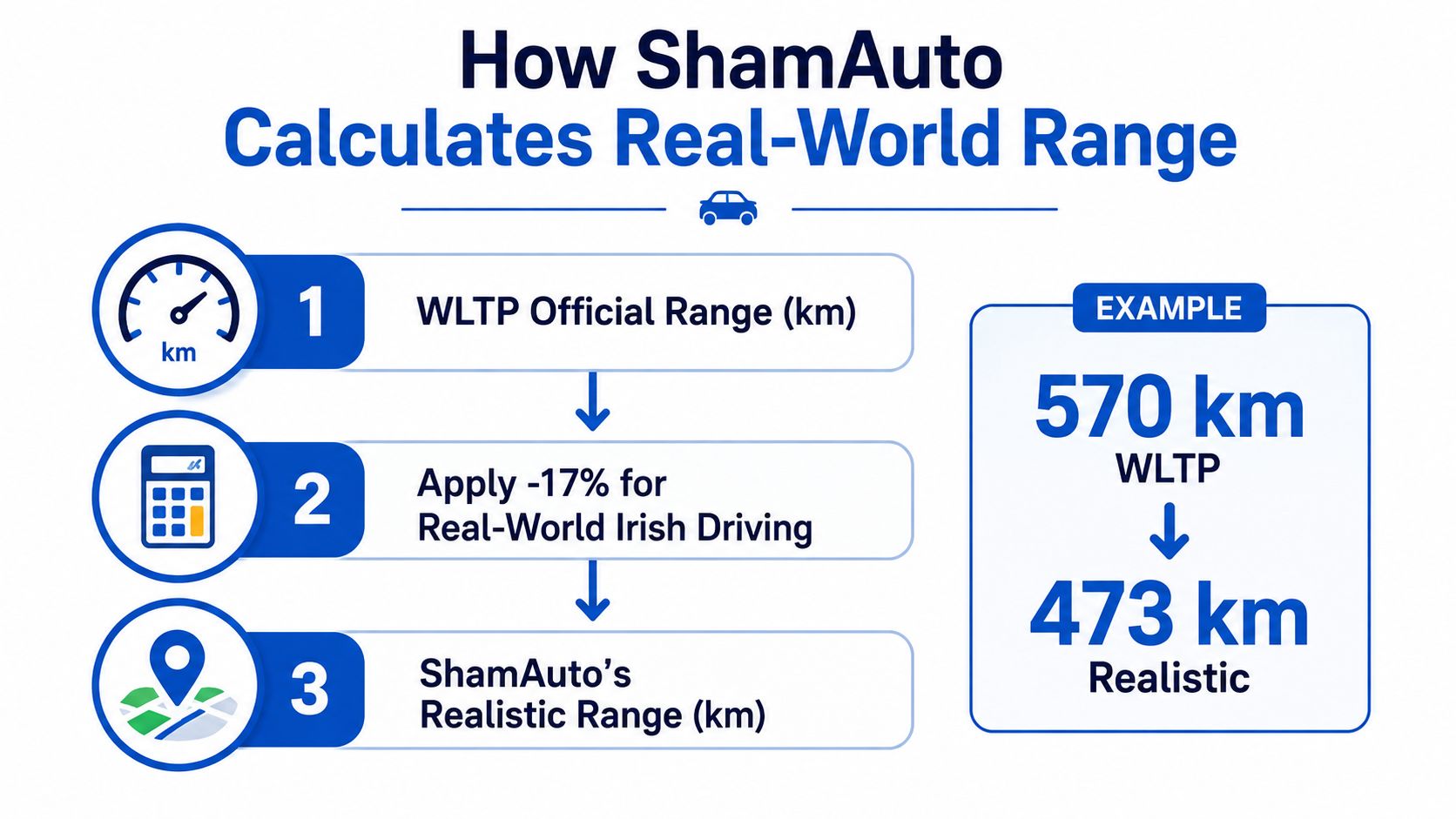
ShamAuto uses a simple WLTP minus 17% method for planning. It isn't trying to flatter the car, it's trying to stop people from overestimating what they'll get on Irish roads. For the Seal, that means the 570 km WLTP RWD Excellence becomes about 473 km, the 520 km WLTP AWD Excellence becomes about 432 km, and the 460 km WLTP Design becomes about 382 km.
A practical trip test helps make that real. The higher-range RWD Excellence is the version that can comfortably support a Dublin to Cork trip on a single charge in favourable conditions, but not a return without recharging. Motorway driving and winter weather reduce the margin fast. That's why a buyer should compare two separate numbers, the official WLTP for model-to-model comparison, and the conservative real-world figure for actual trip planning.
The smartest way to read a listing is to treat WLTP as the spec sheet and the adjusted number as the travel number. That keeps expectations grounded and stops a good car from being rejected for the wrong reason. The same applies across used EV shopping, but it matters especially with a saloon like the Seal, where trim and drivetrain can change the usable range in ways that don't show up at first glance.
For a worked Seal example, the planning guide at ShamAuto's BYD Seal real-world range page is the right place to sanity-check a listing before a viewing.
Battery State of Health and the Used-Seal Checklist
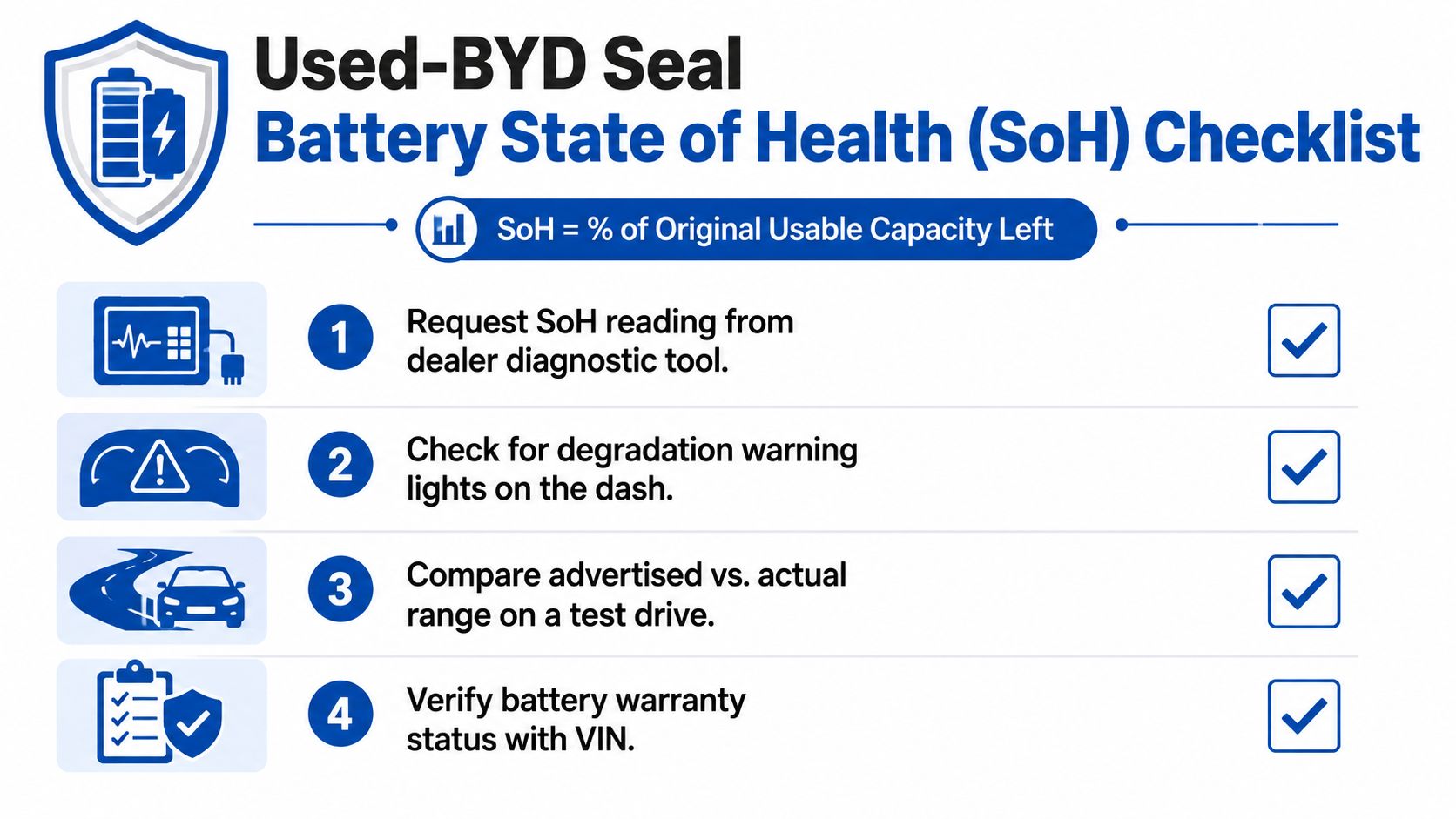
A used Seal lives or dies on State of Health. SoH is the percentage of original usable battery capacity that is still left, and it matters more than a clean odometer or a seller's reassurance. Get the diagnostic readout. That is the evidence that tells you whether the pack still has real headroom.
A Seal with strong SoH should go further on a charge and hold its value better than a similar car with a tired battery. Mileage alone does not show that. Battery health changes the shape of ownership, and it changes the price a sensible buyer should pay.
What a buyer should ask for
- Request a recent SoH screenshot. The seller should show a diagnostic reading, not just say the battery is "fine".
- Check the usable capacity against the variant. The figure has to match the specific Seal version, not a vague EV benchmark.
- Look for warning lights or battery faults. A clean dashboard still matters, because faults can hide behind a tidy exterior.
- Confirm charging equipment works properly. The car should accept 11 kW AC and CCS DC charging as expected.
- Check the car's life story. Heat history matters, so a car that has spent its life in harsher climates deserves extra scrutiny.
That is the right way to judge any used EV, and it fits the Seal well. The Blade LFP pack is a strength, but it does not replace proof. A neat-looking car with weak SoH is still a weak buy, and the asking price should reflect that.
Bring the checklist to the viewing and ask for the diagnostic proof early. Do not spend time talking about trim or paint until the battery evidence is clear. A buyer who skips SoH is guessing. A buyer who has the reading can negotiate properly.
For a more detailed battery health method, start with ShamAuto's guide to checking battery state of health before you buy, then use a broader battery health framework for used EVs to cross-check the rest of the inspection. The wider used-EV process is covered in ShamAuto's Irish EV buying guide, which helps line up the paperwork around the battery check.
Used Value, Irish Pricing Context and Where to Look
Used Seal pricing in Ireland should be judged against year, mileage, and verified battery health, not against a fantasy average. A car with a stronger SoH and the right variant for the buyer's daily use is the one that deserves attention. A cheap one with weak evidence doesn't.
The grant point is essential. Second-hand EVs do not qualify for the SEAI purchase grant, because that support applies to new eligible BEVs only. Buyers should not mentally subtract a grant from a used Seal price, because that money is not coming.
Irish incentives can still affect the wider picture, so it's wise to check the official SEAI and Revenue information before signing anything if the tax position or scheme rules matter to the deal. Those rules can change, and the buyer should rely on the live official source rather than a memory of last month's policy. The same caution applies to VRT and any price-cap-related detail.
For used shoppers, the useful comparison is against current listings, not against a made-up average. That's where a model page with battery and range data earns its keep, because the buyer can compare cars on usable facts instead of guessing from a badge alone. The Seal fits that approach well, because the car's variant, battery size, and real-world range are all meaningful in a second-hand decision.
ShamAuto's used-EV listings framework is built around that logic, with the Seal model data and SoH-first presentation sitting inside the broader used electric car buying guide for Ireland. It's a better starting point than treating every listing as if the battery were invisible. Right now, the smartest move is not to chase a headline price, it's to line up evidence and then judge the car on that.
The Honest Takeaway for an Irish Used-Seal Shopper
The BYD Seal makes sense when the battery is healthy, the range fits the buyer's routine, and the variant matches the use case. The Blade LFP pack is a good foundation for Irish driving, but it doesn't replace a verified SoH reading, and it doesn't make a tired battery magically good again.
The safest buying formula is simple. Choose the version whose WLTP minus 17% real-world range matches the daily distance with a margin for winter, confirm the car is automatic, and ignore any used-deal pitch that tries to smuggle in an SEAI grant. If the numbers line up, the Seal is a serious used EV. If they don't, the buyer should walk.
ShamAuto is newly launched, so early sellers and early buyers are helping shape the market as it grows. The next sensible steps are to check the Seal model data and the battery-health guide, then compare any listing against the evidence rather than the badge.
If a used BYD Seal is on the shortlist, ShamAuto gives Irish buyers a battery-first way to judge it, with real-world range framing, SoH checks, and EV-specific specs in one place. Visit ShamAuto to compare the Seal against the numbers that matter before arranging a viewing.