
EV Charging Ireland: A Practical Guide for Used EV Buyers
Contents
You've just bought a used EV in Ireland, and the first real question usually lands the moment the keys are in hand, where will it charge tonight, next week, and on the long drive you've been putting off. The honest answer is that ev charging ireland works well when the car, the charger, and the owner's habits line up, and gets frustrating when any one of those pieces is mismatched.
For used-EV buyers, the useful questions are rarely about slogans or range hype. They're about connector type, onboard AC speed, DC peak speed, and whether home charging is possible at all. That's where ownership gets practical.
Understanding AC and DC Charging in Ireland
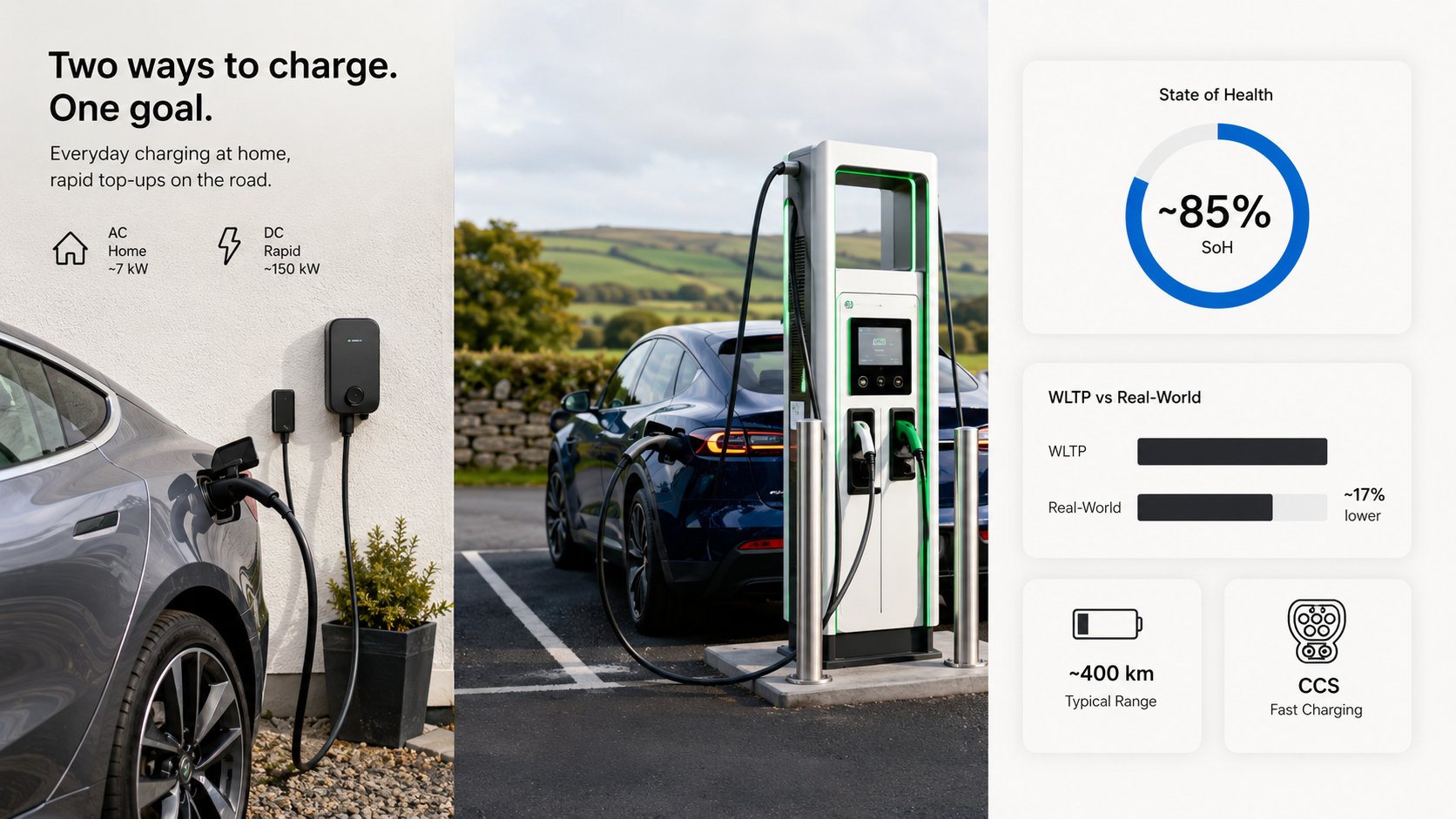
The first thing to get straight is that AC charging and DC charging do different jobs. AC is the slower, everyday option, the one that suits home charging, workplaces, and places where the car is parked for hours. DC is the faster public option, designed for top-ups on the move, where the charger does more of the work and the car spends less time plugged in.
The connectors you'll actually meet
In Ireland, Type 2 is the AC connector to expect on modern cars and home wallboxes. For DC rapid charging, most modern EVs use CCS Combo 2, while older cars such as the Nissan Leaf may use CHAdeMO, a shrinking DC standard that still matters because plenty of used Leafs are on the market.
That difference matters more than most first-time buyers think. A car can look well equipped on paper and still be awkward to live with if its fast-charging standard is fading out locally or if its DC peak is modest compared with your driving pattern. The safest habit is to check the car's own charging port before anything else, then match it to the charging network you'll use.
Why onboard AC speed still matters
A lot of buyers focus on public chargers and miss the car's onboard AC charger. That's the limit the car sets when it's plugged into AC power, so a post that looks powerful can still be bottlenecked by the vehicle itself. Typical onboard AC rates are 7.4 kW, 11 kW, or 22 kW, depending on model and trim.
For a used buyer, that's not a technical footnote. It decides whether a home top-up feels effortless or sluggish, and whether destination charging is useful or only convenient in theory. ShamAuto's guide on EV charging connector types is a useful place to cross-check the basics before a viewing.
Practical rule: if the car will spend most nights at home, AC speed matters more than headline DC speed. If it's for long commutes or frequent motorway runs, the DC connector and peak rate move to the top of the checklist.
Home Charging as the Core of EV Ownership
Home charging is where EV ownership becomes easy, or awkward. A typical home wallbox on a single-phase supply delivers about 7.4 kW, which is usually enough for overnight charging and daily use without any drama, especially for a used EV with a sensible commute and regular parking at home. That's why so many owners treat the driveway or assigned space as their primary charging centre.
The grant distinction that catches people out
The SEAI Home Charger installation grant is separate from the SEAI purchase grant. The home charger grant can apply to homeowners, including people who buy a used EV, while the SEAI purchase grant is for new cars only and does not apply to second-hand EVs, as set out by Citizens Information. That distinction matters, because plenty of buyers wrongly assume a used EV comes with the same support as a new one.
ShamAuto's home EV charger installation guide is a good companion if the property is being assessed for a wallbox. The practical question is not just whether the charger can be installed, but whether the current supply, parking layout, and cable route make the installation straightforward.
A home charger only feels expensive until it replaces repeated public charging. After that, it becomes part of the house, not just part of the car.
What good home charging looks like in practice
A smart setup is usually boring in the best way. The cable reaches comfortably, the unit is easy to schedule, and the car charges overnight without needing attention every day. That matters especially for used-EV buyers, because battery condition and range confidence improve when the car gets regular, predictable charging instead of repeated panic top-ups.
The key trade-off is simple. If the home setup is workable, ownership becomes routine. If it isn't, the driver ends up planning every week around public infrastructure, and the car feels less like a private vehicle and more like a project. For most households that can support it, home charging is the piece that makes the whole EV equation make sense.
Navigating Ireland's Public Charging Network
Ireland's public network has grown quickly, but the practical experience still depends on where someone drives and how much patience they have for legacy hardware. Ireland's public charging network has expanded quickly, but coverage and usable high-power capacity still vary by area.
What that means on the road
Charger counts tell a useful story, but they don't tell the whole one. Charger count alone does not guarantee usable high-power charging, because a site with a post available is not the same thing as a site with enough aggregate kilowatts for busy periods. Ireland's regional charging plan makes that point directly, by focusing on the total public charging power needed rather than just the number of plugs (ZEVI regional and local plan).
That's why long trips still benefit from planning, even in 2026. Motorway service areas are useful for rapid top-ups, but the experience is only smooth if the car can take advantage of the charger's power and the site has enough capacity when you arrive. The live operator pages for ESB ecars, EasyGo, and Ionity are more useful than any fixed price list, because tariffs and coverage move.
Public charging is for trips, not comfort
The public network works best as a supplement to home charging, or as the main option for drivers without access to private parking. It's reliable enough for many journeys, but it rarely feels as cheap or as simple as plugging in at home. Many Irish chargers still behave like legacy infrastructure, and some "fast" units are still only 50 kW in practice, which is fine for a coffee break but not ideal if someone expects a quick in-and-out stop.
For anyone mapping routes or buying a used EV for a long commute, the right question is not whether public charging exists. It's whether the network along the actual route is useful for the car's connector type and DC speed. ShamAuto's public charging in Ireland guide helps with that route-minded view.
Matching a Used EV to Your Charging Situation
A used EV should be bought like a tool, not a theory. The charging spec that works for one driver can be clumsy for another, even if both cars look similar on a forecourt. The best way to judge a listing is to start with the car's charging hardware, then compare it with the way the vehicle will be used.
The three specs that matter most
The first check is the DC connector. CCS is the practical standard for most modern EVs, while CHAdeMO usually points to an older model such as a Leaf, and that matters because public fast-charging support is changing around it. The second check is the car's DC peak charging rate, which decides how quickly it can use a rapid charger in actual use.
The third is the onboard AC rate, because that's what governs home and destination charging speed. A used EV with a modest DC rate can still be a fine ownership choice if it mostly sleeps at home and charges overnight. A driver who depends on motorway runs will want the opposite balance.
Battery health and range need a conservative view
Battery condition should be judged as State of Health (SoH), not by guesswork. SoH tells the buyer how much of the battery's original capability is still available, which is especially important on used EVs where age, mileage, and charging habits vary from car to car. ShamAuto's approach to range uses a cautious estimate, and a useful rule of thumb is real-world range = WLTP minus 17 percent.
That's not an optimistic salesman's number, and that's the point. It keeps the buyer honest about winter use, motorway speeds, and ageing batteries. If a car's quoted range only works in ideal conditions, it's the wrong car for a commuter who needs dependable daily cover.
Good habit: check the port, the charging rate, and the SoH together. Any one of those on its own can make a used EV look better than it really is.
Every EV is automatic, with a single-speed transmission, no clutch, and no gearbox in the normal sense. That simplifies the driving experience, but it doesn't simplify charging, which is why those charging specs need to be read carefully before a purchase.
Charging Without a Driveway or Private Parking
The hardest ownership case in Ireland is not the motorway driver, it's the household that can't charge at home. Around 30% of Irish households do not have easy access to private home charging (RTE Brainstorm), and that group includes many apartment dwellers, terraced homes, and semi-detached homes without driveways.
The practical alternatives
On-street charging helps where local authorities have installed it, but availability is uneven and often depends on the neighbourhood rather than the county headline. Workplace charging can fill the gap if an employer offers it, though that still depends on parking access and whether the car can sit long enough to benefit. Public charging remains the fallback, but it changes the economics sharply because home charging is usually much cheaper than public charging.
That cost gap is what shifts the ownership question. A driver with no driveway can still run an EV sensibly, but the route, commute length, and local charging map matter much more than they do for someone with a wallbox at home. If the car spends its life on public chargers, the budget needs to reflect that from the start.
A sensible way to judge the fit
The best test is simple. Before buying, check whether there are chargers near the home, the office, and the routes used most often. Then ask whether those chargers are useful for the specific EV under consideration, because a compatible connector and a decent DC rate matter more than a high-level network map.
A used EV can still make financial sense without private parking, but only if the charging plan is realistic. If the local area has poor coverage or the commute demands frequent public top-ups, the savings shrink fast and the convenience disappears just as quickly.
Where to Find Current Grant and Tariff Information
Charging costs, grant rules, and scheme dates change often enough that fixed figures go stale quickly. The safest habit is to check live official sources before you buy a car or book an installation. For home-charger grants and scheme eligibility, use SEAI. For tax and vehicle policy, gov.ie is the place to check. For live public charging tariffs, look at ESB ecars and the other network operators. For plain-English ownership guidance, Citizens Information is still one of the clearest references.
One point should stay clear if you are buying used. Citizens Information makes clear that the SEAI purchase grant applies to new cars only, within an SEAI price cap, so second-hand EVs do not qualify for the purchase grant. Readers should check the current grant amount and price cap on SEAI (Citizens Information). That purchase grant is separate from the home-charger grant, which follows a different set of rules.
For charging-spec checks, the most useful ShamAuto pages are the used EV buying guide and ShamAuto. They help buyers compare cars on the details that matter in Ireland, including connector type, AC charging rate, DC peak speed, and how those specs fit the public chargers and home charging options a real owner is likely to use.
If you are buying or selling a used EV and want the charging side understood properly, use those guides to match connector type, charging speed, and battery health to the way the car will be driven in Ireland.