
Home EV Charger Installation in Ireland: A Practical Guide
Contents
- Why the Charger Decision Starts Before You Buy the Car
- Checking Your Property Before You Book a Charger Quote
- Choosing the Right Charger and Power Rating for an Irish Home
- The Actual Installation Workflow From Survey to First Charge
- What Really Drives the Cost and How Long It Takes
- The Three Questions That Separate a Proper Install From a Basic Socket
- From a Working Charger to the Right Used EV
A home EV charger installation looks simple from the kerb. The car is parked, the boot holds a charging cable, and the next question is whether the property can take a proper wallbox without turning into a wiring project. In Ireland, that question matters more than the badge on the car, because the home itself decides whether charging is straightforward, awkward, or impossible without changes.
For most homes, the everyday target is a 7.4 kW single-phase charger with a Type 2 connector. That is the practical default for overnight charging, while 11 kW usually means three-phase supply, which is uncommon in Irish houses. If the property has off-street parking, a sensible electrical supply, and a clear route back to the fuse board, the job is usually manageable. If it does not, the conversation changes before any charger model should be chosen. See the used-EV buying basics on ShamAuto
Before a quote is even sensible, three practical questions have to be answered.
Can the car park beside the charger? Off-street parking changes everything, because home charging is easiest when the charger can be mounted where the cable can reach the vehicle without awkward routing.
How far is the fuse board from the parking space? Longer cable runs add complexity and usually drive cost more than the charger box itself.
Does the electrical supply have room for a dedicated EV circuit? A charger is a permanent fixed load, so the home's capacity needs to be checked properly, not guessed.
Practical rule: the first survey should be about the property, not the brand of wallbox. A charger can only go where the parking, cable route and supply capacity allow it.
Why the Charger Decision Starts Before You Buy the Car
The smartest time to think about a home EV charger installation is before the car purchase, not after the keys are handed over. That is especially true for used EV buyers, because the home setup shapes which cars make sense for daily life. A driver with a driveway and a sensible electrical supply can treat home charging as the main refuelling method, while a driver in a terrace, apartment, or rented home may need a different plan altogether.
That reality is often missed in generic charger advice. In practice, home charging is easiest with a driveway or private parking space and much harder for apartment residents, tenants, and households without off-street parking, which is why property type comes first, not charger model.
Start with the parking, not the charger
The car itself does not determine whether the install will work. The parking layout does. A house with a front driveway and a wall close to the fuse board can often support a clean install, while a home with roadside parking or a shared forecourt may need landlord or body-corporate approval, or a separate scheme if it is a shared-parking arrangement.
That is why off-street parking is the quiet deciding factor in so many Irish jobs. A charger is not a portable accessory, it is fixed equipment, and the cable must safely reach the car where it sits.
Treat apartments and rentals as different cases
Apartments and rented homes are not failed versions of the same job, they are different jobs. Shared parking, landlord permission, cable routes through common areas, and older wiring layouts can all change what is possible. In those situations, the answer is not usually "buy a different charger", it is "check the property pathway first".
A property with no easy cable route does not need a cheaper charger, it needs a different charging plan.
For anyone comparing used EVs, that practical check matters because the right car depends on whether overnight home charging is realistic. Once the property is understood, the charger choice becomes much easier to judge and the purchase decision becomes less guesswork and more fit-for-purpose.
Checking Your Property Before You Book a Charger Quote
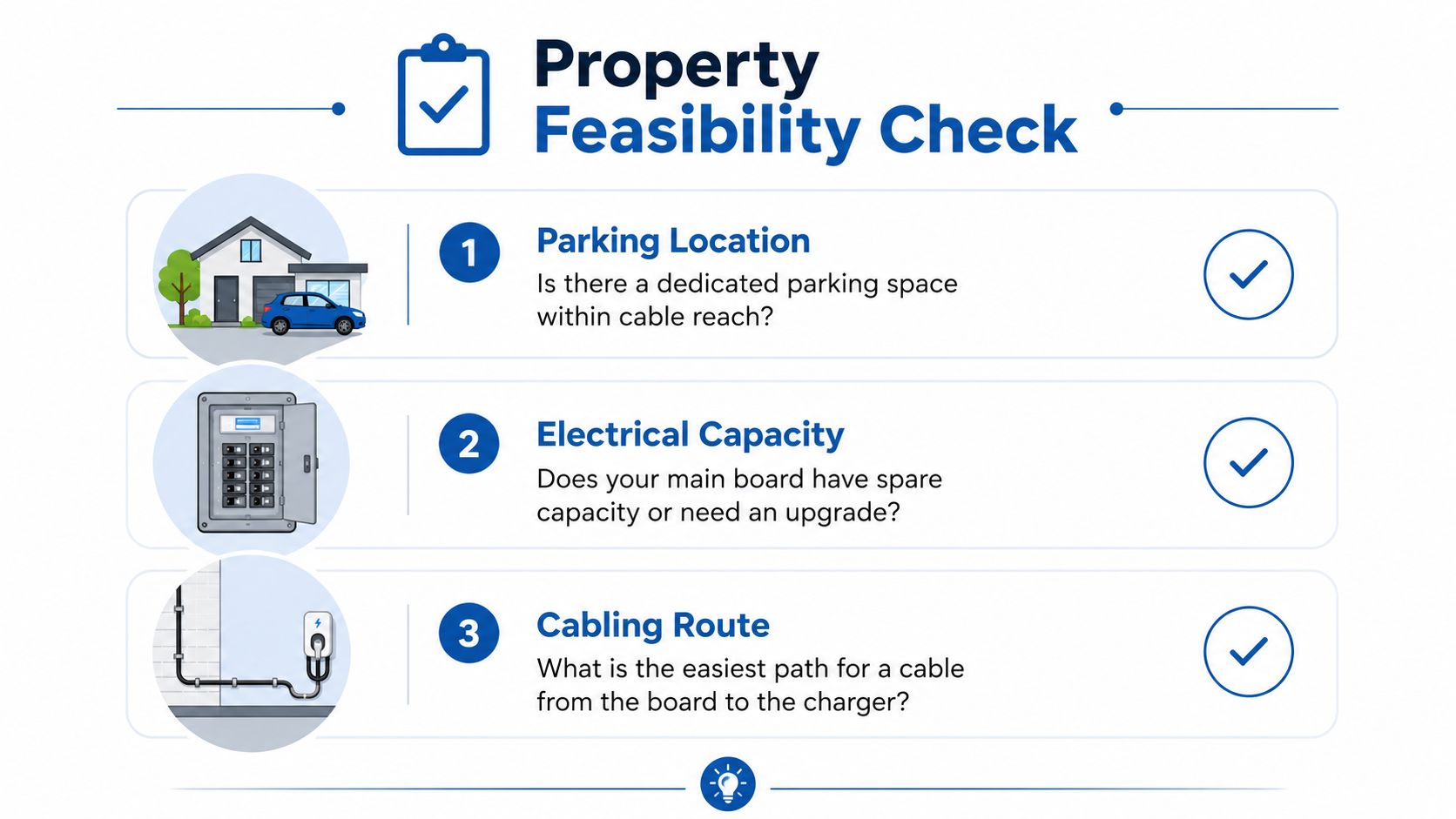
A proper site survey is really a short feasibility check. The electrician is trying to answer one question, can a dedicated EV circuit be added safely without turning the home into an upgrade job. In Ireland, that means looking at the parking place, the wiring path, and the supply capacity before talking about the wallbox itself.
Parking location and cable reach
The first thing to check is where the car will stand. If the charger has to sit on the opposite side of the house from the parking space, the cable route becomes longer, less tidy, and more expensive to install. If the space is right beside the wall where the unit will be mounted, the job is normally simpler and neater.
Electrical capacity and the main board
The second check is the consumer unit or fuse board. Irish homes vary a lot, and older boards often need attention before a new EV circuit is added. ESB Networks says home EV charger installation must be carried out by a registered electrical contractor, and that new or upgraded installations generally need a compliant electrical completion certificate because the charger is a permanent fixed load rather than a plug-in appliance. ESB Networks guidance
Cabling route and practical layout
The third check is the route from the fuse board to the charger. A straightforward wall-mounted run along an exterior wall is very different from a route that needs extra clipping, longer drilling, or more protection. Installation guidance also says the charger should be mounted at the manufacturer-specified height, typically 1 to 1.5 m from the ground to the centre, with cable routing planned from the consumer unit to the charger location and a local isolator fitted if it is not built into the unit. Installation guidance on charger layout
That survey should stay quick. It is there to spot whether the house is ready, whether the wiring needs an upgrade, or whether the home needs a different approach before a quote can be trusted.
Choosing the Right Charger and Power Rating for an Irish Home
Once the property makes sense, the hardware choice gets simpler. For most Irish homes, the right answer is a 7.4 kW single-phase wallbox with a Type 2 connector. That combination fits the way most domestic supplies are arranged, and it matches the everyday use case of plugging in overnight and waking up to a full battery.
The less common option is 11 kW three-phase charging, which needs a three-phase supply. That can be useful in the right property, but it is not the everyday norm in Irish houses. A basic three-pin socket can still work as an emergency fallback, but it should be treated as a temporary option rather than the main charging plan.
What the power rating really means
The wallbox does not set the charging speed on its own. The car's on-board charger sets the ceiling for AC charging, so a more powerful wallbox will not make a car charge faster than the car can accept. That is why chasing the biggest number is usually the wrong instinct. The goal is a charger that matches the home supply, the car, and the normal overnight routine.
Type 2 is the common standard
For a buyer or homeowner, Type 2 means the connector most modern EVs in Ireland are built around for AC charging. It simplifies daily life because the same basic connector standard applies across most current models, which makes a used EV easier to live with and easier to compare.
| Home EV charger options in Ireland | Typical power | Phase needed | Typical use |
|---|---|---|---|
| Standard home wallbox | 7.4 kW | Single-phase | Everyday Irish home charging |
| Higher-output wallbox | 11 kW | Three-phase | Homes with suitable three-phase supply |
| Emergency socket charging | Lower, slower charging | Single-phase domestic socket | Temporary fallback only |
A good installer will also care about how the unit is mounted and routed. The height, the isolation point, and the cable path are part of the installation itself, not afterthoughts, because safe positioning matters as much as the box itself.
The Actual Installation Workflow From Survey to First Charge
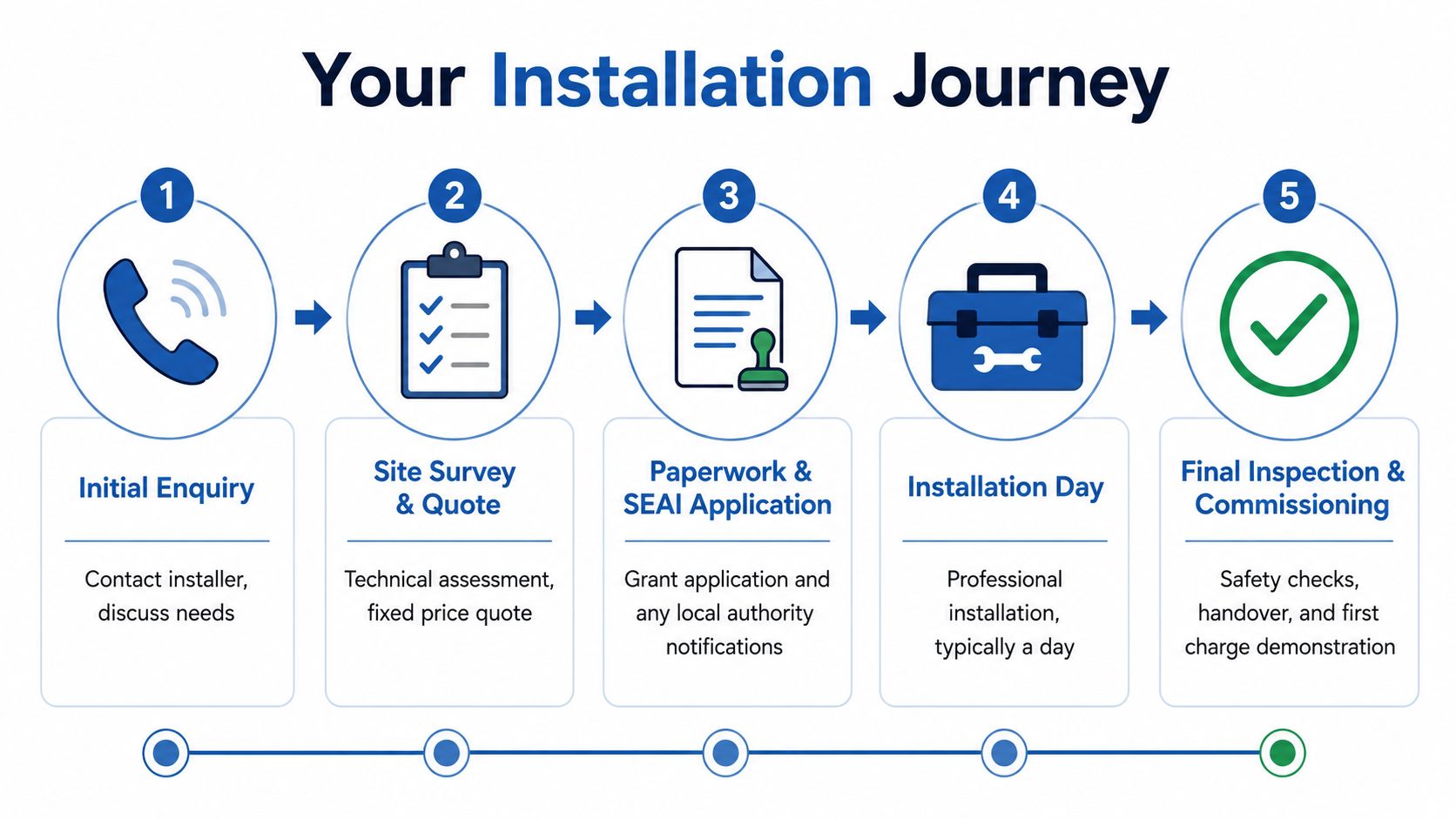
A proper home EV charger installation follows a familiar sequence, even if every house is a little different. It starts with a site survey, continues with a written quote, moves through the Safe Electric registered installer, and ends with testing, certification, and the first proper charge. The physical work itself is often fairly short, but the paperwork and any supply upgrade can stretch the overall process.
What happens before the drill comes out
The first contact is usually a technical conversation about parking, supply, and charger type. The electrician then checks whether the chosen charger is suitable for the property and whether any extra electrical work is needed. If the home needs a supply check or a board upgrade, that should be visible in the quote, not discovered on installation day.
What the installer actually does on site
The electrician mounts the unit, runs the cable, fits the protective devices, and then tests the system. Recent Irish installer guidance also notes that hidden costs can come from earthing and bonding work, consumer-unit upgrades, surge protection, and Wi-Fi or network connectivity for smart chargers, which is exactly why a quote should be broken down clearly. Installer guidance on hidden costs
A neat install is not just the wallbox on the wall. It is the route, the protection, the testing, and the certificate that proves the job was done properly.
Why the certificate matters
ESB Networks says new or upgraded installations generally require a compliant electrical completion certificate. That document matters because it confirms the fixed wiring was completed by a registered contractor and the job was signed off correctly. For a house sale later on, that paperwork is part of the story, not just the charger hardware.
If the SEAI grant is being claimed, the installer also needs to handle the paperwork correctly, and the charger has to meet the scheme requirements. A smart charger is not just convenient, it is part of the grant logic and it also helps with cheaper night-rate charging.
What Really Drives the Cost and How Long It Takes
A home EV charger quote is shaped more by the house than by the charger badge. The biggest cost drivers are usually the cable run from the fuse board to the charger location and any consumer-unit or fuse-board upgrade needed to make the circuit safe and compliant. Two homes can end up with very different prices for the same wallbox because the electrical work is rarely the same.
Timing follows a similar pattern. The physical install is often a matter of hours, while the delay usually comes from booking a Safe Electric registered installer, dealing with the SEAI paperwork if a grant is involved, or waiting for a supply upgrade where the board or incoming feed needs attention.
Why quotes vary so much
The quote changes when the route gets longer, the board is older, the install needs extra protection, or the property needs a smarter load management approach. A home with easy access from the fuse board to the parking space is a very different job from a property where the cable has to travel a long distance or where the board needs replacing first. That is why it makes sense to get more than one quote and compare them on the same assumptions.
The install location matters too. If the charger can go on an outside wall close to the supply, the job is usually simpler. If it has to cross a hallway, go through a garage, or work around awkward cable routes, the labour and materials go up. For anyone trying to budget the charging side of ownership, our guide to the cost to charge an EV at home gives a useful running-cost view alongside the installation quote.
What the grant does and does not do
The SEAI Home Charger Grant is described on SEAI as support of up to €300 for an approved smart charger installed by a Safe Electric registered installer, and the current rules should always be checked directly because scheme conditions can change. SEAI also has a separate path for apartment and shared-parking situations, so flat dwellers should not assume they are excluded just because the standard driveway route does not fit. Check the current SEAI home charger grant rules
The grant is useful, but it should not be the basis of the buying decision. The home has to work first.
For anyone planning the budget around a used EV, the cleaner approach is to treat the charger quote as a site-specific job and the grant as a bonus where eligible. That keeps the numbers grounded and avoids nasty surprises when the electrician finds an old board or a longer cable run.
The Three Questions That Separate a Proper Install From a Basic Socket
A proper EV-native setup should stand up to three blunt questions. If the answers are vague, the quote needs another look. If the answers are clear, the homeowner can compare installers on the same basis instead of comparing slogans.
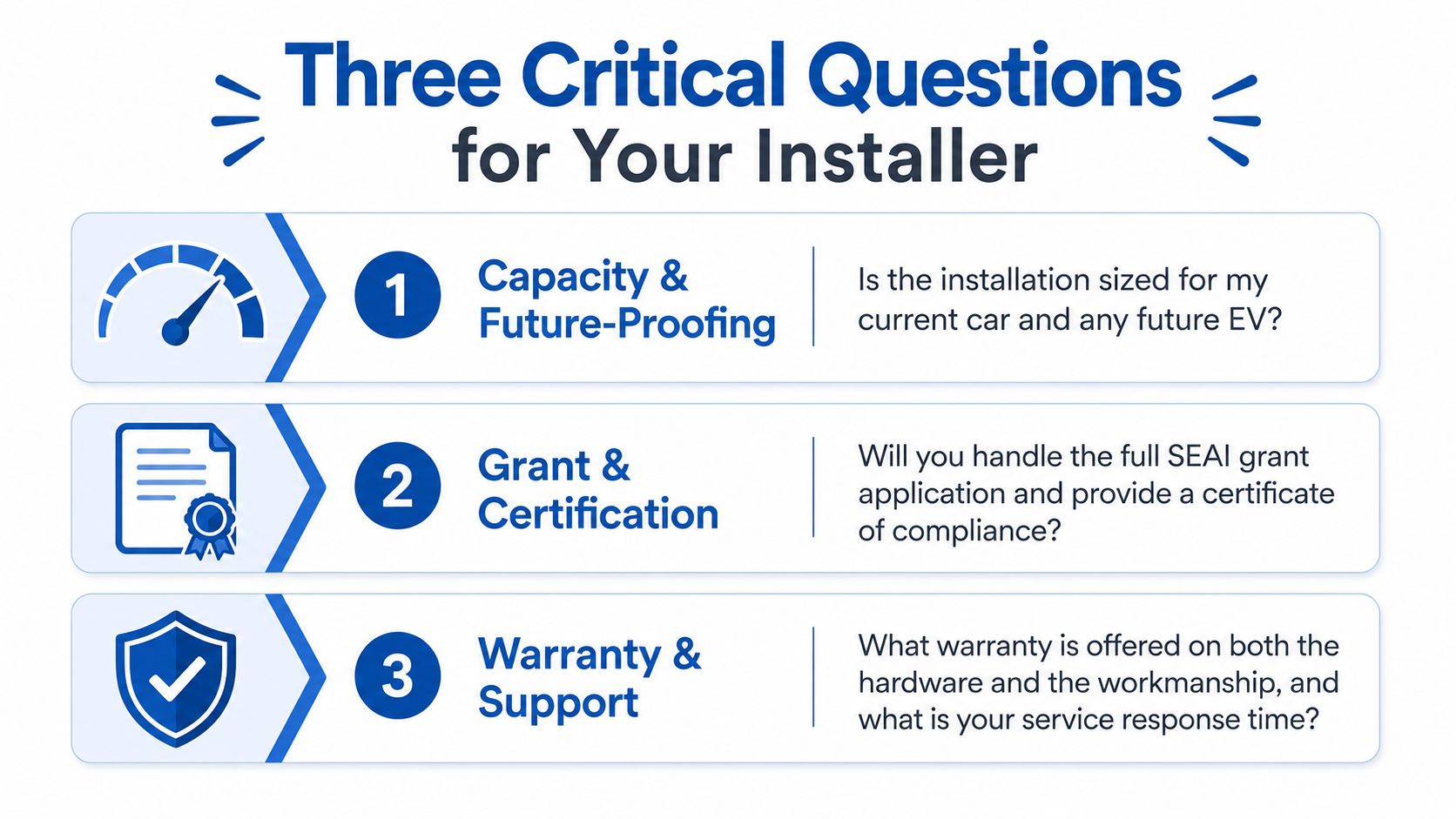
Capacity and future-proofing
The first question is whether the job is sized for the current car and any future EV. That means asking if the fuse board and supply can take a 7.4 kW charger comfortably, or whether an upgrade is already built into the plan. It also means checking that the contractor is Safe Electric registered and that the charger is on the SEAI-approved list if the grant is being claimed.
Grant and certification
The second question is whether the installer will handle the paperwork properly and provide the compliance certificate at the end. A good answer should mention the electrical completion certificate without hesitation, because that is part of a correct domestic fixed-load installation. A vague "don't worry about that" response is not good enough.
Warranty and support
The third question is what happens after commissioning. The homeowner should know what warranty covers the hardware, what warranty covers the workmanship, and who to contact if the charger drops connectivity or the app stops communicating. Smart chargers are useful, but they do rely on the home's network setup, so support matters more than many quotes admit.
Three questions worth asking are simple:
Are you Safe Electric registered, and is the charger SEAI-approved?
Will my fuse board and supply take a 7.4 kW charger, or is an upgrade needed?
Is it a smart charger, and what paperwork and certificate will I receive?
Those questions cut through the noise fast. A real EV-ready install should answer them cleanly, not dodge them.
From a Working Charger to the Right Used EV
Once the driveway has a working charger, the used-EV decision gets more honest. The car no longer needs to be chosen around public charging anxiety first, which means battery State of Health (SoH) and realistic range move to the front of the queue. That is especially useful for Ireland, where property type and charging access can change the value of a used EV more than the badge alone.
Real-world range should be treated cautiously, with WLTP minus 17 percent as the standard comparison frame. That keeps expectations grounded when comparing listings, especially for buyers who want enough usable range for daily life rather than brochure optimism. Every EV is automatic too, with a single-speed drive and no clutch or gearbox to think about.
ShamAuto's used automatic cars guide is a useful place to start if the next step is comparing EVs on real specs instead of guesswork. The other guides are equally relevant for buyers who are still working out whether home charging, apartment charging, or the buying process itself needs attention first: charging a used EV at home in Ireland, charging an EV in an apartment in Ireland, and buying a used EV in Ireland.
Once the charger question is sorted, the next move is simple. Browse ShamAuto, and if you are a private seller or dealer, be among the first to list while the marketplace is still new.