
Dacia Spring Ireland: Honest Used Buyer Guide 2026
Contents
The popular advice is simple: buy the cheapest EV in Ireland, charge it at home and enjoy low running costs. That advice skips the important part. A used Dacia Spring is only a sensible bargain when its State of Health (SoH), realistic range and charging history match the buyer's daily driving. A low purchase price won't rescue a car that leaves too little usable range for an ordinary Irish commute.
The Spring is a four-seat, automatic, single-speed city EV. It has no clutch or conventional gearbox, and its strengths are clear: light weight, easy parking, modest energy use and a purchase price that made it Ireland's cheapest new EV at launch. Its weaknesses are just as clear: a small battery, limited motorway ability, slow rapid charging, basic equipment and a poor Euro NCAP safety result.
For a budget buyer, the right question isn't whether the Dacia Spring Ireland price looks attractive. It's whether the car still works after cold weather, wet roads, motorway speeds and battery ageing are allowed for.
The Reality of Buying a Used Dacia Spring in Ireland
The Spring's cheapest-EV reputation is useful only as a starting point. It launched as one of the most affordable new EVs on the Irish market, with its new price including the SEAI purchase grant at the time.
That history matters to used buyers. A car sold cheaply when new doesn't automatically become good value second-hand. The original grant was applied to new-car transactions, not transferred as a benefit to a later owner. Second-hand EVs don't qualify for the SEAI purchase grant, because SEAI says that support applies to new cars only, with the dealer deducting it at the point of sale. The SEAI electric vehicle grant guidance should be checked for current scheme rules before any purchase decision.
Why the small pack changes the risk
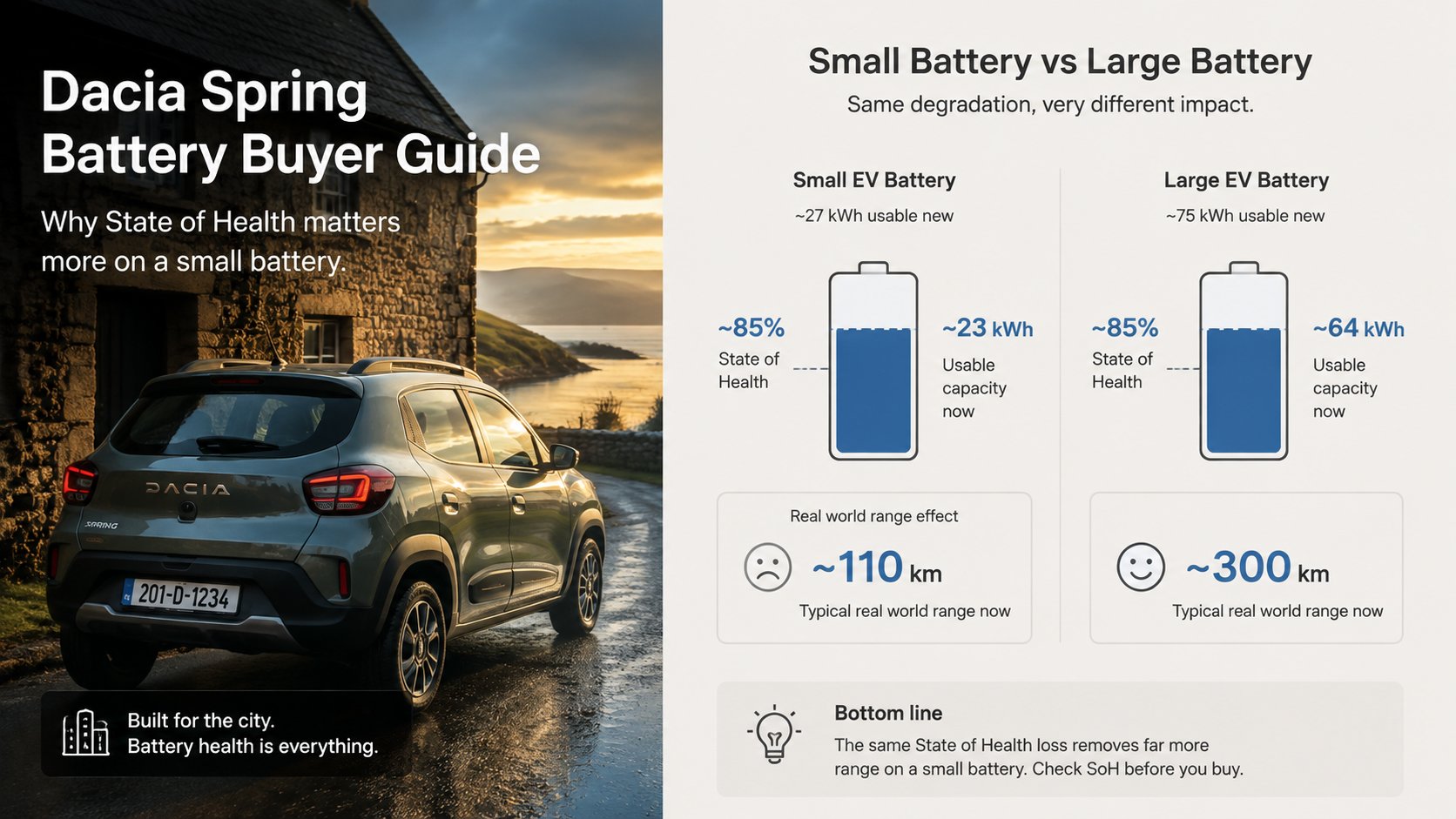
The Spring uses a 26.8 kWh usable battery, so every lost unit of capacity matters. A larger EV can often absorb some degradation without changing a daily routine. In the Spring, a modest reduction can remove the reserve that makes a return journey comfortable.
Used examples may have spent their lives as urban runabouts, which can mean low mileage but frequent short trips and repeated charging. Others may have been used on rural roads where the car's limited range and slow charging were a poor fit from the outset. Neither history proves a problem, but both are reasons to demand evidence rather than judge the car by mileage alone.
Practical rule: A cheap Spring without a verified SoH is not a cheap Spring. It is an unknown battery purchase.
Used value depends on year, mileage, trim, equipment, accident history and verified SoH. Asking prices on general classified sites can move quickly and aren't a substitute for a battery report. Buyers should compare the actual car with current Irish listings, then adjust for missing records, lower SoH and charging limitations. The single biggest mistake is negotiating over cosmetic defects before establishing how much usable battery capacity remains.
Real-World Range and Battery Specs for Irish Roads
Dacia's Irish technical information gives the Spring a 26.8 kWh usable battery and 225 km WLTP range, as shown in the Dacia Ireland price and specification material. The same 225 km WLTP figure appears in the Irish Dacia Spring technical specification listing.
That number is useful for comparing cars, but it isn't the number a buyer should plan around. ShamAuto's cautious catalogue method applies WLTP minus 17%, which puts this Spring at about 187 km of real-world range. The calculation is deliberately straightforward: 225 km less 17% gives approximately 187 km. The Dacia Spring real-world range guide for Ireland uses that framing so buyers don't confuse a laboratory figure with an everyday reserve.
What the Irish figure means
The Spring's low mass helps it use energy efficiently, but it can't overcome the size of the battery. Cold weather, rain, heating, strong winds, hills, heavy loads and sustained motorway speed can all reduce the usable distance further. A driver travelling at higher speeds on exposed routes such as the M1 or N7 should leave a proper margin rather than treating 187 km as a guaranteed route distance.
The 65hp version is the more usable choice outside town, but it remains a small city EV rather than a long-distance car. County-to-county journeys may be possible with planning, yet the slow DC charging rate makes an unplanned top-up more inconvenient than it would be in a larger, faster-charging EV. Dublin to Bray, Cork to Midleton and repeated Galway city errands can suit the Spring when the daily pattern is predictable. A long rural commute with limited charging at either end is a different proposition.
The useful test is not whether a route fits inside the official range. It is whether the driver can complete the normal day while retaining a sensible reserve for diversions, weather and a missed charging opportunity.
| Driving scenario | WLTP official (km) | Real-world Ireland (km) | Notes |
|---|---|---|---|
| Controlled WLTP comparison | 225 | About 187 | The real-world figure applies the WLTP-minus-17% rule |
| Urban and suburban use | 225 | About 187 before conditions | Predictable trips suit the Spring best |
| Wet, cold or windy driving | 225 | Lower than the baseline | Heating, weather and wind reduce reserve |
| Sustained motorway driving | 225 | Lower than the baseline | Speed makes the small battery feel smaller |
For a broader view of how official figures compare with practical Irish driving, the electric car range comparison guide is more useful than a brochure headline. It encourages buyers to compare usable range across models using the same cautious basis.
Why State of Health Matters More on a Small Battery
State of Health, or SoH, describes the battery's condition compared with its original usable capacity. It matters in every used EV, but it matters more in the Spring because the starting battery is small. A lost slice of capacity isn't just an abstract percentage. It reduces the distance available for the same school run, commute or return trip.
A buyer shouldn't accept a seller's dashboard range estimate as proof of battery condition. That estimate changes with recent driving, temperature and driver behaviour. It can be a useful clue, but a diagnostic reading is stronger evidence.
How to verify a used Spring battery
A sensible inspection follows an evidence trail:
- Request a diagnostic report: Ask for a battery health certificate from a Dacia dealer, or an independent diagnostic report that identifies the traction battery and gives the SoH reading.
- Use an OBD2 check: An OBD2 dongle and suitable EV diagnostic software can provide useful battery information, but the buyer should confirm that the tool reads the Dacia's traction battery correctly rather than only generic fault codes.
- Check usable capacity: SoH is important, but the report should also identify usable battery capacity where available. A percentage without context is less useful than a documented reading tied to the car's battery.
- Compare the estimate with evidence: The dashboard range should broadly make sense alongside the SoH and recent consumption. A surprisingly low estimate needs an explanation, not an assumption.
- Record the reading before purchase: The report should show the vehicle identification details and date so the result belongs to the car being bought.
The guide to checking battery SoH before buying gives buyers a practical framework for requesting that evidence. The same principle applies to a used Nissan Leaf electric car, although the diagnostic process and battery design can differ by model.
What a reading means in practice
There isn't a universal SoH number that makes every used Spring acceptable. A higher reading supports confidence, while a lower reading should reduce the price or rule the car out. The buyer should also ask whether the battery warranty remains active and what its terms cover. A warranty may address battery defects or a defined capacity threshold, but it doesn't turn normal ageing into a free upgrade or compensate for an unsuitable range.
The correct decision is therefore combined, not percentage-only. A Spring with strong SoH, complete records and a price matching its age can be sensible. A lower-SoH car may still suit a strictly local driver, but only if the price reflects the reduced range and the buyer can live with the loss every day.
Charging Speeds and Infrastructure Limitations
The Spring's charging system is adequate for a city car and frustrating for a touring car. Irish technical information places AC charging at 7 kW, while DC rapid charging is about 30 to 34 kW. Dacia's charging guidance gives roughly 35 to 45 minutes for a 20% to 80% DC charge, depending on the specific setup, and a full home charge takes about 4 hours on a 7.4 kW wallbox or about 11 hours from a domestic outlet. Those figures come from Dacia Ireland's charging guidance.
The trim detail matters. Only the 65hp version received DC rapid charging, while the lower-power version did not, according to Irish-market reporting on the Spring. A buyer must check the exact car and equipment rather than assume every Spring can use a rapid charger.
Home charging is the deciding factor
A wallbox makes the Spring much easier to live with because the car can be replenished while parked overnight or during a normal day at home. A domestic socket can work for low daily mileage, but it offers less convenient recovery and depends on a safe, suitable electrical connection. Buyers should have the installation assessed properly rather than relying on an extension lead or an improvised outdoor arrangement.
Public charging should be treated as a backup. The Spring's low DC rate means a rapid stop adds range slowly compared with newer EVs, and the driver may spend a substantial portion of a journey waiting for a relatively modest energy gain. That isn't a problem for occasional emergency use. It is a poor foundation for a weekly long-distance commute.
| Charging method | Power output | Full charge | 20% to 80% DC charge |
|---|---|---|---|
| Domestic outlet | Not specified in the cited Dacia guidance | About 11 hours | Not applicable |
| Home wallbox | 7.4 kW | About 4 hours | Not applicable |
| AC charging | 7 kW | About 4 hours in suitable conditions | Not applicable |
| DC rapid charging | About 30 to 34 kW | Not the normal use case | Roughly 35 to 45 minutes |
The Irish EV charging guide helps buyers assess whether home charging, workplace charging or public charging fits their routine. For the Spring, access to dependable home charging isn't a luxury. It is a major part of the car's practicality.
Safety Ratings and Equipment Trade-Offs
The Dacia Spring's low price comes with a safety and equipment compromise that buyers shouldn't minimise. The model scored poorly in Euro NCAP testing, receiving a low star rating, so the Euro NCAP Dacia Spring assessment deserves attention before purchase.
The rating reflects the car's limited active safety assistance and overall protection performance. A low-speed town journey is a different environment from a motorway trip, but safety doesn't become irrelevant because the car is small. The Spring's natural use case reduces exposure to high-speed driving. It doesn't erase the reason for the poor rating.
What the cabin gives and leaves out
Equipment varies by trim and model year, so the exact car needs checking. Buyers may find straightforward infotainment with smartphone mirroring, manual air conditioning and rear parking sensors on better-equipped versions. The cabin is functional rather than luxurious, and the basic materials are part of the price equation.
The missing equipment can matter more than the brochure suggests. Buyers shouldn't expect the driver assistance, comfort features or refinement found in larger and newer EVs. Seat support and noise levels become more noticeable as journeys get longer, which reinforces the city-only recommendation.
The grant position also changes the used-value argument. A new BEV may qualify for the SEAI purchase grant when the transaction meets the scheme rules, but a used buyer receives no SEAI purchase grant. SEAI's used-EV guidance explains that purchase grants and VRT relief apply to new cars, while used buyers may still qualify for separate supports such as a home charger grant or reduced tolls, subject to current rules.
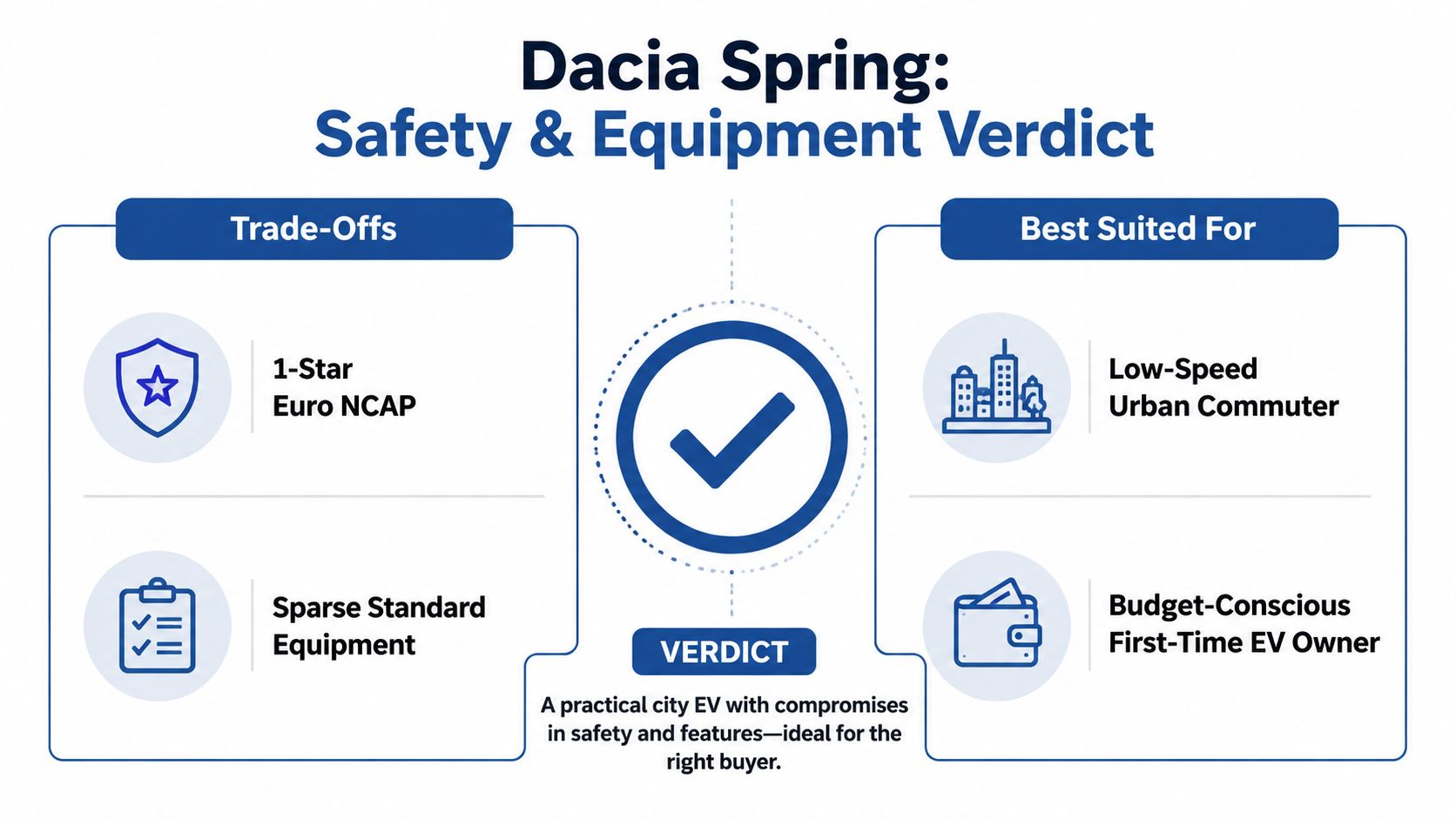
The verdict is narrow but clear. The Spring suits a budget-conscious first-time EV owner, a second car, local errands and short urban or suburban commuting. It isn't the right primary family vehicle, high-speed motorway car or rural all-rounder. Safety expectations, passenger space and charging speed should be accepted before the price becomes tempting.
Your Pre-Purchase Checklist and ShamAuto Verification
A viewing should begin with the battery report, not the paintwork. The Dacia Spring is simple enough to inspect, but its small battery makes missing information expensive. A buyer who confirms history, SoH and charging operation can judge the car properly. A buyer who relies on mileage and a clean interior is guessing.
Before the viewing
Start with the vehicle identification number, mileage history and ownership records. Check for outstanding finance, insurance write-off markers, gaps in service history and inconsistencies between invoices, NCT records and the dashboard. A low-mileage car with unexplained periods off the road deserves more questions, not automatic approval.
The battery evidence should show the State of Health, usable capacity where available and the date of the diagnostic check. The advertised WLTP figure should be converted to the cautious catalogue estimate of about 187 km before the buyer compares it with daily routes. The seller should also confirm whether the car is the 45hp or 65hp version and whether DC rapid charging is fitted.
At the car
- Inspect the charging port: Look for corrosion, moisture, damaged pins, loose connections and a flap that doesn't seal properly.
- Test AC charging: Confirm that the car starts charging cleanly and doesn't interrupt the session.
- Test DC charging where possible: Check that the CCS connection engages and that charging begins without repeated handshake failures.
- Read the 12V system: A weak 12V battery can create confusing electrical faults, especially on a car that has spent long periods parked.
- Examine the underside and suspension: Check tyres, brake condition, shocks, bushes and links for wear caused by rough local roads.
- Run every electrical feature: Test the screen, phone connection, heating, ventilation, lights, sensors and charging indicators.
- Drive beyond the block: Listen for suspension knocks, check steering feel and assess whether the seat and cabin remain tolerable for the buyer's normal journey.
The used EV buying guide for Ireland sets out the wider checks that apply across electric models. ShamAuto is an EV-only Irish marketplace that standardises usable battery, charging and range information, and can display a verified SoH badge when a seller provides diagnostic evidence. It is a useful comparison point, but no marketplace report replaces an independent inspection of the individual car.
Negotiating the right price
Missing records, an absent SoH report, charging faults or a battery reading that doesn't match the advertised condition should affect the offer. A seller who can't provide basic battery evidence may still have a perfectly usable car, but the buyer is carrying the uncertainty and should price that risk accordingly.
Current tax, VRT and incentive rules can change. Buyers should check the live information from SEAI, Revenue and Citizens Information before completing a transaction.
ShamAuto gives Irish EV buyers a focused place to compare used electric cars using SoH evidence, usable battery data and cautious range estimates rather than vague claims. Visit ShamAuto to review the Dacia Spring guidance, understand what sellers should disclose and be among the first to list or find a properly documented car as the marketplace grows.