
Used Nissan Leaf Electric Car Guide for Irish Buyers

Contents
- Why a Used Nissan Leaf Is a Battery-First Purchase
- The Two Leaf Variants Worth Considering
- The Honest Leaf Limitations Buyers Should Know
- Verifying Battery State of Health Before You Buy
- Matching Real-World Range to Your Irish Driving
- What to Check When Viewing a Used Leaf
- Pricing, Grants, and Listing on ShamAuto
A used Nissan Leaf electric car looks simple on the surface. It's a tidy electric hatchback, automatic by design, easy to size up, and usually cheap enough to tempt petrol and diesel drivers who want out of fuel stops without buying a brand-new EV. That simplicity is exactly why buyers get caught out, because the key question isn't how the car looks, it's how much battery it has left and whether the charging setup still suits life in Ireland.
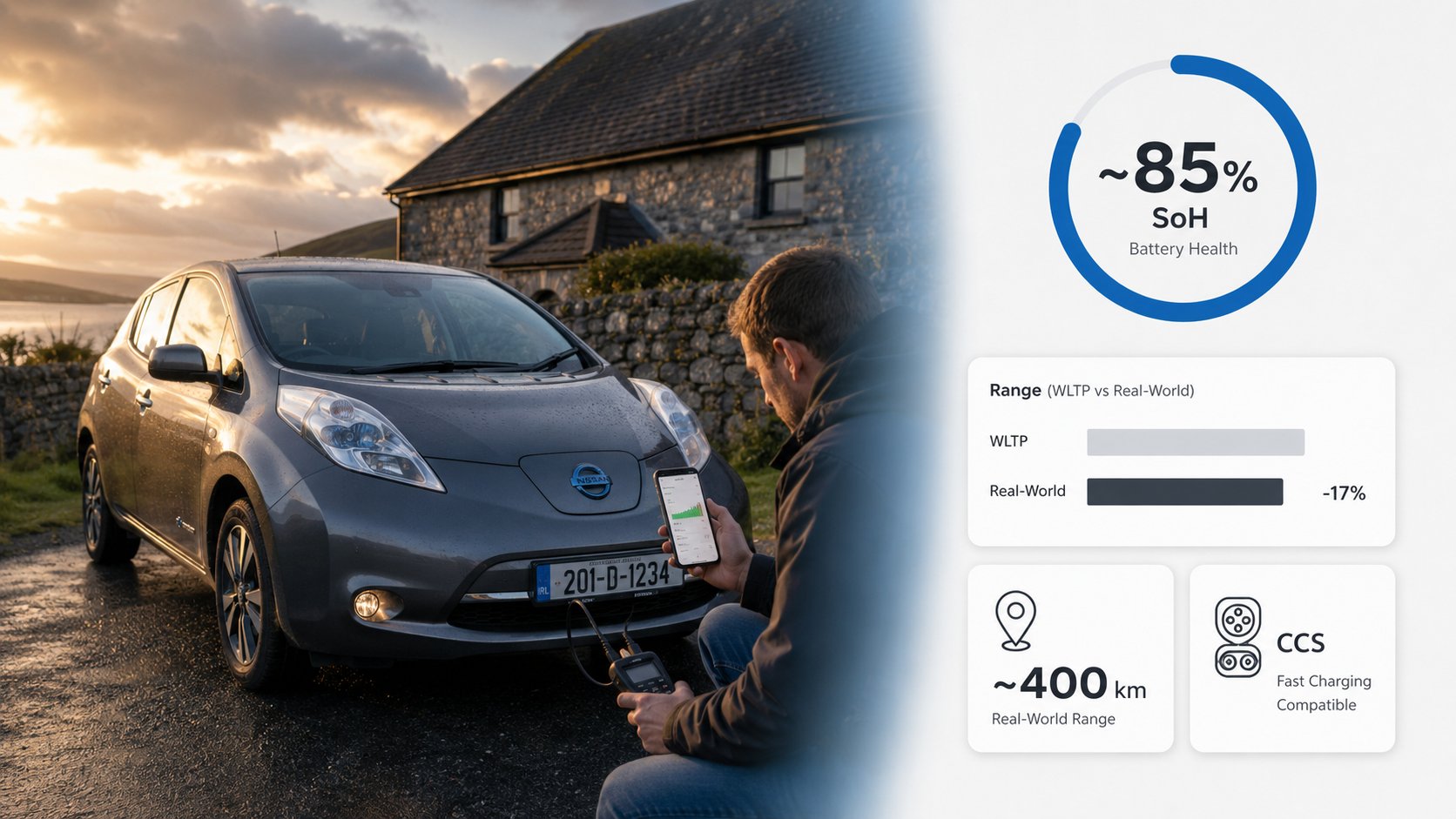
For Irish buyers, the Leaf is a battery-first purchase. A clean body and low mileage do not rescue a tired pack, and a high-mileage car with a verified State of Health (SoH) screenshot can make more sense than a low-mileage example with an unknown battery history. ShamAuto uses a conservative planning rule of WLTP minus 17% for real-world range, so the starting point is always the same, use the number you can plan around, not the brochure headline.
Why a Used Nissan Leaf Is a Battery-First Purchase
You're probably looking at a used Leaf because it seems straightforward. It's a familiar Nissan hatchback, it's automatic, and it should fit the daily grind without fuss. On a Leaf, though, the badge tells you far less than the battery does, and that's the mistake to avoid.
Mileage can mislead on a Leaf
A low odometer reading doesn't mean much if the pack has aged badly. The Leaf's battery condition is the deciding factor because range, charging convenience, and resale confidence all depend on it. Used EVs do not qualify for the SEAI purchase grant, so there's no subsidy safety net for a questionable car, only the listing price and whatever evidence the seller can show.
Practical rule: buy the battery, not the colour. If the SoH is weak or unknown, the rest of the car has to be priced as if the range will disappoint.
ShamAuto's planning baseline is WLTP minus 17% for real-world range, and that matters because it strips out wishful thinking before a buyer starts comparing ads. If a listing cannot survive that conservative test, it doesn't fit normal Irish use. The same logic applies to every EV, but it matters more on a Leaf because the car's history spans very different battery sizes and charging setups.
| Variant | Years | Battery | WLTP range | Real-world estimate (WLTP minus 17%) |
|---|---|---|---|---|
| Leaf 40 kWh | 2018-2024 | 40 kWh | 270 km from Nissan | ~224 km |
| Leaf e+ 62 kWh | 2019-2024 | 62 kWh | 385 km from Nissan | ~320 km |
Older Leafs are a different conversation
The 2015-2017 first-generation Leafs, with 24 kWh or 30 kWh packs, are older, shorter-range stock and not part of this catalogue. They can still suit some city-only buyers, but they're a separate market with a shorter leash on usable range. For anyone shopping the second-generation hatchback, battery condition should come first, then year, then trim, then colour.
The whole point is simple. A used Nissan Leaf is only a bargain if its battery still matches the buyer's life, and every check later in the process feeds back into that one question.
The Two Leaf Variants Worth Considering
The second-generation Leaf comes down to two sensible choices for Irish buyers, the 40 kWh and the 62 kWh Leaf e+. Nissan's own figures make the difference clear, and the used market should be judged from there rather than from badge prestige or speculative online chatter. Independent used-car guidance also notes the e+ brings stronger performance, with output varying by market and trim, but the buying decision is still range and charging flexibility, not headline power.
The 40 kWh Leaf suits short, repeated use
The standard 40 kWh Leaf is the version that makes the most sense for a lot of Irish commuting. Nissan rates it at about 270 km WLTP, and ShamAuto's conservative real-world baseline turns that into roughly 224 km. That's enough for school runs, town driving, work commutes, and regular home charging without forcing the owner to build the day around the battery.
It also keeps the Leaf in its natural territory, which is predictable local use. If the buyer has a driveway, a reliable home charger, and doesn't need frequent motorway miles, the 40 kWh car is the honest pick.
The 62 kWh Leaf e+ gives more breathing room
The Leaf e+ is the one for people who want the same shape but a lot more slack in the battery. Nissan rates it at about 385 km WLTP, and the conservative real-world planning number comes out at roughly 320 km. That extra margin changes the car's role, because weekend trips and mixed county driving stop feeling like a negotiation with every detour.
The e+ is not magic, it's just less restrictive. For buyers who still charge mostly at home, that extra range can be the difference between a useful EV and a car that always needs plotting.
Used buyers should still watch the battery on both variants, because the bigger pack doesn't erase ageing or bad charging habits. The 62 kWh car gives more usable distance if the SoH is still strong.
40 kWh Leaf: Best for shorter daily driving, cheaper entry point in principle, and simpler home-charge use.
62 kWh Leaf e+: Best for longer mixed use, stronger motorway comfort, and fewer charging stops.
Older 24 kWh or 30 kWh cars: Only for buyers who understand the shorter range and accept that they're shopping a different, older product.
If a buyer wants a single rule, it's this, choose the smallest Leaf that still covers the weekly routine with margin. Bigger battery is useful, but only if the actual car's SoH supports it.
The Honest Leaf Limitations Buyers Should Know
The Leaf does a lot well as a cheap, practical EV. It also has three structural limits that Irish buyers need to accept before they get attached to one. None of them is a deal-breaker on its own, but each one changes how the car should be valued.
CHAdeMO is the first problem
The Leaf uses CHAdeMO for DC fast charging, not CCS. That matters because CHAdeMO is a shrinking, slower rapid-charge standard in Ireland, and a buyer who depends on public fast charging needs to understand that reality before signing anything. A Leaf can still work fine for home-charging owners, but it's the wrong car to buy on the assumption that every rapid charger will fit the way newer CCS EVs do.
The AC charger is modest, not quick
The onboard AC charger is 6.6 kW, so home and workplace charging are perfectly usable, just not especially fast. That's fine if the car sits parked overnight, which is how most Irish owners will use it. It's less fine if the buyer expects regular rapid turnaround between long trips.
The battery is passively cooled
The battery uses passive air cooling, with no active thermal management. That's the point people skip, and it's why verified SoH matters so much on a Leaf, because degradation doesn't behave the same way in every climate or use pattern. Hotter use, frequent rapid charging, and poor storage can leave two apparently similar cars in very different shape.
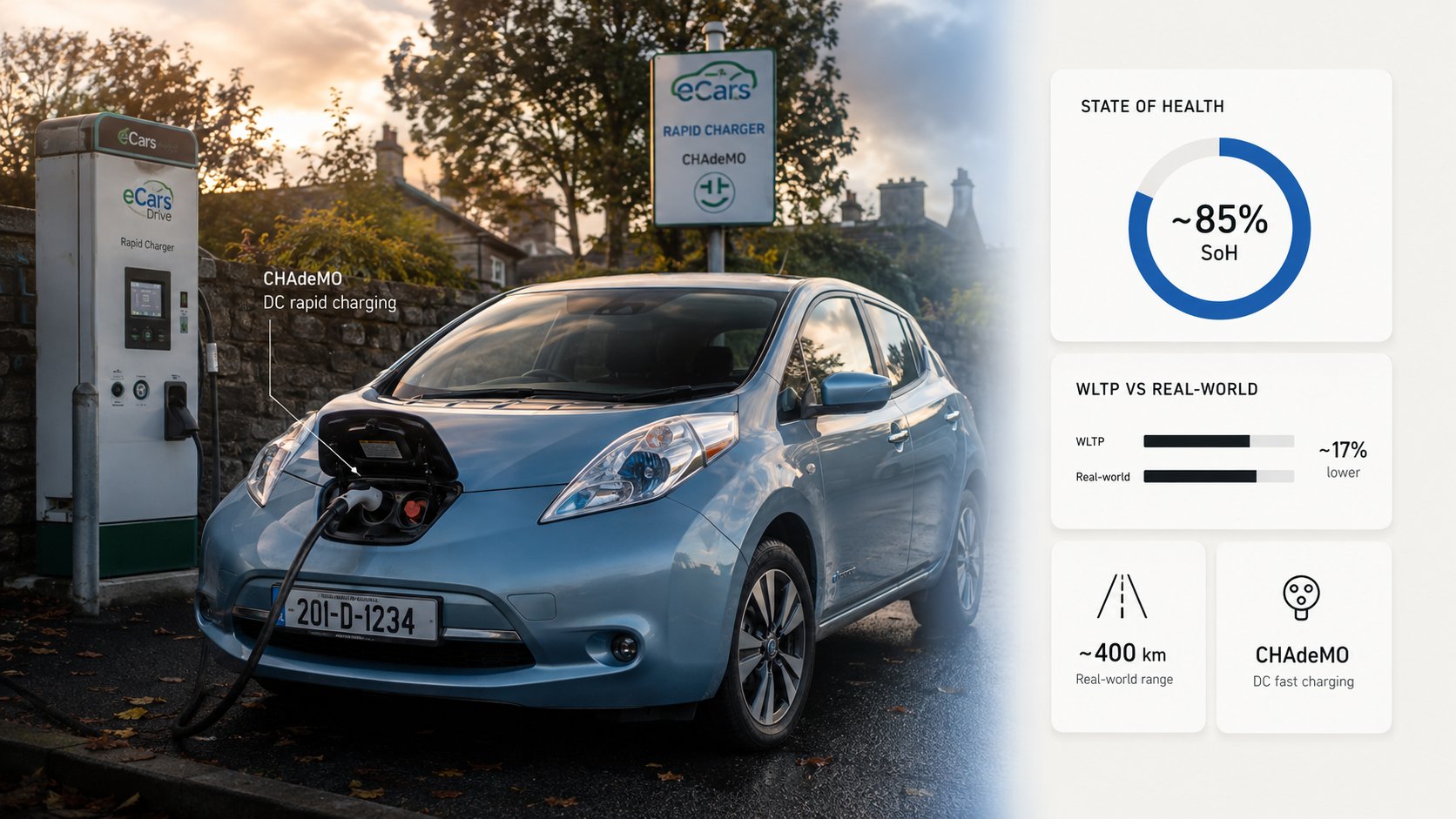
The newer 2025 and 2026 Leaf crossover, with CCS and different battery figures, is a separate car and doesn't belong in a used hatchback buying guide. This guide is about the second-generation used Leaf that Irish shoppers see on the market now.
Verifying Battery State of Health Before You Buy
A used Leaf should not be judged on dashboard bars alone. State of Health (SoH) is the battery condition number that matters, because it tells the buyer how much of the original usable capacity is still there. That's the number that decides whether the car is a bargain or a short-range headache.
Ask for the right proof
The cleanest check is a diagnostic screenshot from LeafSpy via OBD2 or a dealer diagnostic report. The screenshot should show SoH clearly, along with the battery identifiers that confirm the reading belongs to that car. If the seller can't provide that, the buyer is guessing, and guessing on a Leaf is expensive.
Leaf battery health can vary widely from car to car, especially given the model's passive air cooling, so each used example should be judged on its own verified SoH screenshot rather than on any fleet average.
Read the result like an Irish buyer
A second-generation Leaf with a strong SoH can still be a very sensible daily EV. A tired one can fall out of the useful range band quickly, especially once winter use and public charging are part of the picture. The buyer should always compare the screenshot against the actual driving routine, not against the badge or the odometer.
If a car is listed on ShamAuto with diagnostic proof, a verified SoH badge can be shown on the listing. That doesn't make the car good by itself, but it gives the buyer something real to negotiate from instead of a sales pitch.
For a fuller checklist on what the screenshot should show and how to ask for it, use ShamAuto's SoH checking guide.
Strong SoH evidence doesn't just reduce risk, it changes the conversation. A seller with proof has a firmer position, and a buyer with proof can walk away from a weak battery without second-guessing the decision.
Matching Real-World Range to Your Irish Driving
A Leaf only makes sense when the range fits the routine. That sounds obvious, but buyers still overreach because they chase the biggest quoted number instead of the number that survives real life. ShamAuto's WLTP minus 17% rule is the right starting point because it keeps the planning honest before the car is even viewed.
Use the range number against the actual week
A city driver with short hops, home charging, and occasional errands can live comfortably with the 40 kWh Leaf's ~224 km real-world estimate. Someone doing mixed county-town driving, regular school runs, and the odd longer day will feel the 62 kWh e+'s ~320 km margin much more often. The difference isn't just battery size, it's how much pressure the owner feels every time the route changes.
Cold weather, motorway speeds, and detours all cut into usable distance, so a buyer should leave room above the bare minimum. That's why the conservative baseline matters more than the optimistic one. It keeps the car useful when the weather turns or the charger isn't where it was supposed to be.
Automatic driving keeps the comparison simple
Every Leaf is automatic, single-speed, with no clutch or gearbox. That makes the comparison with petrol or diesel cars easier, because there's no manual trade-off hiding in the background. The primary comparison is battery condition, range, and charging convenience, not shifting style.
For a longer planning tool tied to this model, see ShamAuto's real-world range guide for the Nissan Leaf. A buyer who uses that estimate against their own commute will make a better decision than someone staring at the biggest battery badge in the ad.
The right Leaf is the one that leaves margin at the end of a normal day. Anything else is just a nice-looking car with a stressful calendar.
What to Check When Viewing a Used Leaf
A Leaf viewing should be treated like a battery and charging inspection first, and a cosmetic inspection second. Thirty to forty-five minutes is enough if the buyer stays focused and doesn't get distracted by tidy seats or a shiny polish. The important part is proving the car still behaves like a usable EV.
Start with the charging hardware and the battery
Check the CHAdeMO port for damage or corrosion, then ask for a slow-charge test if possible. The seller should be able to show that the AC side works normally as well, because the Leaf's 6.6 kW onboard charger is part of the ownership picture, not a footnote. A car that charges awkwardly or throws warnings during a simple plug-in test deserves a harder look.
Also compare the dashboard battery bars with the SoH screenshot. The bars are not the whole story, but if they look wildly out of step with the diagnostic proof, something is off.
Look underneath, then ask how it was used
The battery pack underside should be checked for scrapes, knocks, or anything that suggests a rough life. Tyres matter too, because the Leaf delivers instant torque and can chew through poor rubber faster than some buyers expect. Brake wear should be sensible, but not perfect, since regeneration handles a lot of slowing.
12V battery: Ask when it was last replaced.
Warning lights: Confirm the dashboard cycles cleanly and nothing stays lit.
Charging habits: Ask how often the car used rapid charging.
Storage conditions: Ask whether it lived outside, indoors, or in a garage.
Passive cooling makes those questions relevant. A battery that lived an easy life can age very differently from one that spent years fast-charged and parked in harsh conditions.
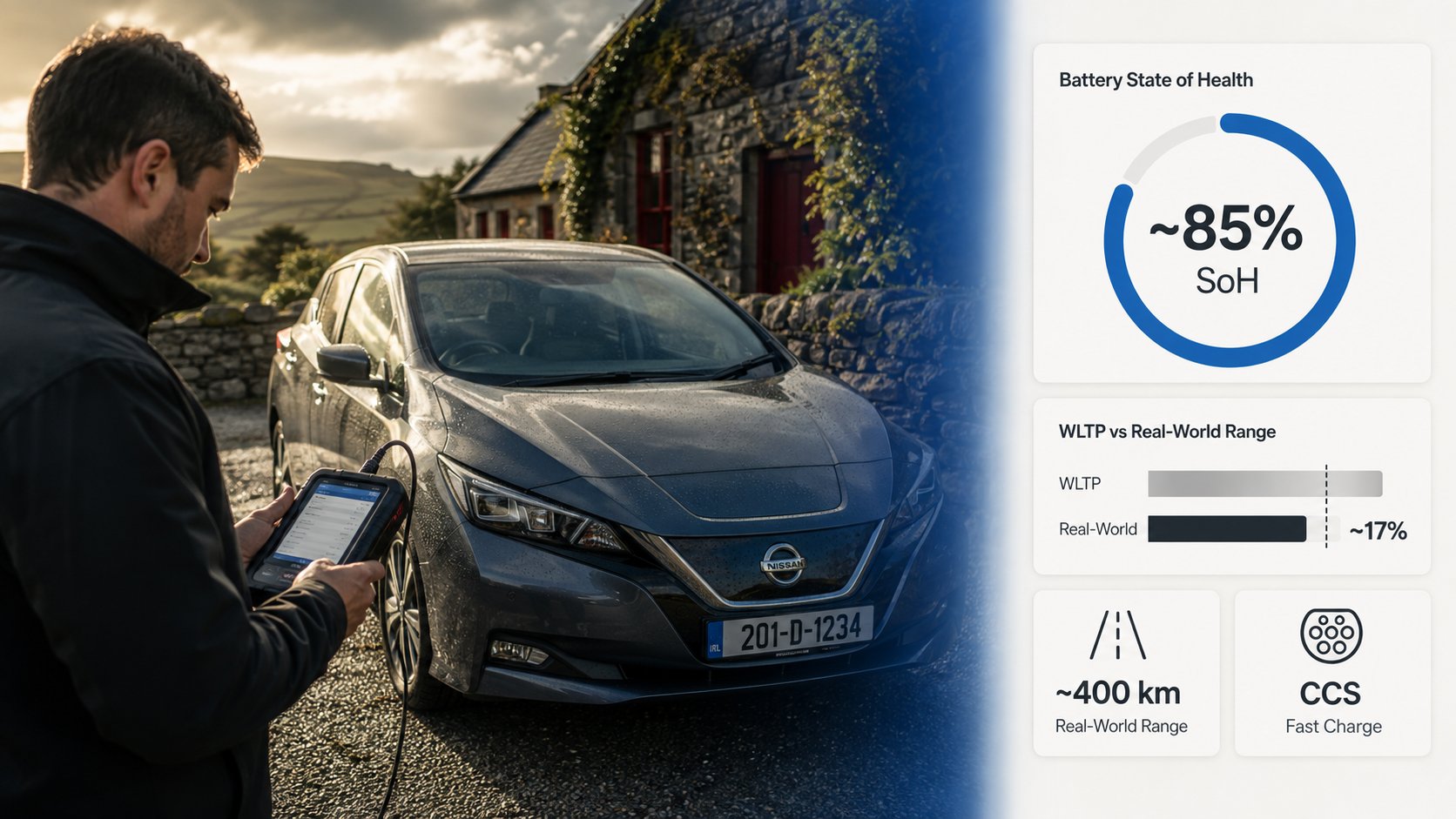
For a full used-EV inspection framework, ShamAuto's buying guide for used EVs in Ireland is the right companion piece. The buyer who brings a calm checklist to the viewing is the one most likely to avoid overpaying for a tired Leaf.
Pricing, Grants, and Listing on ShamAuto
Used Leaf value comes down to three things, year, mileage, and verified SoH. That's the honest order, and it matters more than asking whether the car looks fresh in photos. Price should be checked against current listings, not against assumptions about what an EV "ought" to cost.
Grants and tax treatment need the live source
Second-hand EVs do not qualify for the SEAI purchase grant, which is for new cars only. Any other tax, VRT, or scheme detail should be checked on the live official source, because those rules move and buyers shouldn't rely on stale summaries. If the buyer is comparing costs, the official SEAI and Revenue pages are the places to verify the current position.
Used value should follow evidence
A Leaf with a strong diagnostic record deserves more respect than one with an unknown battery history, even if the odometer is lower. That doesn't mean every good car is expensive, only that the battery proof changes the negotiating range. A seller who can show SoH is selling evidence, not hope.
For pricing context specific to this model, ShamAuto's Nissan Leaf price guide for Ireland keeps the conversation grounded. General classifieds sites may show plenty of ads, but the buyer still needs the same discipline, battery proof, range realism, and a clear view of the charging standard before making an offer.
If the Leaf fits the buyer's routine, it can be a very sensible Irish EV. If the SoH is weak, the charging setup is awkward, or the range doesn't survive the commute, it's not the right car, no matter how neat the photos look.
If you're weighing a Leaf against other used EVs in Ireland, browse ShamAuto for battery-first listings and practical EV guides that keep SoH and real-world range front and centre. If you're selling a Leaf, be among the first to list with clear battery evidence so buyers can judge it properly.