
Nissan Leaf Price Ireland: What a Used One Really Costs

Contents
- Why Two Same-Year Leafs Can Cost Different Money
- The Leaf Generations and What They Cost in Ireland
- Why State of Health Matters More on a Leaf
- Reading Real-World Range the Honest Way
- How to Judge Any Listing Like Evidence
- Price Versus Value, and the SoH Premium
- Timing, Negotiation and What Comes Next on ShamAuto
- Common Questions Buyers Ask Before They Search
A buyer in Ireland opens a listings page, sees two Nissan Leafs from the same year, and the prices don't line up. One looks cheap enough to click. The other costs more, but the ad says the battery is healthier and the range estimate is stronger. That gap is not noise, it's the whole story.
Used Leaf pricing only makes sense when the battery is treated as the main asset, not an accessory. Mileage matters, trim matters, and body condition matters, but the big swing factor is State of Health (SoH). Every EV is automatic, with a single-speed drivetrain, so there's no clutch or gearbox wildcard hiding in the background.
That's why the nissan leaf price Ireland question shouldn't start with the sticker price alone. It should start with battery generation, battery size, mileage, and SoH, then work back to whether the car is good value.
Why Two Same-Year Leafs Can Cost Different Money
Two 2018 Leafs can sit next to each other on a used listing page and still belong in different price conversations. One may have a clean body, average mileage, and a battery that still holds up well. The other can look tidy in photos but carry more battery wear, and that changes what the car is worth far more than most buyers expect.
The battery is the value anchor
On a petrol or diesel car, buyers mostly judge engine noise, servicing, and wear. On a Leaf, the battery is the expensive part that defines range, usefulness, and long-term satisfaction. If the pack has aged badly, the car is less capable, no matter how polished the interior looks.
That is why price gaps between same-year Leafs often exist for good reason. A seller with evidence of stronger battery condition can justify a firmer ask, while a seller with no battery proof has to leave room for uncertainty.
Practical rule: if the ad doesn't show battery evidence, assume the price is carrying uncertainty rather than value.
The useful way to read a listing
A good Leaf ad should answer a simple question, what are you buying for the money. The year tells you the generation, the kWh tells you the battery size, the mileage hints at wear, and SoH tells you how much battery life is left in practical terms.
ShamAuto is built around that logic, with each listing structured to surface battery health rather than bury it in the fine print. That matters because the normal used-car checklist only gets you part of the way on an EV. On a Leaf, the battery is the argument.
The Leaf Generations and What They Cost in Ireland
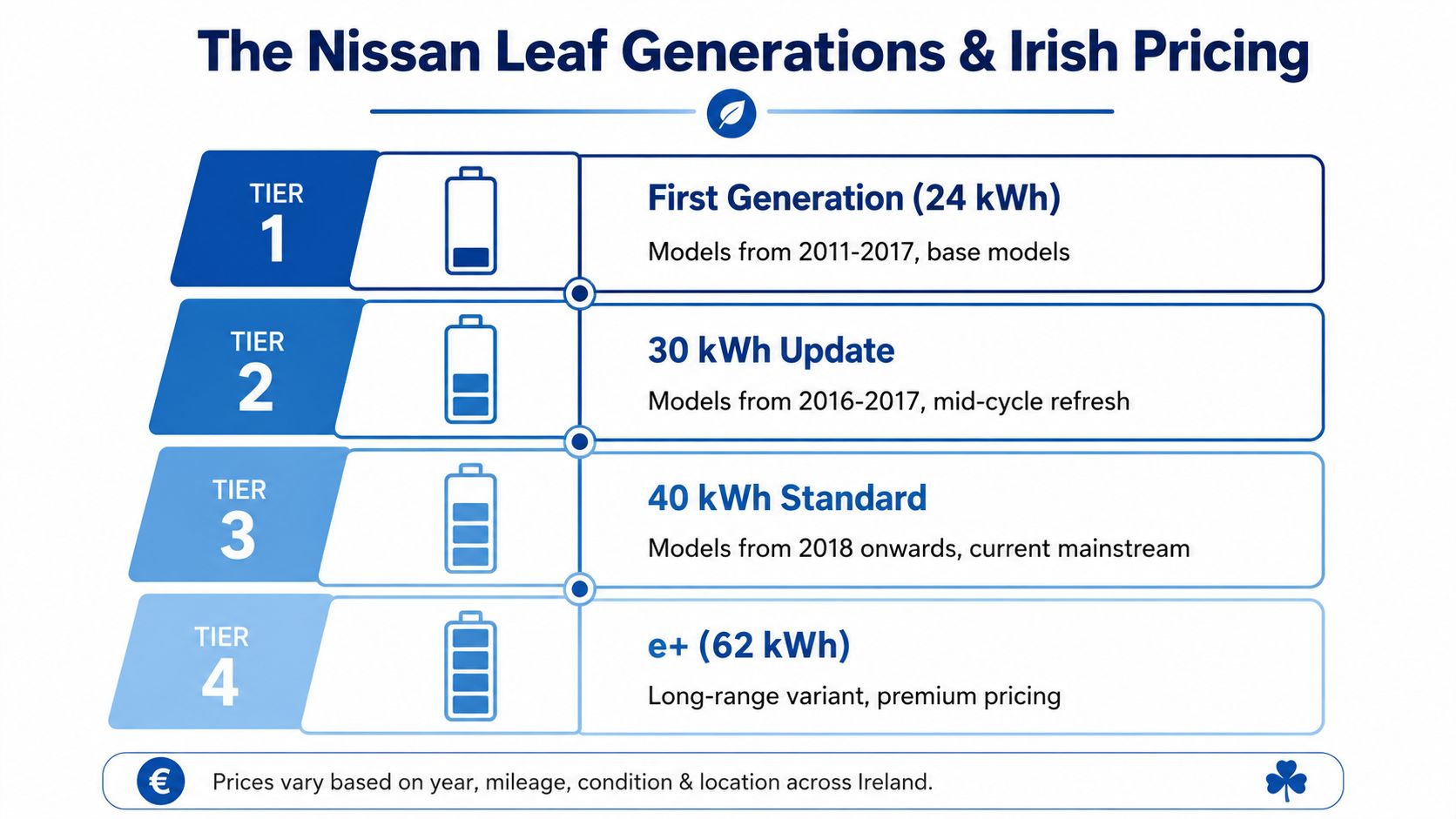
The Irish used market splits cleanly into four Leaf battery generations, and the jump between them matters more than trim alone. The old 24 kWh cars from 2011 to 2017 sit at the entry end, the 30 kWh update from 2016 to 2017 nudges up from that, the 40 kWh cars from 2018 onwards are the mainstream choice, and the 62 kWh e+ from 2019 onwards sits at the long-range premium end. A basic trim badge changes the asking price, but the battery jump usually moves the needle more.
Reading the generations without getting lost in trim names
The older 24 kWh cars are the cheapest starting point, but they only make sense for short urban driving unless the battery health is unusually strong. The 30 kWh update is still an older car, just with a little more breathing room. By comparison, the 40 kWh generation is the one most Irish buyers should inspect first if they want everyday usability without paying new-car money.
The 62 kWh e+ is the obvious choice for drivers who need more range and can justify the extra upfront spend. In Ireland, Nissan's new all-new LEAF pricing starts at €34,995 for the 52 kWh model and rises to €48,295 for the 75 kWh version, with prices inclusive of applicable reliefs and grants according to Nissan Ireland's current release, which gives a useful ceiling for used-car thinking. The used market has moved down far enough that buyers should expect meaningful depreciation, but not enough to ignore battery condition.
General Irish market positioning
Used Leaf pricing in Ireland is best read as a rough ladder, not a fixed table. Older 24 kWh cars generally sit at the bottom. 30 kWh examples sit above that, 40 kWh cars occupy the core of the market, and 62 kWh e+ cars command the top end because they deliver more usable range and a stronger day-to-day brief.
The right move is to compare within generation first, then across SoH and mileage second. That keeps the buyer from overpaying for trim fluff.
Browse current Leaf listings and specs on ShamAuto if you want a battery-first view rather than a vague ad.
Why State of Health Matters More on a Leaf
Battery health matters more on a Leaf than on many other EVs because the car is air-cooled. That makes pack condition more variable from car to car, especially after years of Irish weather, charging habits, and daily use. Two identical-looking Leafs can therefore be worth very different money if one pack has aged better than the other.
SoH is the real number that moves the price
State of Health means the percentage of original usable battery capacity still left. It is a measurable figure, not a guess, and that's why it should sit at the centre of any price decision. A seller can talk about low mileage all day, but if the battery has deteriorated more than expected, the car's value drops because the usable range drops with it.
That's the key difference versus a petrol or diesel car. With an engine, buyers can listen, inspect, and service-check. With a Leaf, the battery is hidden inside the car, so verified SoH becomes the cleanest signal a buyer can trust.
A verified SoH badge is not marketing fluff. It is the most useful price clue on a used Leaf.
What verified battery evidence does for a buyer
When a listing shows verified SoH, it means the seller has backed up the claim with diagnostic evidence. That lets the buyer compare cars on a like-for-like basis instead of guessing from photographs or bodywork. A listing that also shows usable battery capacity in kWh is even better, because it reduces the chance of mixing up nominal battery size with actual available energy.
That is why unverified Leafs should be priced more cautiously. If SoH is missing, the buyer is taking on risk that the seller hasn't priced openly. On a Leaf, that risk is usually where the deal looks cheap on paper and disappointing in practice.
Reading Real-World Range the Honest Way
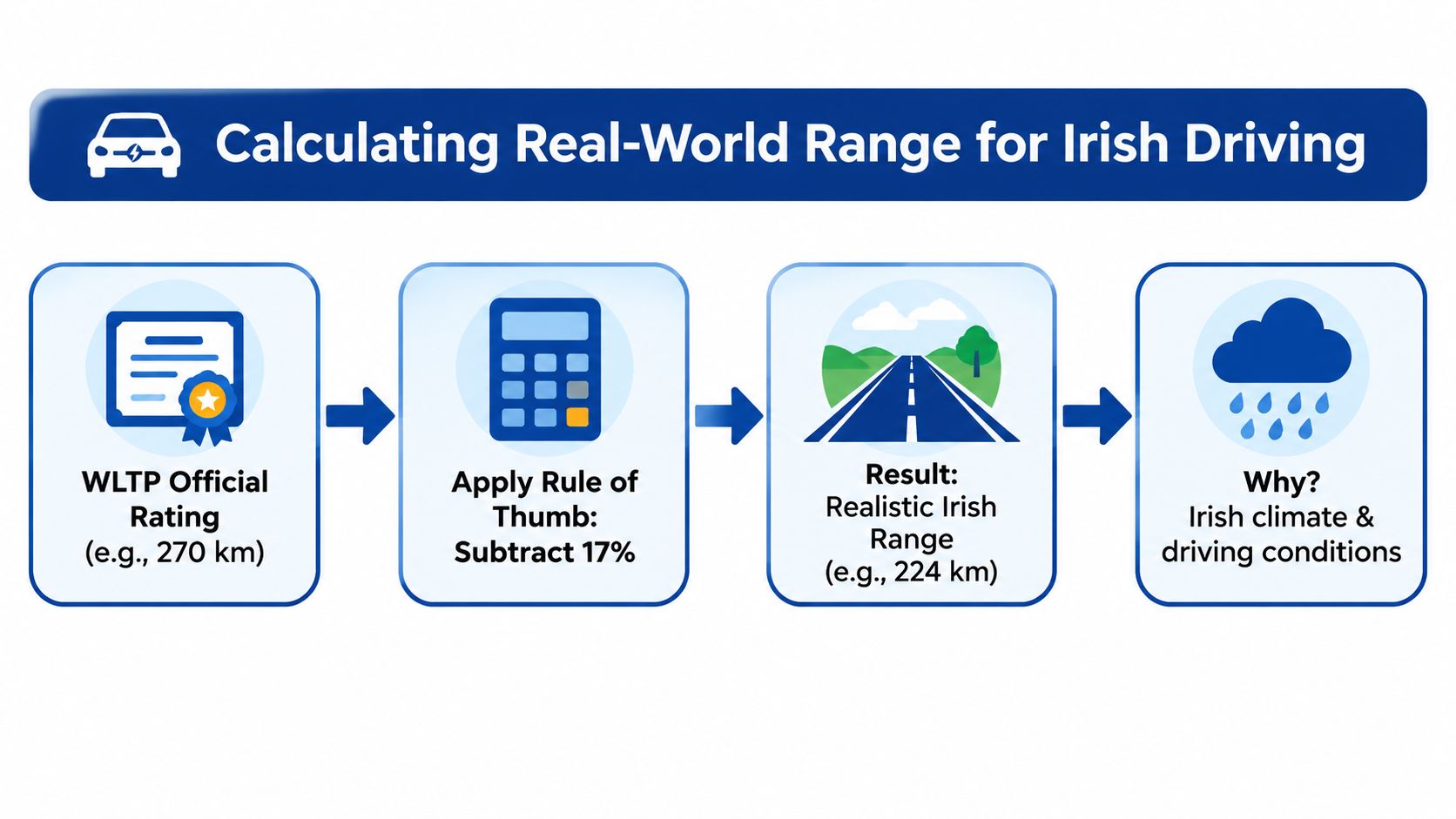
WLTP figures are useful, but they are not the number to plan a journey around in Ireland. The cleaner rule of thumb is to treat real-world range as WLTP minus 17 percent, which gives a more cautious estimate for cold weather, motorway use, hills, and heating load. That's the number that matters when the family is heading across counties, not the brochure figure.
A simple range check that works
Take the Leaf e+ 62 kWh example. On ShamAuto's WLTP-minus-17% method, 385 km WLTP translates to an estimated real-world range of about 320 km in everyday use. That lines up with the basic idea that WLTP is a test cycle, while real Irish driving is harsher on range.
Now apply the same thinking to a tired battery. If usable capacity has fallen, the starting point is already lower, so the real-world figure falls again from a smaller base. The car doesn't just lose laboratory range, it loses practical kilometres too.
Useful habit: always read range as a planning tool, not a bragging right.
Why range and SoH belong together
A weak battery hurts value twice. First, it reduces the amount of energy stored in the pack. Second, it cuts the usable range the driver sees day to day. That's why a buyer should never separate range from SoH when comparing Leafs.
ShamAuto shows a real-world range estimate on each listing alongside WLTP, so buyers can compare the same car in two different ways, official and cautious. For the full method, the ShamAuto Leaf range guide is the right place to check the maths.
How to Judge Any Listing Like Evidence
A good Leaf listing should be treated like a file of clues, not a sales pitch. The first question is the battery generation, because 24, 30, 40, and 62 kWh cars belong to different price conversations. The second question is whether the battery health is verified, because that's the single strongest sign of whether the asking price is fair.
What to check before a call or viewing
- Battery generation: confirm the kWh and model year so the car is compared against the right market.
- Verified SoH: look for a badge or diagnostic screenshot, not just a seller's description.
- Real-world range: sanity-check it against the WLTP minus 17 percent rule.
- Mileage versus year: make sure the odometer reading makes sense for the age of the car.
- Charging history clues: repeated DC use can matter, so look for evidence that the car hasn't lived its life on rapid chargers alone.
The point is not to chase perfection. It's to find a listing where the evidence adds up.
How a proper listing page should look
A Leaf listing works best when the key numbers are already visible. That means SoH, usable battery capacity, and a real-world range estimate, all sitting beside the price. Buyers shouldn't have to piece together a verdict from a free-text ad and a few blurry photos.
That is where a structured marketplace helps. ShamAuto's guide on checking battery SoH before you buy gives the deeper checklist, and the used EV buying guide for Ireland adds the wider inspection logic for tyres, condition, and paperwork.
Price Versus Value, and the SoH Premium
Lowest price is the wrong starting point on a used Leaf. The right question is what the buyer gets for the money after battery health is counted in. Two same-age cars can look similar in photos, but the one with verified battery evidence is usually the one worth paying more for.
Why a verified badge changes the conversation
If one Leaf has a verified 90%+ SoH badge and another does not, the first seller can defend a firmer asking price. The buyer is paying for known battery condition, not just an age plate and a set of keys. The unverified car, by contrast, has to carry the risk of hidden degradation, and that risk belongs in the price.
That principle matters even more in the older, cheaper part of the market. A bargain with poor battery health is often not a bargain at all, because the owner ends up buying range anxiety instead of usable driving.
Grants are a separate issue
Used Leafs in Ireland do not qualify for the SEAI purchase grant, which is for new cars only. Buyers should not factor that grant into a used-car offer, and sellers should not talk as if it lowers the price of a second-hand car. For scheme changes or new caps, the official SEAI site is the place to check, not a dealer ad.
Bottom line: on a used Leaf, price without verified SoH is only half a price.
Timing, Negotiation and What Comes Next on ShamAuto
Used Leaf pricing can move when sellers get pressed, especially around quarter-end or when a newer model gets more attention. That doesn't mean buyers should wait for magic discounts. It means they should negotiate with evidence, not with hope.
How to negotiate a Leaf properly
Lead with the battery health evidence, not the badge, the tyres, or the colour. If the SoH is strong and the range estimate is honest, the seller has a better case for holding price. If the battery evidence is missing, the buyer has a clear reason to push back because uncertainty has a cost.
ShamAuto is newly launched, so there's no honest way to present its own price medians, county premiums, or city-by-city patterns yet. Those figures need enough live listings before they mean anything. As stock grows, county browsing will surface local prices naturally, and the market data will become more useful.

What to watch for next
Private sellers and dealers who want battery-first listings should be among the first to list. That matters because a clean, structured listing makes the negotiation easier for both sides. It also means buyers can compare cars without having to decode generic classifieds one by one.
Used marketplaces and general classifieds sites already exist in the Irish market as context, but the useful bit is the data structure, not the noise. As more Leafs appear, ShamAuto's listing fields will make local price patterns easier to read.
Common Questions Buyers Ask Before They Search
The first question is usually about grants. A used Leaf does not qualify for the SEAI purchase grant because that support is for new cars only, so buyers should check the current scheme directly with SEAI rather than assume a second-hand saving exists.
Is an older 24 kWh Leaf still worth buying
Yes, but only as a cheap short-range car for city use, school runs, and local trips. It makes sense when the price is low and the battery health is still decent. On the oldest air-cooled packs, SoH matters even more because a weak battery quickly turns a cheap car into an awkward one.
How often does a Leaf battery need replacing
Most don't need replacement within normal Irish ownership horizons if the battery still has decent SoH. That's another reason to focus on battery health instead of panicking about age alone. The battery can be fine for years if it has been treated sensibly.
What's the cheapest realistic entry point
Older 24 kWh cars sit at the bottom of the used Leaf market, but any listing that falls below the very low end of the range deserves extra scrutiny on battery health and condition. The cheapest ad is not automatically the smartest buy. If the pack is tired, the cost is higher than the asking price suggests.
For a buyer's wider checklist, the ShamAuto car buyer guide for Ireland is the better place to start than a random classifieds search.
ShamAuto gives Irish EV buyers a cleaner way to judge a used Leaf by showing battery health, usable battery capacity, and real-world range together on the listing. If the goal is to compare price with evidence instead of guesswork, ShamAuto is worth checking before the next viewing.