
Vw Id4
Contents
The most popular advice about a used VW ID.4 is also the least useful: buy the biggest battery available and worry about the rest later. In Ireland, that approach can leave a buyer paying for range that rarely gets used, or choosing a smaller battery that becomes frustrating on motorway and rural journeys. The better question is whether the car's variant, State of Health (SoH), charging capability and real-world range match the driver.
Volkswagen Ireland said that, by April 2023, it had sold 5,876 ID.4s in Ireland, making it the country's all-time best-selling electric vehicle at that point. The same update reported registrations up 134% year-on-year early in 2023 and a 16% year-to-date share of the Irish EV market, with the figures linked to SIMI Motorstats in Volkswagen's account of the milestone. That confirms the ID.4's importance in the Irish market, but popularity doesn't make every used example equally suitable. (Volkswagen Ireland's ID.4 market update)
A sound purchase starts with evidence, not the badge on the boot. The ShamAuto car buyer guide for Ireland is useful background, but the central checks are simple: confirm the battery's SoH, apply a cautious range estimate, inspect charging behaviour and compare the individual car with current alternatives.
Is the VW ID.4 Really the Right Second Car for Ireland
The ID.4 can be an excellent second car, but it isn't automatically the right one for every Irish household. A compact EV may suit a short urban commute better, while a larger battery is valuable for a rural driver travelling regularly between counties. The ID.4's size, quiet cabin and SUV seating position make it practical, yet those advantages don't remove the need to choose the right battery.
Popularity doesn't settle the buying decision
Volkswagen's early sales performance shows that Irish buyers accepted the ID.4 as a mainstream electric SUV rather than a niche experiment. It was the first battery-electric SUV to reach that level of market leadership in Ireland, and its strong registrations gave it unusual visibility among used buyers. That history is reassuring, but it says nothing about the condition of a particular battery or whether a Pure or Pro suits a particular routine.
The main hidden risk is spec mismatch. A buyer who mainly drives locally may spend extra on a Pro 77 kWh without gaining much practical benefit. Another buyer may choose a Pure 52 kWh because the advertised price looks attractive, then find that winter motorway journeys require more planning and more charging stops.
Practical rule: choose the battery for the longest journeys that happen regularly, not for the shortest commute that happens every day.
Range claims need a consistent method
Volkswagen's WLTP figures are useful for comparing variants, but they aren't a promise of the distance available on a wet Irish motorway in winter. ShamAuto's catalogue framing uses real-world range as WLTP minus 17%, giving buyers one cautious method for comparing cars rather than relying on optimistic brochure figures. The calculation still needs context, because speed, temperature, wind, tyre pressure, payload and cabin heating all affect consumption.
Battery condition matters just as much. Two ID.4s with the same battery label can offer different usable range if their SoH differs or if one has incomplete diagnostic evidence. The strongest used-car advert therefore shows the car's exact variant, battery information, verified SoH and a clearly labelled real-world estimate.
The ID.4 makes sense as a second car when home charging is available, daily travel is predictable and the chosen battery covers occasional longer trips without constant route anxiety. It makes less sense when the buyer selects on body style alone or assumes every ID.4 delivers the same range.
Understanding the ID.4 Lineup and Real-World Range
The 2021-2024 used ID.4 range is built around Volkswagen's MEB electric platform. The car uses a 400V-class electrical architecture, a CCS connector for rapid charging and a rear-wheel-drive layout in the main Pure and Pro versions. The ID.5 is the related coupe-shaped sibling, while the GTX is the performance-oriented AWD version and should be treated as a separate drivetrain choice rather than a simple trim upgrade.
The exact figures below come from Volkswagen material used in the ShamAuto catalogue. The figures apply the stated WLTP minus 17% method, so they should be read as cautious planning estimates, not guaranteed distances.
| Variant | Battery (kWh) | WLTP range (km) | Real-world range (km) | DC rapid (kW) | AC on-board (kW) |
|---|---|---|---|---|---|
| Pure | 52 | 345 | Approximately 286 | Up to approximately 100 | 11 |
| Pro | 77 | 520 | Approximately 432 | Up to approximately 135 | 11 |
The underlying Volkswagen catalogue figures identify the Pure 52 kWh at 345 km WLTP and the Pro 77 kWh at 520 km WLTP, with the corresponding charging limits shown above. The Volkswagen ID.4 product guide also shows that published range depends on battery and drivetrain specification, rather than representing one fixed ID.4 number.
Pure 52 kWh
The Pure is the version most exposed to spec mismatch. Its cautious estimate of approximately 286 km can work well for urban and suburban driving, particularly where the car starts most days with a reliable home charge. It becomes less comfortable for frequent high-speed motorway use, long rural commutes or journeys where public charging is inconvenient.
The smaller pack isn't automatically a bad choice. It can reduce the amount of battery capacity a driver carries unnecessarily, and a careful buyer may prefer a well-documented Pure to a larger-battery car with unclear SoH. The decision turns on the driver's regular route and the specific car's evidence.
Pro 77 kWh
The Pro's cautious estimate of approximately 432 km gives substantially more headroom for Irish motorway and mixed-use travel. Its CCS rapid charging limit is also higher than the Pure's, while the 11 kW AC on-board charging suits compatible home-charging equipment.
Across the two variants, the cautious real-world span runs from about 286 km (Pure) to about 432 km (Pro 77 kWh), with CCS rapid charging up to about 135 kW on the Pro. Buyers should keep these figures tied to the individual variant. The updated 2024/2025 cars have different battery and charging developments, so their figures shouldn't be applied to the 2021-2024 used cars covered here.
For more context on how the numbers compare across electric cars, see ShamAuto's electric-car range comparison guide.
How to Check a Used ID.4 Before You Buy
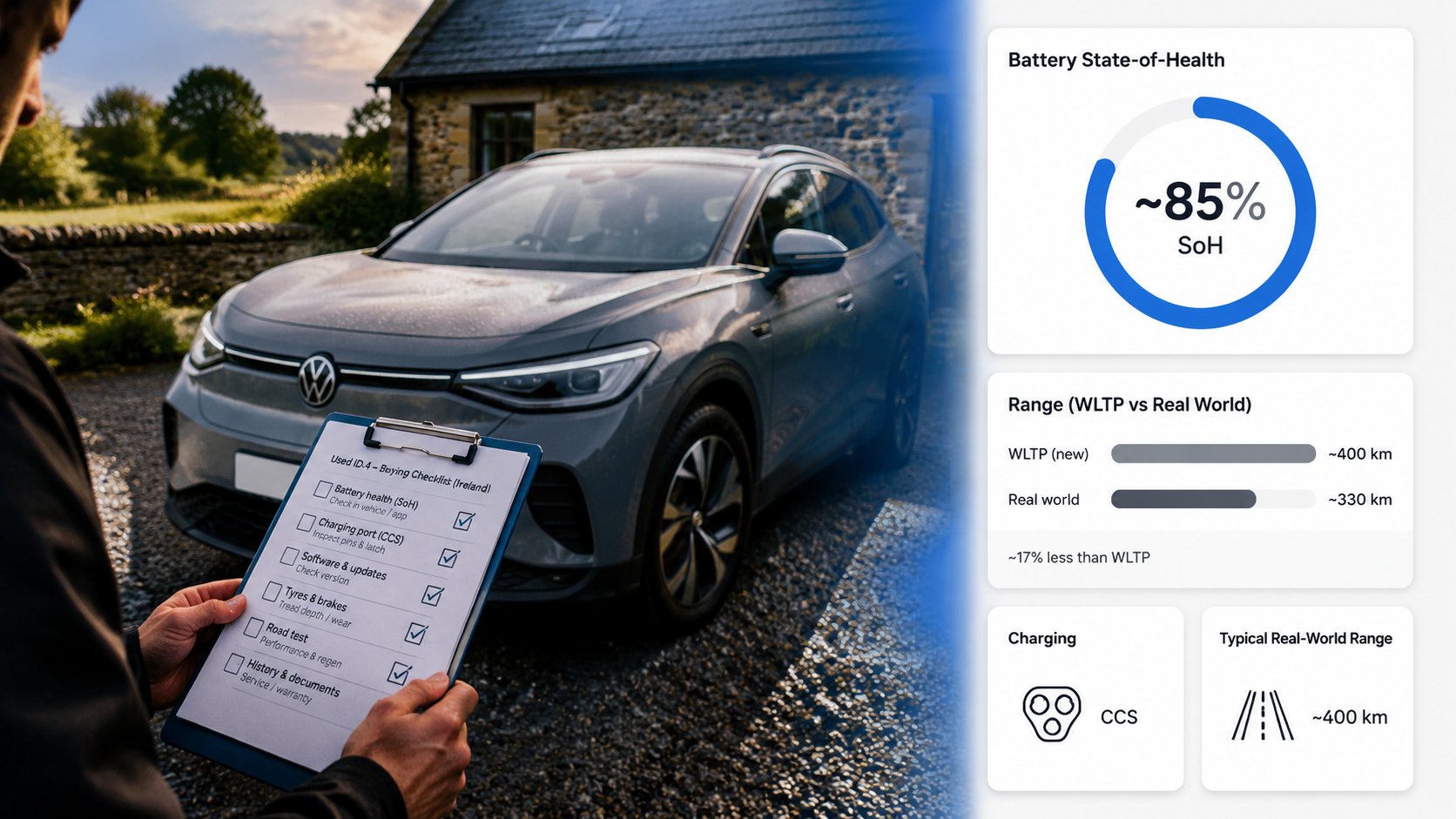
A used ID.4 should be inspected as an electric vehicle first and a Volkswagen second. Bodywork, tyres, service history and accident damage still matter, but battery evidence has the greatest effect on usable range. State of Health, or SoH, describes the battery's remaining condition relative to its original usable capacity, and a seller's clear diagnostic evidence is more valuable than a vague statement that the battery is "fine".
Start with the battery evidence
Request a dated diagnostic screenshot or report showing the vehicle's SoH. The figure should relate to the car being sold, not to a generic warranty statement or a different vehicle. A verified result supports a more realistic range calculation, while an unverified claim should reduce confidence and affect what the buyer is willing to offer.
There isn't a single acceptable SoH figure that can be applied fairly to every ID.4 regardless of age, mileage and use. The practical test is whether the evidence is clear, consistent with the car's age and mileage, and sufficient to support the advertised usable battery and range. ShamAuto's guide on how to check battery SoH before buying explains the evidence-first approach.
Inspect software, charging and the road manners
Early ID.4 infotainment and software behaviour became a known talking point. A buyer should check that the car's software updates have been completed, confirm that the touchscreen, navigation, driver displays, phone integration and heating controls work properly, and ask for supporting service or update records where available.
Charging also deserves a real test. Confirm the presence and condition of the CCS connector, inspect the pins and housing, and check that the car starts a public DC session without unexplained errors. If possible, test AC home charging as well. The ID.4 uses an automatic single-speed reduction setup, so there is no clutch or conventional gearbox to inspect as there would be in a petrol or diesel car.
A sensible viewing checklist includes:
Battery proof: Request the vehicle-specific SoH evidence and compare it with the advertised range.
Charging test: Check CCS rapid charging and, where practical, 11 kW AC charging.
Software check: Test every screen, control and connected feature, then confirm update history.
Physical inspection: Look for uneven tyre wear, kerb damage, accident repairs, water ingress and interior wear.
Route test: Drive a mixture that resembles the buyer's normal Irish roads, including motorway sections if those journeys matter.
The used EV inspection guide from ShamAuto can sit alongside an independent mechanical inspection, especially when the buyer can't interpret diagnostic evidence alone.
How the ID.4 Compares to Irish Market Alternatives
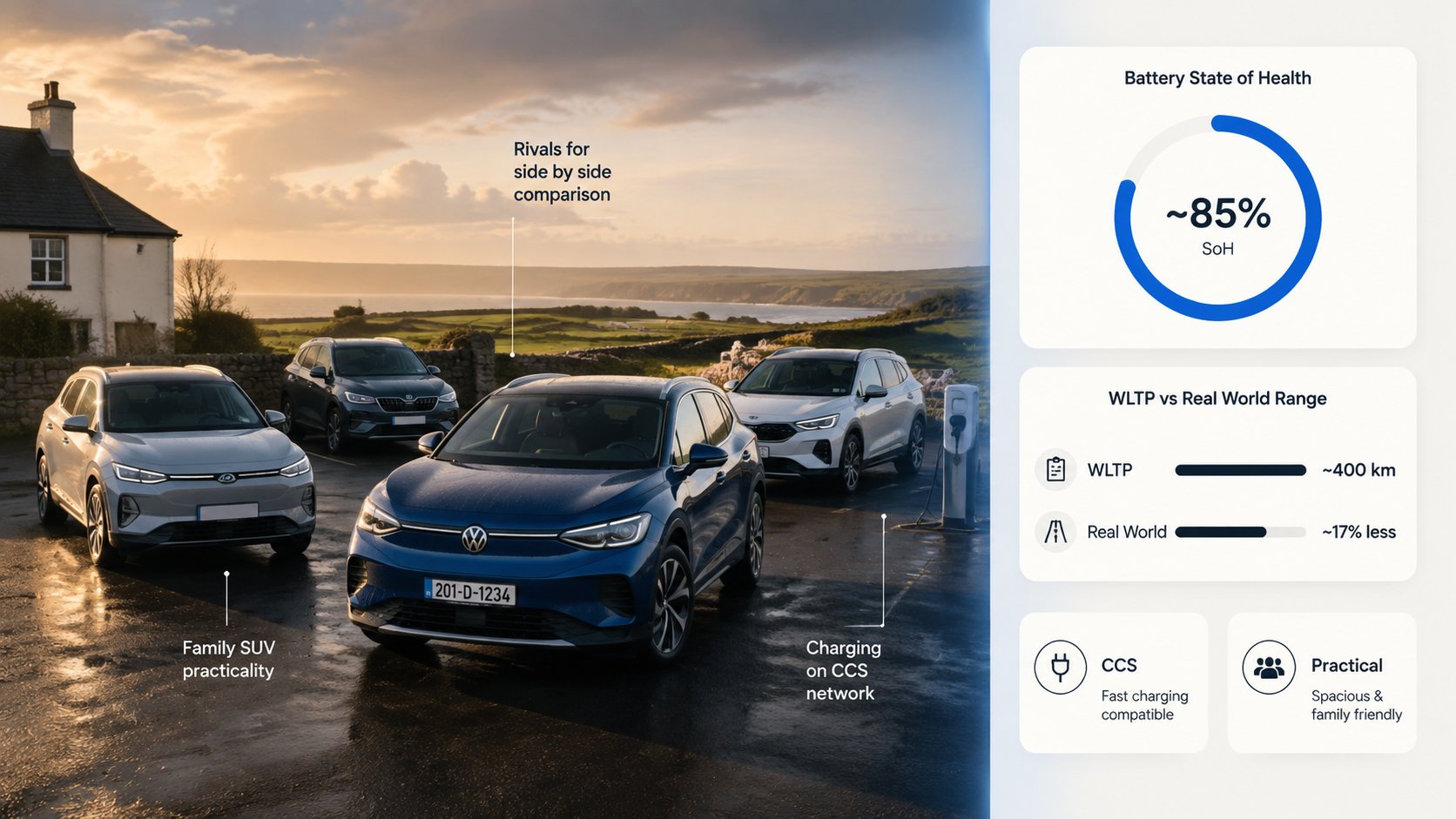
The ID.4's closest alternatives each solve a slightly different problem. The Tesla Model Y appeals to drivers prioritising charging-network integration and a familiar technology-led cabin. The Skoda Enyaq shares much of the ID.4's underlying engineering but presents it with a different interior and practicality balance. The Hyundai Kona Electric is more compact, while the Hyundai IONIQ 5 and Kia EV6 focus more strongly on rapid charging and distinctive design.
A fair comparison needs to separate published specifications from Irish driving experience. Exact range and charging performance vary by battery, wheel choice, temperature and model year, so competitor claims shouldn't be blended into one universal figure. The ID.4's main strengths are its calm ride, familiar controls and useful SUV practicality. Its disadvantages include slower rapid-charging capability than some newer rivals and the need to check early software history carefully.
Where each alternative fits
The Tesla Model Y may suit a driver who values a technology-focused interface and convenient access to Tesla's charging ecosystem. The trade-off is a different ownership experience, with controls and cabin presentation that won't appeal to every buyer.
The Skoda Enyaq is the natural alternative for someone who likes the ID.4's platform but wants a different interpretation of space, trim and interior design. Its suitability still depends on the exact battery, SoH and charging specification rather than the Skoda badge alone.
The Hyundai Kona Electric can be easier to place in tighter urban environments because it is smaller. That makes it less directly comparable as a family SUV, but potentially more sensible for city parking and shorter daily routes.
The Hyundai IONIQ 5 and Kia EV6 are stronger candidates for drivers who place rapid charging and long-distance travel high on the list. Their lower, more aerodynamic shapes and performance-oriented charging systems can be attractive, although the buyer should compare seating position, boot practicality and condition instead of assuming that faster charging makes one car universally better.
The right rival is determined by the journey that causes the most inconvenience, not by the longest specification sheet.
For a buyer who wants a quiet, comfortable, conventional-feeling electric SUV, the ID.4 remains credible. For frequent motorway travel with short charging stops, an IONIQ 5 or EV6 may deserve closer attention. For tight city use, a Kona may be more proportionate. For each model, the used-car decision still rests on battery evidence, exact variant and price against current listings.
Running Costs and Ownership Realities in Ireland
The ID.4 is not automatically cheap to run. The result depends on where you charge, how far you drive and whether the chosen battery matches your routine. Home charging overnight is usually easier to manage, while relying on public rapid chargers makes regular driving more expensive and less predictable. Base the calculation on the car's real energy use, annual mileage and the tariffs available at home and on the road.
Electric drive removes several maintenance jobs associated with combustion cars. There is no engine oil, exhaust system, clutch or conventional multi-speed gearbox, and the single-speed reduction system means every ID.4 is automatic. It still needs upkeep. Tyres, brakes, suspension, steering, cooling equipment, air conditioning, wipers and the 12V electrical system all require inspection and eventual replacement.
Grants and government charges
A used ID.4 does not qualify for the SEAI purchase grant. The SEAI electric vehicle grant guidance states that grants are not available for used EVs, so a second-hand purchase should not be budgeted with that support.
Tax, VRT and scheme rules can change, and the correct treatment depends on the transaction and the vehicle details. Buyers should check live information from Revenue, SEAI and gov.ie rather than relying on an old advert or forum post.
Insurance needs its own check. The premium can reflect the ID.4's value, repair complexity, driver profile, location and how the insurer treats electric vehicles. Get a quote using the exact registration before committing. Assuming an electric SUV will cost less to insure can produce an inaccurate ownership budget.
The costs that advertisements hide
A cheaper ID.4 with uncertain SoH may cost more overall than a better-documented car. If the smaller battery is a poor fit for Irish motorway or rural routes, repeated public charging and longer journeys can remove the apparent saving. The reverse problem also matters. A Pro can cost more without offering useful extra value to someone who charges at home and rarely travels far.
Allow for a pre-purchase diagnostic check, possible home-charging equipment, insurance, tyres and the normal split between home electricity and public charging. The financial case comes from the complete ownership pattern, not the word "electric" alone. A car that fits the route can be cheaper and less frustrating than one bought for range that rarely gets used.
Choosing the Right ID.4 Variant for Your Driving Pattern
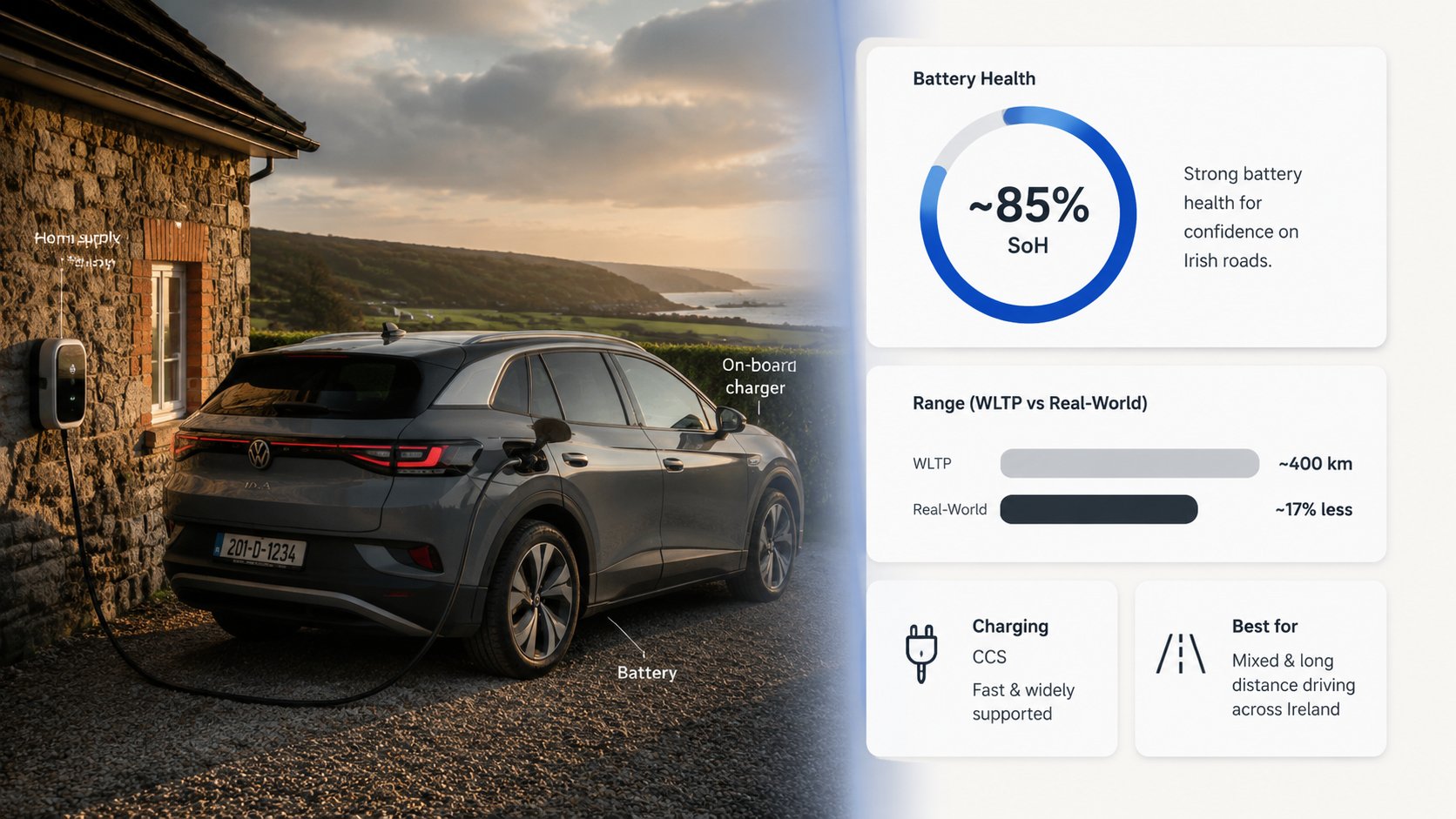
Variant choice should begin with the journey that regularly tests the car. A Pure 52 kWh is a rational choice for urban and suburban driving with dependable home charging, provided its cautious range estimate covers the commute and ordinary errands with room for weather and traffic. A Pro 77 kWh is more appropriate when motorway travel, rural distances or winter headroom feature prominently.
The Pro costs more than the Pure, but it provides much more range. That doesn't make it automatically better value. Used value depends on the individual car's year, mileage, equipment, asking price and verified SoH, so the comparison has to be made car by car rather than by trim reputation.
Match the car to the routine
A useful decision framework looks like this:
Urban and suburban use: The Pure can be sufficient where daily distances are modest, home charging is dependable and longer trips are occasional.
Mixed motorway and city driving: The Pro's larger battery gives a more comfortable buffer and reduces the need to plan every motorway journey around a charging stop.
Frequent long-distance travel: A Pro may be the more suitable ID.4 starting point, but buyers should also compare faster-charging alternatives if repeated long trips dominate ownership.
The GTX should be considered for buyers who specifically want the performance AWD configuration, not because it carries the highest badge. Its drivetrain and equipment can alter efficiency, range and running costs, so the exact vehicle's documentation matters.
A cheaper ID.4 is only a saving if its range covers the journeys that the owner actually makes.
Before buying, the purchaser should check the car's verified SoH, usable battery information, charging specification and conservative range estimate. Current listings should provide the price context. ShamAuto is an Ireland-focused EV marketplace that presents model information such as verified SoH status, usable battery, connectors, charging speeds and a WLTP-minus-17% real-world range estimate, but it is newly launched and doesn't claim an average SoH, stock level, listing history or range-per-euro winner.
The strongest choice is therefore not "the biggest battery" or "the cheapest ID.4". It is the individual car whose evidence matches the driver's longest regular journey, home-charging reality and budget.
Visit ShamAuto to compare evidence-led used EV information, including the battery health and range details that matter when assessing a VW ID.4. Buyers can also use the ShamAuto guides to prepare for a viewing, while sellers can be among the first to list an ID.4 with clear SoH and charging information for Irish shoppers.