
Tesla Model Y Used Buyer Guide for Ireland

Contents
- Why the Tesla Model Y Deserves a Different Kind of Inspection
- Model Y Variants and Real-World Range in Ireland
- Understanding LFP and NMC Battery Chemistry
- Charging the Model Y on Irish Infrastructure
- Verifying Battery State of Health Before You Buy
- Used Model Y Pricing and Value Factors in Ireland
- Pre-Purchase Inspection Checklist for the Model Y
A used Tesla Model Y can look like an easy Irish EV decision. The body is practical, the cabin is spacious, and the charging network is familiar to many drivers. But a clean-looking car with a tired battery can be a weaker purchase than a higher-mileage example with properly documented battery health.
The right inspection starts with State of Health (SoH), not just paint, mileage or the number shown beside the range icon. The 2022-2024 Model Y variants also differ materially in battery chemistry, traction and charging capability, so buyers need to compare like with like. This guide applies ShamAuto's evidence-first range approach, using WLTP minus 17 percent as a cautious Irish estimate, while keeping battery condition at the centre of the decision.
Why the Tesla Model Y Deserves a Different Kind of Inspection
An Irish buyer viewing a used Model Y may instinctively inspect it like a petrol SUV. That means checking service history, listening for engine noise, looking for clutch wear and assessing the gearbox. Those habits matter less here because Tesla describes the Model Y as an electric midsize SUV, and an EV uses a single-speed automatic drivetrain without a clutch or conventional multi-gear gearbox. The absence of those components removes some familiar maintenance risks, but it doesn't remove the need for a detailed inspection. Tesla's Model Y description confirms the car's electric configuration.
The high-voltage battery becomes the central component. It stores the energy that determines usable range, affects long-distance planning and represents a substantial part of the vehicle's value. A buyer shouldn't treat the battery as a mysterious sealed unit that either works or fails. State of Health, or SoH, is the measurable indicator of remaining usable capacity compared with the battery's original condition.
What replaces an engine-focused inspection
A combustion-car buyer may ask about oil changes, compression and timing-belt work. A Model Y buyer should instead request battery evidence, charging behaviour and diagnostic information. The car should still be checked for suspension noise, tyre wear, accident damage and interior faults, but those checks sit alongside battery verification rather than replacing it.
Practical rule: A convincing test drive doesn't prove battery health. It proves that the car drives properly on the day.
The Model Y is also software-led. The central screen controls many functions, while charging settings, driver profiles and vehicle information depend on the car's electronic systems. A seller who can provide organised records and clear diagnostic evidence gives the buyer something much more useful than a vague assurance that the battery is "perfect".
Why the same process matters for every EV
Battery chemistry, trim and age change the questions, but the method remains consistent. The buyer needs a documented SoH reading, a realistic range expectation and a physical inspection that confirms the advertised equipment works.
ShamAuto's guide to checking battery SoH before buying follows that evidence-first principle. The sensible Model Y purchase is not the car with the most optimistic displayed range. It's the car whose condition, battery evidence and expected Irish use all make sense together.
Model Y Variants and Real-World Range in Ireland
The 2022-2024 used market contains three Model Y configurations that should be compared separately. Tesla's published specifications provide the WLTP figures, while the ShamAuto catalogue applies a 17 percent reduction to create a more cautious real-world estimate for Irish driving. That adjustment isn't a promise of identical results on every journey. Motorway speed, cold weather, wind, gradients, tyre condition and cabin heating can all reduce the distance available.
| Variant | Battery | WLTP Range | Real-World Range |
|---|---|---|---|
| RWD, Standard | LFP, 60 kWh | 455 km | approximately 378 km |
| Long Range AWD | NMC, 75 kWh | 533 km | approximately 442 km |
| Performance AWD | NMC | 514 km | approximately 427 km |
The exact Tesla range and battery specifications are presented in Tesla Model Y technical information, while the Irish catalogue framing is explained in ShamAuto's Tesla Model Y real-world range guide.
RWD Standard
The RWD, often referred to as the Standard version, uses a 60 kWh LFP battery and has a 455 km WLTP range. Applying the catalogue's WLTP-minus-17-percent approach gives an estimated 378 km in real-world Irish use. That is a planning figure, not a guaranteed minimum, and a driver covering fast motorway kilometres in winter should leave a sensible reserve rather than plan to arrive with the battery nearly empty.
The RWD can be the rational choice for buyers who charge at home and don't regularly carry out long motorway journeys. Its lower output also suits drivers who value efficiency and straightforward running costs over maximum acceleration. The LFP battery's charging characteristics are covered in more detail below.
Long Range AWD
The Long Range AWD uses a 75 kWh NMC battery and has a 533 km WLTP range, translating to approximately 442 km under the same cautious calculation. Its extra usable energy and all-wheel drive make it the more natural fit for frequent inter-city travel, rural routes and drivers who want more flexibility between charging stops.
That extra range doesn't make weather and speed irrelevant. A Long Range Model Y can still lose distance more quickly during a cold, fast motorway journey, so the buyer should compare the published estimate with the routes that will be driven.
Performance AWD
The Performance AWD has a 514 km WLTP range and an estimated 427 km using the same 17 percent adjustment. It offers the strongest performance focus of the three, but the trade-off is that buyers should be especially careful about tyre condition, wheel damage and previous driving style.
The Performance is harder to justify if the priority is purely efficient commuting. It makes sense when the buyer actively wants its performance character and accepts the associated inspection priorities. The electric-car range comparison guide provides a wider framework for comparing these estimates with other EVs.
Understanding LFP and NMC Battery Chemistry
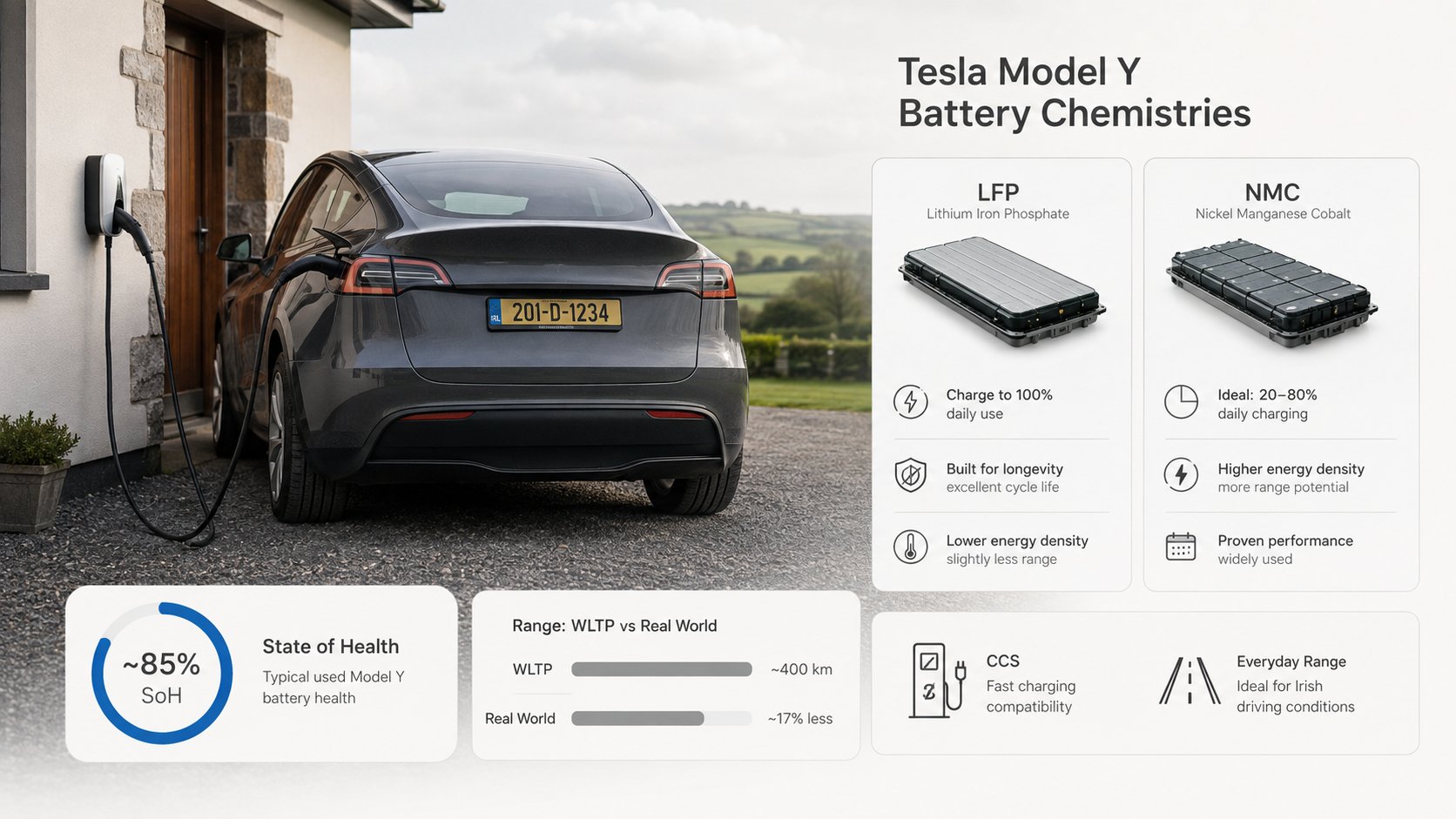
Battery chemistry changes how a Model Y should be charged and how confidently a buyer can interpret general advice. The RWD uses lithium iron phosphate, or LFP, while the Long Range and Performance versions use larger nickel manganese cobalt, or NMC, packs. Neither label replaces a proper inspection, but the distinction helps owners choose sensible charging habits.
LFP in the RWD
LFP chemistry generally offers strong cycle durability and can be charged to 100 percent regularly without the same degradation concerns associated with keeping an NMC battery at a high state of charge. That makes the RWD convenient for a driver who wants the maximum available daily range before leaving home.
The practical point isn't that LFP batteries are immune to ageing. Heat, usage, charging conditions and time still matter. A used RWD should therefore be judged on its own verified SoH, even though the chemistry is generally regarded as durable.
NMC in Long Range and Performance
NMC batteries provide higher energy density, which helps the Long Range and Performance variants deliver more range from their larger packs. They benefit from a more conservative daily charging routine, normally using a partial charge for everyday driving and reserving a full charge for trips when the additional range is needed.
A buyer shouldn't reject an NMC Model Y because the battery needs more careful routine management. The correct question is whether the previous owner appears to have maintained the car sensibly and whether current diagnostic evidence supports the advertised range. Chemistry provides context, not a guarantee.
Battery type explains the care routine. Verified SoH explains the condition of the individual car.
Charging the Model Y on Irish Infrastructure
The European and Irish Model Y uses a CCS2 connector. That means it can use standard Irish CCS rapid chargers as well as Tesla Superchargers that are open to compatible non-Tesla vehicles. It doesn't use CHAdeMO, so buyers who already have a CHAdeMO-only charging routine need to confirm their alternatives before purchasing.
The connector matters because public charging isn't only about the car's maximum power. The site itself, the charger configuration, battery temperature, state of charge and other vehicles sharing the location affect the result. A Model Y connected to a powerful unit may not sustain its peak rate for the whole session.
Home and destination charging
Tesla's catalogue specifications list 11 kW AC charging for the relevant Model Y configurations. That makes overnight home charging the calmer and more predictable part of ownership, provided the property has suitable electrical capacity and an installed wallbox. Buyers without off-street parking should map their regular public chargers before committing, rather than assuming every destination will offer a convenient top-up.
For longer trips, the RWD supports DC rapid charging at up to approximately 170 kW, while the Long Range and Performance variants support up to approximately 250 kW, according to Tesla's published specifications. These are maximum capabilities, not fixed charging speeds. The car normally tapers power as the battery fills, so a short rapid stop is often more useful than waiting for a near-full charge.
Planning Irish journeys
A driver should check the route, charger type and likely arrival state of charge before setting off. Ireland's network supports the Model Y's CCS2 system, but compatibility doesn't guarantee that a particular site will be available, operational or conveniently located.
ShamAuto's EV charging guide for Ireland helps buyers assess home charging, public charging and connector requirements before they choose a used EV. The useful test is simple: can the car's charging routine fit the driver's home, commute and regular longer journeys?
Verifying Battery State of Health Before You Buy
SoH should be treated as evidence about usable battery capacity, not as a decorative badge. A reading that compares the battery's present usable capacity with its original usable capacity helps the buyer understand why two similar-looking Model Ys may offer different range and value.
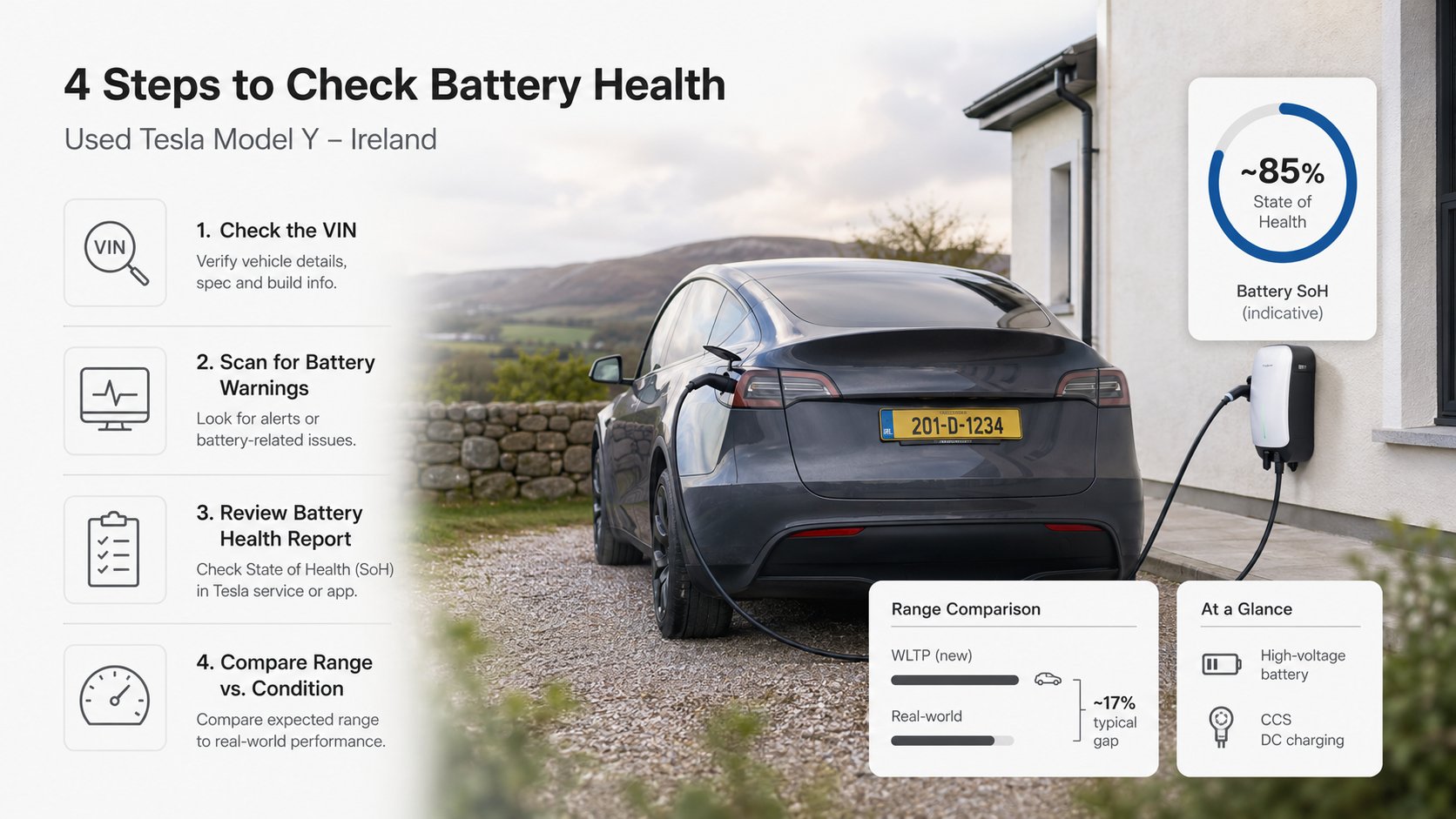
The seller should be asked for Tesla service records or a diagnostic scan that reads the Battery Management System. Screenshots need enough context to identify the car and show the relevant battery information, not just a cropped image containing a percentage with no date or vehicle details.
How to read the evidence
A good battery check should answer four questions:
Capacity evidence: Does the diagnostic information show usable capacity or a clear SoH result?
Vehicle identity: Can the screenshot be matched to the exact Model Y being sold?
Fault status: Are there battery-related warnings or error codes?
Range consistency: Does the evidence make sense beside the car's variant, mileage and advertised range?
A displayed range estimate alone isn't enough. It can change with recent driving efficiency, temperature and charging level, whereas SoH is intended to measure the battery's underlying capacity. The buyer should also compare the reported battery condition with the cautious WLTP-minus-17-percent range estimate used for the relevant variant.
Evidence before emotion
The most useful listing is one that makes battery evidence visible before the viewing. A verified SoH badge can reduce guesswork, but buyers should still inspect the underlying diagnostic proof and confirm that it relates to the specific vehicle.
ShamAuto's guide to private car sales in Ireland covers the wider transaction process. Battery evidence shouldn't be treated as a bargaining trick. It gives both sides a clearer basis for discussing condition, expected range and value.
Used Model Y Pricing and Value Factors in Ireland
There isn't one meaningful used Model Y price. Irish value depends on year, mileage, variant, specification, condition and verified SoH, with battery evidence often separating two cars that look almost identical in photographs.
Because used Model Y prices depend on so many factors, treat any single quoted figure with caution and compare against current Irish listings rather than a fixed average or an old review. Note that the 2025 facelift is a different, newer car, so its prices should not be applied to the 2022-2024 used models this guide covers.
What changes the value
A newer car with low mileage may command more, but mileage isn't a substitute for battery evidence. A higher-mileage RWD with a documented, healthy battery may be a more defensible purchase than a lower-mileage car with no SoH proof. Long Range and Performance versions also need to be compared within their own trim groups because drivetrain, battery and equipment differ.
Used buyers should also remember that second-hand electric vehicles don't qualify for the SEAI purchase grant. The grant applies to new EVs only, so buyers must check the current SEAI grant guidance rather than assume a used Model Y receives the same support as a new car.
For VRT, tax or other scheme details, the safe approach is to consult the live information from Revenue and gov.ie. These rules and schemes can change, so an old listing or informal calculation shouldn't decide the budget.
Pre-Purchase Inspection Checklist for the Model Y
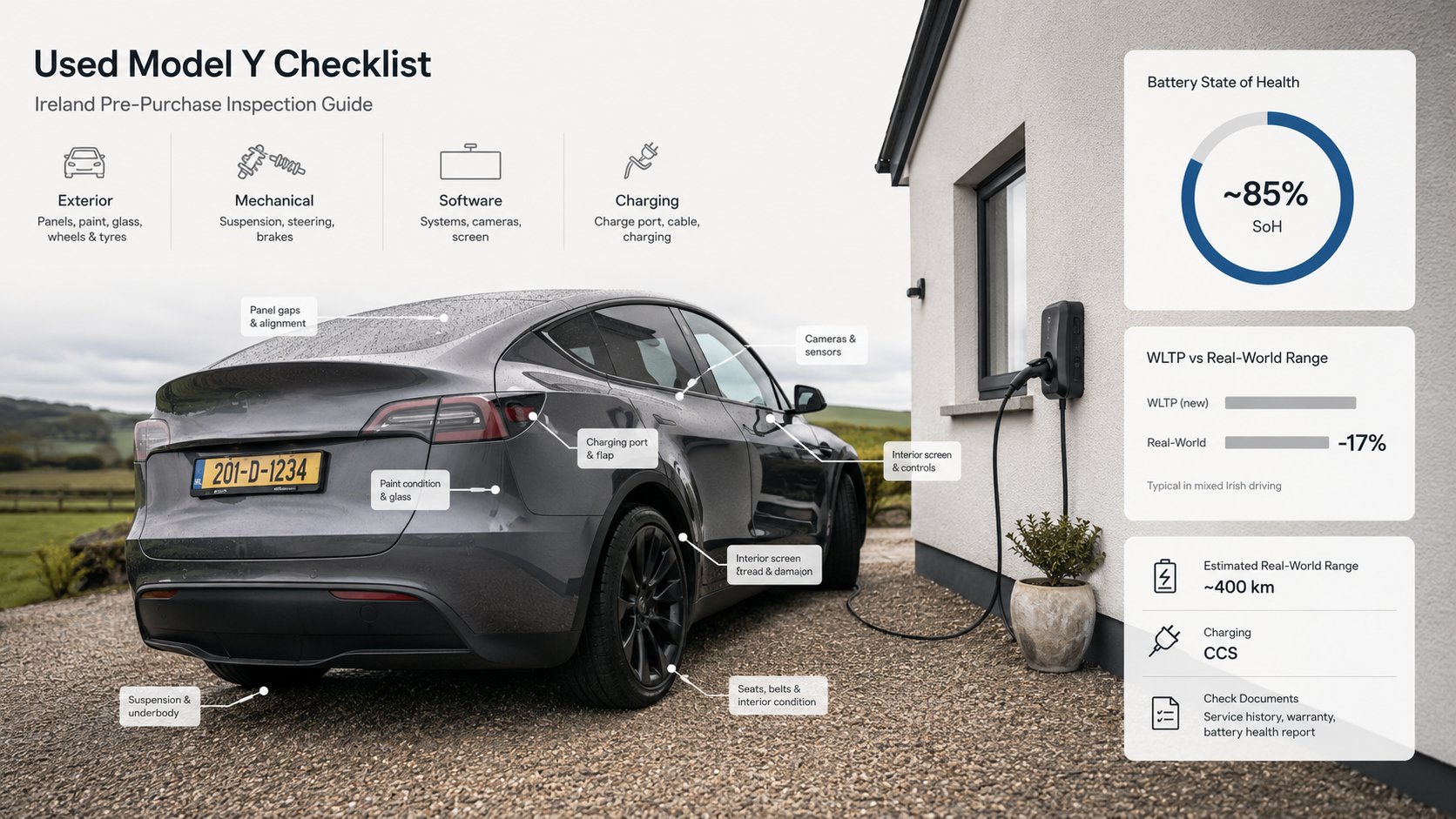
The Model Y has fewer conventional mechanical wear items than a petrol or diesel SUV, but it still needs a proper physical and software inspection. Build quality, tyre wear, suspension condition and electronic functions can affect ownership just as much as the battery report.
Exterior and cabin
Walk around the car in daylight and inspect panel alignment, paint consistency, glass, lights and the charging-port door. Uneven panel gaps don't automatically prove accident damage, but they deserve closer examination alongside paint readings, repair invoices and the vehicle history.
Inside, test the screen, climate controls, seat adjustments, windows, cameras, reversing display, audio and charging settings. A slow or unreliable screen can make everyday functions frustrating, while missing trim, damaged upholstery or loose interior panels may indicate harder use than the advert suggests.
Running gear and test drive
Check all four tyres for even wear, not just remaining tread. Inner-edge wear can point towards alignment or suspension issues, and mismatched tyres may affect handling and efficiency.
During the test drive, listen for knocks over rough surfaces and check that the steering tracks cleanly. Test regenerative braking at different strengths, apply the friction brakes safely and watch for warnings. The Model Y's single-speed automatic delivery should feel smooth, with no clutch engagement or gear changes.
Software and charging
Confirm that the advertised driver-assistance features, cameras and connectivity work as described. Plug the car into a compatible charger if practical, inspect the CCS2 port for damage and confirm that the vehicle begins and maintains a charge without warnings.
The final check is documentary. Match the VIN and mileage to the records, request the battery evidence, verify the included equipment and ensure any promised update or repair is written into the sale agreement. A structured used EV buying guide for Ireland can help keep the inspection organised.
ShamAuto is an Ireland-focused EV-only used-car marketplace that standardises battery, charging and range information, including verified SoH evidence when diagnostic screenshots are provided. Buyers can visit ShamAuto to review the Model Y buying resources and sellers can prepare to list with the battery information serious Irish EV buyers need.