
Private Car Sales Ireland: How to Sell Your Used EV
Contents
- Why Selling a Used EV Is a Different Kind of Private Sale
- How to Get a Verified Battery State of Health Reading
- Pricing Your Used EV Honestly Against the National Market
- Photographing and Writing a Listing That Answers EV Questions Up Front
- Handling the Legal and Admin Side of an Irish Private Sale
- Listing on ShamAuto and Managing Buyer Enquiries Safely
The most popular advice on private car sales in Ireland still sounds like it was written for petrol cars: clean it, price it well, take decent photos, and wait. That misses the part that now decides whether a used EV sells quickly or sits, because buyers are checking the battery, the world range, and whether the car's condition matches the listing. In a market where 22,493 new electric cars were licensed in Ireland in 2023, up 45% from 15,462 in 2022, and EVs made up 19% of all new cars licensed for the first time, the private-sale benchmark has changed too, with more buyers arriving already tuned to EV-specific evidence rather than generic car-ad copy (CSO).
A seller who understands that shift does better than one who just reposts an old used-car template. The strongest listings answer the questions buyers are asking in the Irish private market, not the questions that mattered on a diesel saloon ten years ago.
Why Selling a Used EV Is a Different Kind of Private Sale
Private car sales Ireland used to revolve around service stamps, NCT status, tyre tread, and whether the engine sounded healthy on a short test drive. Those details still matter, but they are not enough on an EV, because the car wears differently and every EV is automatic, with a single-speed drivetrain instead of a clutch or gearbox to worry about.
The buyer's real questions have changed
On a used electric car, the buyer wants to know how much of the battery remains healthy, what range is usable, and how the car charges in practice. Mileage alone does not tell that story. A lower-mileage EV with poor battery condition can be less attractive than a higher-mileage car with strong State of Health (SoH) and honest charging data.
That is why a listing that shows battery evidence feels more credible than one that states "excellent condition." Buyers can compare petrol cars by engine size and fuel economy, but EVs need battery-specific detail to be judged fairly.
Practical rule: if a listing does not answer battery condition, charging, and range up front, the buyer will ask later, or walk away.
The tone of the sale changes too. Private EV buyers in Ireland often arrive with a checklist that already includes battery health, connector type, and whether the range claim sounds realistic. The seller's job is to reduce uncertainty, not to dress up the car.
Why trust matters more than polish
The wider market has also shifted. More buyers now expect used EV listings to stand up to scrutiny, so the seller has to give proof, not just presentation. Clear photos, battery evidence, and a sensible explanation of range build confidence faster than glossy language ever will.
That matters because the strongest listings answer the questions buyers are already asking in the Irish private market. They deal with the battery, the charging setup, and the usable range in a way that feels grounded, not rehearsed.
How to Get a Verified Battery State of Health Reading
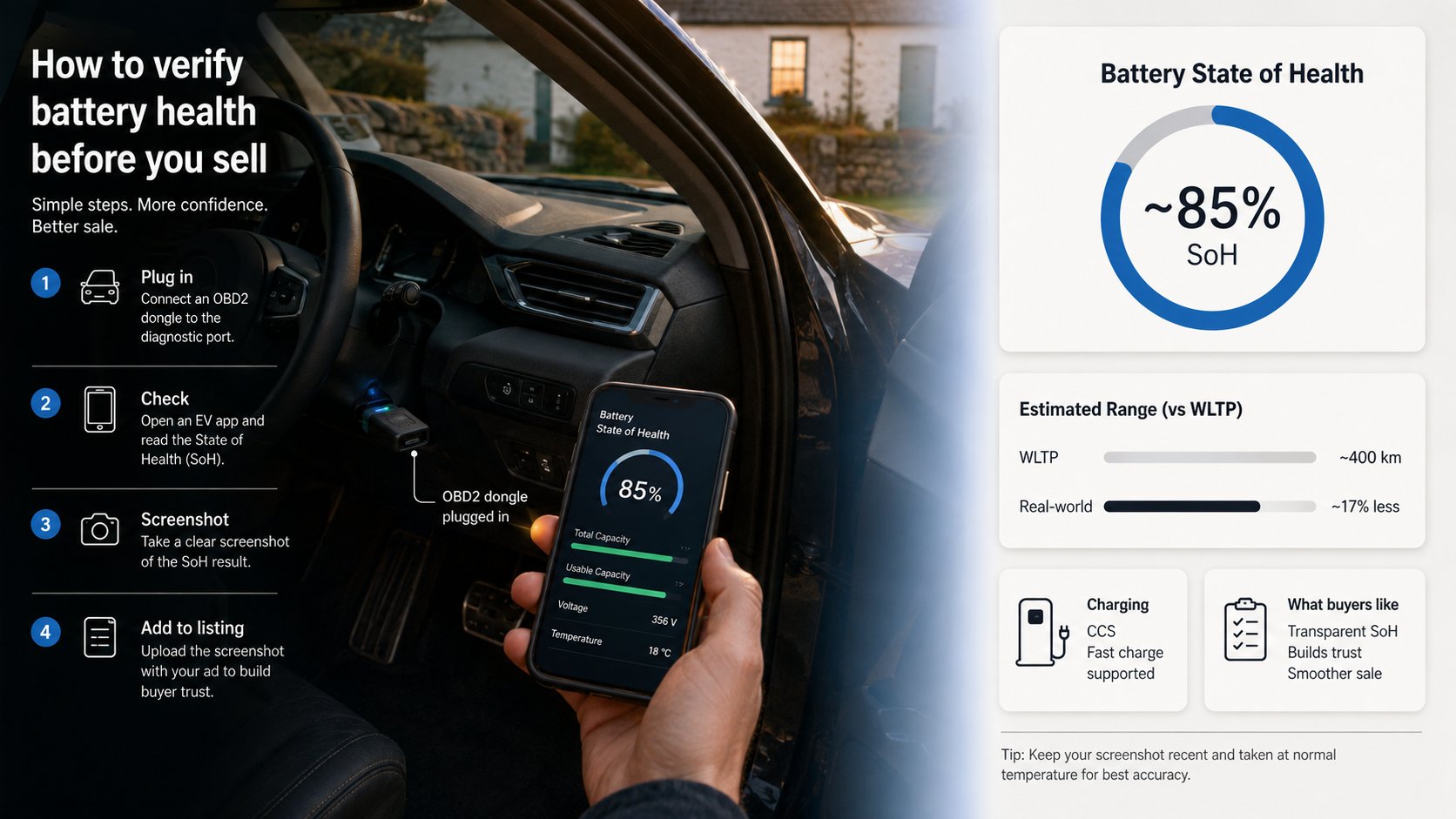
A verified SoH reading is the closest thing a private EV seller has to a battery health receipt. It doesn't tell the whole story, but it gives buyers a concrete reference point, and it's much more useful than a vague claim that the battery is "fine". The simplest way to get it at home is with an OBD2 dongle and a model-appropriate app.
The practical way to read SoH
Start with a compatible OBD2 scanner that plugs into the car's diagnostic port. Pair it with an app that can display battery data, such as Car Scanner, or a brand-specific tool like LeafSpy for a Nissan Leaf. The point isn't to chase fancy diagnostics, it's to pull the battery's SoH reading into a format you can show a buyer.
Once the app displays the battery health figure, take a clear screenshot. If the reading includes the car's VIN or the app shows extra battery details, keep that too, because the buyer is looking for signs that the number is real, not invented.
A good SoH screenshot does more than prove the battery exists. It shows the seller is willing to be specific.
The single most useful habit is to attach that screenshot directly to the listing. If a buyer has to message for basic evidence, the process gets slower and trust drops. A visible SoH image does the opposite.
For a deeper walkthrough of what buyers look for, ShamAuto has a guide on how to check battery SoH before you buy, and the same logic works for sellers who want to present the car properly.
What the screenshot should support
A screenshot is most useful when it sits alongside other EV-native details. That means the listing should mention the car's charging connector, any relevant charging equipment, and the condition of the battery in plain terms. The buyer doesn't need a technical essay, but they do need enough proof to compare one EV against another.
That's also where a marketplace that is built around EV data helps. ShamAuto is one place where sellers can present battery evidence alongside EV-native specifications, but the core task stays the same no matter where the listing goes: show the SoH reading, don't just talk around it.
Pricing Your Used EV Honestly Against the National Market
Used EV pricing works best when it's treated like a comparison exercise, not a guess. The right reference point is the current national market for the same model, battery size, and SoH, not a hoped-for figure based on what the seller needs to get back. A clean, well-documented car can justify a stronger ask, but the price still has to make sense beside other listings.
How to think about the asking price
Private buyers usually expect some room to negotiate, so a sensible tactic is to list near the honest market median and leave a small buffer for negotiation. That approach avoids the common mistake of pricing too aggressively and signalling that the seller isn't serious.
The buffer matters because a private sale is a negotiation system, not a fixed-price retail rack. If the ad is inflated from the start, buyers often don't counter, they just move on. If it's grounded in comparable national listings, the conversation can focus on battery evidence, condition, and timing.
One thing that should never be implied in a used EV ad is that the buyer will get the SEAI purchase grant. Second-hand EVs do not qualify for that grant, so the listing should stay away from any wording that suggests otherwise. If grant rules, VRT treatment, or other volatile items come into the conversation, the safest route is to point people to the live official sources rather than trying to freeze a changing rule in an ad.
What to compare before setting the price
A sensible comparison set looks like this:
Same model and trim: Compare like with like, because trim differences can affect charging hardware and equipment.
Same battery size: A larger battery usually changes how the market values the car.
Similar SoH: Battery condition should sit at the centre of the comparison, not as a footnote.
Current national listings: Use active Irish listings, not old saved screenshots or wishful thinking.
That last point is key. A used EV with clear SoH and real-world range may be easier to price confidently than one with no battery evidence, because the seller has something solid to anchor the ask. A vague car is harder to value than a documented one.
Photographing and Writing a Listing That Answers EV Questions Up Front
A strong EV listing sells information before it sells image. Buyers still want clean paintwork and tidy interiors, but on a used EV they're also scanning for charge-port detail, cable condition, and evidence that the car suits their charging routine. That's why the photo set should look like an EV buyer made it, not a generic car ad.
What to photograph
Shoot the usual exterior angles, then add the EV-specific details. Include the charge port, the charging cable, and any home charging equipment that's being included with the sale. If the car has more than one connector option or charging-related accessory, make that visible rather than burying it in the description.
The listing text should answer the questions that matter most to an EV buyer in Ireland. The car is automatic by design, so there's no clutch wear or gearbox story to tell. What matters is the battery, the charging speed, and the range the next owner can realistically expect.
For EV range, ShamAuto uses a conservative framing of WLTP minus 17 percent for its real-world range metric. That's a helpful way to avoid overpromising, because the buyer is far more likely to trust a cautious estimate than an optimistic brochure figure. If the car has an onboard charger size worth mentioning, include it. If the seller knows the connector type, state it clearly.
For a buyer's-eye view of what matters in an EV ad, the used EV buyers checklist in Ireland is worth reading before the listing goes live.
How the copy should read
Keep the language direct. A good EV listing reads like evidence, not advertising. It should mention SoH, usable battery size if known, real-world range, charging connector, and any home charging gear included, then leave the rest to the photos and the inspection.
Honest wording shortens the back-and-forth. Buyers ask fewer basic questions when the listing already tells the truth plainly.
Clear photos do the same job. If the car looks cared for and the battery evidence is visible, the buyer can focus on whether it suits their use case instead of trying to decode gaps in the ad.
Handling the Legal and Admin Side of an Irish Private Sale
The legal side of a private sale in Ireland is straightforward when the paperwork is in order and messy when it isn't. The key point is that consumer law does not apply when the buyer is dealing with a private individual who is not acting as a trader, which is why records matter so much in a private sale (Citizens Information). A seller who keeps a clean trail is protecting both sides.
Keep the official documents close at hand
Before handing over the car, the seller should have the vehicle's documents, service history, and any battery health screenshot that was shared in the ad or by message. The change of ownership should be completed through the official Irish route, either online or through the paper process tied to the vehicle registration documents, and the buyer should know where the live instructions sit on motortax.ie and the National Vehicle Driver File, as set out by Citizens Information.
The NCT side should be checked against the live guidance on ncts.ie and the RSA, rather than relying on old forum advice. A valid test status matters in the sale conversation, but the exact handling depends on the car and the live rules.
For broader admin questions, gov.ie and Citizens Information are the safest places to verify what applies on the day of the sale. Older vehicles and missing registration documents can trigger a different ownership route, so the registration era and paperwork status should be confirmed before meeting the buyer using the official guidance already cited above.
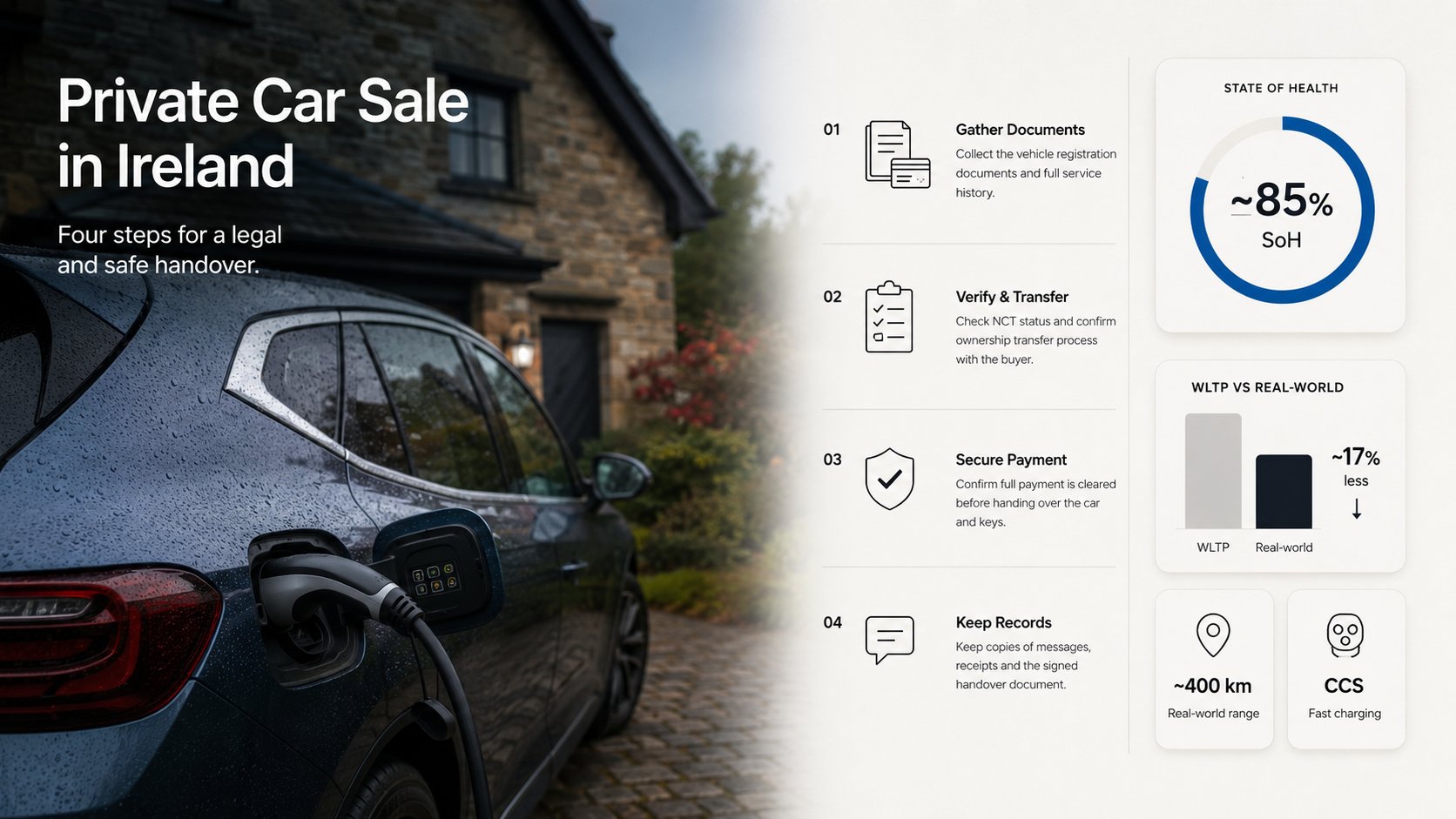
The safest private-sale habit is simple. Keep copies of everything, note what was shared, and don't hand over keys until the payment and ownership transfer are dealt with properly.
Listing on ShamAuto and Managing Buyer Enquiries Safely
An EV-only marketplace cuts out a lot of irrelevant noise. The buyer who reaches an EV listing already wants to know about battery health, charging, and real-world range, so the conversation starts with the details that shape value. That matters more than polished wording, because buyers in Ireland will often compare the numbers and the evidence before they look at the rest of the car.
Sellers who want that kind of audience can list their car on ShamAuto. The site is built for electric vehicles, so the listing can focus on SoH, range, charging equipment, and the other checks EV buyers use.
How to handle enquiries without creating risk
Private-sale safety still matters, even with a well-written listing. Meet in a public place if possible, bring a friend, and keep the first conversation focused on the car instead of letting it drift into pressure or haggling before the buyer has seen the evidence. If the buyer asks to review the battery information again, send the same screenshot and details that were already included in the ad.
Payment should be confirmed before keys and documents change hands. That is basic caution in a private transaction, not overthinking. Written messages also help, because they create a clear record of what was agreed about battery condition, accessories, and any charging gear included with the sale.
A strong EV listing does the heavy lifting before the meeting ever happens. It filters out casual enquiries, brings in people who actually want an electric car, and gives them enough battery and range evidence to ask serious questions instead of guessing. On an EV sale, that usually means fewer wasted conversations and more buyers who arrive ready to deal.