
Renault Electric Car Guide for Irish Used Buyers
Contents
- Why the Renault Number on the Windscreen Is Not the Number You'll Drive
- The Evidence-First Framework for Buying a Used Renault EV
- Renault Zoe ZE50, the Big Used-Volume Renault EV
- Renault Megane E-Tech, the Newer Hatchback With Two Battery Sizes
- Newer Renault EVs Arriving on the Used Market
- Buying a Used Renault EV in Ireland, What to Check Before You Pay
- Grants, Tax and Supports for a Used Renault EV in Ireland
- Comparing Renault EVs and the Questions Irish Buyers Ask Most
Most Renault electric car advice starts with the brochure range and ends with a charging cable recommendation. That is backwards for an Irish used buyer. A Renault Zoe, Megane E-Tech or Scenic E-Tech should be judged first on verified State of Health (SoH), usable battery capacity, charging compatibility and the range a driver can reasonably expect on Irish roads.
The WLTP figure remains useful, but it isn't the distance a driver is guaranteed to cover. ShamAuto applies a cautious real-world estimate of WLTP minus 17 percent to make Renault models easier to compare. That approach isn't a promise of winter performance. Cold weather, motorway speed, traffic, gradients, heating and payload can reduce the result further.
ShamAuto is a newly launched, pre-stock EV marketplace, so it has no Renault price averages, SoH averages or county stock figures to present. Its useful role here is narrower and more honest, standardising the evidence buyers should request and providing model guides that keep brochure claims separate from practical expectations.
Why the Renault Number on the Windscreen Is Not the Number You'll Drive
A Renault showing 395 km WLTP won't deliver 395 km in every Irish journey. Renault Ireland lists that WLTP figure for the Zoe Z.E. 50 in its official Zoe brochure, while the ShamAuto calculation places the same model at approximately 328 km using the WLTP-minus-17-percent rule. That is a planning figure, not a guarantee.
The same correction changes the Megane E-Tech EV60 from Renault's 450 km WLTP figure to approximately 374 km. The difference matters more on a long motorway trip than on short urban driving, because higher speeds and cabin heating put greater pressure on consumption. A driver planning around the brochure number can arrive at a charger earlier than expected, particularly during a cold February morning.
The range rule is deliberately conservative
The calculation is simple, but its purpose is practical. It gives Irish buyers a consistent starting point across Renault's electric range rather than allowing each listing to present an optimistic figure in isolation.
| Renault model | Renault WLTP range | ShamAuto real-world estimate |
|---|---|---|
| Zoe ZE50 | 395 km | approximately 328 km |
| Megane E-Tech EV40 | 300 km | approximately 249 km |
| Megane E-Tech EV60 | 450 km | approximately 374 km |
The Renault Zoe real-world range guide and Megane E-Tech real-world range guide apply the same cautious method. The Scenic figures are treated separately because its battery options and body shape create a different use case.
Practical rule: Budget from the adjusted figure, then leave extra room for cold weather and motorway driving.
This isn't an argument against Renault. It is an argument against treating WLTP as a promise. The right Renault electric car is the one whose verified battery condition and realistic range match the driver's routine, charging access and longer-trip habits.
The Evidence-First Framework for Buying a Used Renault EV
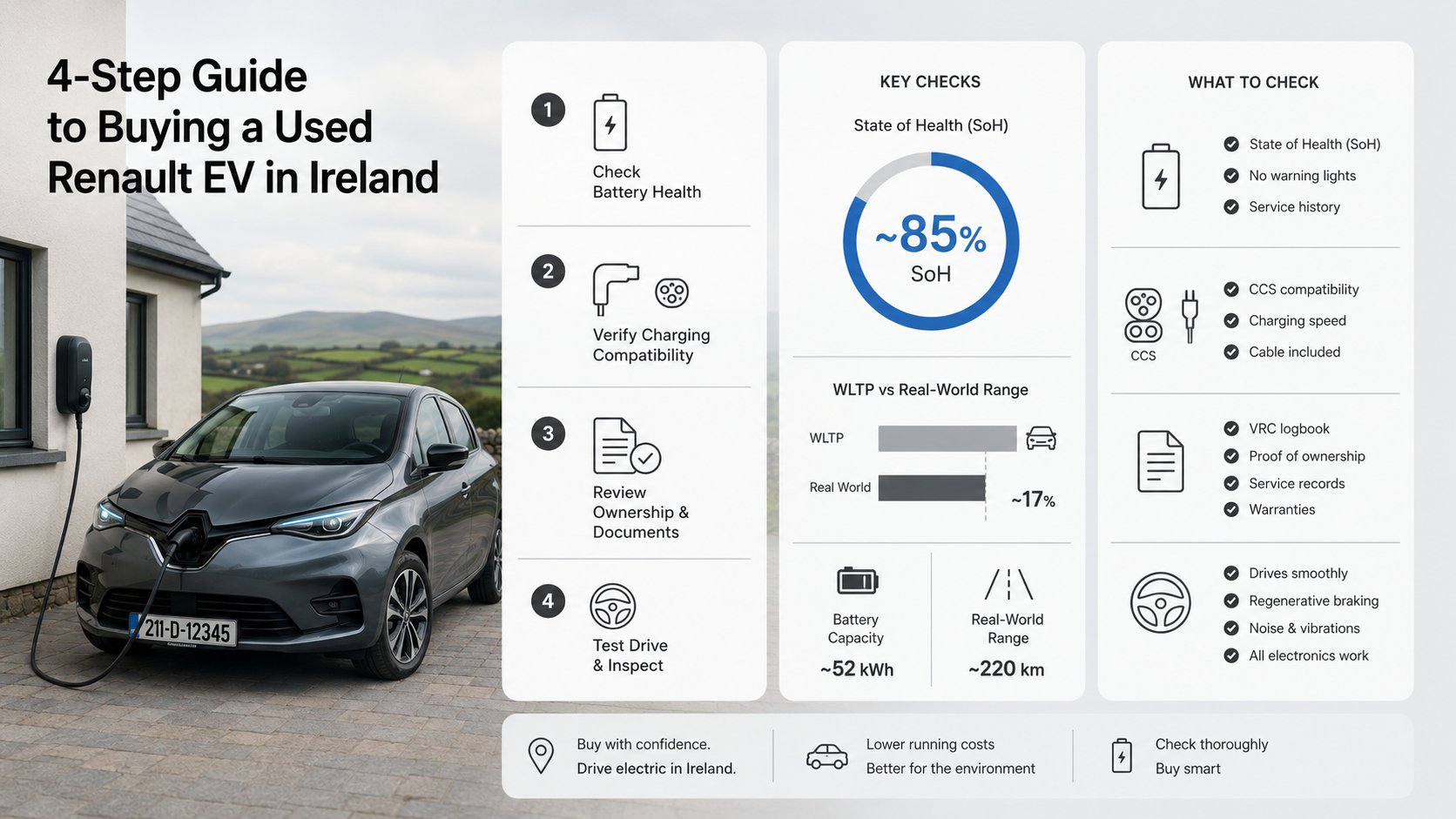
A used Renault EV should come with evidence, not a verbal assurance that the battery is "fine". The essential document is a diagnostic report or screenshot showing State of Health (SoH), which expresses the battery's remaining capacity relative to its original usable capacity. Mileage still matters, but SoH tells a buyer more directly how much energy the battery can store now.
The check should answer four questions:
What is the verified SoH? A screenshot from a recognised diagnostic process is stronger than a seller's description. The figure should relate to the exact car, not a model average.
What usable battery capacity remains? SoH and usable capacity belong together. A buyer needs to understand how the reported condition affects the car's expected range.
Which connector and charging speeds are fitted? AC and DC charging are not interchangeable. The Zoe ZE50 and Megane E-Tech need the correct cable and public-charging expectations.
Do the records support the advert? Service history, warranty status, battery ownership and charging history should be checked before a deposit is paid.
Every EV is automatic. Renault electric cars use a single-speed drive system, so there is no clutch or conventional gearbox to operate. That makes the test drive simpler, but it also means the useful observations are regenerative braking, pedal response, steering, ride comfort, tyre noise and charging behaviour.
Evidence beats mileage alone
A higher-mileage Renault with strong SoH can make more sense than a lower-mileage example with unexplained degradation. That doesn't make mileage irrelevant. It means mileage should be considered alongside battery condition, age, charging history, service records and the specific model's known limitations.
The Car Buyer Guide for Ireland provides a broader document and vehicle-checking routine. For Renault buyers, the battery report should sit near the top of that routine, not be treated as an optional extra after the test drive.
Renault Zoe ZE50, the Big Used-Volume Renault EV
The Zoe is the Renault electric car most likely to attract attention in Ireland's established used EV market. Renault was one of the early EV leaders in Ireland, which is part of why the Zoe is a common sight in the used market today.
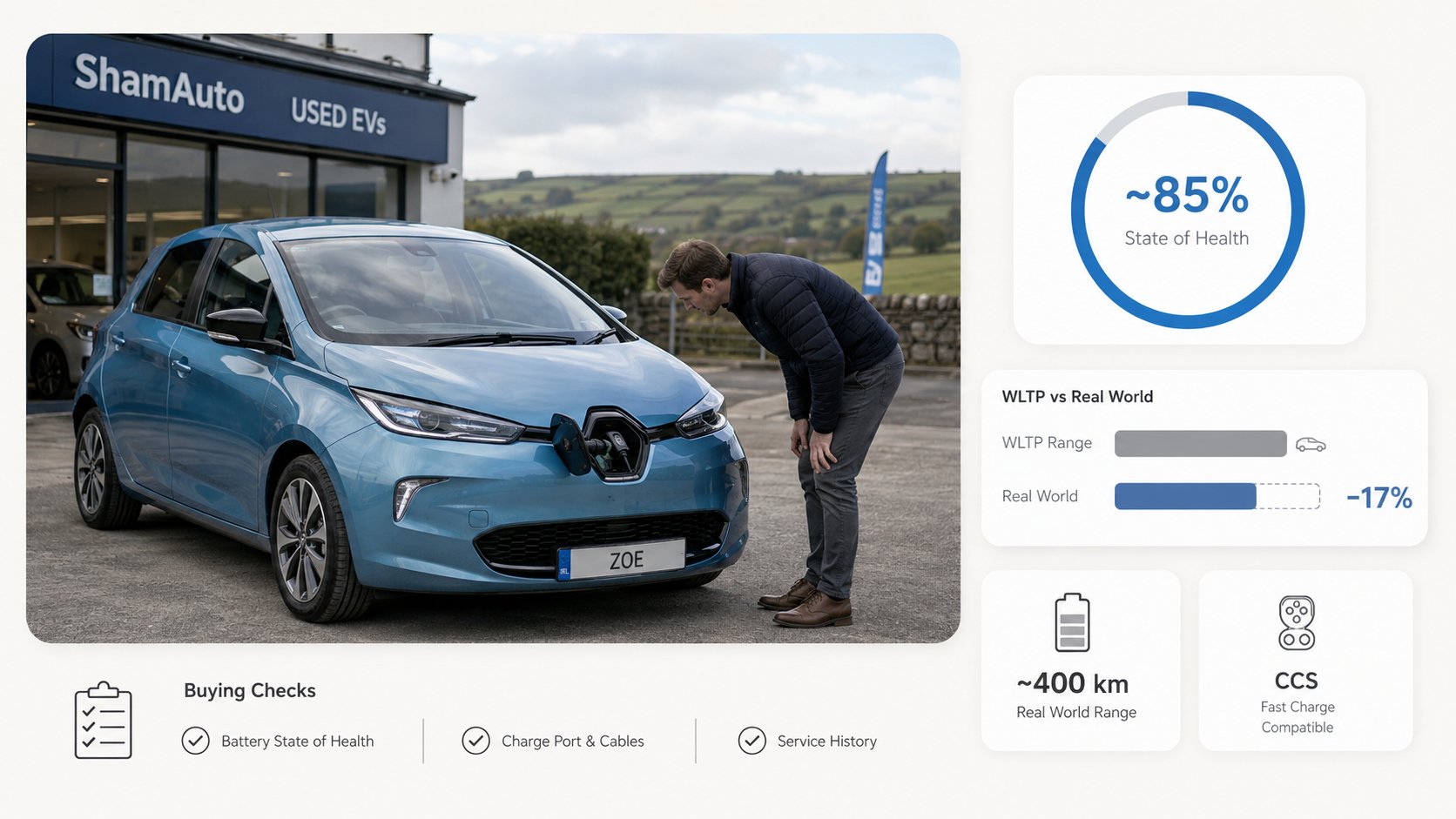
For used buyers, the key version is the Zoe ZE50 with a 52 kWh battery. Renault lists a 395 km WLTP range, which becomes approximately 328 km under the ShamAuto WLTP-minus-17-percent estimate. The model's AC capability is a genuine strength, with an onboard charger supporting up to 22 kW AC where the charging post and electrical supply support it.
The ZE50 also introduced CCS DC charging, but its rapid-charging ceiling is modest at about 50 kW. That isn't a deal-breaker for an urban or mixed-use driver who charges overnight or uses destination AC charging. It is a limitation for frequent long-distance motorway driving, where a newer Renault can spend less time at a rapid charger.
The Zoe traps buyers must not overlook
The Zoe uses an air-cooled, passively cooled battery. That is a real engineering trade-off, particularly when assessing older cars or examples that have seen demanding charging use. Passive cooling doesn't automatically make a Zoe a bad purchase, but it makes a verified SoH report more important. Each car should be judged on its own battery evidence.
Older Zoes can also have a battery-lease or battery-rental agreement. The buyer must establish whether the battery is owned outright or remains subject to a contract, because that changes the ownership position and the costs attached to the vehicle. The paperwork should be checked before any deposit is transferred.
The Zoe real-world range guide is useful for range planning, while Renault's brochure should be used to confirm the specification of the particular version. A seller should be asked for the battery ownership documents, charging history, diagnostic evidence and confirmation that the advertised CCS equipment is fitted.
The Zoe is worth a serious look when the price reflects its age and charging limits, the battery is owned outright, and the SoH is verified. A buyer who regularly drives long motorway distances should be more demanding about DC speed and should consider whether the Zoe's charging profile fits the routine.
Renault Megane E-Tech, the Newer Hatchback With Two Battery Sizes
The Megane E-Tech shouldn't be treated as one specification. The EV40 and EV60 are meaningfully different cars because their batteries and range targets serve different driving patterns.
Renault's Ireland-market specification gives the EV40 a 40 kWh battery and 300 km WLTP range. The ShamAuto adjustment puts that at approximately 249 km in real-world planning. Its DC peak is about 85 kW, so it can suit drivers whose regular journeys are moderate and whose home charging covers most daily use.
The EV60 uses a 60 kWh battery and carries a 450 km WLTP figure, translating to approximately 374 km under the same cautious calculation. Renault specifies DC fast charging up to 130 kW, making the EV60 the stronger choice for longer intercity trips, provided the public charger can deliver the required power.
AC charging can change the ownership experience
Renault Ireland states that the Megane E-Tech can support up to 22 kW AC public charging and up to 130 kW DC rapid charging, with up to 300 km of WLTP range recovered in 30 minutes on rapid DC charging, as described in the manufacturer's Megane E-Tech electric charging FAQ.
The home-charging distinction is especially important. Renault lists about 9 hours 15 minutes for a full charge of the 60 kWh battery at 7.4 kW AC, compared with about 3 hours 15 minutes at a 22 kW public AC post. The same car can therefore feel perfectly convenient at home, or considerably more flexible for a driver who has reliable access to three-phase public charging.
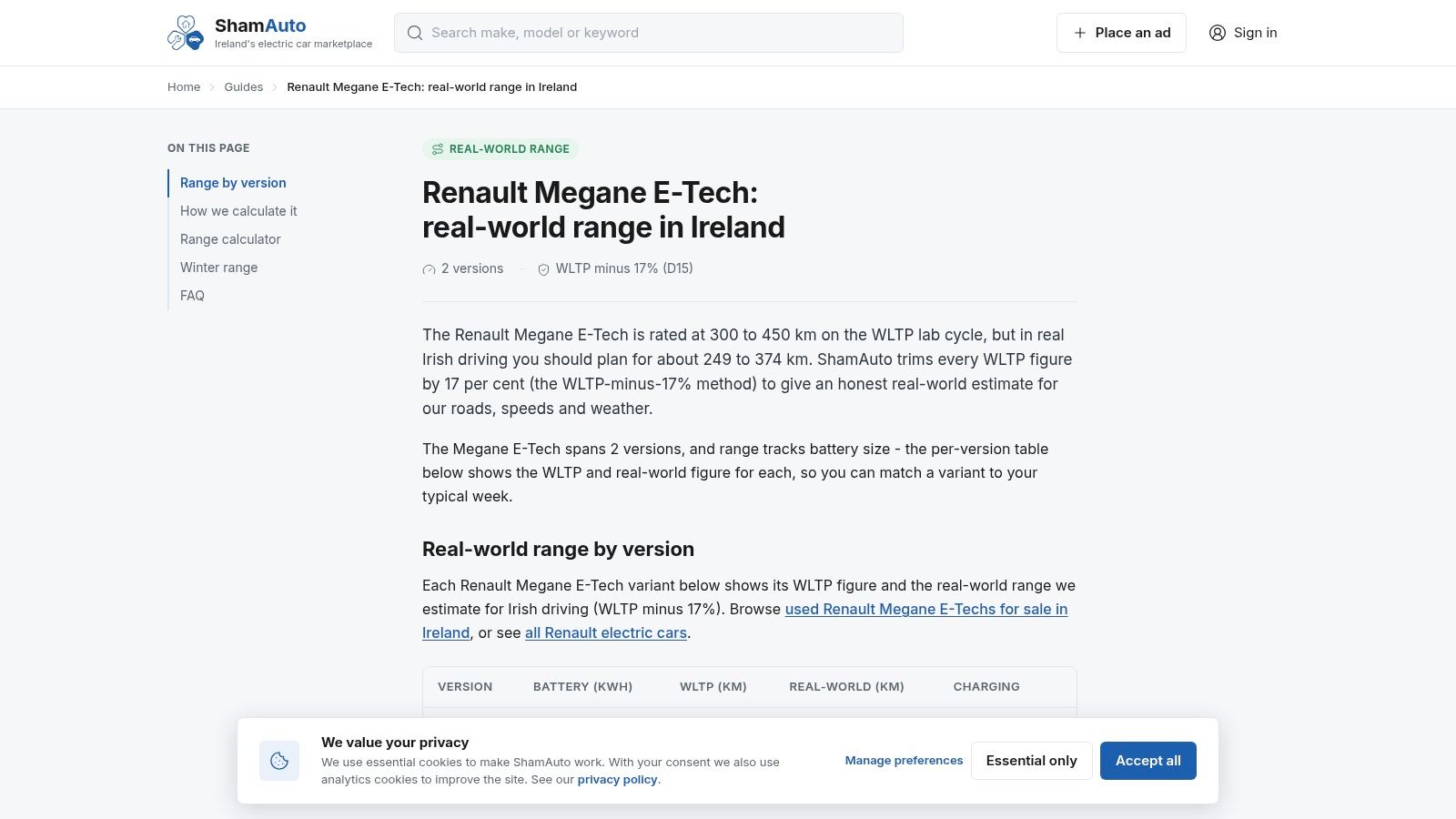
The Megane E-Tech range guide brings the two versions together for comparison. The EV40 is the sensible option for shorter routines and lower energy requirements. The EV60 is the one to investigate for regular longer journeys, but the buyer should still verify SoH, charging equipment and the actual charging locations used most often.
The right battery size depends less on badge prestige than on where the car gets charged.
Newer Renault EVs Arriving on the Used Market
The Scenic E-Tech is the most useful newer Renault to watch for family buyers, although used supply remains thin. Renault gives the 60 kWh Scenic a 430 km WLTP range, which becomes approximately 357 km under the ShamAuto adjustment. The 87 kWh version carries a 625 km WLTP figure, translating to approximately 519 km for cautious planning.
Those figures belong to separate battery versions and shouldn't be blended into one Scenic expectation. A buyer considering the model should check the exact battery, trim and charging equipment rather than relying on the model name alone. The Scenic E-Tech real-world range guide provides the model-specific view.
The Renault 5 and Renault 4 need patience
The Renault 5 E-Tech and Renault 4 E-Tech are newer arrivals, so the Irish used supply is still limited. They may become important options for buyers who want a more modern compact Renault electric car, but there isn't enough established used-market evidence here to justify invented price bands, typical SoH figures or county-level stock claims.
The same discipline applies to newer Scenic listings. The car's official WLTP figure is only the starting point, and battery evidence remains more useful than a seller's generic claim about excellent range. Used buyers should check the ShamAuto guides library for updates as more examples enter the Irish market.
Buying a Used Renault EV in Ireland, What to Check Before You Pay
The first request should be a verified SoH screenshot for the exact vehicle. A seller who cannot provide battery evidence hasn't answered the most important question. The report should be recent enough to describe the car being sold, and the buyer should understand what the stated percentage measures.
Next, compare the adjusted range with the driver's real routine. The Zoe ZE50's approximately 328 km, Megane EV40's approximately 249 km, and Megane EV60's approximately 374 km are planning estimates based on the WLTP-minus-17-percent rule. Cold weather and motorway speed can reduce them further, so a driver shouldn't choose a car that only works when every journey is conducted in ideal conditions.
The pre-deposit checks
Battery condition: Match the diagnostic SoH report to the vehicle identification details and ask how the result was produced.
Charging hardware: Confirm the AC connector and the presence of CCS DC charging on a ZE50 or Megane where rapid charging is expected.
Zoe ownership paperwork: Establish whether the battery is owned outright or covered by a lease or rental agreement.
Vehicle history: Check servicing, warranty status, accident history, imported-car documents and any outstanding finance.
Driving behaviour: Because every EV is automatic, focus the test drive on regenerative braking, acceleration, ride, noise and warning lights rather than clutch or gear changes.
Renault's EV battery warranty has a minimum capacity threshold, but a warranty minimum is not a strong buying target. Check the specific car's remaining battery warranty terms with Renault, and remember a car sitting at the warranty floor is not automatically a sensible purchase.
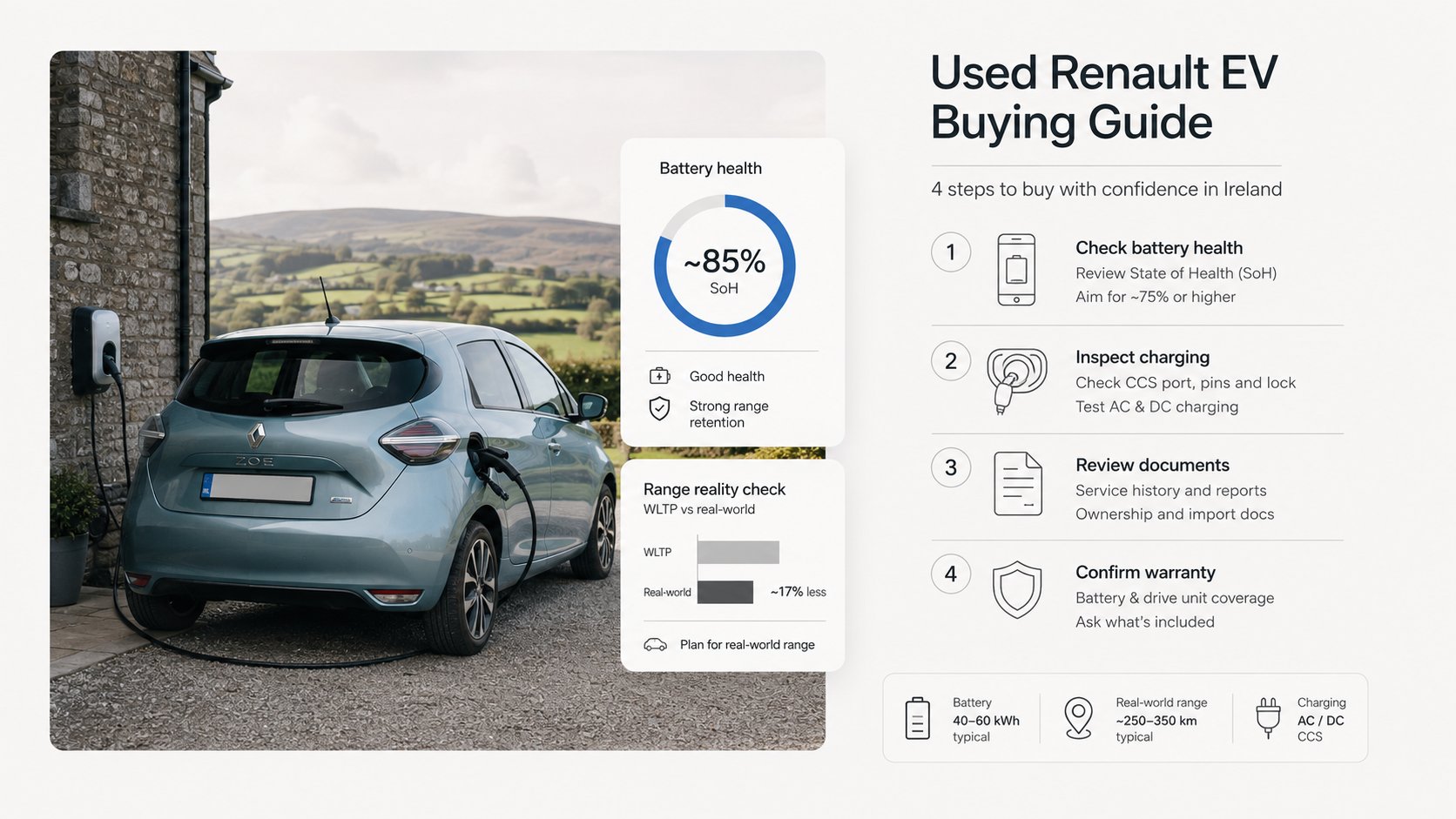
A higher-mileage Renault with strong verified SoH can be preferable to a lower-mileage example with weak or undocumented battery condition. The guide to checking battery SoH before buying and the used EV buying guide for Ireland give buyers a fuller evidence routine. The used Nissan Leaf guide also illustrates why model-specific battery and charging checks matter across the used EV market.
Grants, Tax and Supports for a Used Renault EV in Ireland
A second-hand Renault electric car does not qualify for the SEAI purchase grant. SEAI states that purchase grants are for new vehicles, and its official grant amounts guidance should be checked for the current rules. Citizens Information explains that the BEV purchase grant applies to eligible new battery-electric cars and is handled by the dealer at the point of sale, as set out in its electric vehicle guidance.
Used buyers may still benefit from other supports, depending on the vehicle and the relevant scheme rules. SEAI identifies the home charger grant, reduced tolls, low motor tax and VRT relief for qualifying imports as supports that can still apply to used EV ownership. The SEAI used EV guidance is the appropriate place to check eligibility.
Check live rules before calculating the deal
Tax, VRT, charging support and scheme conditions can change. Buyers should use Revenue's current VRT information, SEAI and gov.ie rather than relying on an old advert or an outdated forum post. The same caution applies to the new-BEV price cap, grant amounts and scheme dates.
The Renault battery warranty also needs careful interpretation: a warranty minimum capacity threshold is a reference point, not a recommendation to buy a car at that level. A used Renault should be assessed on its actual report, expected range and intended use, with the grant position kept separate from the vehicle's underlying value.
The electric car tax guide can help organise the questions, but official sources remain the authority for live rules. A used listing that implies the buyer will receive the new-car SEAI purchase grant should be treated as inaccurate.
Comparing Renault EVs and the Questions Irish Buyers Ask Most
| Model | Usable battery | WLTP range | Real-world range | DC peak | AC peak | Battery cooling |
|---|---|---|---|---|---|---|
| Zoe ZE50 | 52 kWh | 395 km | approximately 328 km | about 50 kW | up to 22 kW | Passive air cooling |
| Megane E-Tech EV40 | 40 kWh | 300 km | approximately 249 km | about 85 kW | up to 22 kW | Active thermal management |
| Megane E-Tech EV60 | 60 kWh | 450 km | approximately 374 km | up to 130 kW | up to 22 kW | Active thermal management |
| Scenic E-Tech 60 kWh | 60 kWh | 430 km | approximately 357 km | Model-specific | Model-specific | Model-specific |
The Zoe remains worth considering, but battery ownership, passive cooling and modest DC charging must be verified. The Megane EV40 suits shorter routines, while the EV60 is the stronger long-distance candidate. Scenic, Renault 5 and Renault 4 buyers should expect thinner used supply and should verify the exact specification.
Common questions from Irish buyers
Do used Renault EVs qualify for the SEAI purchase grant? No. The purchase grant applies to eligible new cars, not second-hand Renaults.
Should buyers automatically avoid a battery-lease Zoe? No, but they must verify whether the battery is owned or leased before paying. The agreement changes the ownership and cost position.
Is a higher-mileage Renault with strong SoH better than a lower-mileage car with weak SoH? It can be. The battery report should carry more weight than mileage alone, alongside the car's age, history and condition.
What range should an Irish buyer budget for in winter? Start with the model's WLTP-minus-17-percent estimate, then allow a further margin for cold weather, motorway speed, heating and payload.
ShamAuto gives Irish sellers a place to be among the first to list a Renault EV with structured battery and charging information, while buyers can use its guides to compare evidence before committing.
ShamAuto offers an EV-only Irish marketplace focused on battery health, usable specifications and cautious real-world range rather than brochure claims. Sellers can visit ShamAuto to be among the first to list a Renault electric car, and buyers can use the connected guides to prepare the right SoH and charging questions before viewing.