
Peugeot 208 for Sale: A Used E-208 Buying Guide
Contents
- The e-208 Is a Different Car from the Petrol 208
- What the Used Peugeot e-208 Actually Is
- Real-World Range and Why WLTP Misleads Buyers
- Charging the e-208 on Irish Roads and at Home
- Reading State of Health on a ShamAuto Listing
- Prices, Mileage and Trim on the Irish Used Market
- Common Myths About Used e-208 Buyers
- Your Used e-208 Checklist and Next Steps
The Peugeot 208 for sale that most buyers find is two different cars. The all-electric e-208 uses either a 50 kWh battery from 2020 to 2023 or a 51 kWh battery from 2023 onwards, charges through CCS, and delivers roughly 17% less than its WLTP range in realistic driving.
That distinction matters because the usual search results mix petrol, diesel and electric versions under one badge. This guide covers only the electric Peugeot e-208, not the petrol or diesel 208. The sensible buying question isn't whether an e-208 is cheap or attractive. It's whether the specific car has verified State of Health, usable battery capacity and enough conservative range for Irish roads.
The e-208 Is a Different Car from the Petrol 208
Searching for a Peugeot 208 for sale in Ireland can produce a confusing pile of cars. Petrol and diesel versions sit beside the silent e-208, often with similar styling, similar badges and very different ownership needs. Treating them as one model is the first buying mistake.
The e-208 shares the 208's small hatchback shape, but its mechanical package is completely different. It's a front-wheel-drive electric supermini with a single-speed reduction drive, CCS charging and no clutch or conventional multi-speed gearbox. Every EV is automatic, so there's no manual e-208 hiding among the listings.
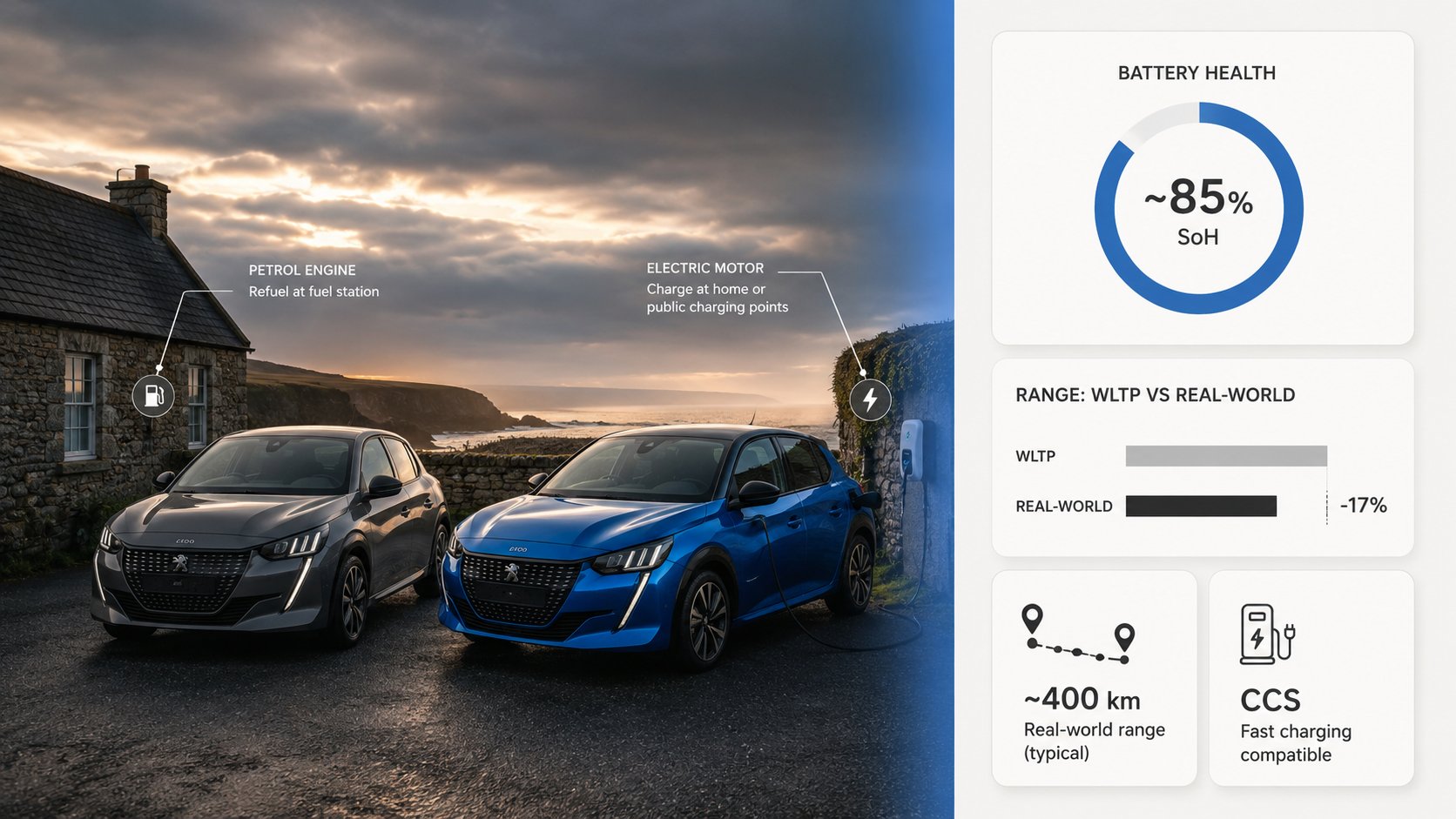
A petrol 208's engine maintenance, exhaust system and gearbox concerns shouldn't be transferred to the electric car. Conversely, an electric buyer needs to ask questions that ordinary listings often ignore, particularly about battery condition, charging capability and realistic range.
Separate the search before comparing prices
The Peugeot 208 badge has been sold in Ireland for over a decade across petrol, diesel and electric versions, so a headline search blurs unrelated cars together. Filtering to the electric e-208 is essential, not optional.
The e-208 should be judged against other used electric cars, not against a cheaper petrol 208 because both carry the same number. A lower purchase price for a combustion car doesn't answer whether an electric car suits a driver with home charging, a regular commute or limited access to public rapid chargers.
Practical rule: Confirm the listing says e-208, electric, CCS and automatic before comparing mileage or asking price.
This separation also protects buyers from false reassurance. The e-208 has fewer conventional service items, but the high-value battery still needs evidence. A tidy body, appealing trim and a low odometer reading can't replace a diagnostic report.
What the Used Peugeot e-208 Actually Is
The used e-208 needs to be divided into two battery generations. They look closely related, but the range figures and usable capacities shouldn't be blended into one average.
The original car arrived in 2020 with a 50 kWh battery and 46.3 kWh usable capacity, according to Peugeot's model information. Peugeot quotes a 362 km WLTP range for this version. From 2023, the updated e-208 uses a 51 kWh battery with 48.1 kWh usable capacity and a 410 km WLTP range in the ShamAuto catalogue framing, with exact specification details attributed to Peugeot's official e-208 materials.
Both versions use a front-mounted electric motor, front-wheel drive and a CCS Type 2 inlet. They're compact hatchbacks designed for urban and commuter work, not large family tourers. The updated battery gives the later car more breathing room, but it doesn't turn the e-208 into a long-distance motorway specialist.
The two generations at a glance
| Generation | Battery usable | Motor | WLTP range | DC charge peak | On-board AC charger |
|---|---|---|---|---|---|
| Original e-208, 2020 to 2023 | 46.3 kWh | Front-wheel drive electric motor | 362 km | Up to about 100 kW | 11 kW |
| Updated e-208, from 2023 | 48.1 kWh | More efficient front-wheel drive electric motor | 410 km | Up to about 100 kW | 11 kW |
The important buying difference isn't the trim badge. Active, Allure, GT and related equipment levels mainly change comfort, technology, wheels and appearance. They don't remove the need to verify the battery fitted to the individual car.
A buyer should therefore record the generation, build year, battery capacity and diagnostic result before becoming interested in leather, alloy wheels or a larger screen. A well-presented car with the wrong battery evidence is still the wrong purchase.
Peugeot's Irish specification information also confirms that charging hardware can vary. The current e-208 sheet lists support for 7.4 kW and 11 kW on-board chargers, so the exact charger option needs checking rather than assuming that every used example charges at the same AC rate. Peugeot Ireland's e-208 specification sheet is the right place to confirm equipment that can change by model year or specification.
Real-World Range and Why WLTP Misleads Buyers
WLTP is useful for comparing cars, but it isn't a safe trip-planning figure. The practical ShamAuto range method applies a 17% reduction to WLTP, producing separate estimates for each e-208 generation.
For the 50 kWh e-208, the catalogue figures are 362 km WLTP, reduced to approximately 300 km real-world range. For the 51 kWh version, the figures are 410 km WLTP, reduced to approximately 340 km. Those estimates must stay separate because the later battery has a different usable capacity and a different official range claim.
| e-208 version | WLTP range | Conservative estimate at WLTP minus 17% |
|---|---|---|
| 50 kWh, 2020 to 2023 | 362 km | About 300 km |
| 51 kWh, from 2023 | 410 km | About 340 km |
The reduction is an editorial planning rule, not a promise of identical results for every driver. Temperature, wind, rain, speed, traffic, heating and tyre condition all influence consumption. A rural driver using national roads may see a different result from a motorway commuter, even in the same car.
Small battery, noticeable consequences
The e-208's compact battery suits a driver who can charge at home and covers predictable daily distances. It becomes less comfortable when the car spends long periods at motorway speed, when winter heating is working hard or when a driver needs to arrive with a generous reserve.
A battery with reduced SoH also has less usable energy than it had when new. That's why a claimed WLTP figure shouldn't be accepted without checking the individual car's health report. The ShamAuto guide to real-world range for the Peugeot e-208 gives buyers a model-specific way to translate the headline figure into a more cautious expectation.
The straightforward test is distance, not optimism. A buyer should compare the conservative range with the complete daily routine, including the return journey, school stops, weather margin and any regular detour. If the calculation only works when the battery is full and conditions are perfect, the e-208 is being stretched beyond its comfortable role.
For broader model comparisons, the electric car range comparison guide provides useful context without hiding the difference between a laboratory number and everyday Irish driving.
Charging the e-208 on Irish Roads and at Home
The e-208 uses a CCS Type 2 inlet. That single connector supports ordinary AC charging at home and DC rapid charging on longer journeys, although the two systems work at very different speeds.
Peugeot Ireland lists AC charging times of 10 hours 30 minutes on a 3.2 kW reinforced home socket and 4 hours 25 minutes on a 7.4 kW AC charging station. The official specification also confirms support for 7.4 kW and 11 kW on-board chargers. Buyers should check the charger option on the car because an 11 kW unit can reduce overnight top-up time compared with a 7.4 kW setup. The official Peugeot charging specification should take priority over a seller's generic description.
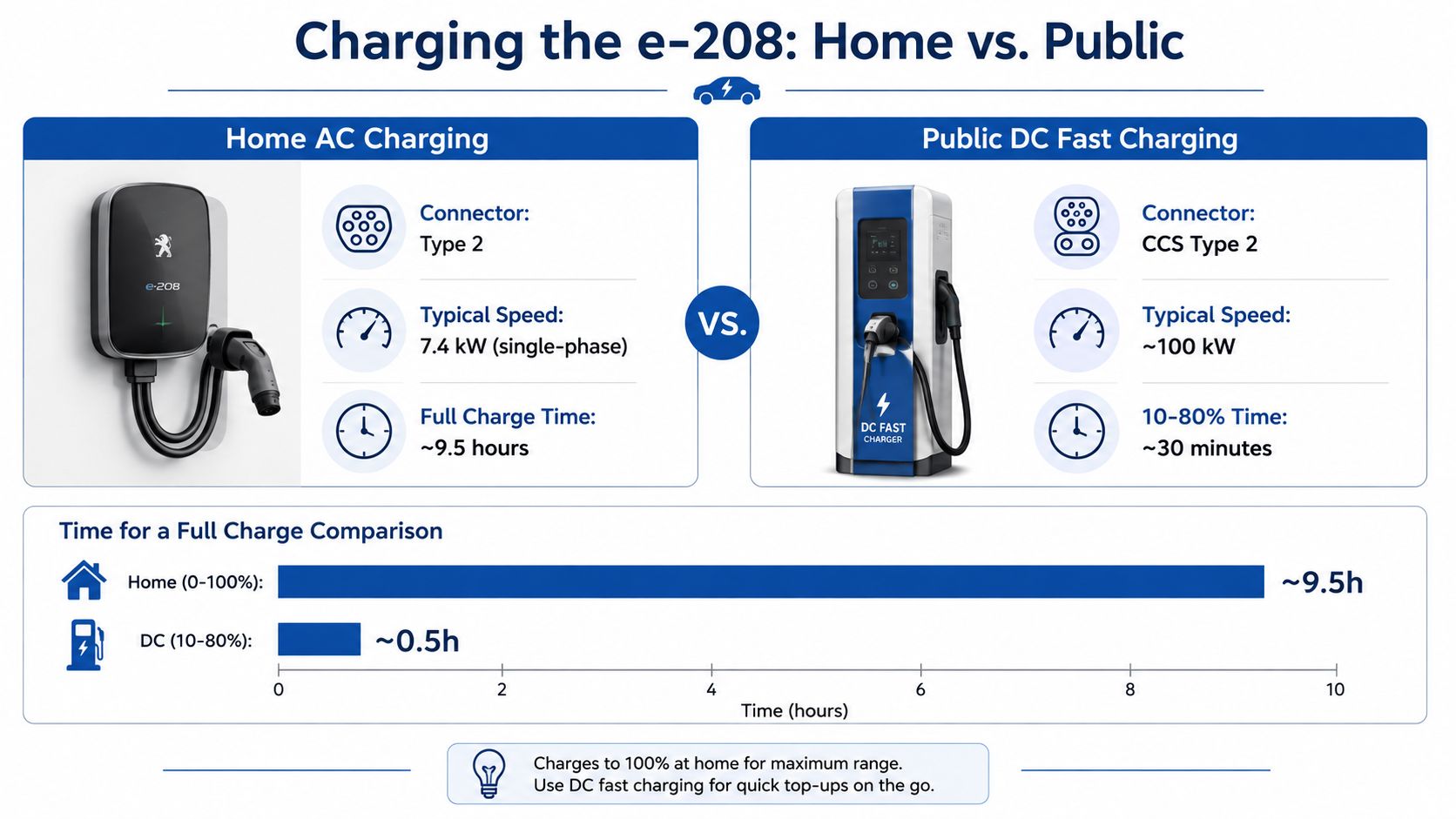
A dedicated wallbox is the sensible home arrangement. A three-pin socket has a place for occasional use, but it isn't the right foundation for a driver who relies on consistent daily charging. A wallbox turns charging into a routine rather than a task that needs constant cable management and planning.
Public rapid charging
Peugeot states that the e-208 can add 100 km of range in 13 minutes at a compatible fast public terminal rated at least 100 kW, and quotes 53 minutes to recover 80% of driving range on a compatible rapid charger. Peugeot's Irish e-208 model information should be checked for the latest charging details.
That makes the car suitable for occasional regional trips when a dependable rapid charger is available. It doesn't make frequent long-distance motorway travel effortless. Charging speed tapers as the battery fills, so rapid charging is most useful during the middle portion of a session rather than for repeatedly pushing the car to full.
For Irish route planning, drivers should check live availability and location information through ESB ecars and IONITY's charging network map. A daily commuter with home charging may rarely need rapid charging, while a rural owner without a private charge point needs a much stricter route plan.
The ShamAuto guide to EV charging in Ireland explains the home and public charging decisions that should be made before buying.
Reading State of Health on a ShamAuto Listing
State of Health, or SoH, is the key battery condition figure. It describes the battery's remaining capacity relative with its original usable capacity. A dashboard charge percentage only shows how full the battery is at that moment. It doesn't show whether the pack can still store the energy it held when new.
A trip computer range estimate isn't SoH either. That figure changes with recent driving style, weather and consumption. Buyers need a diagnostic result attached to the specific vehicle, ideally with enough identifying information to show that the test belongs to that car.
What a useful report should show
A credible battery screenshot should give the buyer more than one isolated percentage. It should make the result traceable and relevant to the vehicle being considered.
Look for:
Battery identity: The report should show the pack size or battery system tested.
SoH result: The percentage should be visible, not paraphrased in an advert.
Vehicle identity: The VIN or registration should connect the test to the e-208.
Test timing: The report date matters because battery condition can change.
Vehicle context: The odometer reading helps the buyer assess the result alongside age and use.
Diagnostic method: The tool or test system should be identified where available.
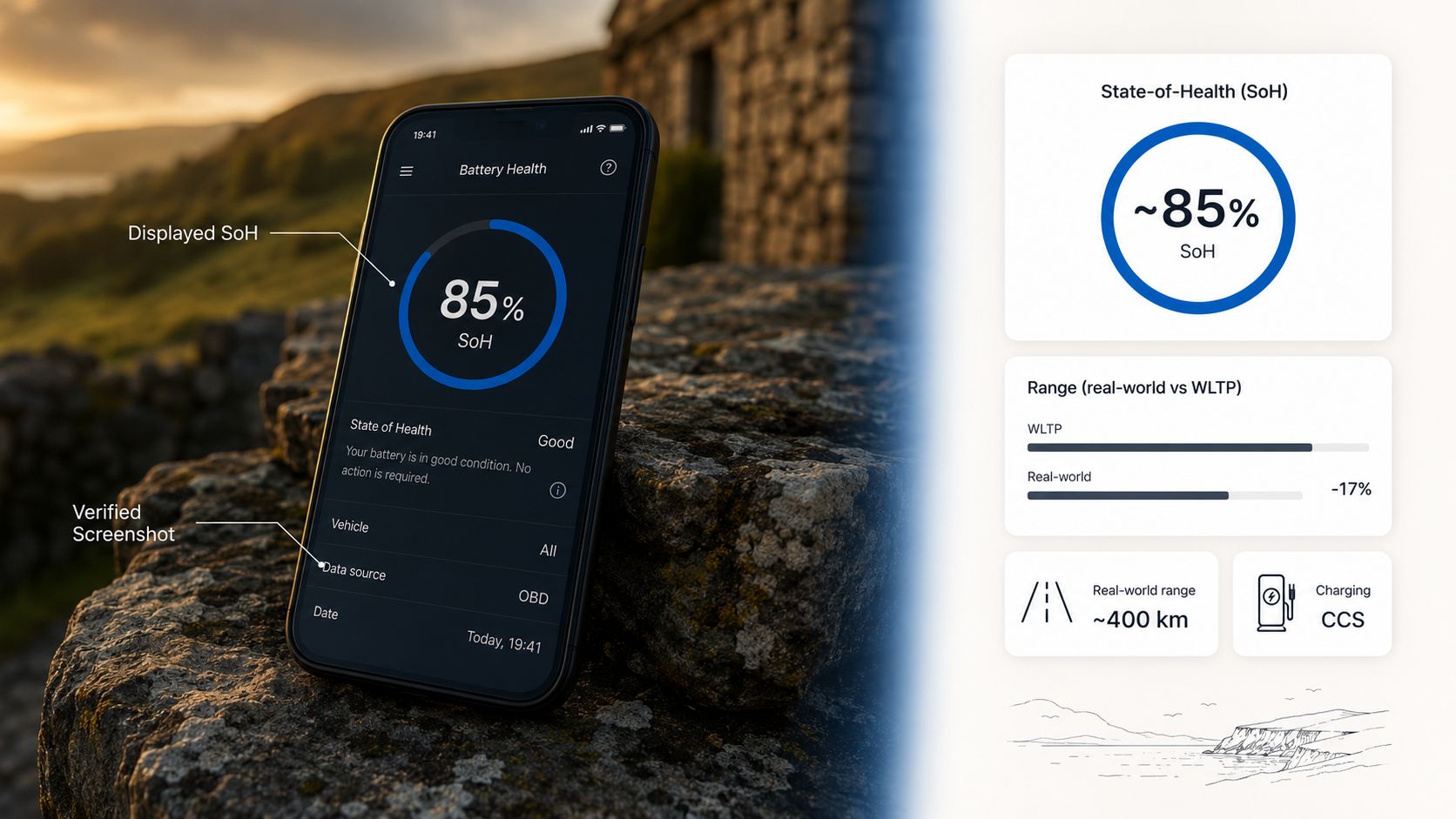
ShamAuto is newly launched and pre-stock, so it has no platform inventory, SoH average or sales history to present as evidence. Its relevant model-page approach is to foreground verified diagnostic information when a seller provides it, rather than inventing a benchmark from unavailable stock.
A dashboard reading can show charge. Only a suitable diagnostic test can support a battery-health decision.
SoH is especially important on the e-208 because the pack is relatively compact. A modest loss of usable capacity can have a noticeable effect on a commuter's reserve. A lower verified result might still suit a strictly local driver if the price reflects the reduced range, but that's a general trade-off, not a documented ShamAuto sale.
The guide to checking battery SoH before buying sets out the evidence a buyer should request. A general Irish used-car checking guide can then cover the rest of the vehicle, including identity, condition and seller documentation.
Prices, Mileage and Trim on the Irish Used Market
Used e-208 pricing in Ireland varies widely by generation, year, mileage and specification, so any single figure means little on its own. Compare an e-208 only against other electric e-208 listings of the same generation, and let verified battery evidence - not the asking price alone - drive the decision.
A fair e-208 comparison should start with the 50 kWh versus 51 kWh generation, then consider mileage and SoH. Odometer reading matters, but it isn't a substitute for battery testing. Time, charging history and the condition of the high-voltage system all deserve attention.
A comparison framework, not invented asking prices
No defensible universal asking bands or minimum SoH thresholds can be supplied without current, like-for-like Irish e-208 listings and verified battery reports. The following framework avoids pretending that unsupported prices or health cut-offs are market facts.
| Generation / mileage | Typical asking band in Ireland | Minimum verified SoH to consider | Trim notes |
|---|---|---|---|
| 50 kWh, under 30,000 km | Compare current same-generation listings | No universal threshold. Require a recent verified test | Equipment is secondary to battery evidence |
| 50 kWh, 30,000 to 60,000 km | Compare current same-generation listings | Judge the individual report with range needs | Check whether the price reflects age and SoH |
| 50 kWh, 60,000 to 100,000 km | Compare current same-generation listings | A weak result should be reflected in the price | A higher trim doesn't repair reduced capacity |
| 51 kWh, under 30,000 km | Compare current same-generation listings | Require a recent verified test | Later range advantage still depends on SoH |
| 51 kWh, 30,000 to 60,000 km | Compare current same-generation listings | Check health against the required commute | Equipment shouldn't outweigh battery condition |
| 51 kWh, 60,000 to 100,000 km | Compare current same-generation listings | Demand clear evidence before proceeding | Price, health and intended use must align |
Active, Allure and GT-style trims can change equipment and appearance. They don't turn a weaker 50 kWh battery into a stronger 51 kWh one. A plain later-generation car with verified health can be a more rational purchase than a better-equipped older car with uncertain capacity.
A buyer should also allow for normal ownership items, including suitable tyres, brake-fluid servicing and a home wallbox where needed. Those costs shouldn't be hidden inside a premium paid for cosmetic trim.
Common Myths About Used e-208 Buyers
The first myth is that an advertised used e-208 can receive the Irish electric-car purchase grant. It can't. SEAI says the electric car grant applies to new vehicles only and can't be claimed on second-hand cars. SEAI's current grant guidance should be checked for live scheme terms, eligibility and any changes.
Citizens Information confirms the same basic mechanic. The dealer applies the grant to an eligible new battery electric vehicle and deducts it from the approved purchase price. That arrangement doesn't transfer to a used e-208. Citizens Information's electric-vehicle guidance is the appropriate source for the consumer explanation.
Automatic means automatic
Every e-208 is an automatic because it uses a single-speed electric drive. There's no clutch pedal and no conventional manual gearbox option. Search results for a petrol 208 may include manuals, but that fact says nothing about the electric version.
The third myth concerns the range shown in a headline advert. The earlier 50 kWh e-208 is listed at 362 km WLTP, while the later 51 kWh version is listed at 410 km WLTP in the model catalogue framing. The conservative planning method reduces those figures by 17%, giving approximately 300 km and 340 km respectively. The calculation is useful only when applied to the correct generation, not blended across both.
Grant rule: A used e-208 should be priced as a used car. It shouldn't be advertised as grant-eligible.
Charging often decides whether the car works better than the range headline. A driver with reliable home AC charging may find the e-208 straightforward for daily use. Someone dependent on public charging needs to study charger locations, access and route reliability before committing.
Tax, VRT and scheme details can change. Buyers should verify current requirements directly through Revenue's vehicle guidance, gov.ie transport information and SEAI rather than relying on an old advert or forum post.
Your Used e-208 Checklist and Next Steps
A good e-208 purchase starts with identification, not enthusiasm. The listing must be the electric car, not a petrol or diesel 208 carrying the same model name. The battery generation then determines which range estimate applies.
Use this short decision filter:
Confirm the powertrain. Check that the vehicle is electric, front-wheel drive, automatic and fitted with CCS charging.
Identify the battery. Record whether it's the original 50 kWh version from 2020 to 2023 or the updated 51 kWh version from 2023 onwards.
Apply the correct range rule. Use approximately 300 km for the 50 kWh car and approximately 340 km for the 51 kWh car, based on the separate WLTP-minus-17% estimates.
Demand battery evidence. Look for a dated diagnostic screenshot showing SoH, vehicle identity, pack information and the test method.
Match the car to the commute. Include return distance, motorway sections, winter conditions and a sensible arrival reserve.
Check charging hardware. Confirm the CCS inlet and the actual AC charger option, including whether the car supports 7.4 kW or 11 kW AC charging.
Treat trim as secondary. Wheels, upholstery, parking equipment and infotainment can influence comfort, but they don't replace battery health.
Check the wider car. Review tyres, brakes, service records, charging cables, accident history and vehicle documentation.
The SoH result should be dated close enough to the purchase decision to remain meaningful. If the listing shows only a dashboard battery percentage or a seller's unsupported range statement, the buyer should request proper diagnostic evidence before paying a deposit.
ShamAuto's EV-only marketplace is pre-stock, with no current inventory, average SoH figures or claimed sales cases to use as proof. Its useful role for this model is evidence-led listing information, including battery health when diagnostic screenshots are supplied, conservative range framing and EV-specific charging details. Buyers should shortlist suitable e-208 adverts as they become available, request fresh diagnostic data where necessary, arrange a viewing or home delivery, and budget for a dedicated home charge point if one isn't already installed.
ShamAuto gives Irish buyers and sellers an EV-only place to assess a Peugeot e-208 using battery-health evidence, conservative range estimates and charging specifications rather than petrol-car listing noise. Visit ShamAuto to follow the e-208 catalogue, prepare a listing or check the latest used-EV buying guides before making a decision.