
Hyundai Ioniq 5 Ireland: A Used-Buyer Guide
Contents
- Standing in Front of a Used Ioniq 5 in Ireland
- What the Ioniq 5 Actually Is
- The Three Variants You Will See on Irish Listings
- Real-World Range and Why It Matters in Ireland
- Battery Health, SoH and What to Demand Before You Pay
- Price, Mileage and How to Value a Used Ioniq 5 Honestly
- Charging at Home and on Irish Roads
- Buying a Used Ioniq 5 With Your Eyes Open
A buyer in Dublin, Cork, Galway or rural Kerry can stand between two used Hyundai Ioniq 5s, see similar mileage on the dashboards, and still be comparing very different cars. One might have the smaller battery, another might have all-wheel drive, and neither listing may show verified battery condition. For a used EV, the odometer is only part of the story.
The useful questions are straightforward. What is the Ioniq 5 in Irish specification? What range can each battery and drivetrain realistically deliver? What evidence should a buyer demand before handing over money? This guide answers those questions without treating a laboratory range figure or a vague "battery health good" claim as proof. ShamAuto is an independent, EV-only marketplace for Ireland, and its Hyundai Ioniq 5 model guide applies the same evidence-first approach to range and battery information that every used EV deserves.
Standing in Front of a Used Ioniq 5 in Ireland
A 2022 or 2023 Ioniq 5 listing usually leads with the attractive parts: distinctive styling, a long equipment list, fast charging, mileage and an asking price. The battery description may be less helpful, often reduced to a broad statement about condition without a diagnostic screenshot or a usable range estimate.
That's where petrol-era buying habits fall short. A service history remains useful, but it won't tell a buyer how much usable battery capacity remains, whether the car's real range suits a long commute, or whether the remaining Hyundai warranty has been documented properly. The battery is the asset that needs checking first.
The Ioniq 5 is worth serious attention because it combines a spacious crossover body with a purpose-built electric platform, rear-wheel drive or all-wheel drive, and exceptionally quick DC charging. But those strengths don't make every used example equally sensible. A smaller-battery car can be the sharper purchase for regular local driving, while a long-range RWD version may suit intercity work better than a heavier AWD model.
Practical rule: A used Ioniq 5 should be judged by verified State of Health, conservative real-world range and remaining warranty, not by the badge or dashboard mileage alone.
The guide covers the 2021-2024 used cars, not the 2025-onwards facelift with its larger battery. Buyers who want a cautious range calculation can start with ShamAuto's Ioniq 5 real-world range guide, then ask the seller to support the advertised car with evidence.
What the Ioniq 5 Actually Is
The Hyundai Ioniq 5 is a mid-size electric crossover built on Hyundai's dedicated Electric-Global Modular Platform, or E-GMP. It isn't a petrol model converted to electric power. The platform was designed around a battery beneath the floor, electric motors at the axles and a flat interior layout. E-GMP is also used by the Kia EV6 and Genesis GV60, which helps explain the Ioniq 5's rapid charging capability and flexible drivetrain choices.
The most important technical detail is its genuine 800V architecture. A simple comparison helps. A conventional 400V EV is like a domestic kettle circuit, while the Ioniq 5 is closer to an industrial oven that can move more power through the system without relying only on very high current. On a suitable high-power DC charger, that can turn a motorway charging stop into a short coffee break rather than a long wait.
The car comes with rear-wheel drive or all-wheel drive, depending on variant. Every Ioniq 5 is automatic, using a single-speed reduction gear. There's no clutch and no conventional multi-ratio gearbox for a used buyer to second-guess. Irish cars use a CCS charging connection for rapid DC charging, alongside AC charging through the same vehicle charging system.
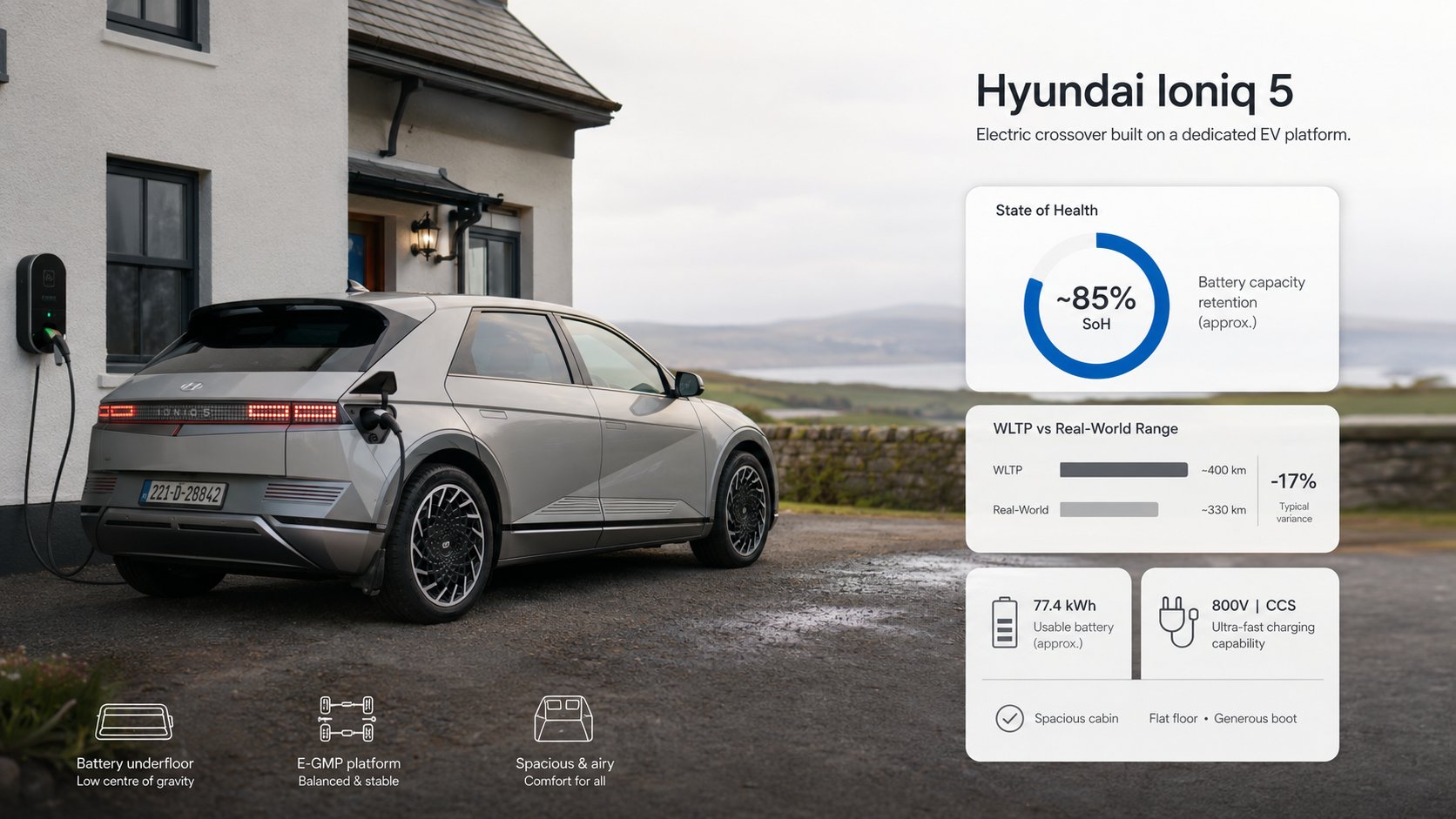
This guide deliberately focuses on the 2021-2024 used-car range. The later facelift's larger battery and longer-range figures shouldn't be applied to the earlier cars being inspected in an Irish forecourt or private sale. For the three relevant variants and their cautious range estimates, the ShamAuto Ioniq 5 range reference keeps the comparison model-specific rather than blending every version into one headline number.
The Three Variants You Will See on Irish Listings
Irish buyers are most likely to encounter three useful combinations in the 2021-2024 used market. Hyundai's Irish technical information gives each version its own WLTP range, charging capability and drivetrain, so the figures shouldn't be treated as interchangeable.
The 58 kWh RWD is the sensible entry point. Hyundai lists 384 km WLTP, which becomes approximately 319 km using the ShamAuto planning rule of WLTP minus 17 percent. Hyundai gives this version a peak DC charging capability of about 175 kW, while its AC on-board charger is 11 kW.
The 73 kWh RWD is the range specialist. Its 481 km WLTP figure translates to approximately 399 km under the same cautious planning rule. Hyundai lists peak DC charging of about 220 kW and an 11 kW AC on-board charger. For regular Dublin to Galway, Cork to Limerick or other intercity driving, this is the variant that makes the strongest practical case.
The 73 kWh AWD gives extra traction and stronger performance, but its 430 km WLTP figure works out at approximately 357 km using WLTP minus 17 percent. Peak DC charging remains about 220 kW, with an 11 kW AC charger. AWD makes more sense for a buyer who needs additional traction or values performance, not for someone chasing the longest possible distance between charges.
| Variant | WLTP range, Hyundai | Real-world estimate, WLTP minus 17% | Peak DC speed, Hyundai | AC on-board |
|---|---|---|---|---|
| 58 kWh RWD | 384 km | Approximately 319 km | Approximately 175 kW | 11 kW |
| 73 kWh RWD | 481 km | Approximately 399 km | Approximately 220 kW | 11 kW |
| 73 kWh AWD | 430 km | Approximately 357 km | Approximately 220 kW | 11 kW |
Hyundai also states that the Ioniq 5 can charge from 10% to 80% in about 18 minutes under ideal DC conditions, but that timing isn't a promise at every Irish charger. Battery temperature, starting state of charge and the output available from the charger all affect the result.
Real-World Range and Why It Matters in Ireland
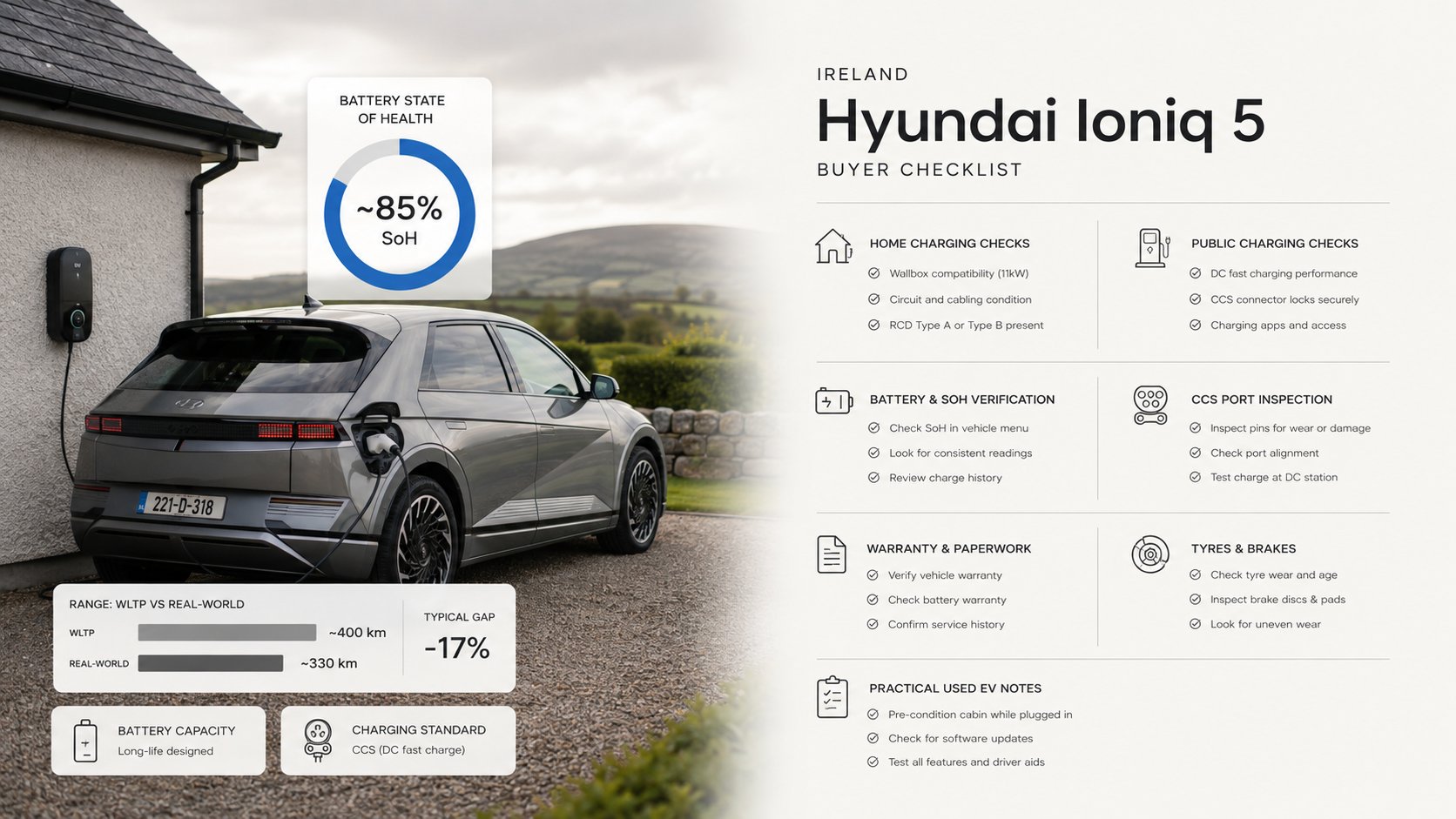
WLTP exists to make cars comparable under a standard test. It isn't a guarantee of the kilometres an Irish driver will see on a wet motorway, a cold morning or a hilly rural route. ShamAuto uses a deliberately cautious rule, WLTP minus 17 percent, to turn the published figure into a planning estimate rather than a showroom promise.
The gap grows or shrinks with the conditions. Motorway speed, cold weather, hills, headwinds, passengers, luggage and driving style all affect consumption. A full car travelling quickly through winter rain won't behave like a lightly loaded car moving through mild urban traffic.
A 73 kWh RWD Ioniq 5 rated at 481 km WLTP should therefore be planned around approximately 399 km in mixed real driving under the ShamAuto rule. A Dublin to Galway return on a cold day can land well below that planning figure, so the sensible buyer thinks in terms of a charging margin rather than trying to use every last displayed kilometre.
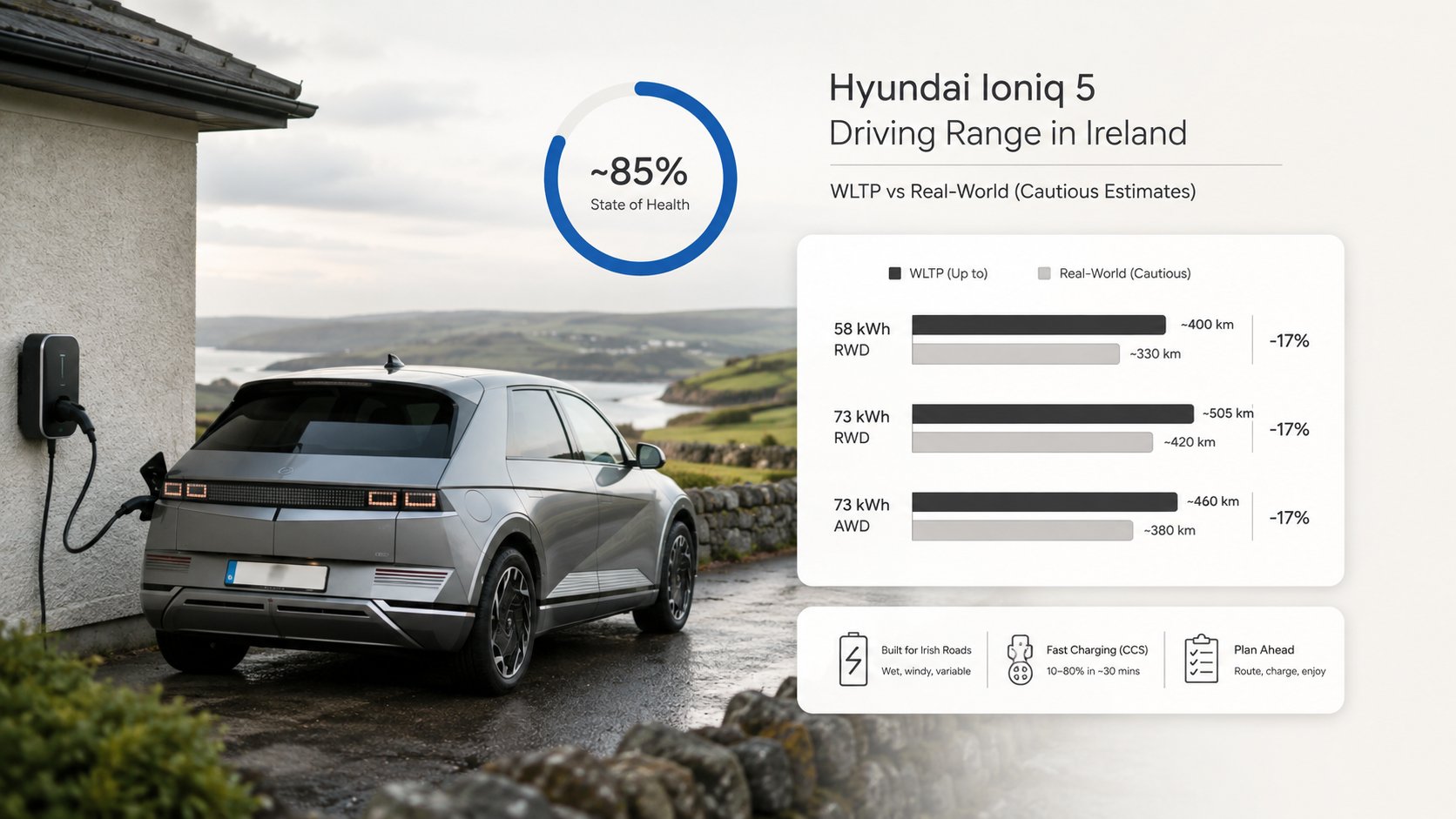
The 58 kWh RWD version's approximately 319 km planning range is still comfortably sufficient for many Irish daily routines. Paying extra for the largest battery only makes sense when the buyer regularly drives long distances, has limited charging access or wants fewer motorway stops. A larger pack also shouldn't excuse weak battery evidence. The range calculation remains an estimate until the individual car's State of Health, or SoH, has been verified.
The Ireland real-world range explanation gives buyers a consistent way to compare variants. That consistency matters more than a single optimistic dashboard reading.
Battery Health, SoH and What to Demand Before You Pay
State of Health, or SoH, describes the battery's remaining usable capacity compared with its original condition. It should come from a diagnostic app or a dealer printout, not from mileage, a seller's confidence or the number shown on a fully charged dashboard.
The Ioniq 5 uses active liquid battery cooling, which is a useful design feature for Irish buyers and generally helps battery temperature management. It isn't a guarantee of identical retention between cars. Year, mileage, charging history, storage conditions and individual battery condition still matter, so every car needs its own verified reading.
A buyer should request the evidence before arranging payment:
- Recent diagnostic screenshot: It should be dated to the viewing or supplied as current, not an old image from an unknown vehicle.
- Clear SoH percentage: The reading should identify the actual car and show whether the diagnostic tool is reporting battery condition or merely displaying a charge level.
- Cell information: Cell-level voltage spread and battery temperature readings can reveal more than a verbal assurance.
- Full-charge capacity: A full-charge kWh figure helps place the SoH reading in context, although usable capacity and displayed capacity must not be confused.
- Warranty paperwork: The seller should show the remaining Hyundai battery and high-voltage system coverage, along with any relevant service records.
A low asking price isn't automatically a bargain if the buyer can't establish how much usable range remains. The more honest comparison is price against verified real-world kilometres, while still accounting for trim, tyres, warranty and general condition. Current Irish listings can provide the price context, but they should be compared like for like.
The used EV battery health guide explains the evidence a buyer should seek. A verified SoH badge can also appear on ShamAuto listings when the seller supplies a diagnostic screenshot. The electric car Ireland guide provides broader buying context, but no badge or guide replaces checking the specific vehicle.
Price, Mileage and How to Value a Used Ioniq 5 Honestly
Mileage is useful, but it isn't the valuation system. Two Ioniq 5s with similar odometer readings can differ in battery size, drivetrain, SoH, warranty remaining, tyre condition and charging history. A newer AWD car may command more than an older RWD example, while a long-range RWD car may deliver more useful kilometres for a buyer who doesn't need all-wheel drive.
Used Ioniq 5 prices in Ireland vary widely by year, battery, drivetrain, mileage and condition, so treat any single figure with caution and compare against current listings rather than a fixed average. A listing that shows a verified battery State of Health and a clear warranty-valid-through date gives the buyer more useful evidence than a bare price and mileage combination.
A proper price check should compare:
- Like-for-like specification: Match 58 kWh RWD with 58 kWh RWD, and separate 73 kWh RWD from AWD.
- Verified range evidence: Use the WLTP-minus-17% planning figure, then adjust the decision for the actual car's verified SoH.
- Remaining warranty: Confirm what Hyundai coverage remains and whether the paperwork follows the vehicle.
- Wear items: Inspect tyres, brakes, suspension and bodywork. An EV has no clutch or exhaust, but it still has costly physical components that wear.
- Seller documentation: A complete history and diagnostic record can justify a stronger price than a vague advert.
Buyers should pay for evidence, not optimism.
The SEAI purchase grant is a separate issue. SEAI states that the grant applies to new M1 battery electric vehicles, with a maximum grant of €3,500, and cannot be claimed on second-hand vehicles. A used Ioniq 5 in the Republic of Ireland therefore does not qualify for the SEAI purchase grant. Tax, VRT and other scheme details can change, so buyers should check the live SEAI grants information and Revenue vehicle guidance rather than relying on an old advert.
For wider model comparisons, ShamAuto's Hyundai Kona Electric price guide shows why battery size and specification must be kept separate when assessing used EV value.
Charging at Home and on Irish Roads
The Ioniq 5's charging advantage only matters when the charging setup matches the car. At home, the 11 kW AC on-board charger can use a suitable wallbox or public AC point, but the actual charge rate also depends on the property's electrical supply and the installed equipment. A standard domestic arrangement may deliver less than the car's maximum AC capability.
For most Irish drivers, home charging is the calm part of EV ownership. A properly installed wallbox can refill the car while it sits overnight, avoiding a separate trip to a public charger. Buyers should check the current SEAI home charger grant information and use an SEAI-approved installer where the scheme requires it. The home charger grant is separate from the purchase grant, and it doesn't change the rule that a used EV cannot receive the SEAI purchase grant.
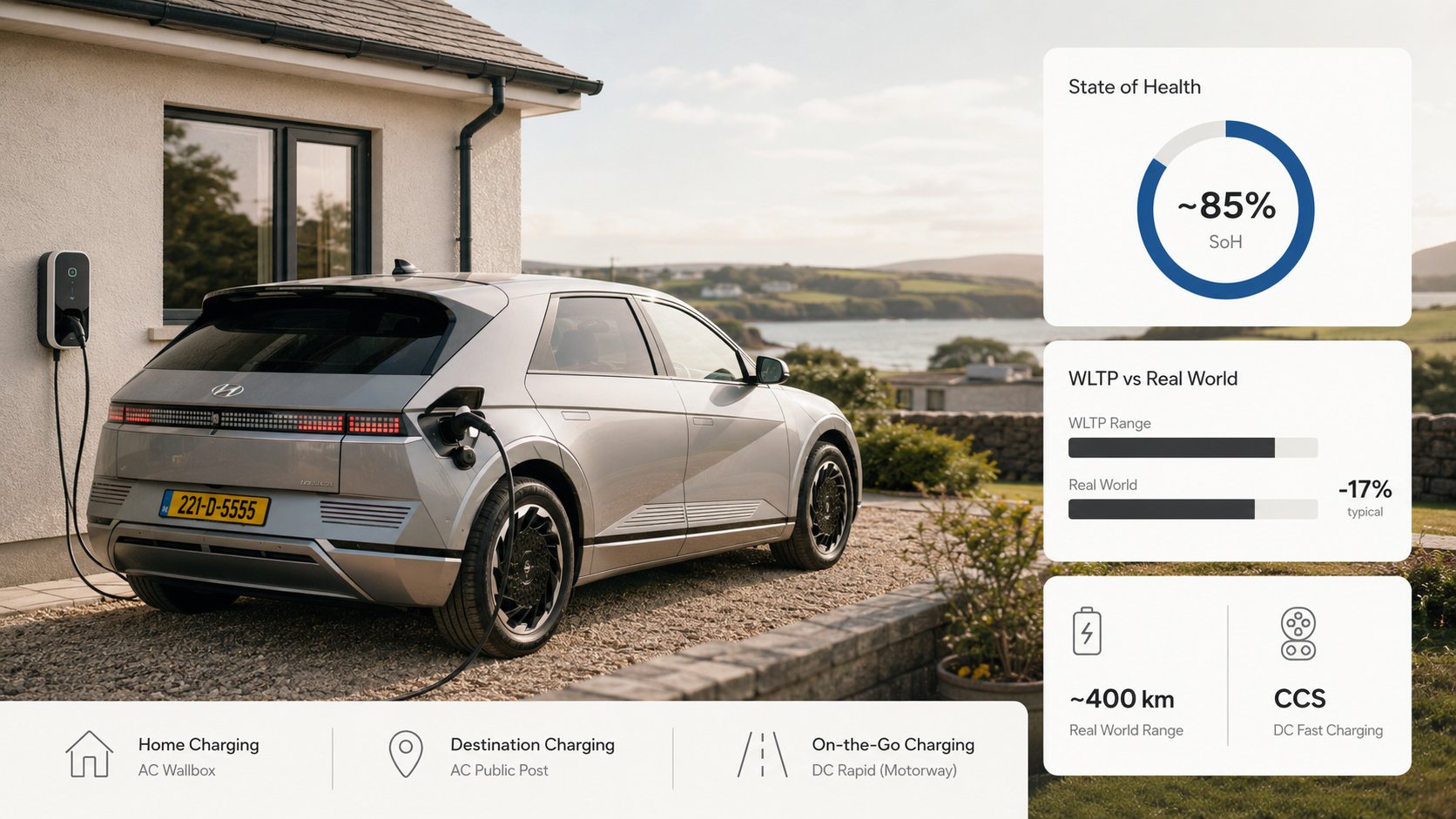
Three charging situations
Home AC is the default for regular use. A buyer should check where the cable will run, whether the parking space is on the buyer's property, and whether the home's electrical installation can support the proposed wallbox. The home EV charger installation guide covers the questions to raise before booking work.
Public AC works well when the Ioniq 5 is parked in a town, workplace or destination for longer. Public posts may advertise a higher output than the car can accept through its onboard charger, so the vehicle won't necessarily take the post's full stated capability. That makes public AC useful for access and convenience, not for the Ioniq 5's headline speed.
Motorway DC is where the 800V system earns its keep. Hyundai lists peak DC capability of about 175 kW for the 58 kWh version and about 220 kW for the 73 kWh versions, with an ideal-condition 10%-80% time of about 18 minutes. A charger rated at 150 kW won't supply more than its own available output, and a 50 kW urban point will be slower still.
Battery state of charge and temperature also affect the charging curve. A cold pack or a high starting charge can reduce the immediate power level, which is why a buyer should plan around a useful 10%-80% window, not assume every stop will deliver the advertised peak. Charging from very low to completely full also takes longer at the top of the battery, where the system tapers power.
A practical Saturday inspection
A serious viewing shouldn't be limited to a quick drive around the block. The buyer should bring a phone, a notebook and, where appropriate, a compatible OBD app or charging-cable tester. The seller should be asked for the SoH evidence before the appointment, not after money has changed hands.
The inspection should include:
- Request the documents: Registration certificate, service history, Hyundai warranty paperwork, evidence of battery or high-voltage recall work, and previous diagnostic screenshots.
- Photograph the evidence: Record the dashboard range, charge level, odometer and diagnostic screen, with the seller's permission.
- Check a full charge: Where practical, note the displayed range and any available full-charge kWh information. Treat the dashboard as supporting evidence, not a substitute for SoH.
- Drive a meaningful route: Include motorway speed, ordinary local roads and a hill. Listen for unusual noises, check steering and braking, and watch how consumption changes.
- Test the charging hardware: Inspect the CCS socket, AC port, cables and locking action. A car with an impressive charging specification still needs sound physical connections.
- Match the car to the commute: A rural Kerry driver with limited public charging may value the 73 kWh RWD more than a Dublin driver with easy home charging. An AWD buyer should have a real reason for accepting the range trade-off.
Electricity tariffs and night-rate plans change. A buyer should check the current offer with the chosen supplier and consult the Commission for Regulation of Utilities for current consumer information rather than relying on an old running-cost calculation.
ShamAuto is newly launched and has limited stock, so buyers shouldn't expect a county-specific inventory to answer every question immediately. They can be among the first to list or browse ShamAuto for Ioniq 5 adverts carrying a verified SoH badge, then use the battery SoH checklist and the used EV buying guide while assessing any private or dealer car.
Buying a Used Ioniq 5 With Your Eyes Open
The Hyundai Ioniq 5 is a strong used EV for Ireland because its useful qualities are practical, not decorative. It has a comfortable crossover body, RWD or AWD, a single-speed automatic drivetrain and a genuine 800V system that can make suitable motorway DC stops exceptionally short.
The headline WLTP figure still needs discipline. The 2021-2024 cars should be planned using the WLTP-minus-17% rule, then assessed against the individual car's verified SoH, driving conditions and charging access. The battery is the asset, range is the working outcome, and mileage is only one clue.
Every Ioniq 5 is automatic, so there's no clutch or conventional gearbox to investigate. The used-buyer focus shifts towards battery condition, high-voltage system records, charging equipment, tyres, brakes, suspension, electronics and remaining warranty. That is a narrower and more useful inspection than just counting service stamps.
The buyer's advantage is verification, not optimism.
The right purchase depends on the commute. The 58 kWh RWD suits many daily drivers, the 73 kWh RWD is the strongest long-distance choice, and the 73 kWh AWD earns its place when traction or performance matters more than maximum range. A buyer should insist on a current SoH reading, compare the price with live Irish listings and use ShamAuto's Ioniq 5 range guide alongside its used EV buying guide.
ShamAuto gives Irish buyers and sellers an EV-only place to present key information such as verified State of Health, conservative real-world range and charging specifications. Visit ShamAuto to assess the Ioniq 5 evidence checklist, browse available listings as the marketplace grows, or be among the first to list a properly documented car.