
Hyundai Kona Electric Price Ireland: A Used Buyer's Guide
Contents
- Why a Used Kona Electric Has No Single Price
- First-Generation Kona Electric Specs at a Glance
- Charging Speeds and What They Mean Day to Day
- How Year, Mileage and Trim Move the Price
- State of Health and the Sliding Scale of Value
- Grants, Tax and Other Official Figures to Verify Yourself
- Spotting a Good Deal in a Live Listing
- Quick Reference Before You Start Browsing
- Common Questions About Kona Electric Value in Ireland
Most advice on the Hyundai Kona Electric price Ireland search is backwards. Buyers keep asking for one fair number, but a used Kona doesn't work like a toaster on a shelf. The asking price depends on the battery, the year, the mileage, the trim, and, above all, the battery's State of Health (SoH).
That's the only honest way to look at it. A clean 64 kWh car with proof of healthy battery capacity belongs in a different price conversation from an older 39 kWh example with weak paperwork and no SoH screenshot. Used EVs also do not qualify for the SEAI new-car purchase grant, so any used-price discussion should ignore that support and focus on the actual car in front of you.
ShamAuto is built around that reality. Its Kona Electric model page uses EV-native specs and a cautious real-world range frame, so the buyer is judging the listing rather than chasing a stale brochure number.
Why a Used Kona Electric Has No Single Price
The biggest mistake in Kona shopping is treating every used car as if it should sit on one tidy price line. It doesn't. A used Kona Electric in Ireland is priced by battery size, year, mileage, condition, and whether the seller can prove the battery still has healthy capacity.
That last point matters more than most sellers admit. A car with strong, verified SoH deserves firmer pricing because it still delivers the range the badge promises. A car with weak or unverified battery evidence should be priced down, even if the paint looks clean and the interior still photographs well.
Stop looking for one number
A 2020 39 kWh Kona and a 2022 64 kWh Kona are not the same product. They don't carry the same range, they don't charge the same way, and they won't age the same in the market. That is why any serious buyer should judge the listing, not the model name alone.
Practical rule: if the seller can't show battery health, the asking price should never be treated as firm.
ShamAuto is a newly launched, EV-only marketplace for Ireland, so there's no first-party stock history or price trend to lean on yet. That's not a weakness, it's a reason to stay disciplined and compare each car on the evidence in the advert, not on folklore from an old forum post.
The good news is simple. Once a buyer understands the four inputs that drive value, any Kona listing becomes readable in a few minutes. The rest of this guide is about teaching that judgment.
First-Generation Kona Electric Specs at a Glance
The first-generation Hyundai Kona Electric sold in Ireland came with either a 39 kWh battery or a 64 kWh battery. Both are automatic EVs with no clutch or gearbox, and both use CCS DC fast charging at 400 V. Hyundai's Irish specs list the 39 kWh car at 305 km WLTP and the 64 kWh car at 484 km WLTP.
Those brochure figures are only the starting point. For buyers, the useful part is the gap between the two batteries, because that gap affects range, charging habits, and how much daily freedom the car gives you. A 39 kWh Kona works well for shorter commuting and steady local use. A 64 kWh Kona suits buyers who want more buffer, more motorway comfort, and fewer charging stops.
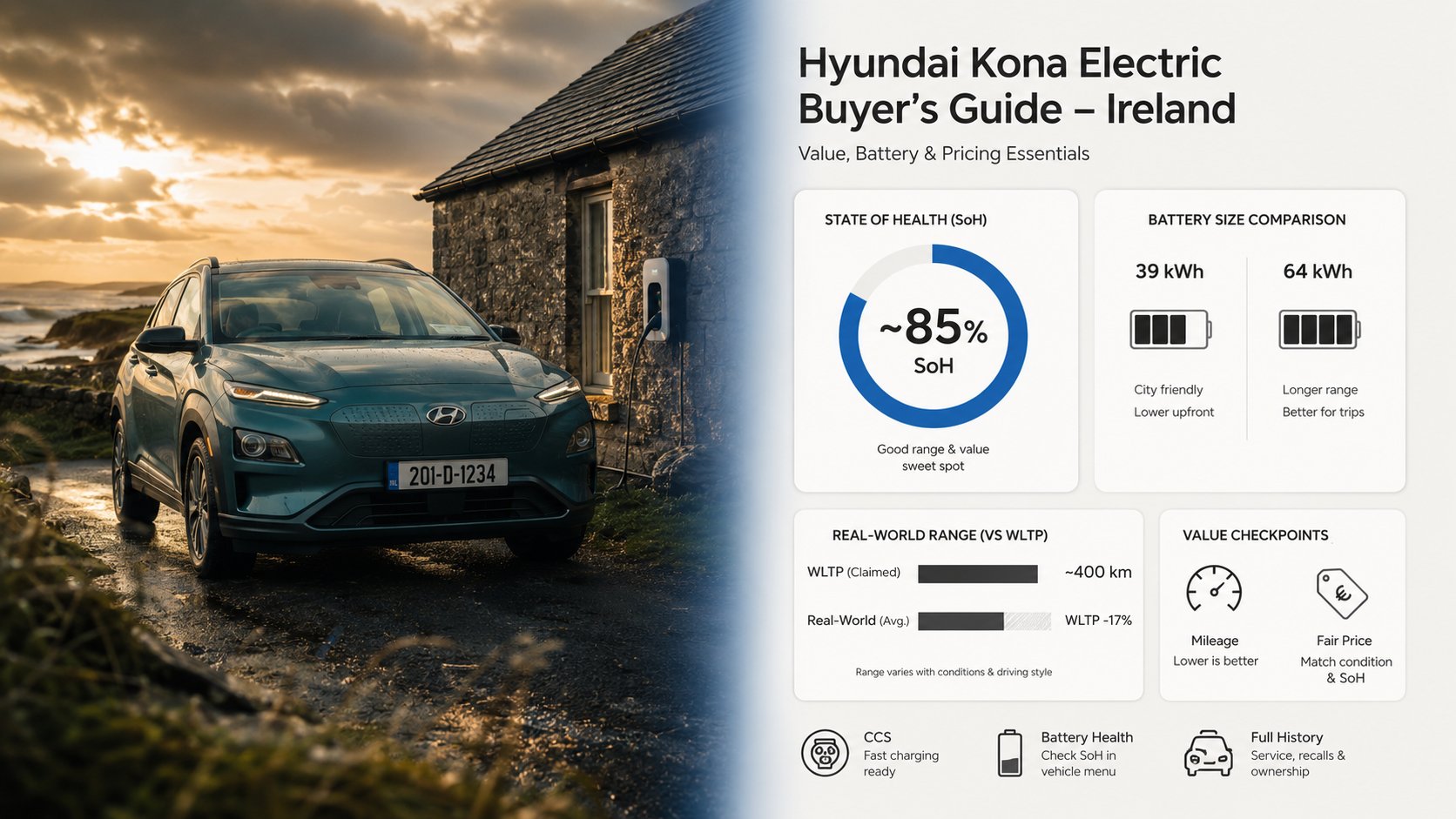
Using ShamAuto's cautious real-world range = WLTP minus 17 percent frame, the 39 kWh car lands at roughly 253 km, while the 64 kWh car comes out at about 402 km. That is the figure to keep in your head if you are judging a listing, because it is closer to how the car behaves in normal Irish use than the polished brochure number.
If you are scanning the used Hyundai Kona Electric listings in Ireland, the battery size should shape your reading of every asking price. The 64 kWh version represents a materially different ownership proposition for motorway users, rural drivers, and anyone who does not want to stop for charging often.
Side by side
| Variant | WLTP range | Real-world range using WLTP minus 17 percent |
|---|---|---|
| 39 kWh | 305 km | ~253 km |
| 64 kWh | 484 km | ~402 km |
Do not confuse this first-generation car with the second-generation Kona Electric sold from 2024 onwards. That is a different model, and its figures should not be used to judge the 2018 to 2023 used cars buyers are shopping for here.
If a seller quotes range, ask which battery version they mean and whether they are talking about WLTP or real-world driving. If the answer is vague, treat the listing carefully.
Charging Speeds and What They Mean Day to Day
A Kona Electric is a sound used buy, but nobody should rate it highly for charging speed. Hyundai's Irish specs put DC rapid charging at around 44 kW for the 39 kWh version and around 77 kW for the 64 kWh version. That is usable, and it is still modest by current EV standards.
What that means on Irish roads
For home wallboxes and workplace charging, the Kona uses 7.2 kW or 11 kW AC, depending on the on-board charger. That matters to a buyer with a driveway, because it shows the car suits steady overnight charging with limited quick-top-up capability. Plug in after work, leave it alone, and it is ready by morning.
For longer journeys, the limit shows up fast. A Kona Electric can use public chargers, but buyers should not expect the motorway-stop speed newer high-voltage EVs deliver. If a seller talks it up as a fast-charging star, they are stretching the truth.
The right question is not whether the Kona can charge. It is whether its charging speed fits the buyer's driving pattern.
That is why the price should match the use case. A commuter with home charging may still pay strong money for a tidy Kona. A driver doing long intercity mileage every week should value the same car more carefully, especially if the charging routine points to frequent public charging.
Used EV buyers often pay too much attention to range and too little attention to charging behaviour. On the Kona, that is the wrong order. Battery size matters, but the charging ceiling decides how easy the car feels on a wet Friday evening at a busy charger.
How Year, Mileage and Trim Move the Price
A Kona's value doesn't move in one straight line. Year and mileage matter, but they don't work alone. A newer car with a weaker battery record can still be worse value than an older one with better proof, cleaner service history and the right trim.
Battery size changes the conversation
A 2020 39 kWh car and a 2022 64 kWh car with similar mileage are not close substitutes. The larger-battery car has more usable range, more flexibility and usually more appeal in the Irish market. That usually gives it a stronger hand when the seller sets the price.
Trim still matters, but not as much as battery and condition. Higher-spec Irish cars often carry extra equipment that buyers like, and that can justify a modest step up. It should not rescue a tired car with missing paperwork or vague battery history.
Mileage matters, but only in context
Mileage should always be read beside battery health and servicing. High kilometres on a well-kept EV can be less alarming than low kilometres on a car that has sat unused, charged carelessly or been treated as a cheap second-car lottery ticket. The seller needs to show consistency, not just a low odometer number.
What to compare in a listing
- Battery version first. A 64 kWh car should not be priced as if it's a 39 kWh car.
- Mileage second. Consistency matters more than a flattering odometer reading.
- Trim third. Extra equipment can justify some uplift, but not much if the car is tired.
- Condition last. Paint, interior wear and service history matter, but they don't outrank battery evidence.
The most useful habit is boring but effective. Open current Irish listings, compare the same battery size, then weigh year, mileage and trim against the quality of the evidence. That's how a buyer avoids paying for marketing gloss.
State of Health and the Sliding Scale of Value
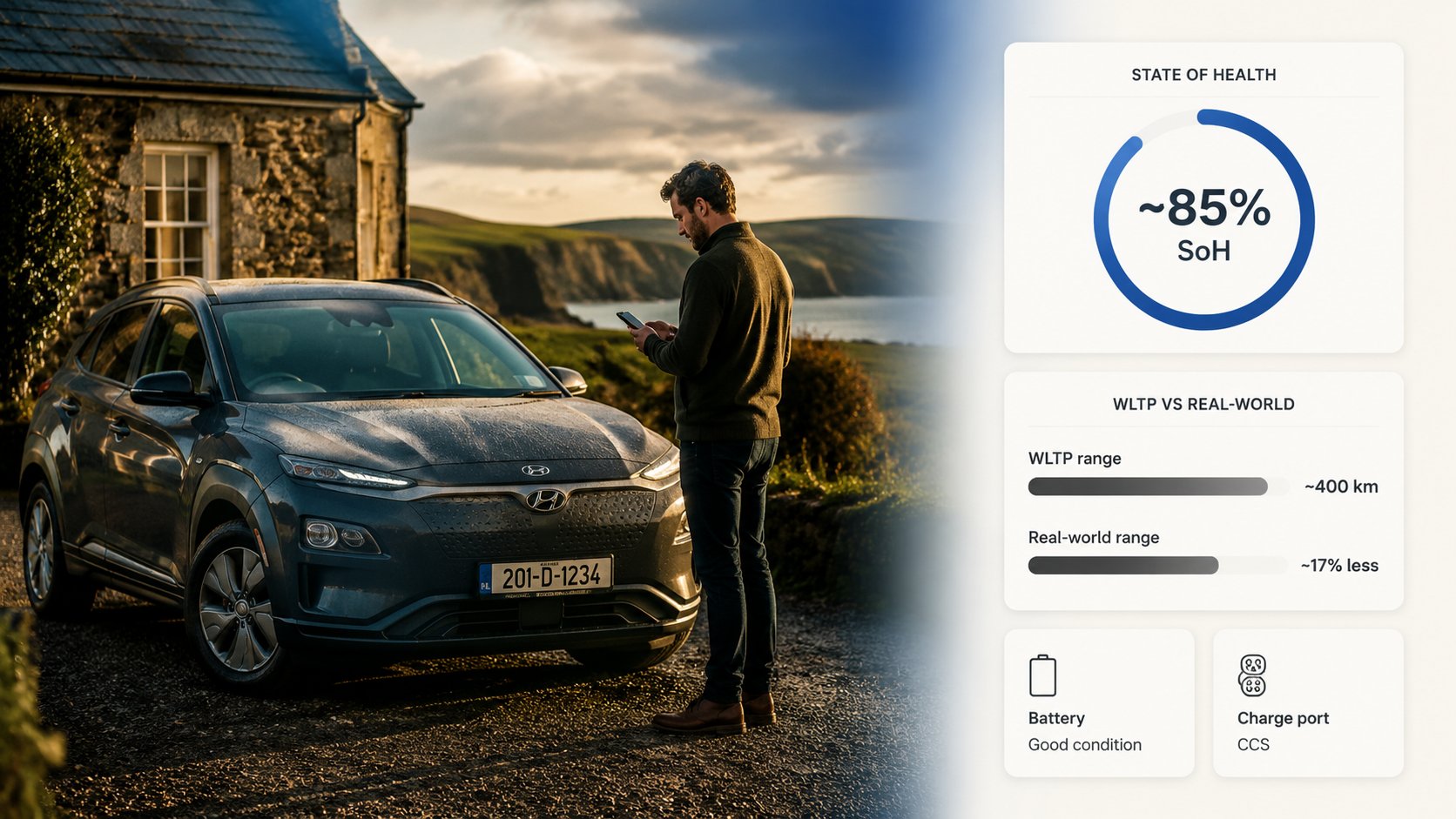
State of Health (SoH) is the battery check that tells a buyer how much usable capacity the pack still has compared with new. In plain English, it's the difference between buying a Kona that still behaves like a proper EV and buying one that only looks like one. If the car has a verified SoH screenshot, the seller has already done part of the trust work.
Why SoH changes the price
A stronger SoH supports a firmer asking price because the car should deliver closer to its original range and be easier to live with. A weaker SoH means less usable kilometres per charge, which directly affects what the car is worth to the next owner. That relationship is continuous, not dramatic, so there is no magic cutoff where the value suddenly collapses.
Treat unverified SoH claims as negotiation fuel, not proof. A seller saying the battery is "fine" is not the same as a diagnostic screenshot from a proper check. If the seller won't show evidence, the price should come down.
Buyer rule: no SoH proof, no full-price confidence.
For a fuller walkthrough of what to ask for and how to read the screenshot, ShamAuto's guide to checking battery SoH before you buy is the right next read.
The seller should be ready to explain where the data came from, when it was captured and whether the car has had any battery-related warning lights or repairs. If they dodge those questions, the buyer already has the answer.
Grants, Tax and Other Official Figures to Verify Yourself
A used Kona Electric should not be priced as if the buyer still gets the SEAI new-car grant. Second-hand EVs do not qualify for the SEAI purchase grant, so any used listing that subtracts it is setting up the wrong comparison. Hyundai Ireland's own price list makes the grant language clear for new private buyers, not used-car transactions. Hyundai Ireland price list
Do not freeze live figures into a used-car ad
Tax, VRT and scheme rules can change, so those numbers should be checked live on the official sources, not copied from an old advert. Buyers should verify the current position with SEAI, Revenue and gov.ie before assuming anything about reliefs or road tax. That is especially important when a seller mixes "grant-inclusive" language into a used listing.
The right approach is simple. Treat official government pages as the source of truth, and treat any used-car advert as a snapshot that may already be out of date. That protects the buyer from paying for a benefit that doesn't exist on a second-hand car.
ShamAuto's guide on used EV grants and VRT is worth reading alongside the official pages, because it keeps the focus on what still applies and what doesn't. If a figure is volatile, the buyer should check the live source rather than trusting a static listing.
Spotting a Good Deal in a Live Listing
A fair Kona listing is usually obvious once the buyer knows what to inspect. The first thing to look for is clear battery size. The second is verified SoH. The third is whether the mileage and service history make sense together, not just on their own.
A quick buyer routine
Open the advert and ask whether the battery version is stated cleanly. Then look for proof of charging health, service records and the correct cables. If the seller has only glossy photos and no substance, the price should be treated as aspirational.
- Verify the battery spec. 39 kWh and 64 kWh do not price the same way.
- Check the SoH proof. A screenshot beats a verbal claim every time.
- Read the mileage. Low mileage is useful only if the car has been cared for.
- Look for EV-specific paperwork. Charging cables, service notes and ownership history matter.
- Ask direct charging questions. A seller who uses the car daily should be able to explain its charging routine.
A good dealer or private seller can answer those questions without wobbling. A poor one talks around them. That is usually enough to separate a decent car from a headache.
For broader buying discipline, ShamAuto's used EV buying guide for Ireland covers the rest of the inspection process, including the parts that sit outside Kona ownership specifically.
Quick Reference Before You Start Browsing
Use this as a reality check before you compare ads. A used Kona Electric is priced by battery size, battery health, mileage and evidence, not by a tidy average from a stale table. If a listing hides any of those, treat the asking price as a guess.
The range and charging figures are already set out in the earlier specs and charging sections, so refer back to those details instead of relying on a quick summary here. What matters at this stage is whether the car is the smaller-battery or larger-battery version, whether the battery condition has been proven, and whether the seller has the paperwork to back up the claim. That is the difference between a fair price and an inflated one.
Used EVs do not get the SEAI purchase grant, and SoH should still move the price on a sliding scale. If the seller cannot prove battery condition, judge the listing as unverified and price it accordingly. That is the clean way to keep a used Kona Electric purchase honest.
Before you go any further, compare the listing with the model page on ShamAuto's Hyundai Kona Electric page. Then read the car in front of you, not the hype around it.
Common Questions About Kona Electric Value in Ireland
Does the 64 kWh model hold value better?
Generally, yes, because it offers longer range and broader appeal. But that only holds if the battery health is solid and the car's history is clean. A tired 64 kWh car can still be worse value than a well-kept 39 kWh one.
What matters more, age or battery health?
Battery health wins. Age matters, but SoH decides how useful the car still is and how confidently a buyer can live with it. A seller with a strong diagnostic screenshot has more pricing power than one with a newer car and no proof.
Do new Kona launches push used prices down?
They can influence sentiment, but buyers should not expect a neat, immediate drop. Used pricing still comes down to battery version, mileage, condition and evidence. The market rewards cars that are easier to trust, not just newer badges.
What should a private seller do before listing?
Get the battery checked, gather the service history and write the listing like a buyer will inspect every line. A seller who shows the battery size, SoH and charging equipment clearly is already ahead of most ads. A vague listing leaves money on the table.
If the seller wants a proper audience for an EV with clear battery data, ShamAuto is built for that kind of listing and that kind of buyer. A Kona Electric sells best when the evidence is visible, the range is framed accurately, and the price is tied to the car rather than the hype around it.