
On Board Charger Electric Vehicle Guide for 2026
Contents
- Why an On-Board Charger Matters to a Used EV Buyer
- What the On-Board Charger Actually Does
- AC Charging versus DC Rapid Charging
- Common On-Board Charger kW Ratings Explained
- The Single-Phase Catch in Irish Homes
- Doing the Charge-Time Maths Yourself
- Matching the On-Board Charger to How You Actually Charge
- Reading On-Board Charger Specs on ShamAuto Listings
You've probably seen a used EV listing that looks perfect on paper, then the charging question lands: how long will it take at home, and why does one car seem fine for overnight top-ups while another leaves the cable in the socket until morning is over? For Irish buyers, that difference usually comes down to one built-in part of the car, the on-board charger, or OBC. It matters because every EV is automatic, so the charging hardware inside the car often tells you more about daily ownership than a gearbox spec ever would on a petrol or diesel car.
Why an On-Board Charger Matters to a Used EV Buyer
A used EV can look simple from the outside. Plug it in, charge it, drive it. In practice, it's less straightforward, because the car itself decides how fast it can turn incoming AC power into battery charge, and that decision sits with the on-board charger electric vehicle buyers need to check before they hand over money.
The spec that quietly sets the ceiling
The OBC is not a separate accessory bolted on later. It is part of the vehicle, and it sets the maximum speed the car can accept AC charging from a home wallbox, a workplace post, or a destination charger. That is why the global market data on on-board chargers matter to Irish shoppers too, with the segment rising from USD 7.17 billion in 2025 to USD 8.17 billion in 2026, and projected to reach USD 15.68 billion by 2031 at a 13.93% CAGR. Battery-electric vehicles accounted for 75.33% of revenue in 2025, while the 3.3-11 kW band held 55.12% of revenue, which lines up with the charging setups most used in everyday Irish ownership. Mordor Intelligence
That makes the charger inside the car a real buying filter, not a footnote. It also explains why OEM-installed units still represented 84.25% of shipments in 2025, because the charging hardware is usually already part of the car rather than something a buyer adds later. Mordor Intelligence
Practical rule: if a listing does not state the OBC rating, treat that as missing charging information, not a minor omission.
For broader used-EV checks, including battery condition and range realism, the starting point is ShamAuto's guide to buying a used EV in Ireland.
What the On-Board Charger Actually Does
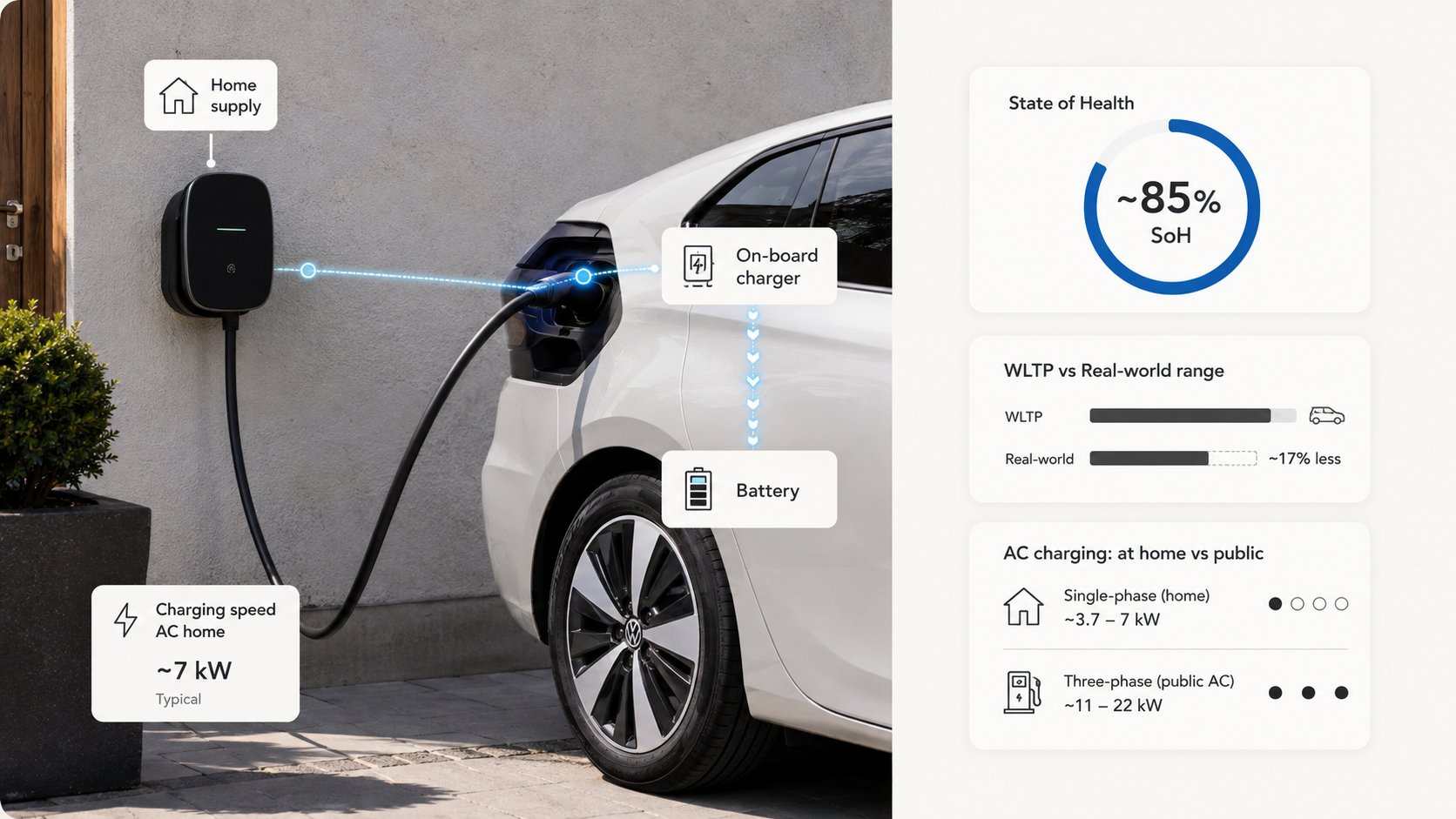
At its simplest, the OBC is the car's AC-to-DC converter. It takes alternating current from the supply, changes it into direct current, and feeds that into the high-voltage battery pack. Panasonic's technical overview describes the OBC as the part built into the EV that converts AC from home or public charging into DC that the battery can store, while a separate DC fast-charging path bypasses it entirely. Panasonic Industrial
Why the battery cannot drink straight from the wall
A battery does not accept household current in the same way a kettle does. The charger inside the car has to regulate voltage, current, safety, heat, and communication with the charge point, which is why the OBC is really a power-electronics system, not just a plug adapter. Technical literature also points to efficiency, power factor, thermal design, noise filtering, and grid interaction as part of the job, which is why some specifications list ≥93% efficiency, power factor ≥0.98, standby draw ≤5 W, and IP67 protection. Another design lists ≥92.5% efficiency and ≤45 dB noise, showing that the kW figure is only one part of the story. Elcon Chargers specification
The clean analogy is a kettle versus a plumbing valve. The wallbox is the tap, but the OBC is the valve and regulator inside the house that decides how much can flow into the tank. A stronger tap does not matter if the valve is smaller.
Why the headline kW number matters
Independent references place mainstream passenger-EV OBCs in the 3.7 kW to 22 kW band, with 6.6 kW often used as a common European baseline and 7 kW, 11 kW, and 22 kW used as familiar commercial tiers. EV Expert The buyer-facing point is simple. The OBC rating tells you the car's ceiling for AC charging, and that ceiling stays the same no matter how powerful the wallbox looks on the wall.
For used buyers, that makes the OBC a practical metric, not an engineering curiosity. It affects how long the car sits plugged in at home, how well it fits a workplace charger, and how often the battery arrives ready by morning.
AC Charging versus DC Rapid Charging
The most common mistake is mixing up AC charging with DC rapid charging. They are different routes through the car, and the OBC only governs the AC side. A car can have a modest AC rate and still support a strong DC peak, because DC charging goes straight to the battery through a separate path inside the vehicle. IIT Kanpur lecture notes
Two charging paths, two different questions
If a listing shows a 7.4 kW OBC and a much higher DC figure, that is not a contradiction. It just means the car charges slowly on AC and faster on a compatible DC rapid charger. Technical references describe OBCs as limited to the low-to-intermediate power band, while DC rapid charging bypasses that hardware entirely. Panasonic Industrial
Connector type matters significantly because the plug standard and charging path must align with the intended use case. For a plain-English breakdown of the plugs and charging styles, see ShamAuto's guide to EV charging connector types.
A high DC peak does not mean fast home charging. A strong AC charger does not make motorway stops quicker.
That distinction matters on a used listing because buyers often scan the biggest number and assume it applies everywhere. It doesn't. A car with a strong DC capability can still be a slow overnight charger if the OBC is modest, and a car with a healthy OBC can still be average on a long trip if its DC system is limited.
Common On-Board Charger kW Ratings Explained
The OBC rating is a per-model spec, not a menu where every EV gets the same hardware. One trim can have a smaller charger, another can have a larger one, and imports can differ again. Independent engineering sources and manufacturer datasheets show why the familiar figures are 3.6 kW, 7.4 kW, 11 kW, and 22 kW, with some older European cars appearing at 6.6 kW. EV Expert Aselsan OBC specification Hyundai KEFICO OBC specification
What each rating usually means in practice
A 3.6 kW unit is basic and slow by modern standards, but it can still work for low-mileage drivers with long parking windows. A 7.4 kW unit is the everyday baseline for many Irish buyers, because it fits a normal home charging pattern and does not ask much of the supply side. EV Expert
An 11 kW or 22 kW unit sounds better, but the headline number only matters if the car can access three-phase AC. Manufacturer data show OBCs are built for specific input ranges, with one reference listing 200-250 VAC single-phase and 360-440 VAC three-phase, and another listing 180-260 Vac single-phase and 320-440 Vac three-phase, with 6.6 kW single-phase and 11 kW three-phase output. Aselsan OBC specification
That is the buyer lesson: bigger is not always more useful. A faster wallbox will not override the vehicle's own cap, and a three-phase-rated charger can be wasted if the car and the supply cannot use it together.
Buyer habit that saves trouble: check the OBC rating alongside the charging connector, because the kW figure only means something when the hardware and supply match.
The Single-Phase Catch in Irish Homes
Most Irish homes are single-phase, and that is the part buyers often miss. In practical terms, that usually caps home AC charging at about 7.4 kW, even if the car's OBC is rated at 11 kW or 22 kW. That means the car may have a bigger charging capability on paper, but the home supply will stop it from using the full speed. IEA Global EV Outlook 2025
Why this changes the buying decision
For an Irish driver, the question is not, "Which OBC is largest?" It is, "Which OBC fits the way this car will be charged?" If the answer is overnight home charging, the bigger rating may not improve the daily experience at all. It can still help at a workplace, a hotel, or a public AC post that supports three-phase supply, but it does not magically upgrade a single-phase home socket or wallbox. IEA Global EV Outlook 2025
That is why a 7.4 kW OBC is often enough for overnight replenishment in Ireland. A car that sits parked for a normal evening and night can usually recover a typical commute without needing a three-phase setup, while a three-phase-capable car mainly gains flexibility outside the home.
For a home-installation perspective, including where wallboxes fit and what the electrician will look for, see ShamAuto's home EV charger installation guide.
The useful mental shortcut
If the car lives on a single-phase home supply, the OBC number above 7.4 kW is often more about public AC convenience than home speed.
That is the trap worth avoiding on used listings. A buyer can pay attention to the biggest AC figure and still end up with the same overnight charging pace as a cheaper car, because the home supply is the limiting factor.
Doing the Charge-Time Maths Yourself
The basic charging formula is simple. Time in hours roughly equals usable battery kWh divided by charger kW. That is not perfect real-world physics, but it gives a useful starting point when comparing used EVs.
A generic example
Take a notional 60 kWh usable battery and a 7.4 kW OBC. Divide 60 by 7.4 and the result is a little over 8 hours in theory. That is close enough to explain why a car with a decent OBC can fit into a typical overnight parking window, even before efficiency losses and taper are considered.
Real charging takes longer than the neat formula suggests. Battery management, temperature, the car's charge curve, and the battery's State of Health (SoH) all affect the usable energy and the time needed to fill it. A battery with lower SoH has less healthy capacity than it did when new, so the same charger can take longer to restore the same practical driving range.
What a buyer should do with the maths
Use the formula as a comparison tool, not as a promise. If a listing gives usable battery size and OBC rating, the buyer can estimate whether a car suits a six-hour, eight-hour, or longer parking window without making guesses.
| Input | Rough calculation | What it tells a buyer |
|---|---|---|
| Usable battery kWh | Divided by OBC kW | Overnight charging fit |
| Lower SoH | Less usable energy | Longer top-up time |
| Stronger AC supply | Only helpful if the car can use it | No benefit above the OBC cap |
That table is the practical version of the maths. It keeps the focus on how the car will live on Irish roads and in Irish driveways.
Matching the On-Board Charger to How You Actually Charge
The right OBC depends on charging habits, not ego. A buyer who charges mostly at home on a single-phase supply usually does not need more than 7.4 kW, because the home supply is already the bottleneck. A buyer who relies on workplace, apartment, or destination AC should pay closer attention to 11 kW or 22 kW and confirm whether the car can use three-phase supply where it matters. Aselsan OBC specification Hyundai KEFICO OBC specification
Three buyer profiles, three different priorities
A mainly home-charging driver should look at whether the car will be full by morning and whether the battery health is still strong enough to make that true in daily life. A mixed-use driver should care about compatibility with public AC posts, especially if the car is likely to spend hours at a workplace charger. A motorway-heavy driver will care more about the DC side, battery size, and SoH, because DC rapid charging bypasses the OBC and the AC rating becomes less important on trips. Panasonic Industrial
ShamAuto standardises EV-native fields such as usable battery, charging speeds, connectors, and OBC so used cars can be compared on the same basis instead of through vague ad copy. For a buyer, that means the OBC can sit next to SoH and realistic range, which is the proper way to judge a second-hand EV in Ireland.
Best practice for used EV shopping: treat the OBC like a daily-use spec, not a prestige number.
That approach keeps the conversation grounded. A bigger number is only useful when it solves a genuine charging problem, and the actual problem in Ireland is usually matching the car to the supply it will live on.
Reading On-Board Charger Specs on ShamAuto Listings
A good listing should let the buyer answer three questions quickly. How fast does the car charge on AC? Can it use the home supply that is available? Does the battery still have enough SoH to make the quoted range believable? ShamAuto is built around EV-specific fields so those questions sit beside each other instead of being buried in generic car text.
What to verify before making a decision
- Check the OBC rating: confirm whether the car is 3.6 kW, 7.4 kW, 11 kW, 22 kW, or another listed figure.
- Check the supply type: confirm whether the vehicle can use single-phase or three-phase AC where it will be charged most often.
- Check the battery condition: read the State of Health (SoH) alongside usable battery and real-world range, because the charger is only half the story.
- Check the charging use case: decide whether the car will live on home AC, workplace AC, destination AC, or DC rapid charging.
That is the shortest honest way to read an EV listing. It keeps attention on the hardware that matters, and it stops a buyer from assuming that any high charging number automatically applies at home. It also fits the way Irish buyers shop, because the important question is not whether the car sounds advanced, but whether it will suit the charger outside the front door.
For the wider battery-health context, the used EV buying guide is the right companion read. Used EVs reward careful checking, and the OBC is one of the easiest specs to get wrong if it is treated like a headline instead of a practical limit.
If you're comparing used EVs in Ireland, ShamAuto gives you a cleaner way to check the numbers that matter, including OBC rating, battery health, and realistic range. Visit ShamAuto to read the guides, compare EV-native specs, and be among the first to list when you're ready.