
Audi Q8 E-tron in Ireland: A Buyer's Honest Guide

Contents
- Why the Q8 e-tron Deserves a Second Look in 2026
- What the Audi Q8 e-tron Is
- Headline Specs and the Practical Range You Should Plan Around
- Why State of Health Is the Number That Matters Most
- Charging the Q8 e-tron at Home and on the Motorway
- The SEAI Grant, VRT and the Price Question
- Common Issues and What to Check Before You Buy
- Pricing Reality and Your Inspect-Before-You-View Checklist
Most advice on the Audi Q8 e-tron starts with the brochure range. That's the wrong starting point for an Irish used-EV buyer. The right question is simpler and harsher, what will it do on a cold, wet commute, how much battery is really left, and what risks sit behind the badge.
A premium electric SUV can look convincing on paper and still be a poor buy if the State of Health (SoH) is weak or the range is overestimated. ShamAuto's approach is blunt on purpose, treat verified battery health and conservative real-world range as the core of the decision, not the shiny headline number. For a broader Irish EV context, the practical starting point is ShamAuto's electric car guide for Ireland.
Why the Q8 e-tron Deserves a Second Look in 2026
A buyer scrolling a listing for a large Audi SUV will usually see the same thing first, a confident range figure and a premium badge. That's where lazy advice goes wrong. The Q8 e-tron is worth a serious look in 2026 because it's a mature, well-finished electric SUV with proper long-distance capability, but only if the buyer stops trusting the brochure at face value.
The model's appeal is real, but so are the trade-offs
Audi's own technical data makes clear that the Q8 e-tron is the updated evolution of the original e-tron line, and Audi labels it "Audi Q8 e-tron (until 2025)" on its technical page.Audi technical data That matters because a used Q8 e-tron is not some early, awkward EV experiment. It's the more established sibling in Audi's electric SUV family, and that maturity shows in the way it drives, charges, and presents itself.
Still, the important question for Irish roads is not whether it looks expensive. It's whether it still makes sense after a few winters, a few ownership changes, and a few charging sessions. On that score, the Q8 e-tron is the kind of car that rewards evidence. A buyer who checks battery condition and plans around realistic range can end up with a strong premium EV. A buyer who only reads the headline figure can get a rude surprise.
Practical rule: on a used Q8 e-tron, the badge matters less than the battery and the paper trail.
That is why this guide leans on a conservative range method and asks the awkward questions up front. For Irish shoppers, that is the sensible way to approach any large EV, especially one positioned as a premium family SUV.
What the Audi Q8 e-tron Is
The Q8 e-tron is Audi's large electric SUV, built for buyers who want space, comfort and all-weather confidence without moving into a petrol or diesel drivetrain. It sits in Audi's EV line-up as the more mature, longer-running model, while the newer Q6 e-tron is the fresher 800V car. That difference matters, because the Q8 e-tron is the older sibling with a different charging architecture and a more established used-market story.
400V architecture and CCS, in plain English
Audi's Q8 e-tron uses a 400V architecture and a CCS connector, which is the standard setup buyers should expect for Irish rapid charging.Audi Q8 e-tron facts In practice, 400V means it is not chasing the very fastest ultra-high-voltage numbers that newer 800V cars can advertise. That does not make it a bad charger, it just means the buyer should judge it on realistic everyday use, not headline charging theatre.
For an Irish forecourt shopper, that distinction matters. A used Q8 e-tron is a more familiar, lower-drama proposition than a brand-new technology showpiece. Parts, charging behaviour and ownership expectations are all easier to reason about than with the newest platform on the market.
SUV or Sportback, same car, different shape
Audi sells the Q8 e-tron here as a large electric SUV, and for a used buyer the practical questions stay the same across listings, battery condition, charging behaviour and real-world range.
One honest note matters in the Irish used market. Before 2023, this car was sold as the Audi e-tron, not "Q8 e-tron". The original e-tron 55 quattro (2019-2022) uses 86.5 kWh usable (95 kWh gross), has a 436 km WLTP range, and works out to about 362 km real-world on the same conservative method. It has its own guide here: Audi e-tron real-world range. That matters because many used cars from that era are the original e-tron, not the facelift.
The useful way to think about it is simple. The Q8 e-tron is a premium large EV with Audi polish, not a leap into unknown territory. That makes it a sensible used buy for the right driver, but only if the listing is backed by evidence, not optimism.
For a buyer comparing cars on paper, the cleanest way to separate the brochure from reality is to use a hard-nosed range check like the one in ShamAuto's real-world range guide for the Audi Q8 e-tron and then compare that with the car's battery report. That is the point where the car's spec sheet stops being theory and starts becoming a decision.
Headline Specs and the Practical Range You Should Plan Around
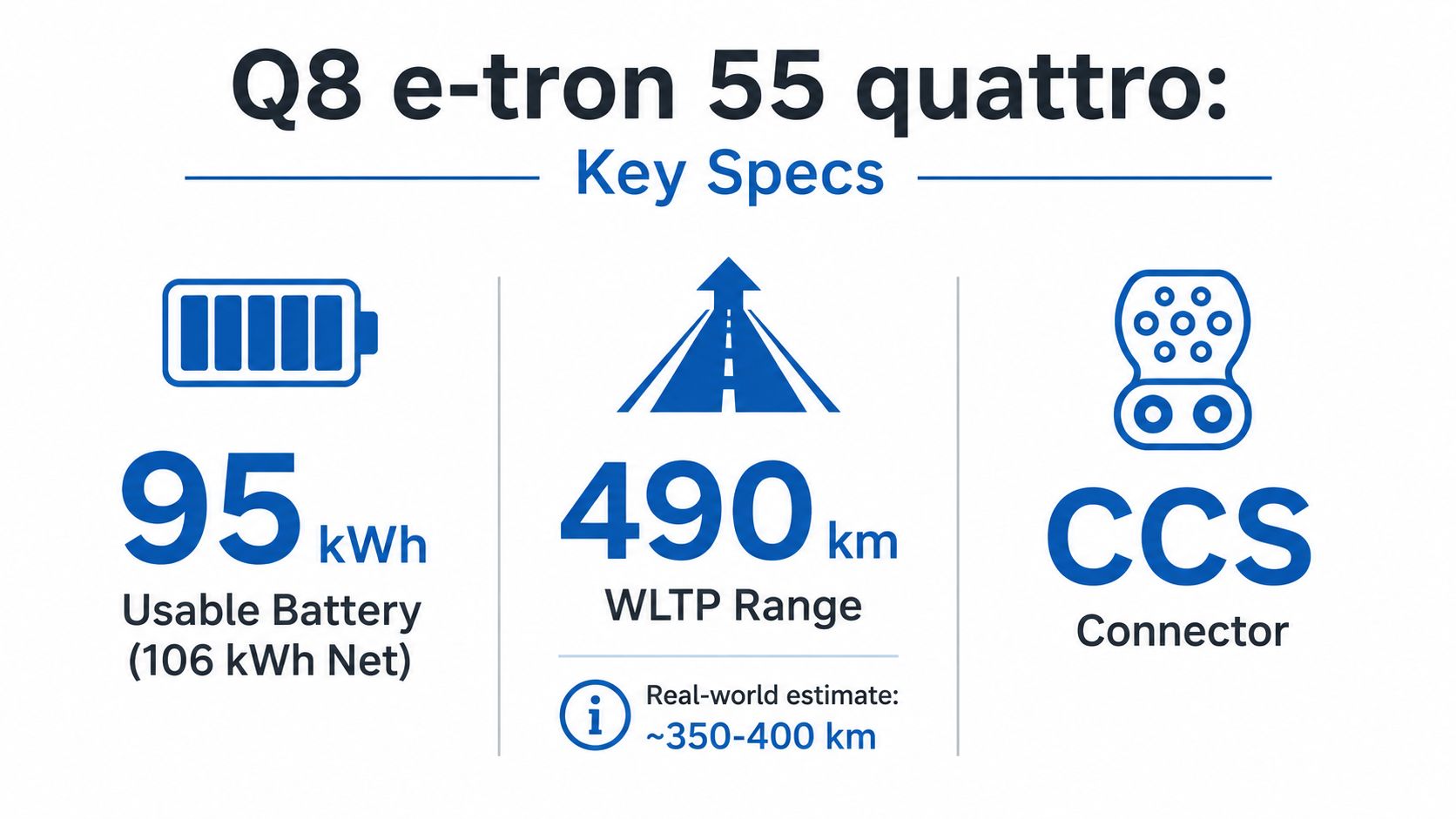
The Q8 e-tron should be judged by variant, not by one blended headline number. For the SUV range, the figures to keep straight are simple. The Q8 55 e-tron (2023-2025) uses 106 kWh usable (114 kWh gross) with a 582 km WLTP range and about 483 km real-world on the WLTP minus 17 percent method. The Q8 50 e-tron (2023-2025) uses 89 kWh usable (95 kWh gross) with a 491 km WLTP range and about 408 km real-world. The SQ8 e-tron (2023-2025) uses 106 kWh usable (114 kWh gross) with a 494 km WLTP range and about 410 km real-world.
WLTP is a comparison tool, not a journey planner
For Irish driving, the ShamAuto method applies the WLTP minus 17 percent rule across each variant. That gives you about 483 km for the Q8 55 e-tron, about 408 km for the Q8 50 e-tron, and about 410 km for the SQ8 e-tron. Those are planning numbers for cold weather, motorway use and mixed charging, not promises.
That is why the variant matters. A buyer comparing listings should match the exact version of the car to its usable battery and conservative range, then compare that with the battery report. For a tighter comparison against Irish conditions, use this Q8 e-tron range guide beside the listing and stop relying on brochure optimism.
Buy on usable battery, not gross battery. The usable figure is what the car genuinely works with, and that is the number that matters when comparing used EVs.
A long WLTP number will not rescue a tired battery or a car with weak charging history.
The one number that changes the whole conversation
The cleanest way to compare a Q8 e-tron against another used EV is to keep the same conservative range basis across every listing. That is where paper specs lose their shine, and where a buyer starts asking better questions about battery condition, charging behaviour and the kind of driving the car has been doing.
Why State of Health Is the Number That Matters Most
State of Health (SoH) is the battery number that tells the truth. It shows how much usable capacity is left compared with when the battery was new, and that matters more than the odometer on a premium EV. A low-mileage Q8 e-tron with weak SoH can be a worse buy than a higher-mileage one with a clean diagnostic result.
Treat SoH like a fuel tank check, not a vanity metric
The simplest way to read SoH is to treat the battery as an ageing fuel tank. The tank may still hold plenty of energy, but it will not hold the same amount it did when new. That gap is what you are buying, and it affects usable range and day-to-day confidence.
For a used Q8 e-tron, unverified SoH is not a harmless detail. It is missing evidence. On ShamAuto, the process is direct, a seller supplies a diagnostic screenshot, the listing can carry a verified SoH status, and the buyer gets something concrete instead of a hopeful claim. That suits a premium EV far better than vague wording ever will.
Ask for proof, not reassurance
A seller who says "battery's fine" has not given a buyer enough to work with. The buyer needs the screenshot, the SoH figure, and a clear idea of whether the reading came from a proper diagnostic check. If the car is being considered on a direct classifieds site or a dealer listing, the same rule applies. The badge does not waive the need for evidence.
Ask for a diagnostic screenshot. A proper SoH readout is the starting point, not the end of the conversation.
Check whether the reading is recent. Old battery data is weaker than current evidence.
Use the number in pricing. A verified stronger SoH supports confidence, while an unverified claim should lower it.
Listings on general classifieds sites and dealer listings can look complete while leaving out the one number that matters most. That is why a premium used EV should be judged on battery evidence, not enthusiasm. Before you hand over a deposit, demand the proof and treat any refusal as a warning sign.
Charging the Q8 e-tron at Home and on the Motorway
Audi lists the Q8 e-tron with 11 kW AC charging as standard and 22 kW AC charging as an option, while the big battery can go from 10% to 80% in roughly 31 minutes under ideal conditions.Audi facts That is enough to give the car proper long-distance usability, but the buyer still has to match the charging setup to real Irish life.
Home charging is the daily reality
A 7.4 kW wallbox is the practical home solution for most Irish owners, because overnight charging will suit normal commuting without drama. The Q8 e-tron's standard 11 kW AC capability means it can take advantage of a better home setup, while the optional 22 kW unit is a nice extra for buyers who know they'll use public AC charging more often.
That said, the home charger matters more than the spec sheet in most cases. A buyer who plugs in overnight and starts each morning with a healthy battery will get a far easier life than someone who relies on public charging for every top-up. The Q8 e-tron is comfortable enough to make that routine feel normal, which is exactly what a premium EV should do.
Rapid charging is for trips, not daily drama
Audi's 400V setup supports DC rapid charging up to roughly 150 to 170 kW on the Q8 e-tron, which is perfectly adequate for motorway runs and cross-country trips.Audi facts The buyer should think of that as "fast enough to be useful", not "ultra-fast by today's latest platform standards". On Irish rapid networks, the CCS connector is the bit that matters, because it fits the infrastructure you'll use.
Rapid charging is useful when the trip demands it. It shouldn't be the foundation of the ownership plan.
For charger installation guidance, the sensible companion read is ShamAuto's home EV charger guide. The right home setup makes the Q8 e-tron feel calm, which is the point of buying a premium electric SUV in the first place.
The SEAI Grant, VRT and the Price Question
The first financial mistake Irish buyers make is assuming every EV comes with the same support. A second-hand Audi Q8 e-tron does not qualify for the SEAI purchase grant, because the grant is for new electric vehicles only, as explained by Citizens Information. That needs to be said plainly, because used buyers still get caught out on it.
Don't price the car on a grant that doesn't apply
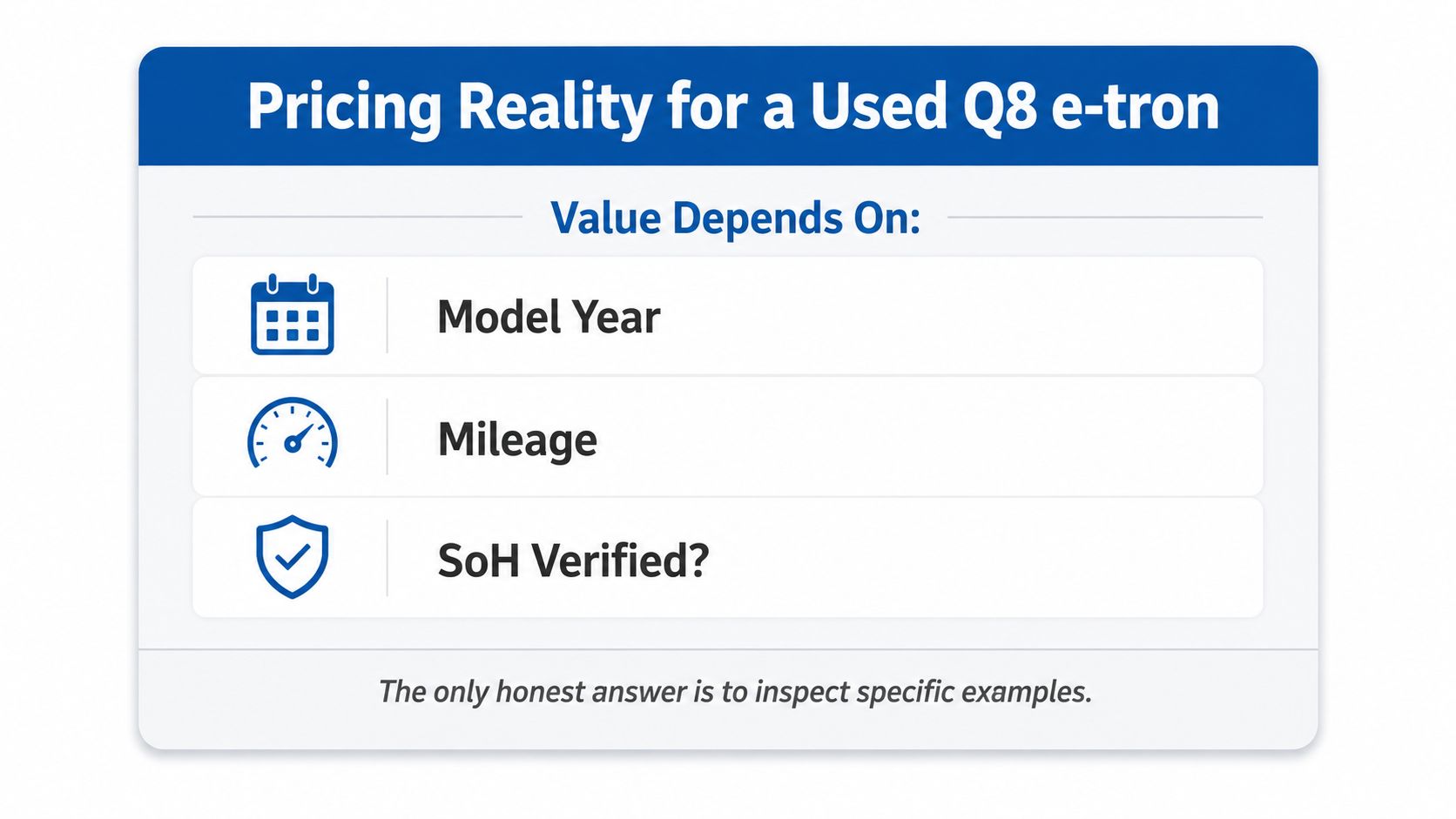
A used Q8 e-tron is a premium large SUV, so its value depends heavily on year, mileage and verified SoH. There is no honest shortcut around that. The only defensible way to judge an asking price is to compare the car against current listings and see whether the battery evidence, condition and history justify the number.
That's also why this article refuses to invent a price range. A premium EV changes hands based on specific condition, not assumptions. If a seller is using vague battery language or leaning on a model name alone, the buyer should treat that as a warning, not a reason to rush.
What matters more than a headline asking price
A good Q8 e-tron listing should give enough detail to answer the practical questions quickly. If it doesn't, the buyer should move on or demand proof before travelling. The price is only fair when it matches the evidence.
Common Issues and What to Check Before You Buy
Some owners have reported two areas worth checking on a used Q8 e-tron. One is 12V auxiliary battery drain. The other is HVAC or climate compressor faults. Those are not reasons to panic, but they are good reasons to inspect properly.
Ask the seller the right questions
A careful buyer should go straight at the weak points rather than chatting vaguely about "EV reliability".
12V battery history. Ask when it was last replaced, whether the car has had warning messages, and whether the battery has been tested recently.
HVAC function. Check that heating and air conditioning work cleanly, because a fault here can turn into an expensive fix.
Warning lights or odd behaviour. Ask if anything has appeared on the cluster, especially anything tied to electrical systems or climate control.
Software updates. Confirm the car has had the relevant updates and that no recurring faults were left unresolved.
The ownership picture is still EV-simple in one important way. Every Q8 e-tron is automatic by design, single-speed, with no clutch or conventional gearbox to worry about, which keeps the drivetrain straightforward for used buyers. That said, it is still a complex premium car, so basic upkeep matters, especially tyres and brake-fluid checks.
Pricing Reality and Your Inspect-Before-You-View Checklist
A used Q8 e-tron holds itself in the premium end of the market, so price is driven by the specific car, not by wishful thinking. Year, mileage and verified SoH set the tone. If those three don't line up, the buyer should walk away or negotiate hard.
A sensible inspection order
Before any viewing, the buyer should run the same short checklist every time.
Confirm the verified SoH. If there's no diagnostic proof, treat the battery claim as incomplete.
Translate the range properly. Use the WLTP minus 17 percent rule and ignore brochure optimism.
Check 12V and HVAC history. These are the ownership risks that deserve attention before money changes hands.
Plan charging around the car's AC ceiling. The 11 kW standard setup is more than enough for overnight use, and the 22 kW option is a bonus, not a necessity.
ShamAuto is a newly launched EV-only marketplace, so the right way to use it is simple, compare evidence, check the guides, and be among the first to list or find a clean example rather than relying on guesswork. The useful reads are the Q8 e-tron real-world range guide, the battery SoH guide and the Irish used EV buying guide.
If the Audi Q8 e-tron is on your shortlist, don't buy it on badge and range alone. Check the SoH, price the car against the market, and use the guides on ShamAuto to judge the battery, charging setup and ownership risk before you put down a deposit.