
Audi Q6 E Tron Guide for Irish Used-EV Buyers
Contents
- Why a Used Audi Q6 e-tron Deserves an Evidence-First Approach
- What the Audi Q6 e-tron Actually Is
- Battery Size and Real-World Range by Trim
- Charging Speeds and Connectors in Irish Daily Use
- Trim Differences and What Used Buyers Will See
- How to Buy a Used Audi Q6 e-tron Well in Ireland
- Common Misconceptions About Battery and Charging
- What an Irish Buyer Should Do Next
A first used Audi Q6 e-tron listing can trigger the same reaction in an Irish buyer every time. The shape is familiar enough, the badge feels premium, and the headline range looks strong, but the core question is simpler, does the car's battery still have the health and charging behaviour needed for Irish driving, or is the listing leaning too hard on the brochure number?
That caution matters even more with the Audi Q6 e-tron, because it is still new enough that used examples in Ireland are scarce. The sensible way to judge it is to start with the battery, the charging setup, and a realistic range estimate, then treat mileage and service history as supporting evidence rather than the whole story. For a broader used-EV checklist, the Irish buying guide for electric cars is a useful companion to this model-specific view.
Why a Used Audi Q6 e-tron Deserves an Evidence-First Approach
A careful buyer looking at a Q6 e-tron ad is usually trying to answer one thing first, "Is this really the right kind of EV for Irish roads, or just a premium badge with a big battery?" That is the right instinct, because the Q6 e-tron sits in a part of the market where the listing headline can look reassuring while the practical details still need checking.
The model is recent, so there isn't a deep second-hand track record in Ireland yet. That means the safest approach is to lean on Audi's published specifications and on a conservative planning range rather than on anecdotes from general classifieds sites such as DoneDeal, Carzone, or Cars.ie, where EV listings often appear without the battery detail a buyer needs. A used Q6 should be assessed like any other EV, but with more attention on State of Health (SoH), usable battery capacity, and the charging pattern the car has lived with.
Practical rule: if a listing does not clearly show battery health evidence, treat the price as provisional, not firm.
That is especially important with a premium EV, because the badge can hide very different use cases. A motorway commuter, a school-run car, and a long-distance charger hopper can all show similar odometer readings while the battery story underneath is completely different. That is why this guide stays close to the published facts and avoids pretending that a fresh model already has a long Irish used-market history.
What the Audi Q6 e-tron Actually Is

The Audi Q6 e-tron is a premium electric SUV built on Audi's 800-volt Premium Platform Electric (PPE) architecture, with a 94.9 kWh usable battery and a peak 270 kW DC fast-charging capability in Audi's official media materials. Audi's media download makes the platform shift clear, this isn't just another battery pack dropped into an old body shell, it's the EV equivalent of moving from a narrower pipe to a much wider one, so electricity can flow in and out more quickly.
That matters because a premium EV buyer in Ireland is not only buying a badge, they're buying how the car behaves on a wet Tuesday, at a motorway services stop, and on the driveway at night. Audi's platform choice is the reason the Q6 can be talked about as a long-distance EV rather than just a city crossover.
Every Q6 e-tron is automatic in the EV sense. There's no clutch pedal, no manual gearbox, and no multi-speed transmission to choose from. Car and Driver lists it with a single-speed automatic transmission, which is exactly what most petrol or diesel cross-shoppers need to understand before they compare it with a Q5 or another conventional SUV.
For a standardised spec view, the model is now in the ShamAuto catalogue on the Audi Q6 e-tron range page. That page is useful because it frames the car the same way every EV should be framed: battery size, charging setup, and a cautious range number that's easier to use in actual daily driving than a glossy headline figure.
Used stock is still thin for now, so any price you see on the day deserves a fresh check against current Irish market conditions.
Battery Size and Real-World Range by Trim
A used Q6 e-tron buyer usually wants one simple answer first. How far will it go in normal Irish use, and how much does trim change that answer? Audi's technical material gives the model family a 94.9 kWh usable battery, but the range figure still depends on which version you are looking at and how the car is driven.
Audi quotes different headline numbers for different versions. Audi's broader documentation for the Q6 e-tron quattro cites up to 625 km WLTP. For an Irish buyer, those figures are best treated as starting points, like a brochure map before you factor in hills, weather, and motorway speed.
ShamAuto's planning method is deliberately cautious. It uses real-world range = WLTP minus 17 percent. That gives a number that is easier to trust for daily use, because cold mornings, higher cruising speeds, and a full cabin all reduce range in ways a lab figure does not fully show.
| Trim | Usable battery (kWh) | WLTP range (km, Audi) | Real-world estimate (km, WLTP minus 17%) |
|---|---|---|---|
| Q6 e-tron performance (RWD) | 94.9 | 641 | 532 |
| Q6 e-tron quattro | 94.9 | 625 | 519 |
| SQ6 e-tron | 94.9 | 598 | 496 |
The table makes one thing clear. Audi's headline range is not the same as the number a cautious buyer should plan around. If the exact version is unclear on a listing, the range assumption is unclear too, and that weakens the whole comparison.
For a similar large-Audi benchmark, the Q8 e-tron real-world range guide shows the same basic point in a different model line. Bigger premium EVs can still be practical, but only if the buyer reads the usable number rather than stopping at the brochure figure.
Buying note: if the trim is unclear, the range estimate is unclear too, and that means the listing is not ready for a serious offer.
The useful takeaway is straightforward. The Q6 e-tron's battery is large enough to make it a credible long-distance EV, but an Irish buyer should still plan with a conservative figure, especially if the car will spend time on motorways or rural roads where charging stops are less predictable.
Charging Speeds and Connectors in Irish Daily Use
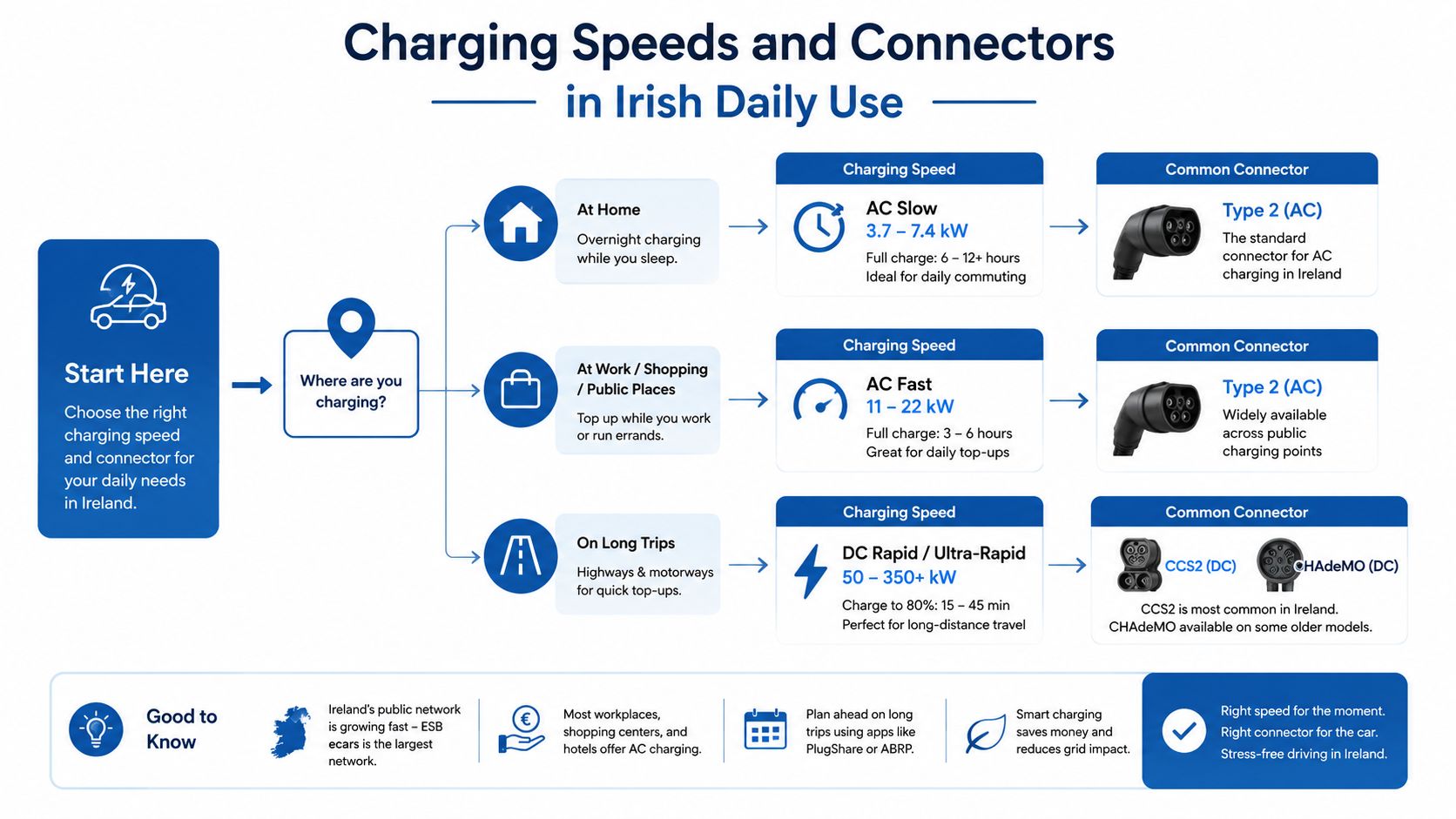
The Q6 e-tron makes more sense once its charging numbers are translated into normal Irish life. Audi says the car can charge from 10% to 80% in about 21 minutes on a suitable high-power DC charger, and can recover up to 255 km of range in roughly 10 minutes under optimal conditions. Those are the figures that matter at a motorway stop, because they tell a buyer whether the car behaves like a premium tourer or a car that forces long waiting times into every journey.
The other key detail is the everyday charging setup. Audi's specification includes 11 kW AC on-board charging and a CCS connector, which is the plug type Irish buyers are most likely to meet on public fast chargers. In practical terms, 11 kW AC suits home or workplace charging, while the DC figure matters on long trips. A buyer who uses a home wallbox will think about overnight convenience, while a buyer who relies on public charging will care far more about the car's ability to accept a strong DC feed.
A few charging realities are worth separating:
Home charging: 11 kW AC is the right kind of spec for overnight top-ups.
Motorway stops: the 270 kW DC peak is what makes short breaks useful.
Older public chargers: 50 kW units still work, but they won't show what the Q6 can really do.
Irish networks: current tariffs should be checked directly with the operator, because charging prices change and shouldn't be guessed.
That last point matters for cost planning. Public charging rates and home electricity tariffs move around, so any buyer should confirm the live price at the source on the day of charging rather than relying on an old forum post or a stale screenshot. The useful takeaway is not the exact bill, it's that the Q6 e-tron has the charging hardware to make Irish long-distance driving realistic if the charger access is there.
Trim Differences and What Used Buyers Will See
Audi's launch materials show a clear performance ladder. The Q6 e-tron quattro is quoted at up to 285 kW and 0-100 km/h in 5.9 seconds, while the SQ6 e-tron reaches 380 kW and 0-100 km/h in 4.3 seconds. Audi Waterford has also listed the Q6 e-tron performance from around €81,000 in the Irish market, which places it firmly in premium territory from the start. Audi Waterford's launch note makes the point clearly, this is not a small EV with a luxury badge, it's a serious large electric SUV.
What matters most second-hand
Used buyers rarely need every trim line item. They usually need the handful of differences that change daily ownership:
Single motor versus dual motor: this affects traction, performance, and often efficiency.
Wheel size: larger wheels can hurt real-world range.
Option packs: technology features, head-up display, and adaptive air suspension can matter more than badge names.
That is why a used listing should be read like a specification sheet, not a showroom leaflet. If the exact variant is missing, the battery and range numbers lose some of their meaning, and the buyer's price comparison becomes sloppy.
A premium EV also changes how people think about trim. With a diesel SUV, trim often means seat trim, sound system, and cosmetic details. With the Q6 e-tron, trim can change how quickly the car accelerates, how far it travels on a charge, and how confidently it fits into a motorway routine. That's a more meaningful distinction for an Irish buyer than a chrome pack or a paint finish.
Used examples remain scarce, so there may not yet be a deep pool of trim-specific Irish listings to compare. The safe approach is to confirm the exact version from the registration documents and then compare it with Audi's published figures, not with vague model-family naming on a classifieds page.
How to Buy a Used Audi Q6 e-tron Well in Ireland
A used Q6 e-tron should be bought from the battery outward, not from the paintwork inward. Start by asking for a verified State of Health (SoH) reading, ideally shown on a diagnostic screenshot, because SoH says more about the battery's present condition than the odometer ever can. For a clear walkthrough of the evidence to request, this SoH guide shows what a seller should be able to produce before any money changes hands.
Next, line up the car's recorded capacity with Audi's published usable battery figure. If the listing presents the car as a long-range premium EV but the paperwork, diagnostic evidence, or charging behaviour does not fit together, slow down and ask for a proper explanation. Then turn to planning range, and use the WLTP minus 17 percent approach rather than the brochure number in the advert. That gives a more realistic figure for Irish roads, where weather, traffic, and speed all affect what the car will do in daily use.
A practical used-buying checklist
SoH evidence: ask for a diagnostic screenshot, not a verbal reassurance.
Usable capacity: compare the car's battery figure with Audi's published spec.
Range planning: use the WLTP minus 17 percent number for journey planning.
Transmission reality: remember the Q6 is automatic in EV form, with a single-speed setup.
Paper trail: check VRT status, original registration country, service history, and recall completion.
The paper trail still matters, even with an electric car. A premium EV can carry the same used-car risks as any other vehicle if the documents are thin or the history is incomplete. The Irish used-EV buying guide is worth keeping beside the listing because it links the battery check to the normal ownership checks a buyer would do on any car.
Used Q6 examples are still thin on the ground in Ireland, so buyers need to be ready when a suitable one appears. Sellers who are listing one should expect a market that is still forming its view of what a clean, well-documented Q6 is worth. Browse verified used EVs on ShamAuto's Irish used-car marketplace before making an offer.
Common Misconceptions About Battery and Charging
A lot of buyers still worry that regular DC rapid charging ruins an EV battery quickly. That fear made more sense years ago, when battery management systems were less mature, but it doesn't describe how modern liquid-cooled packs are designed to live. A useful industry benchmark from Geotab says average battery degradation in modern EVs is about 1.8 percent per year, which shows that everyday use, including regular DC rapid charging, is much less destructive than old advice suggested. Geotab's battery health overview is a strong reminder that the battery story should be measured, not guessed.
That doesn't mean all charging habits are equal. A car that lives permanently on hot, high-power charging with poor battery management will age differently from a car that mostly charges at home and only hits fast chargers on trips. The point is not to fear rapid charging, the point is to understand the car's SoH at the time of sale.
A verified SoH reading beats a rule of thumb every time.
For a used Q6 e-tron, that matters more than a blanket warning about "too much fast charging". A seller can't prove good battery health by saying the car was only charged slowly, and a buyer shouldn't assume a fast-charged car is tired. The right question is always whether the battery still tests well today.
There's also a simple market reality. The Q6 e-tron is still so new to the Irish used market that there isn't meaningful model-specific second-hand data to lean on. So the safest advice is the most boring advice, verify the battery, read the paperwork, and judge the car in front of you rather than relying on myths about charging style.
What an Irish Buyer Should Do Next
A sensible Q6 e-tron purchase in Ireland comes down to three checks. First, insist on a verified State of Health figure. Second, use the WLTP minus 17 percent range estimate from the model page as the planning number, not the glossy brochure figure. Third, confirm the car's EV-native setup, that means single-speed automatic transmission and CCS charging, so the listing matches how the car works.
The Irish paperwork still needs a fresh look on the day. Second-hand EVs do not qualify for the SEAI purchase grant, because that support is for new cars only, so a buyer should never assume used stock gets that benefit. VRT relief status, current electricity tariffs, and any model-specific recalls should also be checked directly with the relevant official source before a deal is signed.
The Q6 e-tron makes sense for buyers who want a premium, long-distance EV and are willing to verify the battery properly. It's a strong machine on paper, but the right used example is the one with clean documentation, clear SoH evidence, and a range expectation that's grounded in reality rather than badge optimism.
Check the Q6 e-tron model page, read the battery-health and used-EV guides, and watch for listings as they appear. If you're selling one, be among the first to list it and give buyers the battery evidence they'll need to trust the car.