
Peugeot 3008 Electric: Honest Used Buyer Guide for Ireland
Contents
The first thing most Irish shoppers notice about the Peugeot E-3008 is that it looks like a nearly new car rather than a traditional used one. That matters, because the used supply is still thin and the right example usually comes down to a short list of cars, not pages of stock. For an EV this new, the smart approach is to stop thinking in petrol-car terms and start with battery health, charging fit, and realistic range.
A used Peugeot 3008 electric is a different buying exercise because the battery is the main asset, not the engine. Every EV is automatic, so there's no clutch, no gearbox to worry about, and far fewer moving parts than a combustion SUV. What still matters is whether the battery is healthy, whether the software behaves properly, and whether the claimed range matches how the car will be used in Ireland.
Why the Peugeot 3008 Electric Demands a Different Approach
A buyer looking at the Peugeot 3008 electric in Ireland is usually not shopping for an old, heavily depreciated EV. This is a 2024+ model, so most used examples are likely to be nearly new, lightly driven, and still close to factory condition. That sounds simple, but it creates a trap, because mileage alone won't tell the full story on an electric car.
The battery is the big value item. If it's healthy, the car can make strong sense. If it isn't, the car can still look spotless while hiding a weaker ownership proposition. That's why a verbal assurance from a seller is never enough on its own, especially when the Irish used EV market is still developing and the car's price has to be judged on evidence, not optimism.
Practical rule: judge the car on its verified State of Health (SoH), not on how shiny it looks or how low the odometer is.
That approach is especially important on a model like this, because the e-3008 is meant to be a serious family EV, not a niche compliance car. Buyers want range that works on Irish roads, charging that suits home and trip use, and battery data that can stand up to scrutiny. When those things line up, the car becomes easy to understand. When they don't, the badge and brochure copy won't rescue the deal.
What the Peugeot E-3008 Is
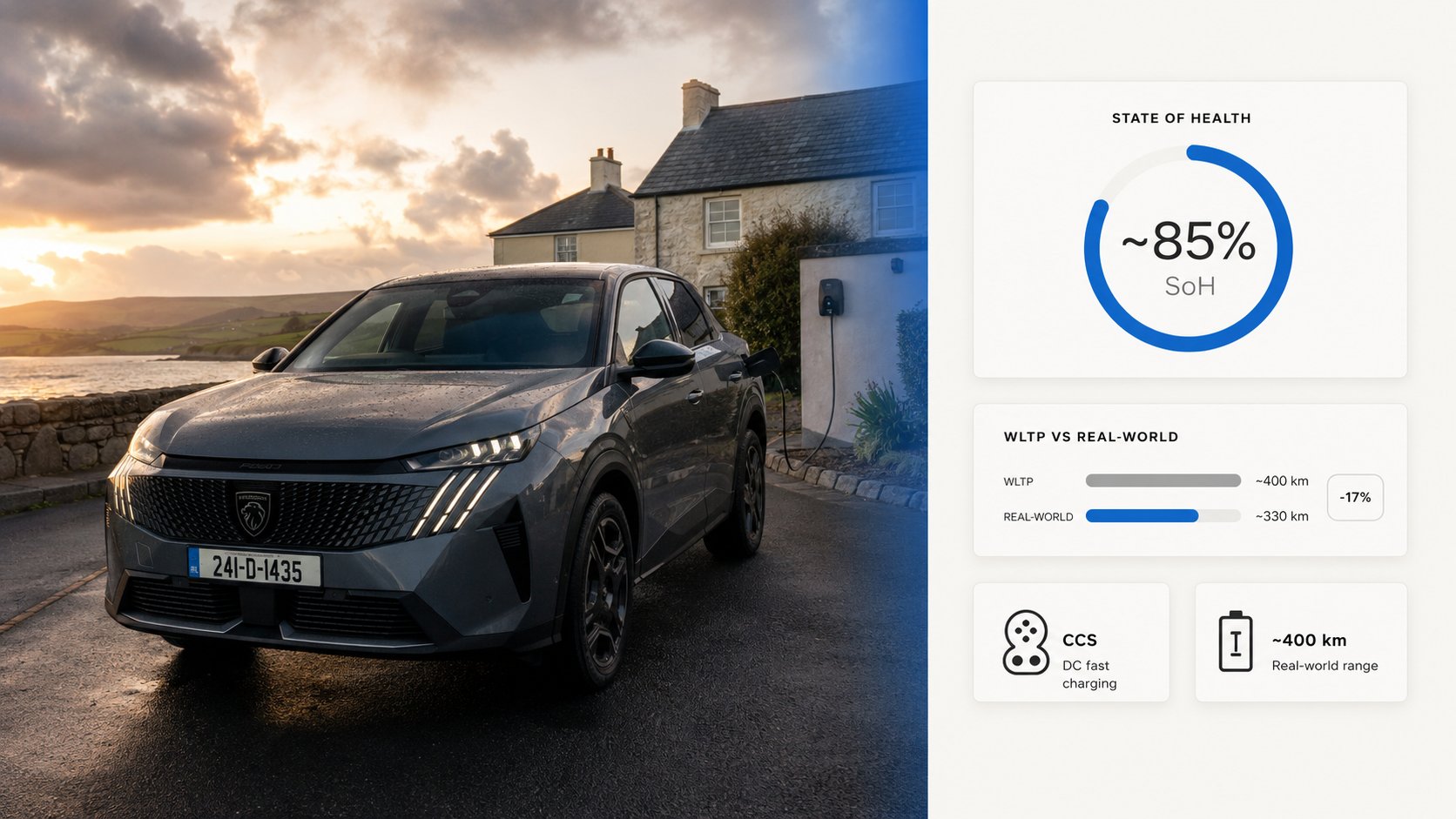
The e-3008 is Peugeot's all-electric mid-size SUV, built on the STLA Medium platform and using a 400V-class architecture with CCS charging. It sits in the mainstream family-SUV part of the market, so Irish buyers are likely to judge it on practicality, efficiency, charging ease, and battery condition rather than on badge prestige alone. Peugeot's technical data also shows that the related seven-seat model is the e-5008.
Drivetrain and everyday use
Most versions are front-wheel drive, and Peugeot also offers a dual-motor AWD option. That matters to Irish buyers who live with wet roads, steeper rural routes, or regular motorway miles, because traction and stability needs differ from one household to the next. Every EV, including this one, is automatic in the normal driving sense, with a single-speed reduction gear and no clutch pedal.
The car's role is straightforward. It is a modern electric SUV with long-legged range in standard form and even more in long-range form, so it suits buyers who want one vehicle to cover commuting, school runs, and longer trips without constant charging anxiety. Peugeot Ireland's model page lists 0g/km CO₂ in the Irish market, while Peugeot's technical data for the family shows a fully electric version with 526-701 km mixed WLTP range, depending on battery and trim. Peugeot Ireland model page
Why that matters for a used buyer
That range of capability changes the buying conversation. A buyer is not asking whether the car can travel far enough in ideal conditions, but which version suits real Irish use once battery health and weather are factored in. For a practical read on that side of the decision, see battery health and real-world range checks. The next section breaks those variants down for comparison.
Range and Battery Specs by Variant
A used e-3008 should be judged by version, because Peugeot has given the model distinct battery and drivetrain combinations rather than one catch-all spec. For Irish buyers, the most practical lens is battery size, drivetrain, and the gap between WLTP and real-world range on Irish roads. ShamAuto uses a cautious WLTP minus 17% guide for planning, because motorway speeds, cold weather, hills, and load all cut into real range.
| Peugeot e-3008 Variants: Range Comparison | Battery (kWh) | Drivetrain | WLTP Range (km) | Real-World Estimate (km) |
|---|---|---|---|---|
| Standard Range | 73 | FWD | 527 | ~437 |
| Long Range | 97 | FWD | 700 | ~581 |
| Dual Motor AWD | 73 | AWD | 490 | ~407 |
Peugeot's Irish spec sheet lists the 73 kWh usable battery on the 210 hp version and the 96.9 kWh usable battery on the Long Range version, both on a 400 V system with a Type 2 AC port at the left rear. For a buyer, that is not brochure fluff, it is the specification that should match the advert and the car in front of you. Peugeot technical data
How to read those numbers
The Standard Range car is the cleanest all-round option for many Irish drivers because the estimated figure still sits in the high 400 km region under careful planning. The Long Range car makes more sense if your use includes heavier motorway mileage, rural detours, or you want fewer charging stops between busy days. The Dual Motor AWD version brings extra traction and flexibility, but the estimate is lower because the added drivetrain hardware has to be carried everywhere.
That trade-off is the point. Buyers should not look at the badge first, then the range number after the fact. They should decide how often the car will face winter commuting, wet roads, long trips, and full loads, then choose the variant that still works when the weather turns and the battery is not new anymore.
Peugeot's own Irish material shows that the electric 3008 family is built as a serious long-range EV, with the long-range version reaching 701 km WLTP and the standard electric version at 526 km WLTP in mixed-cycle testing. Independent summaries also describe the long-range car with a 101.0 kWh nominal battery, 11 kW AC charging, and 8.7 seconds 0-100 km/h, which explains why it feels like a proper step up from older electric crossovers. EV Database e-3008 overview
Buying rule: choose the version that still covers your route after a cold spell, not the one with the biggest lab figure.
For a more practical read on how battery condition changes usable range, ShamAuto's guide on EV battery health and real range is the right starting point.
Charging Speeds and Irish Charging Realities
A used e-3008 only makes sense if the charging routine fits Irish life, not just the brochure. Peugeot lists up to 160 kW DC rapid charging and 11 kW AC charging, and independent summaries describe a 20%-80% DC top-up in about 30 minutes under ideal conditions, with roughly 10 hours 30 minutes on 7 kW AC. Peugeot charging confirmation
For a buyer in Ireland, that split matters more than the headline rate. Home charging handles the bulk of ownership, while public DC charging is the backup for longer journeys, busier weeks, and winter days when energy use climbs faster than expected. If you want a clear overview of how that public side works here, ShamAuto's guide to public charging in Ireland is a useful reference point.
What that means at home and on the road
A 7.4 kW home charger is usually enough for overnight top-ups. It does not make the car charge faster than its onboard AC limit, but it matches the way most owners plug in, parked for hours rather than minutes. Public DC charging is the motorway tool, the one you use when the car needs energy quickly between longer legs.
The e-3008 is a 400V-class EV, not an 800V car, so charging figures should be read against the exact battery and trim rather than treated as one broad family promise. That matters because charge curves vary in actual conditions. The larger battery does not automatically hold the same rate in practice, and software-controlled taper still shapes the last part of the session.
Irish charging checks that matter before purchase
- Connector and port position: Peugeot's spec sheet shows a Type 2 AC port on the left rear side, so the buyer should confirm the flap opens properly, the cable sits correctly, and the car starts charging without hesitation.
- Home setup fit: if the household already has a charger, the buyer should check whether the normal routine is mainly overnight AC or occasional DC on route.
- Public charging comfort: the live network and tariff situation in Ireland changes, so buyers should check current public charging coverage and pricing through the relevant official sources before committing to a travel pattern.
- Trip expectations: a car that charges quickly on paper still needs planning in winter or at higher speeds, where usable range drops faster than brochures usually admit.
The practical test is simple. Match the car's charging profile to your own routes, then verify that the port, cable, and charging session behave as they should before money changes hands.
Essential Checks Before You Buy a Used e-3008
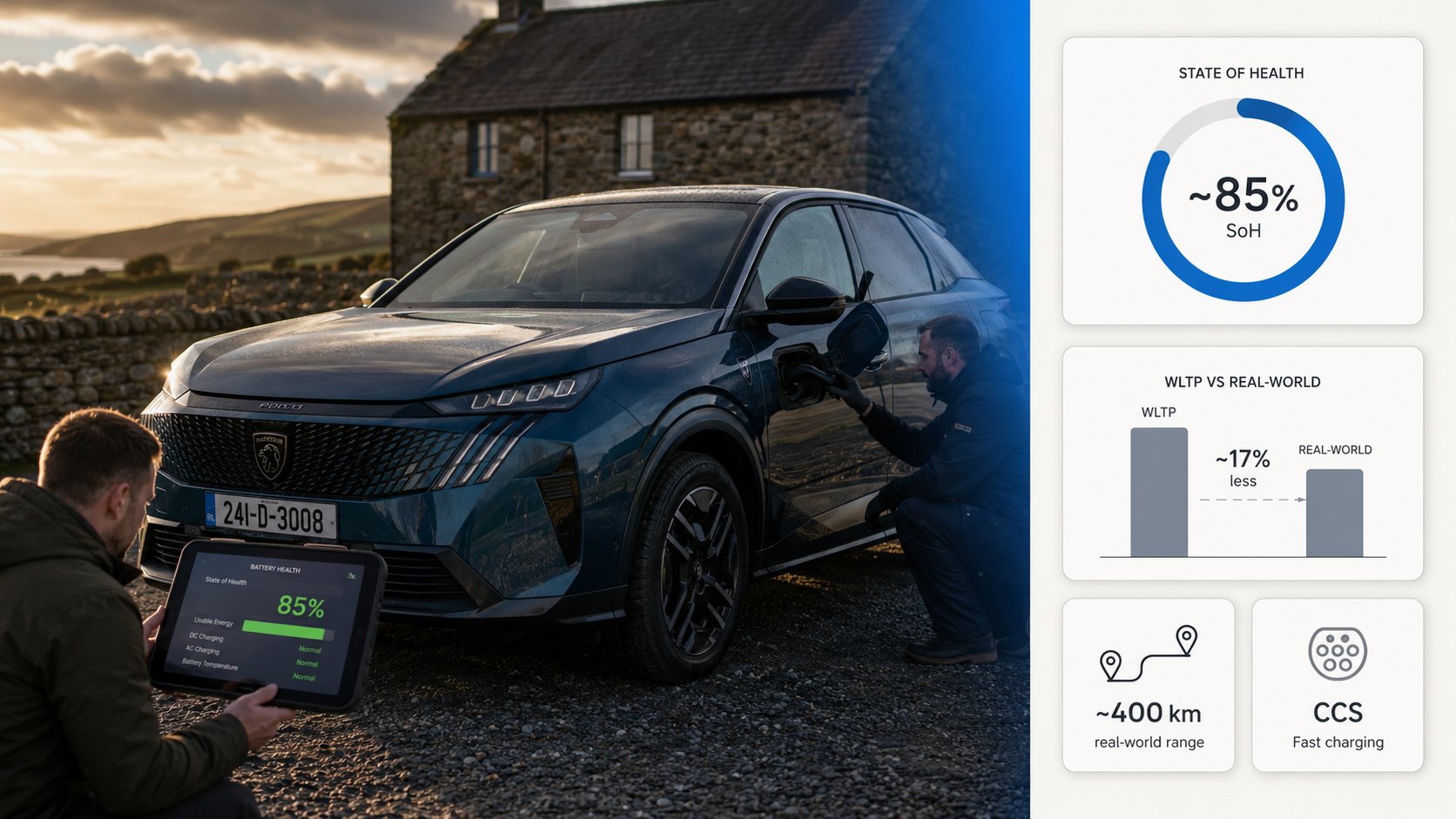
The first thing to ask for is a diagnostic screenshot showing SoH. That is the only clean way to turn battery condition from a promise into evidence, and it matters more than a seller saying the car "feels fine". A stronger verified SoH supports a firmer price, because it gives the buyer proof that the battery still looks healthy relative to age and use.
What to inspect beyond the battery figure
The e-3008's 12V battery still needs attention, because a modern EV can behave badly if the low-voltage side is weak. That sounds unglamorous, but it's a common place where early issues show up, and it's easy to miss if the inspection focuses only on the high-voltage pack. The charging port should be checked for clean engagement, flap function, and stable connection during a live charge session.
Software maturity also deserves a close look. Independent guidance on the model points buyers toward checks such as infotainment glitches, app connectivity, charging-port function, and software update status, which is exactly the sort of verification that matters on a newer EV with a small used pool. Early ownership reports don't need to be turned into scare stories, but they do justify a careful test of the screen, the app, and any driver-assistance settings before money changes hands. Carchecker e-3008 report
A sensible used-EV checklist
- Verified SoH screenshot: ask for a battery health readout, not a verbal estimate.
- Usable battery size: confirm whether the car is the 73 kWh or 97 kWh version so the range expectation matches the trim.
- Live charging test: watch the car start charging properly on AC or DC, depending on what's available.
- Infotainment behaviour: check that menus, phone pairing, and connected features work without lag or drop-outs.
- Software status: verify that updates have been applied and that the car isn't showing obvious unresolved faults.
For a fuller inspection framework, ShamAuto's used EV buyers checklist in Ireland is a practical companion, and the guide on how to check battery SoH before you buy goes deeper on what the screenshot should show.
Irish Market Realities for the Used e-3008
The used e-3008 has to be priced against reality, not theory. Second-hand EVs do not qualify for the SEAI purchase grant, because that support is for new cars only, so a used buyer should check the live official SEAI and Revenue pages for current scheme rules, tax treatment, and any VRT-related details that may affect the final decision. Those rules can move, so a general blog should not pretend to freeze them in time. SEAI electric vehicle grant information
Used value depends on year, mileage, and verified SoH. On a newer model like this, those three factors matter more than broad guesses about brand reputation or headline range claims. A well-kept car with documented battery health will always make a better case than a similar example with missing evidence.
ShamAuto is an EV-only marketplace, so the comparison point stays inside the electric-car world instead of drifting into irrelevant mixed-fuel noise. That makes the e-3008 easier to judge on its own merits, with a standardised real-world range view and battery-health focus rather than wishful thinking. Buyers still need to compare current listings carefully, because the market is thin and the right car may be a near-new example rather than a long-established used bargain.
Deciding If a Used E-3008 Is Right for You
A used Peugeot E-3008 makes sense when the numbers and the paperwork line up. The variant should offer enough real-world range for the buyer's daily pattern, with margin left for colder weather and motorway use, and the car should have a verified SoH screenshot rather than a hand-wave from the seller. If the battery looks healthy and the price reflects the car's year, mileage, and trim, the deal starts to look serious.
The biggest mistake is buying the badge and ignoring the evidence. A newer EV like this can be an excellent used purchase, but only when the battery data, charging behaviour, and live-market price all support the decision. That's the same standard worth applying to every used EV in Ireland.
ShamAuto helps Irish EV buyers compare electric cars on verified battery health, usable battery size, charging detail, and cautious real-world range estimates. If a Peugeot E-3008 is on the shortlist, visit ShamAuto and use the guides and model pages to judge each listing on evidence before you commit.