
Kia EV6 Price Ireland: A Buyer's Guide to Fair Value

Contents
- Why Two Used EV6 Ads Can Sit Thousands Apart
- What Actually Sets a Used Kia EV6 Price
- EV6 Variants in the ShamAuto Catalogue
- Reading the State of Health Before You Read the Price
- Grants, Tax and Headline Price Traps to Avoid
- Why the EV6's 800V Charging Earns a Pricing Premium
- Inspecting and Test-Driving a Used EV6
- Official Sources for Live Irish EV Pricing Details
- Quick Reference for Judging a Used EV6 Price
You're standing at a screen with two used Kia EV6 ads open in Ireland, both looking tidy enough on paper, both wearing confident asking prices, and neither one giving away the full story. One seller leans on low mileage, another leans on trim, and both are trying to make the car sound simpler than it is. That's exactly why kia ev6 price ireland has to be treated as a battery and evidence problem, not a lazy average-price hunt.
ShamAuto is built around that reality. It doesn't pretend a headline number tells the full truth, and it doesn't dress up missing battery evidence as if it were fine. A used EV6 is an automatic, so there's no clutch or gearbox drama to hide behind, but the battery, range and proof of condition still decide whether the asking price is fair.
Why Two Used EV6 Ads Can Sit Thousands Apart
Two EV6s can look similar until the details start doing the heavy lifting. The year is usually the first divider, because a newer car may have less wear, more warranty left and a cleaner paper trail. After that, mileage matters, but on an EV it's not the whole game.
A petrol buyer might obsess over odometer numbers first. With an EV6, that habit is too blunt. The battery's State of Health (SoH) can matter more than a modest mileage gap, because SoH tells the buyer how much usable capacity the pack still has and how much real-world range the car can still deliver.
The buyer should read the ad like a detective
A neat listing with a vague battery claim is not the same as a strong listing with proof. Trim can help, but it's not a magic wand, and drivetrain matters in a real way because RWD and AWD versions suit different buyers. Condition, service history and import provenance still count too, but they don't outrank battery evidence.
Practical rule: if the seller can't show battery evidence, the price should be treated as a request, not a verdict.
ShamAuto is honest about its limits here. It doesn't have its own EV6 sales history to lean on yet, so it won't fake a local premium or pretend it has a house view on resale spreads. That caution is a strength, not a weakness, because it keeps the buyer focused on what can be verified.
What Actually Sets a Used Kia EV6 Price
Start with the parts that change the car's value
A used EV6 price in Ireland is shaped by year, mileage, variant, battery size, drivetrain, and above all verified SoH. A clean service history and sensible ownership story still matter, but the price usually moves most when the battery spec and battery condition are clear. That's especially true on an EV because the usual engine and gearbox anxiety isn't part of the equation.
Mileage deserves context. High kilometres are not a deal-breaker on an EV the way they can be on a worn diesel, but they still influence wear, range confidence and buyer appetite. A buyer should ask whether the odometer reading makes sense alongside the battery evidence, not treat the number as a verdict by itself.
Trim badges matter less than buyers think
A higher trim can make the car easier to sell, but it does not rescue weak battery proof. Likewise, a lower trim with excellent SoH, clean history and sensible mileage can be the more rational buy. That's the part many sellers skip over, because it's harder to market a battery report than a shiny badge.
The best negotiating position is simple. If the seller can document the battery, the car has a firmer case for its asking price. If the SoH is missing, soft, or based on hand-waving, the buyer should push back immediately.
A final point for pricing discipline. ShamAuto won't invent a resale premium, because there's no ShamAuto price history to support one. That's the right call for a market that should reward proof, not wishful thinking.
EV6 Variants in the ShamAuto Catalogue
Kia's EV6 range is straightforward once the buyer ignores the marketing gloss and looks at the usable hardware. For Irish used shoppers, the most relevant versions between 2021 and 2024 are the 58 kWh rear-wheel-drive, the 77.4 kWh rear-wheel-drive, and the 77.4 kWh all-wheel-drive. Every one of them is automatic with a single-speed reduction gear, so there's no clutch and no traditional gearbox to worry about.
| Variant | Usable battery | Drivetrain | WLTP range | Real-world range (WLTP -17%) |
|---|---|---|---|---|
| 58 kWh RWD | 58 kWh | Rear-wheel-drive | 394 km | ~327 km |
| 77.4 kWh RWD | 77.4 kWh | Rear-wheel-drive | 528 km | ~438 km |
| 77.4 kWh AWD | 77.4 kWh | All-wheel-drive | 506 km | ~420 km |
Kia EV6 listings and specs on ShamAuto should be read with that structure in mind. The bigger-battery cars give the buyer more range headroom, while the AWD version trades some of that for traction and flexibility. The right answer depends on use case, not badge snobbery.
Kia's genuine strength here is the EV6's 800V architecture and CCS support, with DC rapid charging up to about 240 kW in the relevant variants. That's a real technical advantage, not brochure fluff, and it matters when the buyer expects frequent motorway use or wants shorter charging stops.
What should not be mixed into this conversation is the later facelift with the 84 kWh battery, because that isn't the same used-car pool this guide is dealing with. The performance GT is also out of scope here, so a fair Irish used price should be judged against the in-catalogue cars above, not against newer or hotter variants.
Reading the State of Health Before You Read the Price
The first serious question on any used EV6 is not "How many kilometres did it do?" It's "What's the battery SoH?" That number tells the buyer how much of the original battery capacity is still usable, and it directly affects confidence in real-world range and future value.
Proof beats reassurance every time
A seller's word is not enough. A proper battery health screenshot, a diagnostic readout, or an OBD-II scan gives the buyer something to judge, and it gives the price discussion a factual anchor. A car with strong, verified SoH deserves a firmer position than one with nothing but a hopeful shrug.
How to check battery SoH before you buy covers the evidence buyers should ask for before they talk numbers. The key point is simple. If the SoH is missing or unverified, the buyer shouldn't ignore it, they should negotiate harder.
A battery report is not a nice extra. It's the document that tells the buyer whether the asking price is built on reality.
ShamAuto's own listings are organised around that idea, so the evidence is visible instead of buried. That matters because SoH is the thing that explains why one EV6 can feel like a strong buy and another can feel overpriced even when both cars look tidy.
What the buyer is really checking
The buyer is looking for consistency. A strong SoH figure, a believable mileage record and a clean ownership trail make the asking price easier to defend. Weak evidence does the opposite, and it should drag the offer down rather than be waved away as "just an EV thing".
Grants, Tax and Headline Price Traps to Avoid
Used EV buyers in Ireland keep making the same mistake. They look at a used EV6 price and mentally subtract the SEAI purchase grant as if it still applies. It doesn't, because the grant is for new private cars only, not for second-hand EVs.
That mistake creates bad negotiations. A used car should be compared against what it cost new, what evidence it carries now, and how much real depreciation has happened. It should not be compared to a grant-adjusted fantasy number that no longer exists for that transaction.
Check the live source, not the memory of a figure
Anything tied to tax, VRT or scheme rules should be checked on the day from the live official source. SEAI, Revenue and gov.ie are the places that matter, not an old screenshot or a dealer's loose summary. Used EV grants and VRT explained is useful background, but the live official pages still win whenever the rule might have moved.
The same discipline applies to finance offers. A new-car monthly payment can be useful context, but it is not a fair way to judge a used car unless the buyer is comparing like with like and understanding what's included. List price, grant treatment, dealer extras and finance cost are four different things, and sellers often blur them together.
Buyers who keep those buckets separate make better decisions. They stop overpaying for noise, and they notice when a used EV6 is being dressed up with borrowed numbers that don't belong on a second-hand purchase.
Why the EV6's 800V Charging Earns a Pricing Premium
The EV6 isn't just a range story. Its 800V system and rapid charging ability are part of the value, because they change how the car fits Irish driving. A Dublin-to-Cork run, or a longer trip west, is easier to plan when the car can take meaningful DC power instead of crawling through a stop.
That technical advantage matters in the used market. A buyer is not only paying for a badge or a cabin. They're paying for a car that can cover everyday driving comfortably and still make motorway charging stops feel short enough to be practical.
The charging hardware also helps explain why the EV6 sits above cheaper EVs in buyer interest. Real-world range, battery size and charging speed work together, so a car with more usable energy and faster refill potential is a more capable tool. A fair asking price should reflect that capability, not just trim decoration.
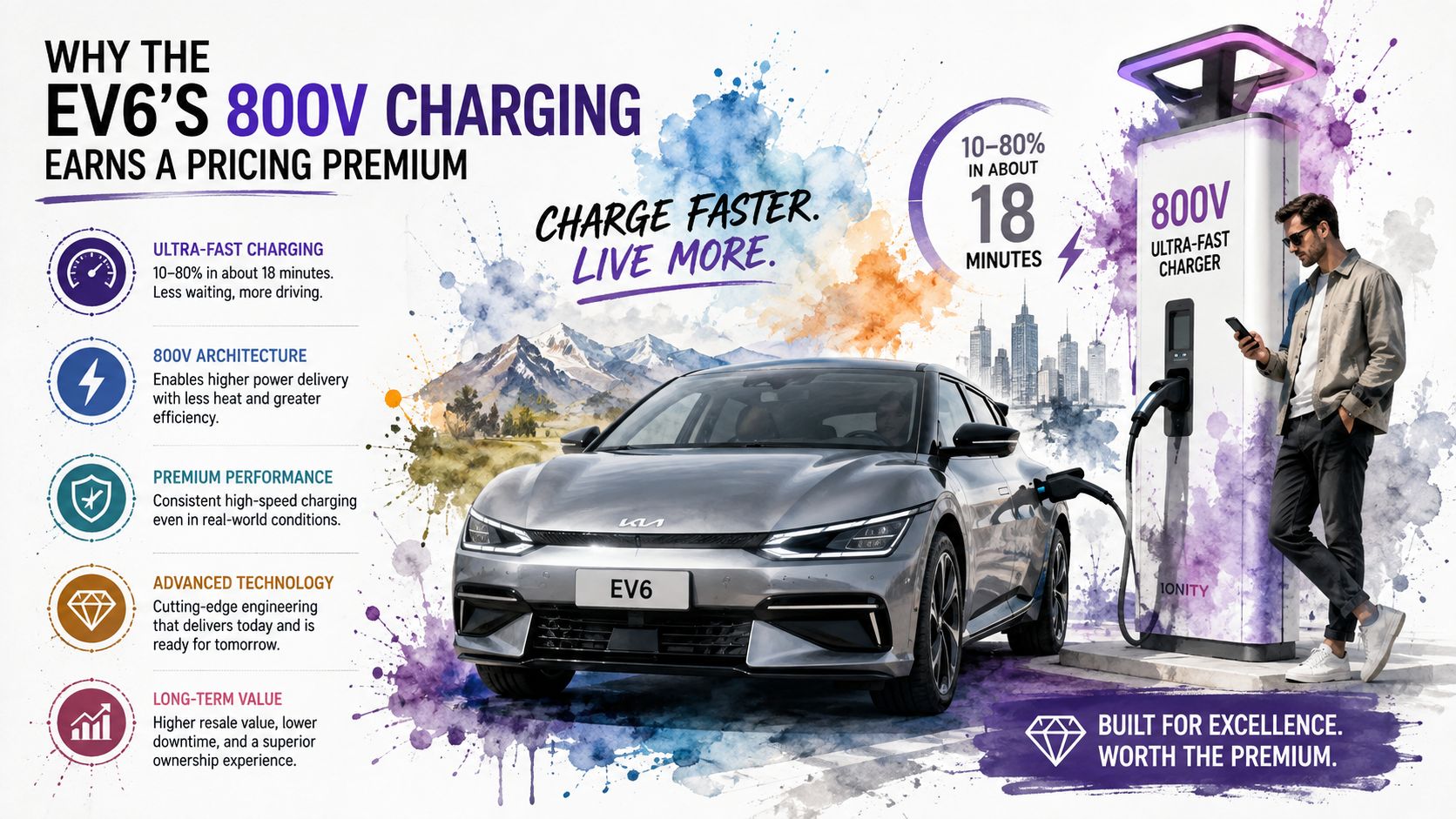
A seller who leans heavily on charging bragging rights still has to prove the battery is healthy. The buyer should keep one rule in mind. Fast charging is valuable only when the pack underneath it still has the evidence to justify confidence.
Inspecting and Test-Driving a Used EV6
The best used EV6 purchase starts before the test drive. Ask for a recent diagnostic screenshot, ask whether the SoH was read through an OBD-II app or another proper tool, and ask for the service record without being apologetic about it. If the answers are vague, the price should come down.
What the car should show in person
A clean EV6 should feel calm on the road. Because every EV6 is automatic, a smooth pull-away and steady progress are normal, and any jerking, warning lights or odd drivetrain behaviour deserves attention. The buyer should also look for range behaviour that makes sense on a mixed route, not a seller's optimistic guess after a short hop.
Paperwork matters just as much as the drive. Service history, charger use, and any recall or software update evidence should be on the table. If the car has lived on DC fast charging alone, that does not automatically kill the deal, but it does push the buyer to ask better questions.
If the seller can't show recent battery evidence, the test drive is already doing damage control for the asking price.
A proper in-person check should leave the buyer with a clear answer to three things. Does the battery evidence look real, does the car drive as expected, and does the paperwork match the story being told? If any one of those fails, the price should be treated as negotiable, not fixed.
Official Sources for Live Irish EV Pricing Details
Some figures change too often to hard-code into a buying guide. That includes grants, tax treatment, scheme rules and charging tariffs. The buyer should go straight to the live source on the day, because a stale number is worse than no number at all.
The main official places to check are SEAI for grants and scheme rules, Revenue for VRT and motor tax, gov.ie and Citizens Information for scheme updates, and ESB for public charging information. These bodies control the live details, so they are the only sources that should settle a dispute when a dealer's summary sounds out of date.
That habit protects the buyer in a practical way. A used EV6 can look expensive or cheap depending on whether the reader has accidentally mixed in a scheme that doesn't apply, or relied on a tax figure that has already changed. Official sources keep the decision grounded.
ShamAuto's guides on used EV buying in Ireland and battery checks are worth keeping open alongside the live official pages. They help the buyer separate useful evidence from marketing noise without pretending static guides can replace current state-backed information.
Quick Reference for Judging a Used EV6 Price
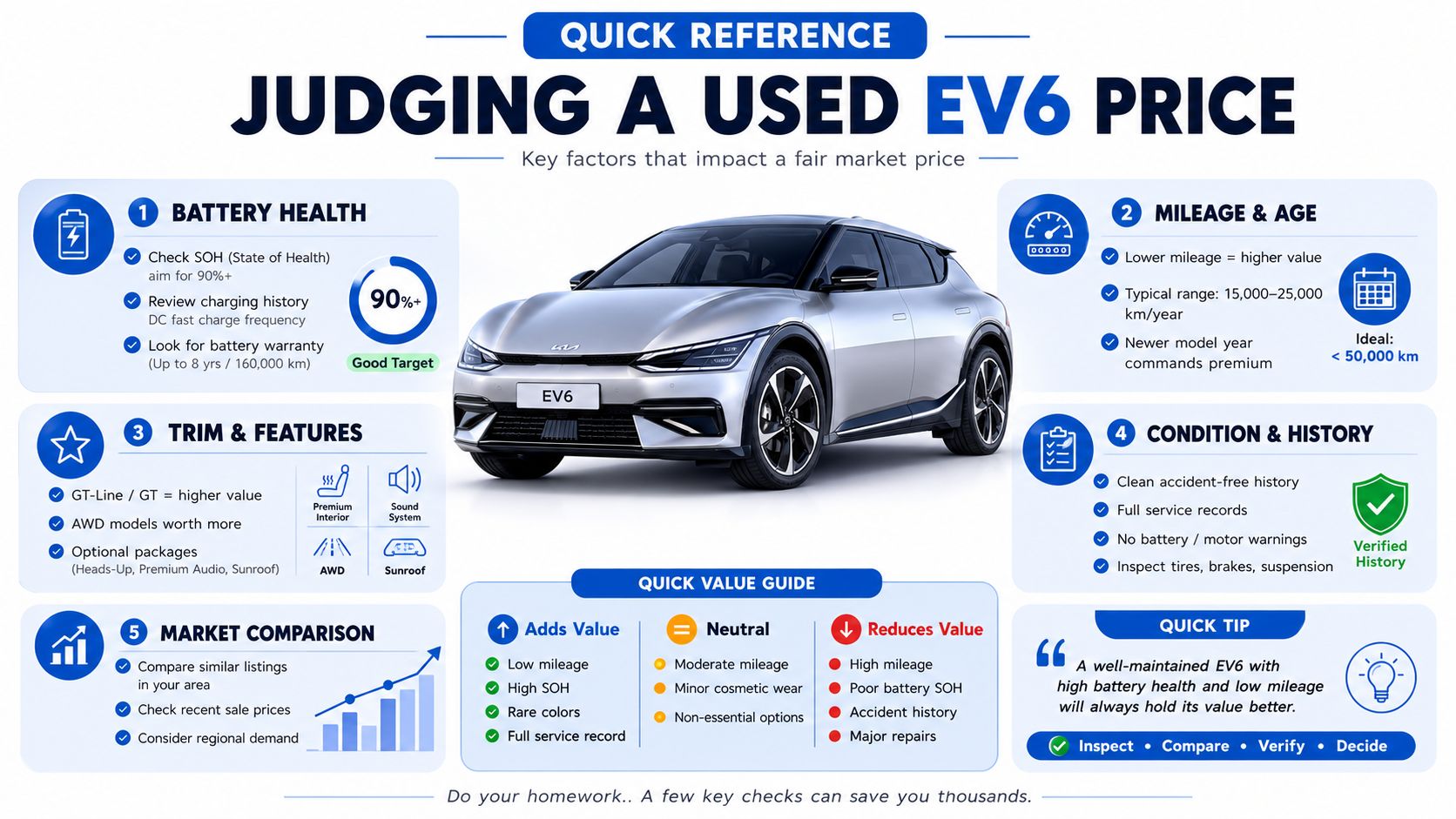
The fast checklist is simple. Confirm the variant, confirm the battery size, compare the WLTP range with the cautious real-world estimate, check whether the car is RWD or AWD, and then demand a verified SoH before agreeing a number. If any of those pieces are missing, the asking price should be treated carefully.
A buyer who runs that check in under a minute is already ahead of most shoppers. The goal is not to chase a mythical average price, it's to judge whether this specific car makes sense on evidence. That approach is exactly why ShamAuto is built around battery health and EV-native specs rather than generic car-ad spam.
ShamAuto is still new, so the right move is to browse the framework, list a car if needed, and keep cross-checking live official sources whenever tax, grant or scheme details come into the conversation. The market for used EVs rewards buyers who stay evidence-led.
If the next EV6 ad you open feels fuzzy on battery proof, use ShamAuto to sanity-check the spec, the SoH evidence and the real-world range before you make an offer. Visit ShamAuto to compare the car against an EV-first standard and make your next decision on facts, not headline noise.